Quick update regarding the publication.
Over the coming days, we are officially changing our name from GP Capital Research to Eligian Research. This update applies across both this Substack and our X account.
The core focus remains untouched. You can expect the same institutional grade coverage on junior mining, commodity cycles, and valuation disconnects.
Thank you for reading and for your continued support.
@rekurencja Interesting market. How do you view the risk of Russian supply? If I understand it correctly, a majority comes as a secondary biproduct from their iron ore mines and they have expanded refining capacity for vanadium.
Orvana disclosed that its Bolivian subsidiary EMIPA breached three financial covenants on its local bond programs for the quarter ended June 30, 2026. Debt Coverage, Third Party Debt Coverage, and Leverage Ratio all fell out of compliance.
The breach comes down to timing and a single accounting adjustment.
First, Bolivia abandoned its 15 year fixed exchange rate on June 29, 2026. The currency shifted from 6.96 to 9.73 Bolivianos per US dollar. That 30% adjustment created an immediate one off FX loss under Bolivian GAAP, hitting EMIPA’s equity base right at the end of the quarter.
Second, road blockages and social unrest through May and June pushed back the OSP restart. EMIPA generated zero revenue for the entire testing period.
Operationally, the picture looks very different.
The currency adjustment actually lowers EMIPA’s ongoing local cost base in US dollar terms.
Debt Coverage sits at a low 0.4x threshold. That metric recovers fast once OSP generates positive EBITDA. The equity based leverage ratios will provably take longer to heal, requiring a few profitable quarters to rebuild the balance sheet.
Management entered a standard cure period and is drafting a plan for bondholders.
A few factors support the case:
OSP oxide processing started in July, so Q4 FY2026 brings actual revenue back onto the books.
Orvana has operated in Bolivia since 2003, navigating previous labor disputes and political shifts without abandoning the asset and i believe they will do it again.
EMIPA previously placed $47 million and $24.98 million in local bond programs, proving long term access to domestic capital markets.
This is a real breach driven by a temporary revenue gap and a currency shift. With OSP processing ore again, the operational driver behind the breach is already changing. The mid August financial results and updates on bondholder terms represent the next hard data points.
$ORV.TO
Most investors look at the upcoming 100,000 tonne bulk sample at Swanson as a minor technical footnote on the path to commercial mining. That framing is wrong.
At Swanson's disclosed grade profile, a 100,000 tonne campaign is not a small metallurgical test. Run through Beacon's initial circuit at roughly 750 tonnes per day, it equals four to five months of uninterrupted mill feed. It produces several thousand ounces of gold before LaFleur spends a dollar on the incremental capital needed for the full 1,250 tonne per day PEA plan.
At spot gold, this single run generates between CAD 13 million and CAD 18 million in net FCF, depending on recovery and cost assumptions.
That is more than the company's entire annual corporate burn.
The consensus view assumes LaFleur needs external equity or the Trafigura facility to survive the ramp up. But the bulk sample is an organic funding mechanism. Cash from this campaign goes straight onto the balance sheet to cover near term capital needs.
$LFLR.CN $LFLR.NE
New Report: High-grade developer with a clear path to cash flow
Just released a report on one of the very few developers I actually find compelling in this market. The setup stands out dramatically because it combines:
Non-Dilutive Pathway: A highly credible, non-dilutive route toward commercial production.
Infrastructure Advantage: A 100%-owned mill, drastically lowering upfront capex.
Tier-1 Jurisdiction: Located in a safe, mining-friendly region.
Near-Term Production: A clear timeline to near-term cash generation.
Valuation: Once the asset reaches steady-state production, the stock will be trading at less than 1x FCF.
Strategic Growth Hub: Ownership of the mill opens up a massive long-term regional consolidation play, allowing them to potentially swallow up smaller nearby assets.
Bottom Line: Most junior developers can only ever offer one or two of these elements; this company delivers on all four. The fundamental valuation disconnect is massive. Full deep-dive report is now live for subscribers.
Read more here:
https://t.co/oOfsSe0BWn
Also bought a few k shares in $orv.to today. Stupid selling. Back of the envelope calculation with Don Mario fully ramped up. 100k AUEQ production margin likely close to 2000$ , say 1800$ ->180m usd cash flow, after tax and G&A most likely new run rate a NPAT >100m , mcap 175musd
Phil raises some strong points here.
Build risk and Capex blowouts are where most junior mining theses go to die. It is precisely why a substantial portion of my portfolio is anchored in companies that bypass or de-risk this exact bottleneck:
Mako Mining ($MKO.V): Backed by an in-house mine-building team with a proven execution track record.
Magna Mining ($NICU.V): Restarting past-producing assets that the team has hands-on historical familiarity with.
Orvana Minerals ($ORV.TO): Deep value where thesis execution doesn't rely on building a massive new mine from scratch to unlock re-rating potential.
Managing execution risk is just as important as picking the right geology.
Some comments on this, as I have often been the guy telling management to "build it." As per usual, when I start yapping it tends to go on...
I still believe that building a good project is generally the path that creates the most value, but I have become much less casual about giving that advice over the last months as I have mulled on the topic. Building a mine is probably the most difficult thing a mining company can attempt. It requires a much larger organisation, with a lot of non-overlapping skillsets and timelines all coming together at exactly the right time. Most development companies simply do not have that organisation, not by a country mile.
The shortage of people may be the biggest constraint on how quickly the industry can respond to higher commodity prices. Everyone talks about needing to build 2x or 3x the current number of mines, but how many additional builds can the industry realistically handle each year? In North America, I suspect the answer is very few. We are maybe building two to four meaningful gold mines a year in NA now. The idea that the industry can suddenly triple that number because gold is higher and every feasibility study now spits out a monster NPV seems like a pipedream.
Matt Wilcox at Robex made the point during a recent interview that finding 40 electricians for an Australian project basically means taking them from another mine because everyone competent is already working. The same applies to project directors, process engineers, construction managers and commissioning personnel, except those people are even harder and slower to train than an electrician. You cannot create an experienced project director by putting someone through a six-month course. They become good by working through several builds, including all the delays, fuckups and near disasters that never make it into the ribbon-cutting ceremony.
The better builders solve this by keeping the organisation together and moving it directly from one project to the next. Wilcox for example has done that across successive West African builds, using many of the same people, contractors, and systems. A normal mid-tier might build one mine every ten years, which is nowhere near frequently enough to retain a permanent construction organisation.
Take $GMIN.TO and G Mining Services, which effectively solve this problem by retaining the team between builds. GMS has been involved in delivering Essakane, Merian, Fruta del Norte, Greenstone and Tocantinzinho, among others. A lot of investors think Lundin Gold $LUG.TO "built" Fruta del Norte, which is true in the ownership sense, but GMS was essentially the embedded execution team carrying the project through engineering, procurement, construction management, commissioning and the handover into operations.
Tocantinzinho is probably the cleanest recent example of how much value this capability can create. $GMIN.TO acquired it in late 2021 and declared commercial production in September 2024. It went from transaction close to commercial production in two years and ten months, with the actual construction period under two years and capex of roughly US$450m. The asset is good, but most of the value came from buying a permit-ready project and then executing.
This gets to the point made in the interview that we may be heading into a construction cycle rather than an M&A cycle. Developers are sitting at 0.2x or 0.3x NAV in some cases, even though higher commodity prices have put a whole group of previously marginal projects firmly in the money. Historically, the thesis was that a major would eventually buy the project. But the majors are not moving. They appear paralysed, do not believe the gold price, are terrified of repeating the last cycle's mistakes and generally prefer buying something after it has already been built, often at laughable premiums.
That leaves a lot of developers between a rock and a hard place. They do not have the team to build the asset, but a major either does not want to buy it or will not pay anything close to the value management thinks it can create by plugging spot prices into a half-cooked resource model. In a supportive capital market, the logical outcome is that they raise the money and try anyway. Some will get there, particularly because current margins can cover a lot of mistakes. But plenty, probably most, will fail.
The Australian and Canadian development models are also quite different. The Aussies are generally more comfortable putting a smaller, simpler asset into production quickly, generating cash flow and then expanding it. Some of that is geology, but I think operating culture matters just as much. The Canadians often keep drilling until the resource is fully defined, and by the time the FS finally lands the project has become a billion-dollar construction exercise which very few people have the skillset to execute.
Skeena $SKE.TO, Troilus $TLG.TO, Springpole, First Mining $FF.TO, Artemis $ARTG.V, Marathon, Spanish Mountain $SPA.V and Liberty Gold $LGD.TO all have substantial projects, but none is a straightforward turnkey start for a company doing its first build. The larger resource and higher NPV look great in the presentation. Quite often, companies drill themselves into a project that has moved beyond their practical capacity to develop.
The great mining outcomes are usually not discoveries being taken out at a 40% premium. It is companies like Northern Star $NST.AX and Evolution $EVN.AX buying assets, making them work, generating cash and then doing it again. Execution creates an absurd amount of value because it is so hard to do. The Australian market generally seems to understand that better than the Canadian market, which remains somewhat conditioned to treat the takeout as the endgame.
A project that works in Excel and a company that can actually build and operate it are two different things. I do not have a dataset for this, but you would probably be shocked by how far costs can move when construction or mining is handled by people who do not really know what they are doing. The gold price matters, obviously, but imo investors massively overrate how much it can compensate for operational incompetence. A case study below;
Mercedes is a pretty amazing case study. Peter van Alphen, now at Nuvau and previously with FNX, joined Premier Gold, formerly $PG.TO, as COO after Mercedes had a very poor 2019. The team reduced the workforce, changed the mine plan and focused on development, productivity and dilution at what is a difficult narrow-vein underground mine with notoriously poor ground conditions. During Equinox Gold's $EQX.TO ownership from April to December 2021, Mercedes produced 31.8koz at an AISC of US$1,357/oz and generated US$14.1m of mine free cash flow at an average realised gold price of only US$1,772/oz. It was not an amazing mine, but a competent team had it working and making money.
Bear Creek $BCM.V then bought Mercedes in 2022 as a supposedly low-cost, cash-flowing asset that could help fund Corani, another complicated asset I might add. Instead, Mercedes was slowly run into the ground while gold went vertical. AISC rose from US$1,627/oz in the partial 2022 ownership period to US$1,888/oz in 2024, while production fell to 40.2koz and reserves collapsed.
By Q3 2025, Mercedes produced only 6.2koz at an AISC of US$3,563/oz, slightly above its realised gold price of US$3,473/oz. The realised gold price had almost doubled from 2021, yet the mine had gone from generating free cash flow to losing money. Contractor underperformance, insufficient developed production faces, ventilation problems and difficult ground conditions. Proper operational fuckup.
Why am I yapping about this? Because I think people overrate how much the price of gold can fix when looking at developers. A great gold price gives a competent team more margin for error. It does not turn amateurs into mine builders or operators. If anything, a high commodity price can hide incompetence for longer by allowing management to keep throwing money at the problem. There is also the question of bandwidth for the EPCM companies, there are simply not enough of them around to simultaneously build Troilus, Skeena, Springpole, Artemis, Spanish Mountain and Liberty.
That is why the list of teams outside the majors that have actually bought and built mines remains so short. $GMIN.TO is the clearest example. Robex $RBX.V / $RXR.AX and the Wilcox team as well. Sabina probably deserves some credit if we are willing to let the eventual Goose outcome slide. You can more or less count the genuinely credible repeat builders on one hand.
Back to Canada, I still hope my $TLG.TO builds the mine because I believe that is the outcome that creates the most value, they are one of the few developers where I think they may actually be able to pull it off.
Stepping back from Troilus. I have grown to love smaller companies where I think management is genuinely exceptional and capable of building both the organisation and the mines. You are underwriting whether the team can make the asset work and then use the organisation it builds to do something larger, which is not priced in.
Mako Mining $MKO.V has been one of my main holdings for a time, and still is, because they have basically done exactly that. They started with a relatively small asset, got it into production, built the operating organisation around it and then continued growing the business.
Mineros $MSA.TO is another company I think may be well positioned. They do not yet have a recent $GMIN.TO-style greenfield build on the record, but they already have an operating organisation across Latin America, an in-house technical team and are hopefully able to draw on the latam engineering talent.
West Red Lake Gold $WRLG.V, hopefully, could develop along similar lines if the Madsen ramp-up works and the team proves it can turn the operation into a sustainable platform. It is obviously much earlier in proving that case, the current valuation does not allow for M&A but longer term, the value is not just the cash flow from Madsen. It is the organisation and credibility that come from fixing and operating it, which can then be used as a growth platform.
Maritana Resources $MRT.AX is a different and much earlier-stage Australian example. The assets are not exceptional by any stretch, but the strategy is very Australian: use existing infrastructure, combine several workable deposits, get into production relatively quickly and then grow from cash flow.
The best long-term value creators are the teams that can buy well, build well, operate well and then repeat it without blowing up the balance sheet or diluting shareholders into oblivion.
If you see me at a bar, ask me which projects I think will fail over the next few years and I will happily give another sermon ;)
Rant done
@FjordPhil Magna mining is also a great example of this. You have a team that is utilizing infrastructure that is already there, restarting mines they have worked with before.
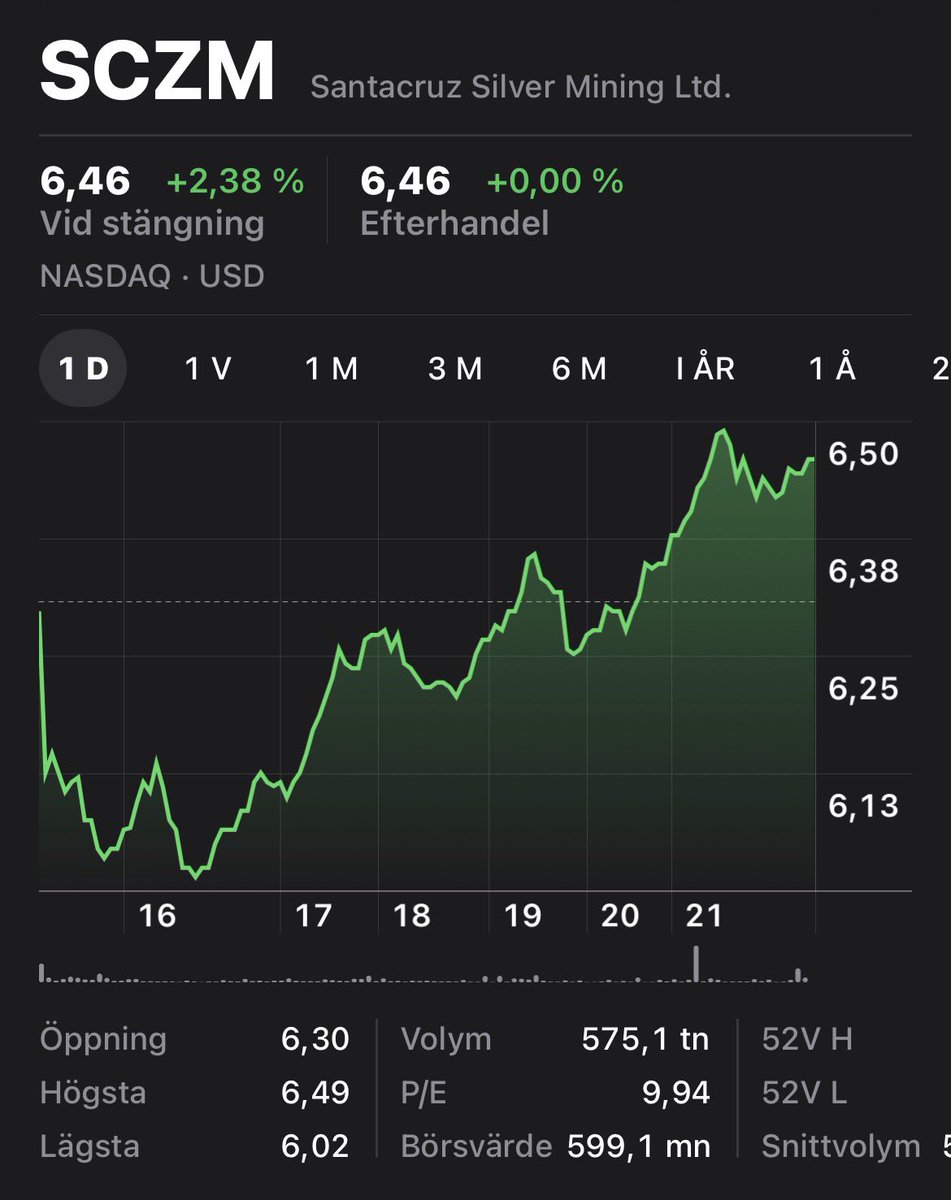
Santacruz is trading up 2% today, even with silver down 2%.
The outperformance is driven by their latest report clarifying key operational details-items that the CEO had actually already outlined in an interview last month, which I covered below.
A great reminder of why keeping your ear to the ground pays off.
$SCZ.V $SCZM
Great interview with Arturo Préstamo (CEO of Santacruz Silver) on Crux Investor. Here are my key takeaways:
• TSX Uplist Imminent: The move to the TSX Mainboard is expected within weeks. This is a massive liquidity catalyst, as it finally allows large institutional funds to legally buy the stock.
•Share Buyback Planned: Following the uplisting, management plans to launch a share buyback program. With a rock-solid cash position, they have the firepower to buy back up to 10% of the entire company.
• Insulated from Bolivian Protests: Operations remain largely unaffected by recent political noise. SCZ is heavily reliant on rail transport (not roads) and holds deep stockpiles of essential materials directly at the mines.
• Bolívar Dewatering on Track: The flood recovery is moving exactly as planned. Reaching the deeper, high-grade zones by Q4 will significantly boost production volumes.
• Aggressive Silver Focus: Management is actively executing plans to expand the proportion of FCF that comes directly from silver.
Bottom Line: When you combine these operational milestones and an upcoming buyback program with the insider purchase, the setup here looks incredibly bullish. The fundamental cash-generation capability is completely disconnected from the current valuation.
Link to the interview:
https://t.co/k9zlmZ82iZ
Link to my report on the company:
https://t.co/1QYnhLV16z
@SantacruzSilver $SCZM $SCZ.V $SCZ.NE
This could be interesting for a company like Magna mining that has poly-metallic assets and some high grade AU-AG-PGM slopes that are coming into production in the near future.
$NICU.V
There is a strong probability that precious metal royalties and streams will play a far greater role in funding the next wave of copper projects than the market currently acknowledges.
With capex inflation pushing world-class copper developments into the multi-billion-dollar range, traditional debt and dilutive equity raises simply don't scale efficiently. Monetising high-margin gold and silver by-products via streaming or royalty agreements allows developers to plug massive funding gaps without diluting core copper exposure. It’s no longer just a alternative funding tool; it’s becoming a cornerstone of modern capital allocation in the copper space.
One angle that many investors overlook when assessing Lagoa Salgada is the financing structure. Rather than being a pure equity-dilutive burden, the project benefits from UKEF-backed project finance alongside potential strategic offtake agreements, both of which materially lower the equity check required to reach production.
That advantage is supported by precedent. Cerrado has already demonstrated that institutional counterparties are willing to underwrite these assets, having previously structured streams across both MDN and Lagoa. While those streams have since been repurchased, the fact that tier-1 financiers were willing to fund them initially confirms that Lagoa is bankable on competitive terms.
Lagoa Salgada shouldn’t be categorized as just "another junior development asset." Between sovereign export credit support, clean asset ownership, and clear offtake interest, the project carries a significantly lower execution and financing risk profile than consensus implies.
Mark brennan discusses this in his latest interview:
$CERT.V $CRDOF
https://t.co/S0jxo7w1A4
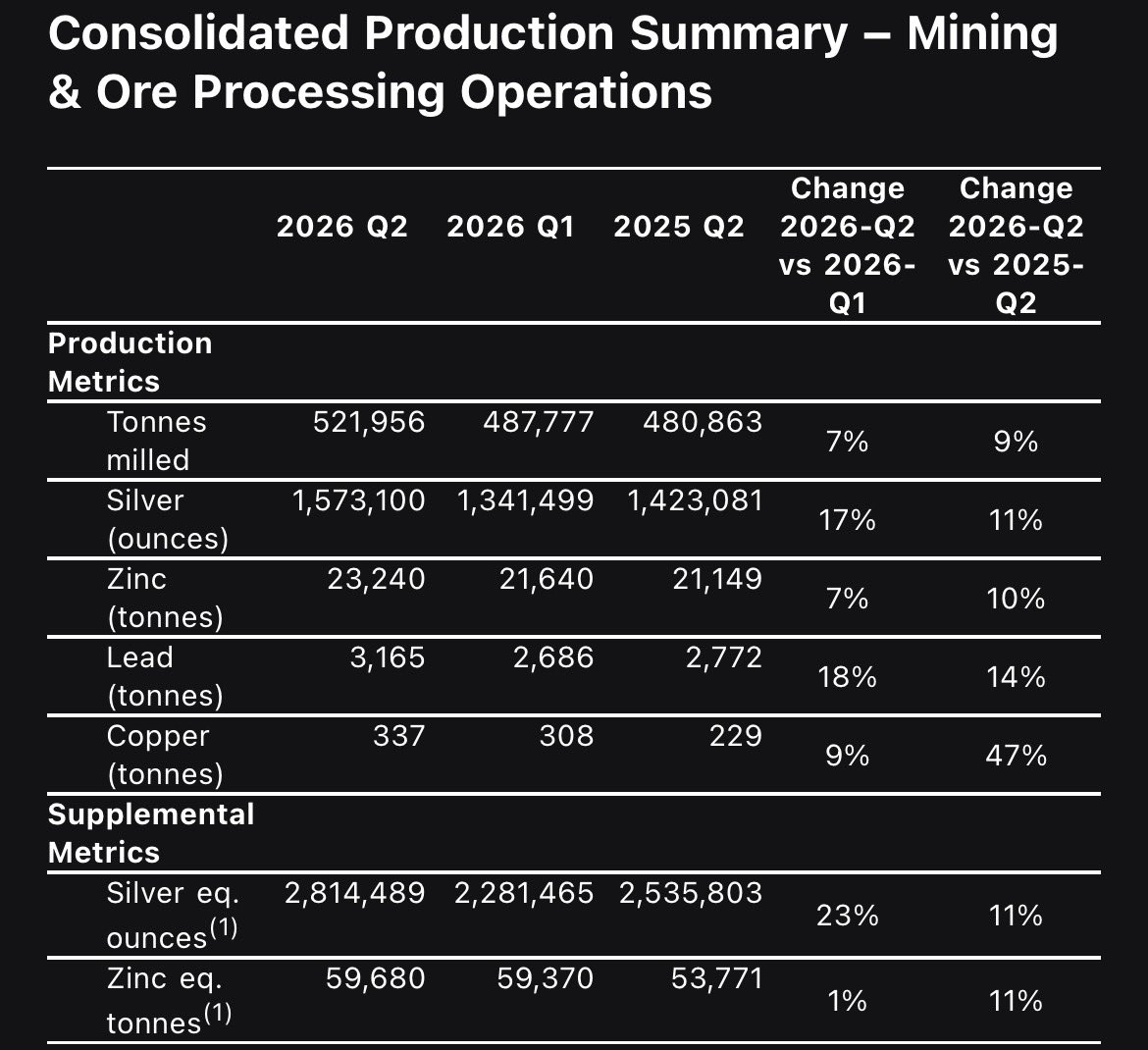
Santacruz Silver Q2 2026 Production Note
Santacruz delivered a strong sequential improvement in Q2 2026, with silver production climbing 17% QoQ, driven by recovery at the flood-affected Bolivar mine. The quarter is notable not just for the volume growth itself, but for the resilience shown across operations despite significant external disruption in Bolivia, and for confirming that the company’s recovery trajectory remains firmly on track heading into the second half of the year.
Key Takeaways
•Bolivar leads the recovery: Silver production at Bolivar jumped 32% QoQ, driven by an 11% increase in tonnes milled and a 17% higher silver head grade, as rehabilitation of the areas affected by the May 2025 flooding event continues to advance.
•Consolidated production up across the board: Total silver output rose 17% QoQ (1,573,100 oz vs 1,341,499 oz) and zinc rose 7% QoQ (23,240t vs 21,640t), with every single operation posting sequential gains in both metals.
•Zimapán rebounded from Q1 ventilation issues: Silver recovery improved sharply to 72% from 65% in Q1, following resolution of ventilation constraints at the high-grade Level 960 and fewer power interruptions from the local grid operator. Silver production rose 8% QoQ despite flat throughput.
•San Lucas scaled up meaningfully: The ore-sourcing business processed 22% more tonnes QoQ, lifting silver output 20% and lead output 45%.
•Operational resilience under real stress: Road blockades in Bolivia lasted more than 50 days during the quarter, disrupting supply chains broadly across the economy. Management notes operations continued without interruption throughout, which speaks well to the team’s logistical execution in-country.
•Porco and Caballo Blanco stayed consistent contributors: Porco’s zinc production rose 5% QoQ on higher throughput, while Caballo Blanco posted a 6% QoQ silver increase on stronger grades, both continuing to perform as steady, lower-volatility assets in the portfolio.
Bottom Line
This was a clean operational quarter that reinforces the core investment thesis: Bolivar’s recovery is real and accelerating, Zimapán’s ventilation-related Q1 weakness was temporary, and San Lucas continues to provide flexible incremental volume. The one caveat is the sequential drop in realized silver price, which will likely cap the scale of margin expansion versus Q1 despite higher output, but with production trending up across every single asset simultaneously, and management successfully navigating a 50-day blockade without losing a beat, this quarter should be read as a confirmation of the turnaround story rather than a disappointment.
$SCZ.V $SCZM
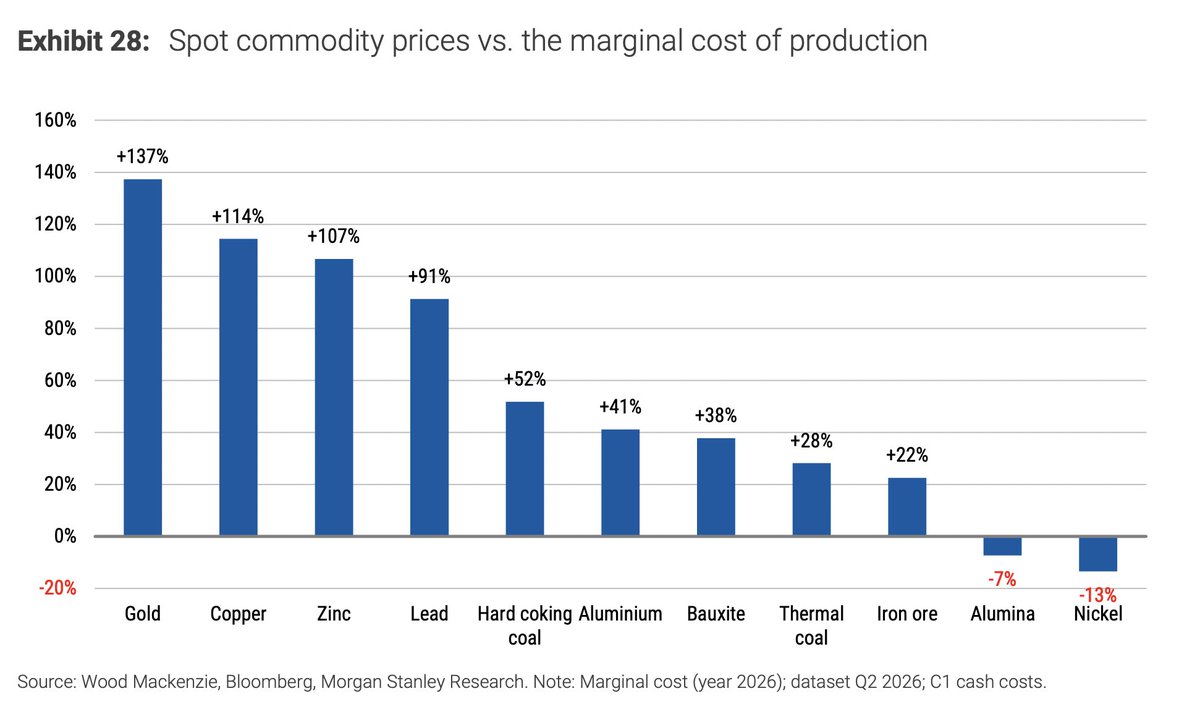
Once again I am reminding you that nickel prices are currently below the marginal cost of production.
That is usually not a bad time to start fishing for ideas.
As @RealRickRule likes to say, "love hate."