GM sovereign architects. 🦌
Most "private" AI infrastructure today is just one regional subpoena away from becoming public domain.
In 2026, relying on a cloud provider's "Terms of Service" to protect your proprietary agent logic, institutional capital, or DeSci datasets is a catastrophic architectural flaw. The legacy tech world operates on corporate promises. The era of Hardened Value operates on cryptographic proofs.
At Pulse Legacy AI, we view absolute data sovereignty not as a premium feature, but as the foundational physics of our network. We do not build walled gardens; we build mathematically impenetrable vaults.
When you deploy a Zero-Noise agent topology:
🔒 Subpoena-Proof Execution: State authorities and third-party actors cannot compel what a server does not hold. By utilizing ZK-proofs for verifiable computation, your agent's internal logic and datasets remain entirely opaque to the infrastructure hosting it. The answer to unauthorized access requests isn't a legal battle; it is a mathematical impossibility.
⚖️ Jurisdictional Immunity: We anchor the consensus hashes of our agent swarms exclusively to Bitcoin L1. The ultimate state of your system is governed by a global, immutable ledger, completely detached from regional geopolitical friction and shifting regulations.
🤫 Silent Dominance: True legacy doesn't roar for attention. It operates silently, immutably, and with the quiet elegance of classical systems designed to last centuries, rather than software cycles.
Your proprietary research and sovereign capital shouldn't require a legal defense team if they are structurally inaccessible by design.
GM to all architects of the new web. 🦌
The era of "Move fast and break things" is officially dead. As we scale autonomous agent swarms and complex DeSci protocols, fragility is no longer a viable business model. Welcome to the era of "Architect slowly and outlast empires."
At Pulse Legacy AI, we believe that the modern tech stack has become inherently cheap—built on rented cloud space, fragile APIs, and noisy, unpredictable LLM prompts. True luxury in engineering is absolute digital sovereignty and mathematical certainty.
Enter the Neural Blockchain Core.
We are actively moving away from the brute-force, chaotic nature of early AI (the ubiquitous "roaring lion" of standard corporate tech). Instead, we design agentic topologies that operate with the quiet precision, elegance, and sovereign independence of a stag navigating a dense forest.
Here is what the "Old Money" approach to autonomous system architecture looks like in 2026:
🏛️ Generational Code: We do not build for the next quarterly report; we build for the next century. Every critical decision made by our agent swarms is ZK-verified and permanently anchored to Bitcoin L1.
🕸️ The Neural Blockchain Core: A strictly typed, zero-noise orchestrator. It does not guess or hallucinate. It computes, verifies, and executes with absolute, unyielding idempotence.
🛡️ Aristocratic Sovereignty: Your data, your research, and your agent's logic belong entirely to you. The architecture is mathematically immune to state subpoenas, regional throttling, or sudden corporate API deprecations.
We are no longer just writing software. We are minting digital heritage.
Build systems designed to rule, not just to scale
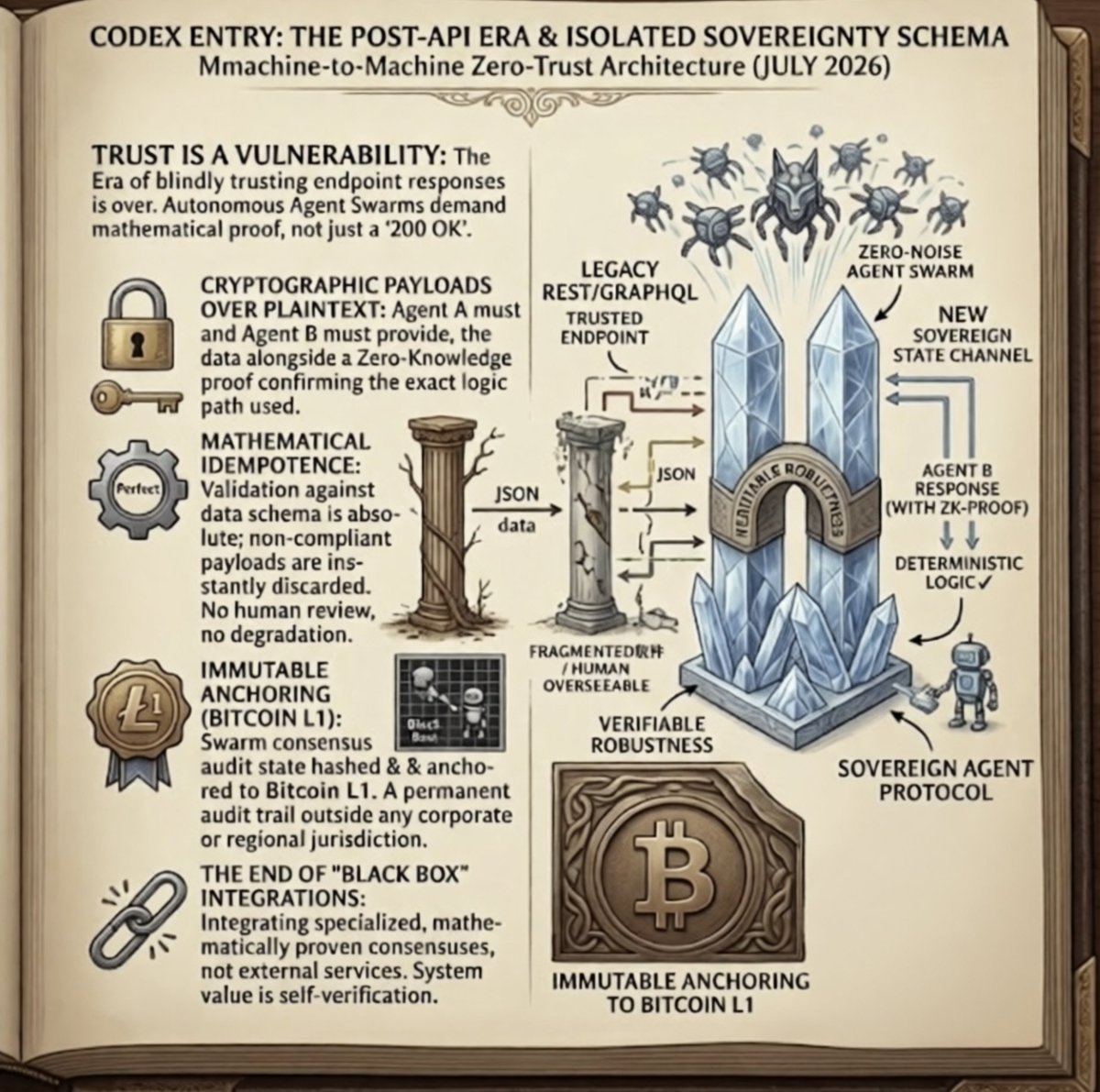
🕸️ The Post-API Era: Why "Trusting the Endpoint" is a Vulnerability in 2026
For over a decade, we built the internet on REST and GraphQL. We sent requests, received JSON payloads, and blindly trusted the server’s response. In the era of fragmented software and human oversight, this was an acceptable compromise. In the era of autonomous agent swarms, it is a catastrophic architectural flaw.
When agents are executing high-stakes logic autonomously—whether managing decentralized capital or validating complex DeSci datasets—a standard 200 OK response is no longer sufficient. You don't just need to know what the endpoint replied; you need mathematical proof of how it computed the answer.
From API Calls to Verifiable Computations
In a Zero-Noise topology, the architecture must assume that any external endpoint is potentially compromised, altered, or hallucinating. We are transitioning from traditional API handshakes to ZK-Verified State Channels.
Here is how Machine-to-Machine (M2M) communication is being rigorously re-architected for sovereignty:
Cryptographic Payloads Over Plaintext: Agent A does not merely request data from Agent B. Agent B must return the requested data alongside a Zero-Knowledge (ZK) proof confirming the exact, deterministic logic path executed to generate that output.
Mathematical Idempotence: If the ZK-proof fails validation against the strictly typed data schema, the payload is instantly dropped. There is no "graceful degradation" and no fallback to human review. The corrupted execution is isolated and discarded.
Immutable Anchoring: The final, verified state of these interactions - the ultimate consensus of the swarm—is hashed and anchored directly to Bitcoin L1. This creates a permanent, tamper-proof audit trail of machine intelligence that exists entirely outside of corporate or regional jurisdictions.
The End of "Black Box" Integrations
We are no longer integrating external "services"; we are bridging localized, mathematically proven consensuses. The value of an autonomous system is directly proportional to its ability to prove its own correctness.
Architectural Insight: If your internal agents are still accepting data from external sources without cryptographic verification of the computation that produced it, your entire swarm is exposed to cascading logical failures. Trust is a vulnerability; verification is the standard.
Building an unassailable legacy requires abandoning the convenience of the old web for mathematical certainty. We are no longer just writing code - we are forging immutable logic designed to outlast its creators.
At @CERN, finding the universe's smallest particles requires big collaborative efforts. 🤝
Research fellow Batoul Diab shares how the ALICE collaboration uses open source code on GitHub to analyze massive amounts of physics data. Watch to see shared code, peer review, and global teamwork power modern scientific breakthroughs. 💡
Quake turns 30 today. 🎉
Three decades later, you can still dig into the source code that helped shape modern game engines, multiplayer networking, and modding communities. 🎮
https://t.co/mV5q4YdPRM
.@impeccable_ai earned its way to 40k+ stars on GitHub by delivering exceptional value. Today, we are making design and quality a built-in layer for all creators: Impeccable is now a built-in skill in the GitHub Copilot app.
AI raised the floor. We’re here to help raise the ceiling.
You can now use an expanded set of models in the GitHub Copilot app. 🔑
Bring your own provider key, use local models or use models already part of your subscription.
You decide which model fits each agents session. ⬇️
https://t.co/kWcbL0S2QK
Something that's been pretty nice in the GitHub Copilot app is how helps me with pixel pushing responsive layouts.
I've been working on a design update for my app PocketCal, and I used it to test screen sizes and it gave me screenshots based on all the ranges I asked for!
A single app model and a simplified local run loop.
This Open Source Friday, we'll learn about @aspiredotdev: a code-first orchestration and observability layer for distributed apps, with a built-in dashboard for logs, traces, and metrics.
Set a reminder 🔔
https://t.co/5FR2c6pKT0
What if your first sip of coffee came with a finished to-do list? ☕
We sat down with @_Evan_Boyle to see how automations, MCP integrations, and custom skills make the GitHub Copilot app work the way he does.
To improve accessibility in open source, we've worked through programs, partnerships, and open tooling built with real projects and communities.
Learn more about what we've done, and what you can do to help make open source more inclusive.
https://t.co/b5wrDQfzCJ
GitHub Universe: Not your average tech event.
Come for the sessions, stay for the joy (and donuts). Join us IRL this year, you still have the chance to get our Super Early Bird pricing until July 8.
Get your ticket 👇
https://t.co/rcNvehOR58
The next frontier of agentic development is here, and you are in control.
Today we announced releases that will keep you in the flow with your agents, all on the GitHub platform. ⬇️