Announcing the @jneurolang award for Best Paper of 2023! 👏
Information-Restricted Neural Language Models Reveal Different Brain Regions' Sensitivity to Semantics, Syntax and Context | https://t.co/hqRlK6SiAJ | by @a_pasquiou, @lakretz, @BertrandThirion & @chrplr
The editorial team at @jneurolang congratulate our recipients of Honorable Mention for Best Paper 2023!
Understanding the effects of constraint and predictability in ERP | https://t.co/n93EyzJyZF | by Kate Stone, @bruno_nicenboim, @ShravanVasishth & Frank Rösler
I have always been a big fan of the Language Neuroscience podcast, so it feels a bit unreal to be part of this episode. It was a new (but fun!) experience, so a big thank you to @smwilsonau for guiding me through it.
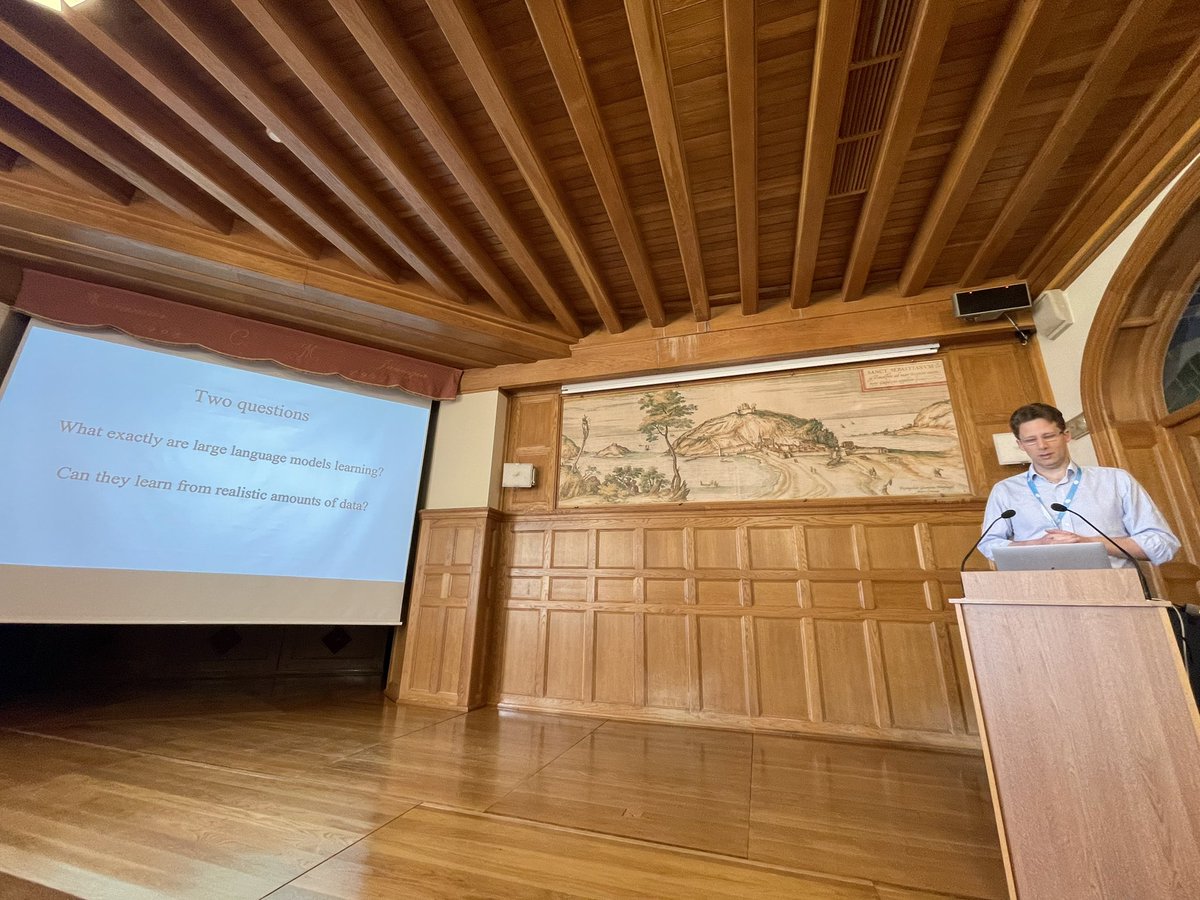
I had a great time presenting our recently published study on predictive reading and statistical learning at #IASL2024, San Sebastián ☀️
Thanks to the great organisers and colleagues for the great talks and inspiring feedback!
📋 https://t.co/10MHw18kHo
Really cool paper from @FabianGloeckle, @syhw et al @AIatMeta showing the importance of learning to predict beyond the next word:
https://t.co/qdgM4DIYXh
I'm real pleased as we showed last year that this objective better accounts for brain activity: https://t.co/dnofVxQiLw
"L’efficacité des méthodes d’enseignement de la lecture"
Cette recherche de Jérôme Deauvieau (membre du @CsenOfficiel) et Paul Gioia examine quelles stratégies pédagogiques et quels manuels de lecture facilitent la réussite des élèves de CP/CE1.
https://t.co/9zsrSxOMgC
📣 💡 📚 Phonological Decoding and Morpho-Orthographic Decomposition: Complementary Routes During Learning to Read.
New article with Brice Brossette, post-doc @LPL_lab_Aix as 1st author, É. Lefèvre, E. Beyersmann, E. Cavalli, J. Grainger & B. Lété.
➡ https://t.co/H3aMRPklf2
📣Doing work on statistical learning?
The deadline for submitting your research to the International Conference on Interdisciplinary Advances in Statistical Learning is just over 3 weeks away:
📅 March 1, 2024
The conference takes place June 5-7 in San Sebastian, Spain
1/4
The dynamics of multiword sequence extraction
Leonardo Pinto Arata, Laura Ordonez Magro, Carlos Ramisch, Jonathan Grainger, and Arnaud Rey
https://t.co/8xFBTs2pgi
Lors de l'examen du dernier PLF, la droite sénatoriale, aidée par Bruno Le Maire, a voulu retirer 100 millions d’euros au CNRS. Nous avons dû batailler pour contrecarrer ses plans. Hélas, ce n'était qu'une répétition pour le plan d'austérité qui se concrétise aujourd'hui.
Voici les annulations de crédits annoncées par décret :
- 80 M sur le 150 (enseignement sup et recherche univ)
- 383 M sur le 172 (recherche)
- 125 M sur le 231 (vie étudiante)
- 192 M sur le 193 (recherche spatiale)
Les élites de notre pays n’aiment ni nos chercheurs, ni nos universités, c’est pourquoi elles n’éprouvent aucune difficulté à les maltraiter financièrement.
C'est un drame pour notre époque et notre avenir. Sans savoirs, nous ne répondrons jamais aux urgences sociales et écologiques qui nous font face.
Want to measure individual differences in language processing? Be careful about using the self-paced reading task. Although used in 100s of group-level experiments, it's not reliable for individual differences! 😱
Read all about in @FFrinsel's new paper: https://t.co/zsjH3M0RnX
Is genetic disposition to #dyslexia associated with brain structure? @neurosoren investigated in over 30,000 adults using data from @uk_biobank & @23andMeResearch , highlighting brain networks involved in motor, language and vision functions https://t.co/QjXUuKARnE 1/8 ⬇️
I am happy to share our new paper in the Quarterly Journal of Experimental Psychology🥳@SageQJEP
If you want to know more about how the structure of multiword sequences influences their processing, check it out here: https://t.co/Dmggxkn0QF