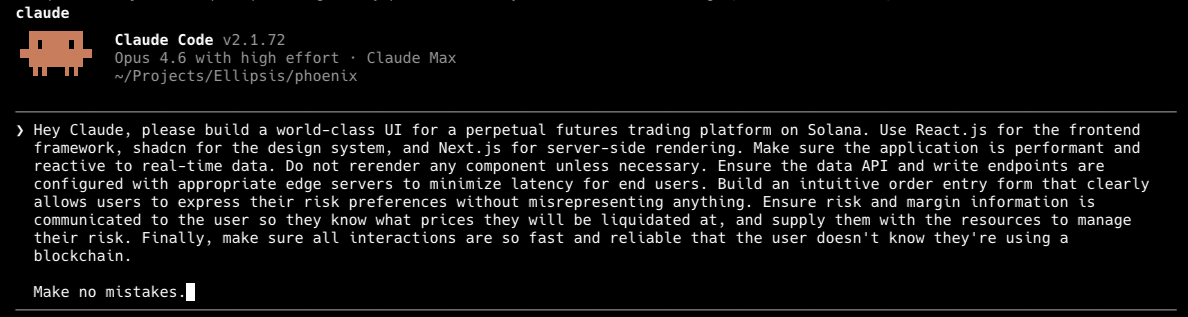
I'm hiring an exceptional product engineer to join @ellipsis_labs so I can stop vibecoding.
An ideal candidate:
• Ships full-stack products
• Has high user empathy
• Deeply understands modern frontend
• Is fluent with AI tooling
All roles are in person, in NYC
New episode with @0xShitTrader CEO of @ellipsis_labs
We Discuss:
- Ellipsis Labs History on @solana
- MCP and Phoenix Perps
- Trends in Market Structure
- And more!
Timestamps 👇
(0:00) Introduction
(2:25) Solana Market Structure Shift
(8:07) Why Phoenix Perps Now
(21:16) Why Perps Need No Router
(29:39) What Solana Must Improve
(34:49) The Block Builder Problem
(43:24) Will DeFi Mimic TradFi?
(52:48) Phoenix Perps Launch Plans
(53:38) Closing Comments
.@ellipsis_labs is showing that fully onchain markets can deliver performance on par with centralized exchanges, and now they’re doing it again for derivatives with Phoenix Perps 👇
Phoenix is fully on-chain, including the risk and matching engine, so anyone can build on top of the program.
Developer docs are coming soon. If you’re interested in building on top of Phoenix in the meantime, reach out to us via DM.
I’ll be in Abu Dhabi all week for @SolanaConf!
DM me if you want to chat about:
- Technical shit (spot market microstructure, prop AMMs, smart wallets, perps, borrow/lend, JIT routing)
- Why I’m cynical/optimistic about crypto
- Speculations on evolving capital market structure
Most of the breakthrough products in AI are wrappers around generalized LLMs.
Most of the breakthrough products in crypto are wrappers around USD.
For example:
- Hyperliquid perps are collateralized by USDC deposited into an EVM bridge contract on Arbitrum
- Arbitrum (as a whole) is backed by assets deposited into the canonical L1 bridge on Ethereum
- Native USDC on both Arbitrum and Ethereum is backed by dollar assets (TBills and overnight repos) held by Circle
In both cases, there is an innately powerful primitive (AI: information retrieval and synthesis, crypto: programmable money) that is made broadly useful with computation and product design.
The biggest advantage of CLOBs is that they are easily interpretable. Every price level has a fixed supply: removing lots by crossing is similar to buying items from a vending machine. You can reasonably explain the mechanics to a sharp high school student.
This simplicity is one reason CLOBs dominate traditional finance. But it also means many talented young people spend their prime years cracking the queue games of FIFO matching engines rather than reimagining new market structures.
Crypto introduces a paradigm shift. Programmable asset ledgers enable experimentation with matching engine design itself—not just strategies within existing systems.
@Uniswap pioneered this shift by bringing automated market makers to scale. While vanilla AMMs excel at price discovery for long-tail assets, they struggle with highly liquid markets that demand tighter spreads and deeper books.
Today's builders are addressing these limitations with purpose-built solutions. @gavelxyz's sandwich-resistant AMM is a highly opinionated extension of the vanilla xy=k model that is specifically catered to Solana's block production and leader rotation. @SolFiAMM chooses a different set of tradeoffs than traditional CLOBs to provide competitive on-chain prices for liquid spot assets.
Crypto's permissionless nature enables rapid iteration on market microstructure in ways traditional finance never could. These next-generation matching engines represent a fundamental shift: instead of one-size-fits-all solutions, we're seeing purpose-built market designs that optimize for specific assets, chains, and use cases.