Introducing: Explore
A new way to discover tokens on JTX. See what the highest-signal wallets are trading and where money is moving on Solana.
Signals: a live feed of what Solana's highest-signal wallets are buying and selling. As long-time block builders, we've analyzed wallet behavior across all of Solana to find the ones that historically lead: strong PnL, and other traders tend to follow them. Now you can see their trades as they happen.
Live: onchain flow on Solana, visualized in real time. See which tokens are picking up volume and where that volume is coming from, across every venue.
The exchanges, clearing houses, settlement systems and depositories behind every trade (financial market infrastructures, or FMIs) earn about $31.5bn a year.
Our new Solana Research Institute report works out how much of that survives when the same business runs on public blockchains. If regulation stops protecting the incumbents, we estimate they keep about $11.2bn, with the other $20.3bn going to users as lower costs or to new competitors.
We also found that new onchain services could come close to replacing that revenue, which raises the question of who wins them 🧵
How does BAM schedule transactions? How do BAM nodes sort txs vs bundles? What happens in every auction tick?
Our eng will share highly technical details about all the above and more.
Seats are v limited. tell us why you should get one!
https://t.co/JxCkCwubXQ
“Settlement times used to be 500 milliseconds to a second. Today it's 100 milliseconds or 200 milliseconds.”
“This is only going to get faster. This is the slowest [Solana] will ever be.”
– @buffalu__, CEO @jito
We're proud to support @formation_so as a distribution partner to bring tokenized shares to @solana, with voting, dividends, and other shareholder rights intact.
Equities, built for equity traders.
Now live on JTX.
Trade tokenized US and international equities from @Backpack and @Ondo with direct issuer quotes (RFQ), live pricing, and a full equities data experience.
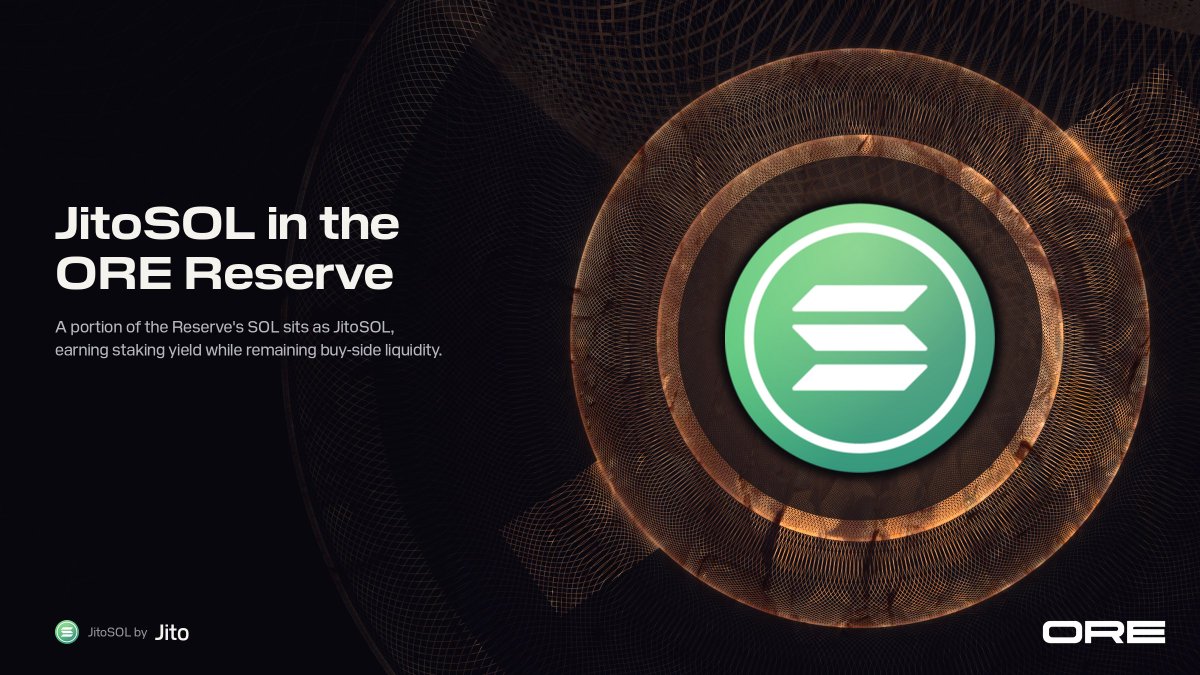
JitoSOL now backs part of the ORE Reserve.
Part of the ORE Reserve’s SOL allocation now earns yield as JitoSOL while supporting ORE buy-side liquidity.
The Jito Foundation has also added ORE to its treasury.
JitoSOL in the ORE Reserve. ORE in the Jito Treasury.
The Reserve holds part of its SOL allocation as JitoSOL, another productive asset earning yield while providing buy-side liquidity for ORE.
@JitoFDN has also added ORE to its treasury, establishing a position with its first ORE purchase.
Going to Breakpoint? 🏴
We're proud to sponsor 200ms: an event on Solana microstructure, emergent trends, how protocol changes impact DeFi & what traders need to know.
📅 Nov 13 · London
Apply: https://t.co/ncv1NmRHcO
Bitwise is proud to be one of the first three independent @jito BAM node operators, alongside @triton_one and @solstrategies.
Block building decides which transactions land on Solana and in what order. Jito built BAM to do it inside sealed hardware, where transactions stay private until execution.
Until now, Jito ran every BAM node itself, so this is a big step toward decentralizing block building on @Solana.
Decentralizing block building means BAM Nodes run by operators outside of Jito.
We're happy to announce the first cohort of third-party BAM Node operators: @triton_one, @Bitwise, and @solstrategies.
Read the full post for the onboarding phases and the path to full mainnet:
Settlement in seconds. Collateral that moves 24/7. Wider access to US capital markets.
@RebeccaRettig1 on what tokenization offers public company CEOs (and their shareholders):
Join @DrNickA of @jito for an interactive and applied workshop on Cryptoeconomics and Governance at our next SRI Sessions from the House of Sol.
The session is 30-45 minutes, followed by a Q&A. Admission is FCFS.
5pm, Clerkenwell, London.
Thursday 29th October
Sign up now: https://t.co/sh8AcF8rj1
With Alpenglow live, vote transactions are no longer recorded in blocks. IBRL scores that rely on vote packing don't reflect the new consensus model.
The site is being refactored to account for this. Updates to follow.
Small blocks from BAM are down ~77%.
Fewer underfilled blocks means less validator revenue left on the table and less unused blockspace.
Read the full breakdown: