Expositores del Conversatorio en conmemoración del 105o aniversario del PCCh: Julio Yao, Richard Morales, Samuel Prado y Abdiel Rodríguez, organizado por el CEEAP y la Embajada de China en Pmá (20/8/26)
Conversatorio 105 años de reingeniería social en China, oportunidades de desarrollo sincronizado entre China y Panamá”, inaugurado por S.E. Zhang Xiangyan, embajador de China, y Roberto Montañez, presidente del CEEAP
Expositores y público asistente al Conversatorio “105 años de reingeniería social en China, oportunidades de desarrollo sincronizado entre China y Pmá”
Esta semana me ha recordado que nadie sabe lo que está pasando por la mente de otra persona.
Por eso sean amables, abracen cuando puedan, saquen tiempo en el ajetreo cotidiano y manden un mensajito de cariño a sus amigos.
"Mientras uno este vivo, debe amar lo más que pueda"
@fargote507 El presupuesto de propaganda del estado panameño es mayor que el de Coca-Cola y McDonald's juntos. Se podría usar para campañas que estimulen estilos de vida saludables, incluyendo dieta sana. Es un ejemplo de cómo el estado puede propiciar conductas ciudadanas positivas.
@TReporta@FelipeChapman Primero debería ver si puede cobrar ISR a esas empresas y a otras empresas que brindan servicios digitales globalmente. Si lo logran, pueden cobrar el ITBMS.
@UrsulaKiener Pero no son huevos. Son sucedáneos. Buen aporte. Hay que tratar de comer lo más cercano a lo natural y alejarse de los comestibles ultraprocesados. Lo más recomendable es que lo que comes sea no venga empacado. Gracias y saludos.
@mirolda06@BlandonJose Es una política que se conoce como "pueblos bien gobernados". Muchos de los pueblos "mal gobernados" se han vaciado, porque la población emigra a pueblos "bien gobernados".
Hemos iniciado talleres en seguridad alimentaria y no cesaremos con el único objetivo de mejorar la Alimentación Saludable accesible y asequible para todos y todas!
Nosotros como M.A.S seguiremos trabajando por la justicia alimentaria sin vulneración.
Desde nuestra organización, reafirmamos nuestro compromiso inquebrantable con la justicia alimentaria como un derecho humano fundamental.
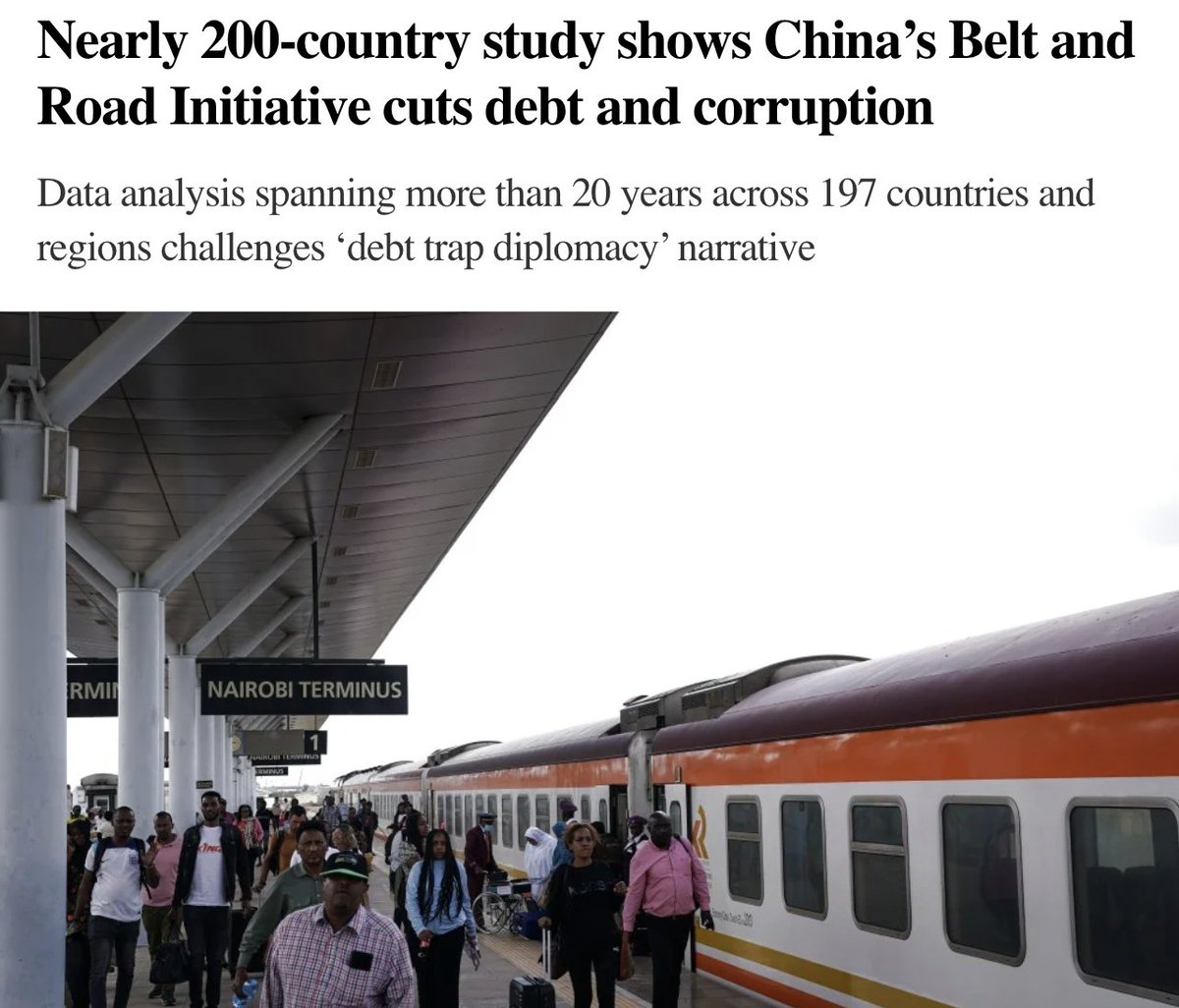
Well this is awkward. Everything you’ve been told about the Belt and Road Initiative being a “debt trap” is provably wrong.
A new study from Nanjing University, published in the peer-reviewed Quarterly Journal of International Politics, has run the numbers on the Belt and Road Initiative across 197 countries and regions over 2000 to 2023 – including the 146 countries that have signed BRI agreements and the 135 where projects have been launched or completed.
The headline finding: there is no evidence that BRI participation increased financial vulnerability. Quite the opposite. Debt levels fell in participating countries, and the more infrastructure was built, the more debt fell.
The team also found improvements in corruption control, government effectiveness and quality of governance among recipient countries.
Study lead Mao Weizhun noted: the debt trap “lacks empirical support”, and the limited cases of genuine debt distress “were not caused by the Belt and Road Initiative or infrastructure construction, but by long-term structural economic problems accumulated by participating countries”.
The mechanism is not complicated. The investment paid for productive assets – ports, railways, power networks, communications. Those expand logistics capacity, industrial activity and the tax base, which is how a country repays a loan. This is the opposite of borrowing to service previous borrowing, which is what a great deal of Global South sovereign debt actually funds.
Somebody will point out that this is a study in a Chinese journal. Sure. But its findings are entirely consistent with what Western researchers found when they bothered to look. Chatham House demolished the debt trap thesis in 2020. Deborah Brautigam at Johns Hopkins has spent years documenting that Chinese lending to Africa is overwhelmingly infrastructure finance – around 40 percent to power generation and transmission, another 30 percent to transport – on a continent where over 600 million people have no electricity.
Over three-quarters of Global South external sovereign debt is owed not to states but to private Western financial institutions, which have no obligation to consider anybody’s development needs and every incentive to extract the maximum. As Tim Jones of Debt Justice UK has put it, Western leaders blame China for Africa’s debt crises, but their own banks, asset managers and oil traders are far more responsible; he further notes that China took part in the G20 debt suspension scheme during the pandemic while private lenders did not.
The debt trap is real enough, but it’s been set by Western financial institutions and their governments, not by China. The BRI is a South-South cooperation initiative that helps countries build productive capacity, and all serious analysis indicates that it’s strengthening rather than weakening the countries that participate.
@gloriamelania Habrá un buen MEDUCA cuando haya un acuerdo político amplio que incluya metas de excelencia educativa, incremento de infraestructura y mejora de la planta docente actual. Además debe asumido como política de estado.
@SraPulpo La Guerra contra las Drogas es la mayor estafa que EUA le ha hecho al mundo y a Latinoamérica. Apenas se van los estadounidenses se acaba el problema de las drogas. Es puro cuento útil para intervenir en otros países.