1/12 Animals often communicate in phrases with sequential structure. Vocal learners, however, are often studied one note or syllable at a time. What are the origins of vocal sequences in animals that learn vocal communication? Find out in our new paper spanning birds+babies🧵
Our special issue on Social Contingency is out in @RSocPublishing ! Two years of hard work by our authors, reviewers, and editors have paid off. We are thrilled to share a phenomenal set of empirical, theoretical, and review papers with you. https://t.co/KzA9IUp6XR
12/12 When comparing across languages and species, learning faster vocal communication systems may well show a stronger developmental reliance on social feedback, which guides learners to compress their sequences into the range expected by their future conversation partners.
1/12 Animals often communicate in phrases with sequential structure. Vocal learners, however, are often studied one note or syllable at a time. What are the origins of vocal sequences in animals that learn vocal communication? Find out in our new paper spanning birds+babies🧵
11/12 Our findings suggest that social feedback is more efficacious than previously imagined – it even guides improvements in fundamental vocal timing.
We found a non-obvious pathway to robust language learnability across cultures & languages. Future work will assess just how widespread this pathway is across the world’s languages, and the role that contingent simplification plays in language development. 9/9
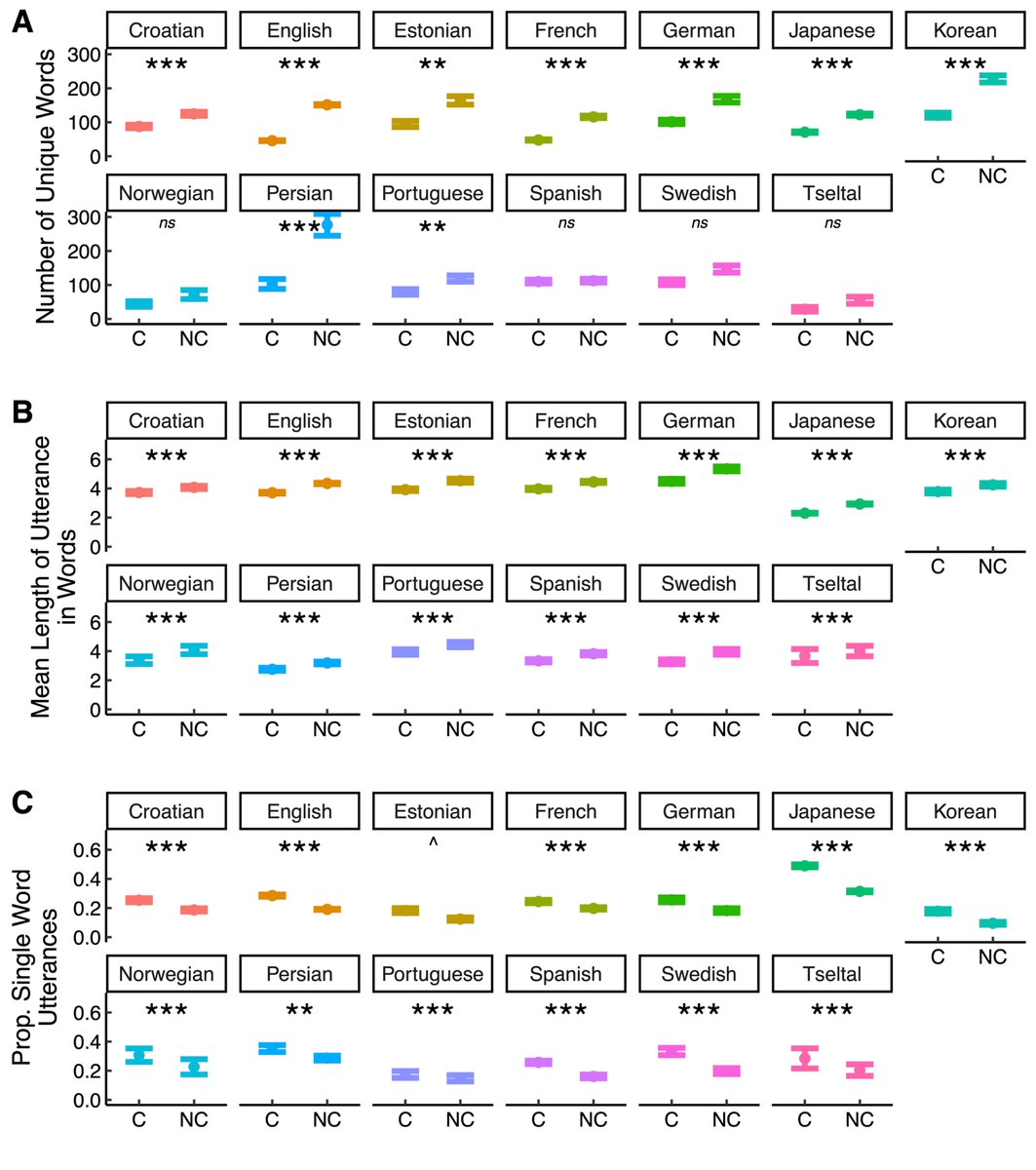
In response to their child’s immature speech, caregivers produce fewer unique words, shorter utterances and more single-word utterances compared to caregivers’ baseline speech complexity. We call this the simplification effect of contingent speech. 3/9
Languages don't only become learnable over evolution, they’re also learnable at precise moments during language development. Children actively shape their own learning input, eliciting learnable speech during vocal turn-taking, the central context of language use. 8/9
w/ @MikeHGoldstein & @levy_jacob we show that kid’s immature vocalizations & speech actively elicit language from caregivers that is linguistically simplified & learnable. We find this in 13 languages, showing a robust social pathway for making language learning easier to do 2/9