🎄This cinnamon star bread is officially on my to-bake list for December 💫
Soft, pull-apart layers, so much cinnamon-sugar, and it looks way fancier than it actually is to make. Save this for your holiday baking days.
25 million CAR T cells successfully injected into my brain this morning.
Hoping to kill any remaining glioblastoma cells.
Grateful to be apart of the medical breakthroughs at @PennMedicine
The goal isn’t to “hack” your vagus nerve. It’s to practice winding down.
Your vagus nerve is the main highway for "rest-and-digest" signals. Tone it gently, and your whole system calms.
Strong vagal tone means easier downshifting from stress, better digestion, stable heart rate, improved mood, and deeper sleep.
Modern life often weakens it—leading to scattered focus, anxiety loops, and recovery struggles.
Simple, daily ways to nurture vagal tone without force:
🧠 Slow, extended exhales (4-7-8 breathing or longer out-breath)
🧠 Humming, singing, or gargling — vibrates the vagus nerve directly
🧠 Cold exposure (face splash or brief shower end) — shifts the autonomic nervous system, leading to a drop in heart rate.
🧠 Gentle neck/ear massage or yoga poses (child's pose, legs up wall)
🧠 Social connection or laughter — oxytocin + vagus synergy
🧠 Probiotic/fermented foods — gut-vagus link supports tone
Which of these have you tried? I’m a big fan of the 4-7-8 breath, as it works quickly.
#VagusNerve
Strength gets the attention. But POWER may be what keeps you independent.
Strength is how much force your muscles can produce.
Power is how quickly you can produce it.
That difference matters more than it sounds. You need it for:
1. Getting out of a chair quickly.
2. Climbing stairs.
3. Catching yourself when you stumble.
4. Stepping off a curb.
5. Reacting before a fall.
These aren't just strength tasks. They require force and speed.
Research in older adults shows muscle power is closely tied to physical function.
Power-focused resistance training provides a modest functional advantage over traditional slower strength training.
The good news: power is trainable, even later in life.
Your move: Don't train only to be strong.
Once you have a safe strength foundation, add quick but controlled movements.
Some options:
• Fast sit-to-stands
• Quick step-ups
• Medicine-ball throws
• Kettlebell swings
• Fast resistance-band rows
• Low-impact squat-to-calf raises
• Short, brisk stair climbs
The goal isn't reckless speed.
Use a manageable resistance, accelerate with control, and slow down if technique starts to break down.
Because healthy aging isn't just about how much you can lift.
It's also about how quickly your body can respond when life demands it.
Are you training power - or only strength?
“When you arise in the morning, think of what a precious privilege it is to be alive – to breathe, to think, to enjoy, to love.”
– Marcus Aurelius
Let gratitude fuel your day. :-)
#MorningMotivation#Morning
One of the greatest 20th Century “Swan Lake”s is the 1966 Covent Garden production with Rudolf Nureyev and Margot Fonteyn. It wasn’t only Nureyev and Fonteyn who stood out. Below, the famous Dance of the Cygnets, one of the hardest ballet sequences to perform. It was choreographed by the great Marius Petipa (1818-1910). Unfortunately, most of his choreography for “Swan Lake” was lost, so this is one of the few fragments we have, and it is genius.
Your GLUTES love a deep range of motion, and the STEP UP is one of the best ways to achieve it safely.
In a 2020 systematic review of 16 studies step-up variations averaged 125% of maximal voluntary contraction,
This was the highest gluteus maximus activation of the exercises they tested and a bigger demand than a regular squat for many people.
Action Tips:
1. Keep your hips square and knees tracking over your toes so the work stays in your glutes and hamstrings instead of leaking into your low back or quads.
2. Use a box high enough that your thigh is roughly parallel or just below, and drive through the whole foot.
3. Do 2–3 sets of controlled step-ups and notice where you actually feel it.
Do you already use step-ups, or are squats still your go-to for glutes?
Source: Neto et al., Journal of Sports Science and Medicine, 2020.
#GluteWorkouts
This video just released by the Prince and Princess of Wales is heartbreaking ❤️🩹
Anyone who has been touched by cancer knows that the battle is always the hardest one
But the light and hope at the top of the mountain must never be lost from sight 🫶
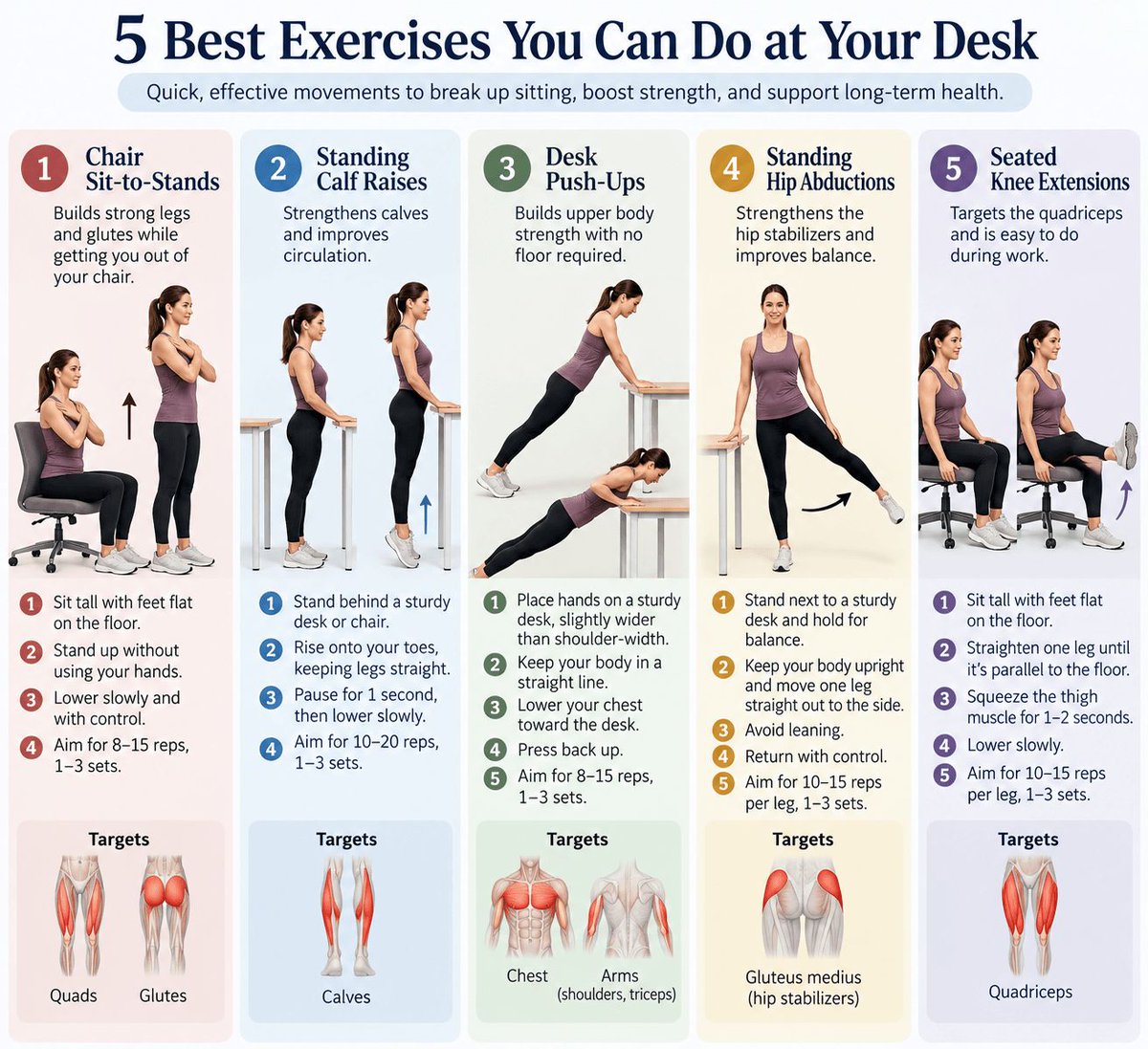
Desk push-ups and chair stands sound too easy to matter. A 60-person trial proved otherwise.
-
Prolonged sitting weakens your quads, glutes, and calves while creating a vicious cycle: weaker legs make standing harder, so you sit even more.
In a 60-person trial of sedentary adults, just 3 sets of 5 or 10 chair sit-to-stands, 3 days a week for 8 weeks, improved muscle quality 40–45% and relative power 29–38%. (Lizama-Pérez et al., PeerJ 2023)
No gym, no equipment.
Here's the line-up:
1. Chair sit-to-stands — Stand from your chair without using your hands, then lower slowly. Great for quads and glutes.
2. Standing calf raises — Rise onto your toes, pause, and lower slowly. Use the desk for balance if needed.
3. Desk push-ups — Hands on a sturdy desk, body straight, lower your chest toward the edge and press back up.
4. Standing hip abductions — Hold the desk and move one straight leg out to the side. Targets the gluteus medius and challenges balance.
5. Seated knee extensions — Straighten one leg, squeeze the quadriceps briefly, then lower with control. Add an ankle weight or resistance band when body weight becomes too easy.
For breaking up prolonged sitting, sit-to-stands may give you the most bang for your buck: one movement gets you out of the chair while training some of the largest muscles in the body.
Start with 5–8 slow sit-to-stands every hour today. Which of these five will you actually do this week?
Did the 40–45% muscle-quality result surprise you, or did you suspect basic movements could work that well?
#DeskExercises