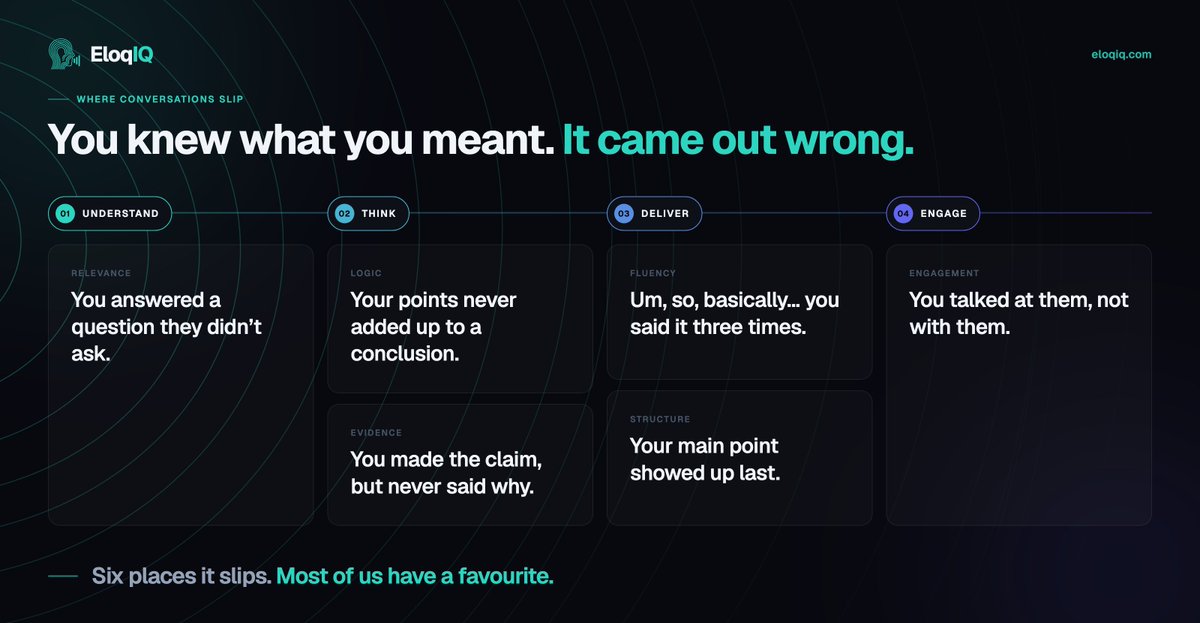
You knew what you meant.
It came out wrong.
It slipped in one of six places:
→ answered what they didn't ask
→ points never reached a conclusion
→ made the claim, never said why
→ said it three times
→ main point came last
→ talked at them, not with them
Which one's yours?
“I’m not good at explaining things” is almost never a confidence problem.
It’s a first-draft problem.
Nobody should have to spend theirs on the person who matters.
Attention isn’t the first stage of communication - it’s the thread running through all of them.
7 cognitive factors shape how we understand, process, deliver & engage:
• Attention (cross-cutting)
• Working memory
• Verbal ability
• Reasoning
• Processing speed
• Executive functions
• Social cognition
It filters noise in a meeting, sustains focus on complex logic, keeps you on track while speaking, and lets you notice confusion and adapt in real time.
Research: Diamond (2013), Daneman & Merikle (1996), Levinson & Torreira (2015).
Communication is a cognitive skill.
The people who are easy to talk to still know what you said at minute three.
You don't have to start over. You don't have to re-explain yourself.
That's not charm. That's memory.
#EloqIQ
@thejeffcallahan Most communication coaching tells you what good looks like. The part that actually changes is getting interrupted on the one point you were about to land, then trying it again. #EloqIQ
@stfu_aayushiii The why is the easy part on paper. It breaks when they interrupt you.
Practice the interruption on EloqIQ. One decision, defended out loud.
#EloqIQ
Work conversations have a point. Personal ones don’t. That’s why the person who can explain a broken model goes quiet when someone asks about their weekend.
EloqIQ doesn’t make you talk more. It trains the miss: recall, story, an unexpected follow-up, curiosity, delivery under a little pressure.
Happened. Noticed. Curious. https://t.co/cArcwPq0op