Education leader with 15+ years of experience—purpose-driven, resilient, and committed to developing others. Chicago-based mom, wife, and lifelong learner.
"Making Whole Book Instruction Work": an essential piece by the brilliant @CarolJago (past president of the National Council of Teachers of English and AP English Literature development committee member) on the importance of assigning full-length texts in literature courses.
"Simply browsing a text will not serve a reader well when the stakes of comprehension are high," she writes.
To reverse national declines in readership, assigning novels is critical: excerpts and short fiction simply have not been shown to engender the empathy and engagement that lead to a lifelong love of reading. Those first chapters can feel so difficult, with so many pages ahead, and then the breakthrough happens. I remember that experience myself with both Sense and Sensibility and The Mayor of Casterbridge when I took AP Lit – wondering how I would ever make it through the first chapter, and then gradually finding myself unable to put the book down.
So kudos to AP teachers in subjects ranging from AP Lit to AP Latin, who continue to oppose the technology of distraction, encouraging students to persist in the effort such reading in these classes requires.
https://t.co/INWdDBs82D
This #TeacherAppreciationWeek, we’re recognizing the incredible AP teachers who dedicate their time, passion, and effort to bringing out the best in their students. Thank you for all that you do. 👏 #APTeacherAppreciation
Have an AP teacher you’d like to thank? Give them a shoutout below! 👇
How can we scale skills-based learning in the classroom to better equip students for the job market?
We’re proposing our session, “The Skills Solution: Employers, Educators, and Chambers,” for @SXSWEDU 2026. This conversation highlights new research and career readiness strategies from @TIAA, @USChamber, & College Board.
Learn more 👉 https://t.co/e744pMXp5K
#careerdev #careerreadiness #STEM #K12
#olchspride English teachers, Mr. Denton and Mr..Gerny @OLSpartansBsb spent the afternoon passing out signs to our Spartans who received a perfect score of ✨5✨on their AP exams! Way to go, Spartans! We are so proud of you!
Administrators delivered AP signs to 59 students who earned a score of 5 on their AP tests. Our students scored a 5 on 71 tests. We also had students earn a total of 469 passing tests of a 3 or higher with a total potential value of over $600,000 in savings.
2025 AP Exam scores are available starting today. Students can access their scores via their College Board account.
💻 View your AP Exam Scores: https://t.co/VM6Hcjpfo6
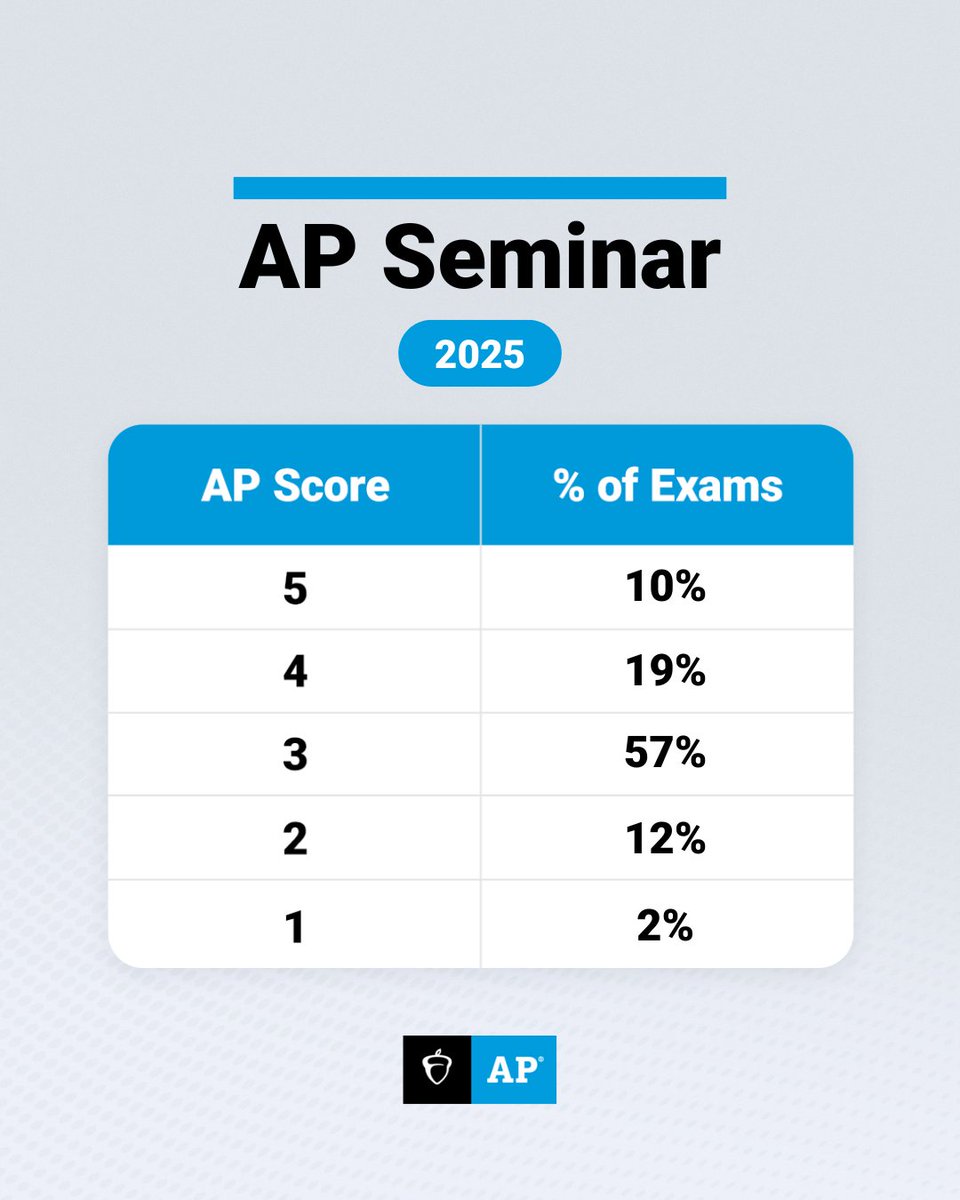
The 2025 AP Seminar scores:
5: 10%; 4: 19%; 3: 57%; 2: 12%; 1: 2%
Of the four AP Seminar tasks scored at the AP Reading, students generally earned highest points on their Individual Research Reports, with especially high marks on accurate source citation and use of a writing style that is appropriate for an academic audience. Approximately 11% of students scored maximum points for the IRR.
The most challenging of the four AP Seminar tasks is the Individual Written Argument. Looking at the 7 rows of the scoring guidelines, students earned highest scores for use of effective sentences, precise word choice, and a writing style appropriate for an academic audience (row 7). The most challenging rubric rows were 3 and 4, which award highest points to students whose paper evaluates multiple perspectives (row 3), and who articulate clear reasoning that connects their various claims and evidence into a logical and effective argument (row 4).
https://t.co/39XiSKIMaS
AP Seminar students performed well across both of the writing tasks on the final exam. Set 1 students engaged with an analyses of an argument for paid parental leave (Part A), and then wrote their own source-based argument related to the theme of power (Part B). Set 2 students analyzed an argument on energy transmission lines (Part A), and then wrote their own source-based argument related to the theme of work (Part B). In their essays in both sets, ~20% of students earned all or all but one of the points possible.
https://t.co/GEMn63yH8A
https://t.co/QvziRzhJl2
All subjects’ AP score distributions for 2025 will be posted here when available: https://t.co/nOqjmgOnry
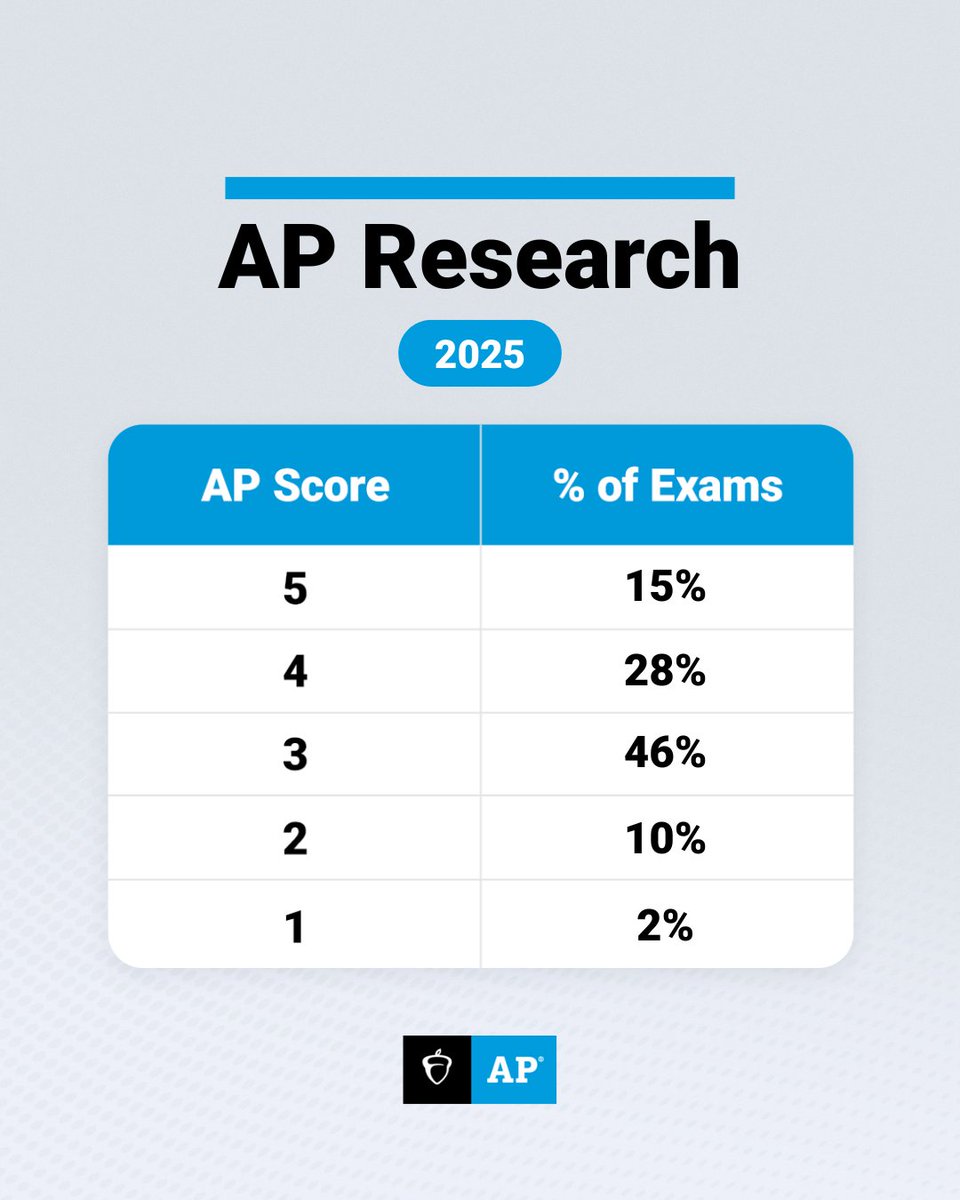
The 2025 AP Research scores:
5: 15%; 4: 28%; 3: 46%; 2: 10%; 1: 2%
Nearly 44,000 students submitted academic papers this year, up from 36,000 last year.
Here’s the percentage of this year’s academic papers that received the various scores on the 10-point scale the faculty use to score these sustained projects:
3%: 10 points
7%: 9 points
13%: 8 points
24%: 7 points
35%: 6 points
10%: 5 points
6%: 4 points
1%: 2 points
1%: 0-1 points
Animal training, an interactive moss wall, team collaboration based on birth order -- the topics students chose for their sustained research were wide ranging and frequently very interesting to the faculty who scored the academic papers.
All subjects’ AP score distributions for 2025 will be posted here when available: https://t.co/OrkaQhPZYO
It’s that time of year when AP Readers begin finishing the scoring of AP essays, portfolios, and free-response questions, so as the data roll in, I’ll post that info here. A few reminders follow.
I won’t know in advance the day when each subject will reach a critical mass of psychometrically confirmed scores, so I can’t provide a schedule of when I’ll post each subject. Because these score distributions include all students worldwide, individual classrooms will often have score distributions that are either higher or lower than this aggregation.
AP Exams aren’t scored on a curve. Rather, as many students as earn the points necessary for college credit receive a score of 3 or higher. Each AP Exam version (e.g. west coast vs east coast; digital vs paper) is separately equated so that regardless of which version you take, you receive a comparable score. More details on exam versions and equating: https://t.co/hHxkzezmOm
Student performance on equated questions from year to year enables psychometricians to determine whether this year’s students, overall, demonstrated stronger, weaker, or similar content/skill mastery in relation to prior years’ students.
These scores represent a critical mass of scored exams, but faculty will continue to score throughout June. So we don’t upload scores for educators and students to view until July when all subjects are complete. If you’re an AP student, here’s information about how to make sure you’re able to view your AP scores starting July 7. https://t.co/YiSc8q9IcY
Remember that you have until June 20 to indicate which college should receive your free score send. https://t.co/FXyxVHESJ0
If you’re an AP educator, here’s information about how to view your students’ AP scores starting July 7: https://t.co/uvid823lkh
After the remaining exams in each subject are scored between now and the end of June, the score distributions may slightly shift. We seek to serve a wide array of student interests by offering AP courses in 40 subjects. Students should resist pressure to take large numbers of AP classes.
Our research finds that taking just 1-2 APs per year optimizes a student’s readiness for college. Take more only if the subject matter truly interests. https://t.co/MMddTR4L9S
While we celebrate students who earn scores that qualify them to place out of a college course, AP scores, high or low, are not a verdict on academic potential, intellectual curiosity, or motivation to continue to learn and grow.
🔔 Reminder 🔔
If you are taking AP Seminar, AP Research, and/or AP Computer Science Principles, don't forget to submit your performance tasks by April 30 at 11:59 p.m. ET.
Attention educators! Explore how to integrate AP Seminar into your English 10 curriculum with our new implementation miniseries, now available at our English 10: AP Seminar Resource Library.
🎥 Discover more: https://t.co/iZDyX5YOHP
#AP_Conf brings together thousands of education professionals from the AP and Pre-AP communities. Here are some tips on how to make the most of this year’s gathering. 🙌
The 2024 AP Seminar scores:
5: 9%; 4: 20%; 3: 60%; 2: 10%; 1: 1%
All subjects’ AP score distributions for 2024 will be posted here when available: https://t.co/dGHdSrtbBF
The 2024 AP African American Studies scores:
5: 15%; 4: 30%; 3: 28%; 2: 19%; 1: 8%.
All subjects’ AP score distributions for 2024 will be posted here when available: https://t.co/zpj3T3VUab
Accordingly, this year’s students achieved a higher % of 3+ scores than prior groups. (Remember that this is the only AP subject taken primarily by 9th graders, so AP 1s are also more common in this subject than most others.)