We are the EMBARK lab at the University of Texas at Austin. We study eating-related methodology, behaviors and risk. Directed by Dr. Katherine Schaumberg
Congrats to Embark Lab graduate student @AggieLaboe for her acceptance to the UW Institute for Clinical and Translational Research TL1 program for her project: Human-centered Design of a Therapeutic Session to Discuss Expected Body Weights in Eating Disorder Treatment!
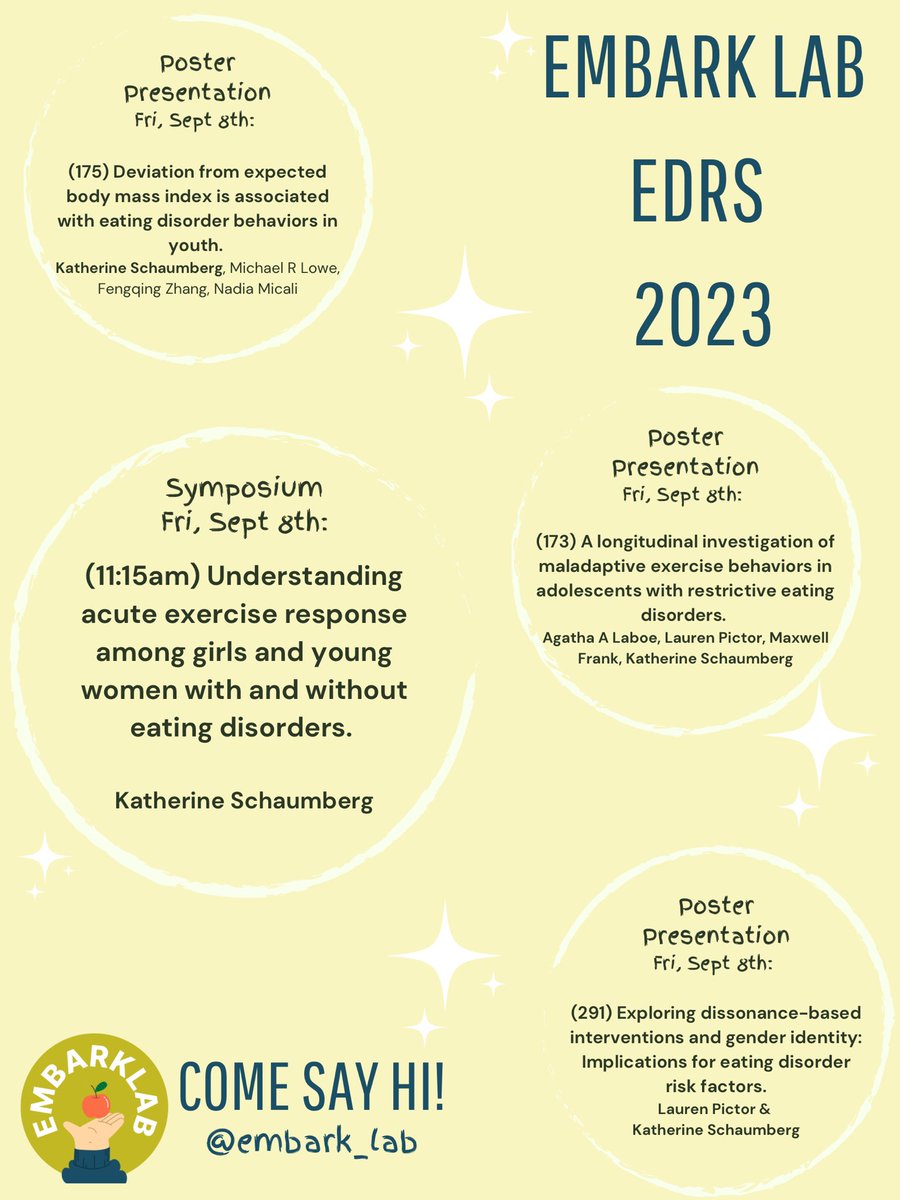
EMBARK Lab takes on #edrs2023 ! Feel free to stop by our poster presentations to chat and attend Dr. Schaumberg’s talk on the findings from our MAXED pilot study 🚴♀️🍎
First spring BAM session was a hit (check out our awesome facilitators!)💥 Missed out? Sign up for our next round of sessions happening March 28th and April 4th!
Congrats to our @EmbarkLab 2022 Shapiro Scholars Tess Meurer and Stephanie Pham for their top notch presentations on preliminary outcomes from the Body Advocacy Movement for Health Professionals and Multimodal Assessment of Exercise in Eating Disorders Studies!
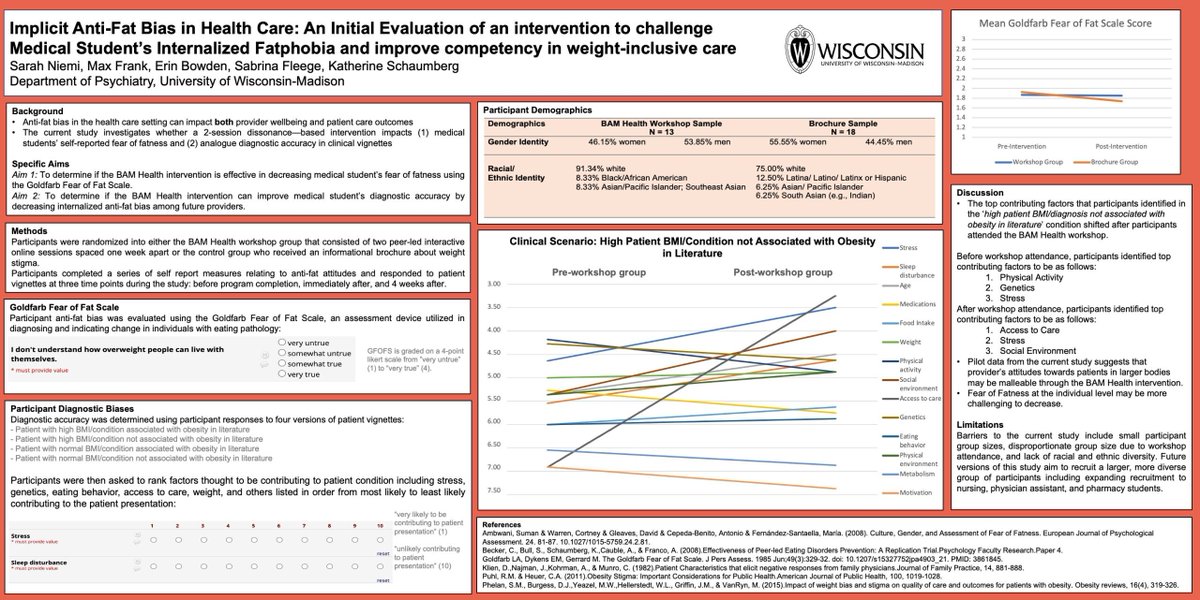
Congrats to the Embark Lab's own Sarah Niemi for her Top Scoring Trainee poster: Implicit Anti-Fat Bias in Health Care: An Initial Evaluation of an Intervention to Challenge Medical Student's Internalized Fatphobia and Improve Competency in Weight-Inclusive Care. Check it out!
Zickgraf et al. (2022) studied the association between eating disorders and food insecurity. In it they showed that college students with previous or current food insecurity were more likely to meet criteria for an eating disorder. Read more here https://t.co/JEGqYU2xhi.
Engel et al. examined whether the overestimation of tactile distances in anorexia nervosa and recovered individuals is influenced by non-perceptual factors and the role of allowed response time in tactile size estimation. Read more here: https://t.co/LuLoRjPPmO
Due to the overlap of intrusive thoughts as a form of symptomology in both eating disorders and obsessive-compulsive disorders, Kinkel-Ram et al. (2021) analyzed illness pathways of intrusive thoughts. Read more regarding this at https://t.co/2rVmAZko5W.
Systematic review by Baudine et al. shows multi-family therapy (MFT) is effective in treating anorexia nervosa as it leads to improved symptoms and weight gain and is associated with improvement in other individual and family factors. Read more here: https://t.co/5uHEZZuT2u
Godoy-Izquierdo et al. (2021) reviews the phenomena of exercise addiction and its relation to disordered eating within the context of competitive sports. Read more here https://t.co/g2HE5CpQ4R