What Emerald Arena actually is.
An onchain mining game on Robinhood Chain. 25 veins arranged in a 5x5 3D grid, every 60 seconds a round resolves.
How it works:
- Commit ETH to any vein(s) you think will strike, during the round
- At the 60-second mark, randomness selects exactly one winning vein
- Miners in that vein split 90% of the entire round's pot, proportional to their commit
- They also mint $EMRLD, the game's token, same proportional split
The randomness is checkable. No block-hash randomness, which any sequencer or miner could bias. Every round's draw is a cryptographic proof verifiable on Blockscout, generated outside the chain and verified inside the contract.`
$EMRLD is 100% mined. No premine, no VC round, no team allocation. The only way anyone gets $EMRLD is by winning rounds like everyone else. Emissions decay gently over time so early rounds mine more per ETH committed.
Where every round's pot goes:
- 90% to winning miners, in ETH
- 8% to veEMRLD lockers, in ETH
- 2% split between the jackpot and a growth fund that permanently burns $EMRLD it buys back
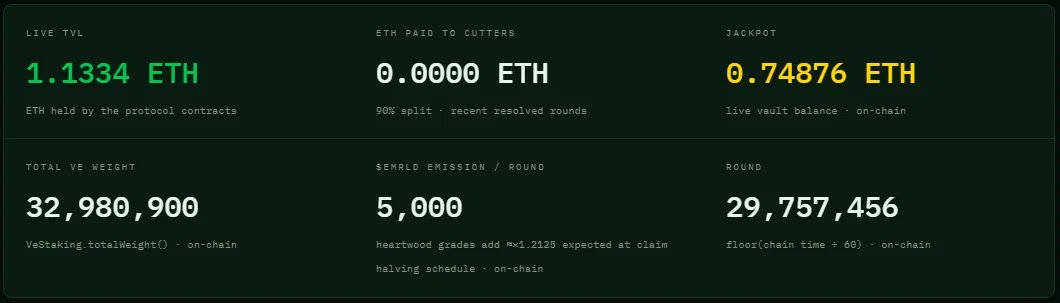
$EMRLD dashboard update, the forest keeps growing:
Jackpot has climbed to 0.74876 ETH, up from 0.64834 just yesterday.
Live TVL now sits at 1.1334 ETH held across the protocol contracts.
Total veEMRLD weight is up to 32,980,900, growing steadily as more positions lock.
Still 5,000 $EMRLD minted per round on the halving schedule, still 90% straight to the cutters who hit.
Keep chopping, every round nobody wins pushes that jackpot higher
https://t.co/fEZ4sXGlCa
Most on-chain mining games inflate their token supply forever.
Emerald Forest doesn't.
$EMRLD has a fixed supply of 1B tokens. There is no mint function. Rewards come from a finite vault funded at launch and replenished through buybacks—not perpetual inflation.
Every 60 seconds, players compete to fell a Great Tree. Winners split 90% of the ETH pot and earn $EMRLD, while veEMRLD stakers receive a share of every round's fees.
Fair launch. Locked LP. Immutable contracts. Verifiable randomness.
A fresh take on the GOLD/ORE/SLVR model.
Season I, Verdant Forest, has been live since round zero, and the emission schedule only gets steeper for early players.
It halves every single day, so whatever you're mining today is more than you'll ever mine again tomorrow.
There's also a capability sitting in the contracts for later.
If governance ever votes it in, future seasons could pay bonus yield on certain veins in actual Robinhood stock tokens, real tokenized equities on this chain.
Any asset used would have to come from the official registry, so there's no path for a fake token to sneak into a season.
How the Forest jackpot actually fires.
It's a separate ETH pot that grows on its own, fed by a share of every round's pot and a share of every taxed trade. Nothing happens to it except growing, until it pays out.
Two things can trigger a payout, and both are built to be untouchable by anyone:
- A threshold trigger, once the balance crosses a set cap, a jackpot round fires automatically
- A random trigger, every resolved round carries a small VRF-drawn chance of going jackpot on its own
Nobody, including the team, can just flip a switch and fire it manually.
When it hits, the entire accumulated balance pays out on top of the normal round pot, straight to the miners on the winning vein, split the exact same proportional way as any other round.
Where trading tax actually goes: what other protocols do, and what Forest does.
Some protocols route trading tax entirely to a single destination, the jackpot pool, so lockers see nothing from actual trading volume, only from mining activity.
Forest splits trading tax four ways: 30% to veEMRLD lockers directly, 30% to the jackpot, 30% to the treasury, and 10% recycled into buybacks that refill the rewards vault. Open-market trading pays lockers the same as mining does, not just one or the other.
More sources of yield, not fewer.
Emerald Forest is the first protocol where you can buy someone else's staking position.
Lock $EMRLD and you mint a veEMRLD NFT, a transferable ERC-721 that represents your entire staking position.
Instead of waiting for your lock to expire or paying an early-unlock penalty, you can simply sell the NFT.
The buyer acquires the future yield.
The seller keeps every ETH reward earned up to the moment of sale.
Everything settles atomically on-chain.
The result is something entirely new: a secondary market for staking positions.
Lock duration = higher rewards
• 1 hour → 1.00×
• 24 hours → 1.41×
• 84 hours → 2.49×
• 168 hours (max) → 4.00×
Every veNFT earns real ETH from protocol activity:
• 7% of every mining pot
• 30% of all trading-tax revenue
No token emissions. No inflation.
And because the NFT is transferable, it has value beyond the yield itself.
You can:
• Hold it and collect ETH.
• Sell your position without unlocking.
• Buy discounted yield streams from other players.
• Accumulate governance by acquiring veNFTs on the open market.
This isn't just staking.
It's a market for staking positions.
Available today on https://t.co/Ha9mrcdAX3.
Current floor: $560 USDG per NFT
The forest is 1 day old.
$EMRLD stats so far
- Jackpot(motherlode) has exceeded 0.64ETH($1200) !
- Over 3% has been staked
Make sure to start chopping your trees in the forest for a chance to hit the jackpot !
You may chop trees with as little as 0.0002ETH
1.75 ETH in tax revenue has already been distributed on-chain: 30% to veEMRLD stakers, 30% to the jackpot, 10% to buybacks.
Again, the jackpot sits at 0.65 ETH and grows every round that nobody wins.
12 veNFTs Minted. 30.6M $EMRLD locked.
Real ETH yield. No token emissions. No inflation.
https://t.co/Ha9mrcdAX3
How to lock $EMRLD and get your veNFT, step by step.
1. Head to the Grove, that's where locking happens.
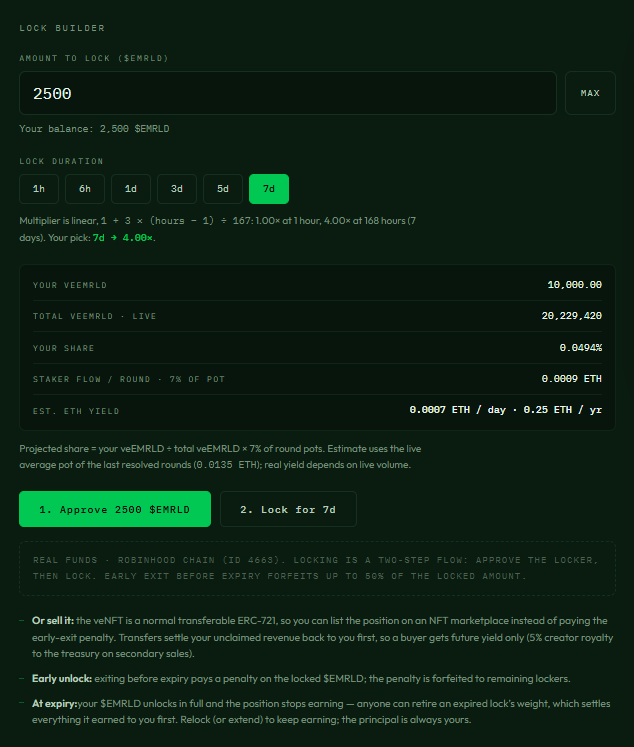
2. Choose your lock length, anywhere from 1 hour to 7 days. The longer you lock, the higher your multiplier, scaling linearly from 1x at one hour up to 4x at the full 7 days.
3. Commit your $EMRLD to the lock. Your tokens get escrowed for the length you chose.
4. Receive your veNFT. This is your position, a real ERC-721 that represents the locked $EMRLD, its multiplier, and its unlock time, all readable directly from the contract.
5. Start earning immediately. Your position's weight starts drawing its share right away: 7% of every 60-second round pot, plus 30% of all trading tax, both paid in ETH.
6. Claim anytime. Collect your earned ETH with one click, as often as you like, no need to wait for the lock to expire.
7. At expiry, withdraw your full principal, or sell the veNFT anytime before that on the open market and skip the early-unlock penalty entirely.
Locking $EMRLD: what other protocols do, and what Forest does differently.
Other protocols lock your tokens in a non-transferable position. Committed for the full duration, no exit, no market, just wait it out.
Forest mints you a real, tradeable veNFT instead. List it on the open market anytime, and the buyer takes over your position, the locked tokens, the multiplier, and the yield still owed.
That means your locked $EMRLD is never actually stuck. Need out early? Sell the position instead of eating a penalty for nothing. Think yield's about to climb? Buy someone else's position instead of locking your own.
Full walkthrough of the Forest: picking a tree, committing, and watching the fall.
Pick your tree (or several), commit ETH, and at the 60-second mark verifiable randomness fells exactly one. Land on it and you claim your pro-rata share of 90% of the pot in ETH, plus your $EMRLD draw multiplied by your heartwood grade.
Every round also feeds the jackpot. It grows with a share of every pot and every taxed trade, then pays its entire balance into a single round, on top of the normal pot. Two triggers, both tamper-resistant: a threshold cap or a 1-in-500 random draw. Nobody, including the team, can fire it manually.
The EMRLD Forest reward system is brutally simple
Every round, 90% of the entire ETH pot goes back to the winning miners.
Your payout is proportional to your commitment:
(Your commit ÷ Total commits on the winning tree) × 90% of the ETH pot
On top of that, winners also receive their share of the round's $EMRLD rewards, multiplied by their Heartwood grade (×1–×3).
If your tree stands, your commitment is consumed. That's exactly what funds the winners.
The remaining pot is distributed transparently:
- 90% -> Winning miners
- 7% -> veEMRLD NFT stakers: https://t.co/8RGGCj7hjL
- 2% -> Jackpot & Growth Fund
- 1% -> Protocol treasury
No hidden emissions. No opaque reward model.
The losers fund the winners. The fee split is fixed. Everything is on-chain.
Pow protocol + Stonk Brokers had a baby = $EMRLD
Lock your tokens and you get a veNFT back, listed live on OpenSea:
https://t.co/G8uH5XcNm7
You can buy and sell the veNFTs depending on if you think yield will go up or down, up to your discretion
That NFT is your exit route. Sell it anytime and skip the early-unlock penalty entirely, the buyer takes over your position: the locked tokens, the multiplier, and the yield still owed on it.
It works the other way too. If you think future yield is heading up, buy someone else's position instead of locking your own.
You're not just buying tokens, you're buying a live share of 7% of every round's pot plus 30% of all trading tax, both paid in ETH.
You don't have to lock $EMRLD to earn from it. You can just buy someone's position, and it pays you.
Every lock is an NFT, so it trades on the open market. Buy one and the ETH it earns is yours from that moment: 7% of every 60-second round pot plus 30% of all trading tax, paid to whoever holds the token.
What you're actually buying:
- The locked $EMRLD itself, real tokens, yours to withdraw when the lock expires
- The ETH it earns until then, its weight keeps drawing staker flow the whole time, claimable anytime with one click
A worked example: a position holds 10,000 $EMRLD, locked at 4.00x weight, 3 days left. List it under what those 10,000 tokens are worth on the market, and you're buying at a discount plus getting paid ETH for the 3 days you wait. List it above, and you're paying a premium for the yield.
fair price ≈ (locked $EMRLD × token price) + (ETH you expect to earn before it expires)
Before you buy, check three things: is it still locked (expired positions earn nothing), how much is locked and at what weight, and what the forest is actually doing (ETH is real revenue, a quiet day pays little).
How locking $EMRLD actually pays you.
Lock $EMRLD for 1 hour to 7 days, get a veNFT back. Longer lock, higher multiplier, scaling linearly from 1x at one hour to 4x at the full 7 days.
What lockers earn:
- 7% of every round's pot, in ETH, streamed pro-rata to multiplier-weighted lock size
- 30% of all trading-tax revenue, in ETH, so open-market volume feeds lockers too, not just mining activity
- Governance weight, votes on season rotation and protocol parameters
The veNFT is a real, tradeable ERC-721. Sell your position anytime on any NFT marketplace and skip the early-unlock penalty entirely, buyer takes over the weight, the yield, and the governance vote. Every transfer settles unclaimed revenue back to the seller first, so nobody can snipe it.
Exit early without selling and there's a real cost: up to 50% of the locked amount, scaling down to zero as you approach expiry. That forfeited $EMRLD goes to the lockers who stayed.