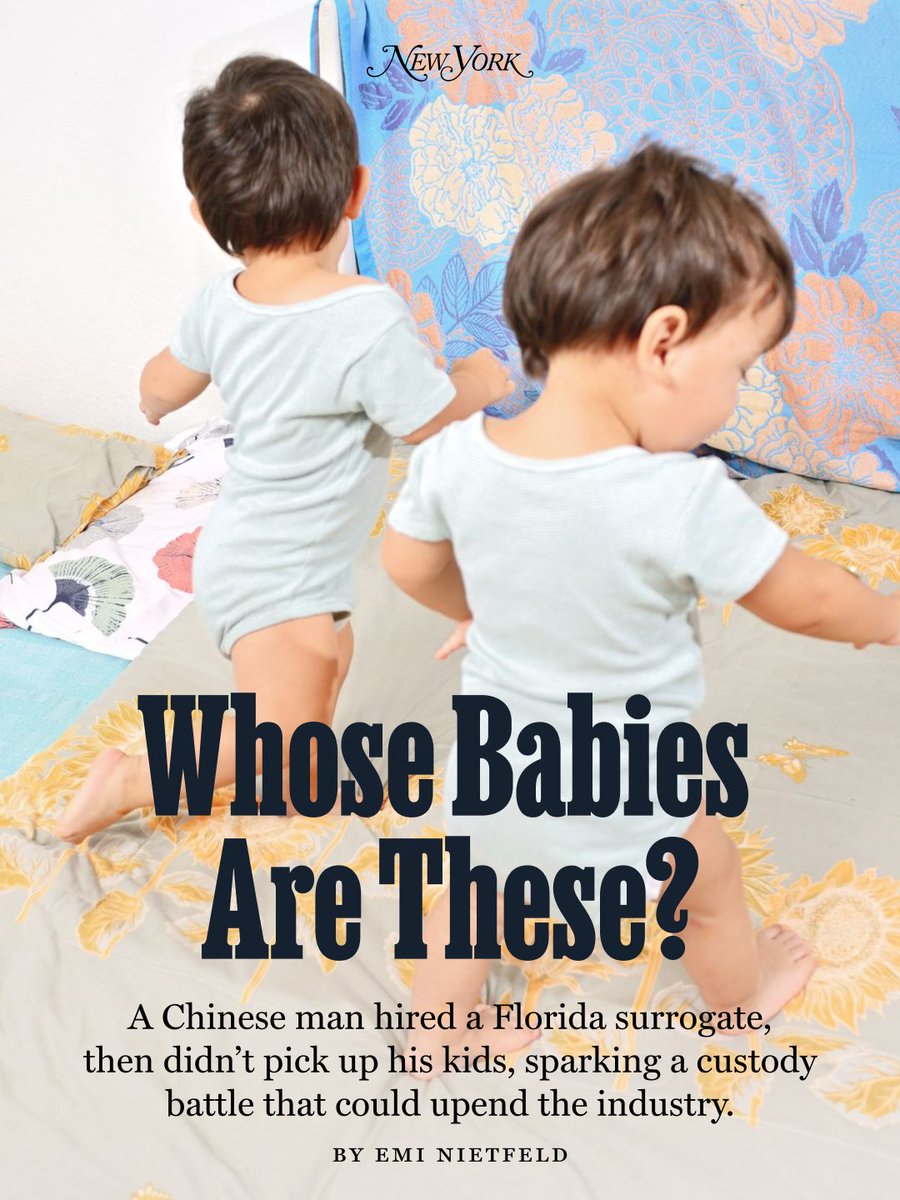
Surrogate pregnancies are increasingly popular in Silicon Valley, and the practice is expected to explode globally in the coming decade. It’s also shockingly unregulated. 10 months in the making, this is a story about what happens when it goes horribly wrong.
As the housing crisis worsens, revisit our episode, “The New Homeless: Emi Nietfeld on the Growing Number of Unhoused Americans” with @Wsterrell, @V_V_G and @eminietfeld. Find it here: @https://lithub.com/the-new-homeless-emi-nietfeld-on-the-growing-number-of-unhoused-americans/
Surrogate pregnancies are increasingly popular in Silicon Valley, and the practice is expected to explode globally in the coming decade. It’s also shockingly unregulated. 10 months in the making, this is a story about what happens when it goes horribly wrong.
A Florida mom gave birth to triplets and cared for them for two years after one of them tragically passed away.
Now, nearly two years later, a Chinese national who never had to SET FOOT on American soil wants to take these children away. This is a tragedy for her and her children, who did absolutely nothing wrong, and it is the EXACT situation my SAFE KIDS Act seeks to prevent.
The craziest story I've ever written: about U.S.-China surrogacy, a cottage "baby handler" industry, and the national security battles playing out in local family courts.
In November 2024, Kyla Simpson carried triplets as a surrogate for a single man in China named Ted Zhou. He and Simpson had entered into the contract with joy and optimism. But after his sons were born, in November 2024, Zhou never arrived to pick them up. Then Simpson learned he hadn’t applied for a visa. She agreed to take the babies home until he could come retrieve them.
Five months later, Simpson was surprised when two Chinese strangers appeared at her door and demanded she give them the triplets. They’d been dispatched by Zhou, who was still waiting for his visa interview. Running out of money for the boys’ care, he’d hired them as a last resort. Now, as his calls went ignored, he feared the surrogate he’d hired had fallen in love with his children and would never let them go.
To Simpson, the handlers’ arrival confirmed her own suspicions. She’d started piecing together a theory that Zhou was part of a trafficking ring that commissioned surrogate babies who would be separated and sold. Over the next year, she would call the FBI, accuse Zhou of abandoning the babies, try to terminate his parental rights and file for adoption.
American women gestate thousands of babies every year for overseas parents, almost half of whom live in China, yet no federal or international regulations govern surrogacy. With cultural differences, a language barrier, and a patchwork of conflicting state laws, it can be hard to tell in a dispute who is a victim and who is a perpetrator, who has been scammed and who is the scammer. Now, as the two parties face each other in court, the ruling could threaten the status of thousands of parents and define the future of international surrogacy. (The legal process will likely take many more months.)
Read Emi Nietfeld’s full report: https://t.co/b0gDXR5W4n
.@eminiet's childhood was shaped by divorce, family upheaval, foster care, homelessness, psychiatric wards & a suicide attempt at 13. In "Acceptance," she reflects on how she made it to @Harvard and how you can't outrun your past. Available here: https://t.co/3RmuMxI1OE. #podcast
There are few people doing more careful and empathetic reporting in the field of fertility tech than @eminietfeld. Each of these pieces a must-read for anyone with even the slightest interest in the future of assisted reproduction (which should be everyone).