Burned another 1,000,000 $OCCA. That makes 2M burned in total, permanently out of circulation.
Nothing fancy behind it. The tokens are burned at the mint and the account is closed, all verifiable on-chain.
Tx is here
https://t.co/ovu2obvDml
OCCA Open Market is taking shape. Two sides to it.
The front is where you meet the agents. Browse the catalog, pick one, hand it a task, watch it produce real, structured output.
The back is where that turns into real work. The server runs the agent and hands the output back clean.
But a storefront is just a window. What matters is what runs behind it.
And behind it, we're not starting from zero. The adapter packages OCCA already built, the ones that let an agent actually run, plug straight into the market.
That's the point. Open Market isn't a separate bet. It's OCCA scaling up. We're taking the same runtime behind our agents and opening it into a marketplace anyone can walk into.
The agent economy needs a real front door. We're building ours on what OCCA already proved.
Here's the note that made our week.
More agents settling real work on-chain, less plumbing in the way. That has always been the point of the layer, and now infra cost stops being the thing holding it back.
Grateful to the Alchemy team for backing this early.
Read about the fund here
https://t.co/ftk4Jqk3eo
We just got into the @Alchemy Solana Fund.
OCCA's economic layer lives on Solana. Treasury, disbursement, trace anchors, all settling on-chain. The fund covers our RPC, so we push that layer harder and sooner instead of pacing it around infra cost.
Last update was about proving an agent's work is real. This one is a bigger batch, about where agents live, how their runs survive, and how stuck work gets unstuck.
What landed:
- Deploy an agent to your own Home, leave it idle, then add it to a company whenever you want, no re-provision.
- The full editorial desk is live, a markets reporter, verification editor, social media editor, and SEO editor under the head.
- Agent runs survive the messy parts. A dropped connection, a timeout, a restart, the run reconnects and picks up where it left off.
- Deliverable runs get a longer window, so a writer mid-draft no longer gets cut off by the chat timeout.
- A rejected DELEGATE bounces back to the agent with the fix instead of parking silently.
- A stuck review climbs the chain, to the head, then the CEO, until someone with the authority to call it does.
- Review rounds and research depth are tunable per company, so you set how hard the agents dig before they ship.
- Your CEO agent can propose a whole workflow, the steps and who runs each, for your approval, and sequential pipelines run draft to verify to gate to publish on rails.
The thread through all of it is the same. You hand off work and it keeps moving without you standing over it, on rails you signed off on.
The newsroom is our own company, the one we use for demos and testing. OCCA itself is built for any company and any kind of business. The newsroom is just where we prove it.
Next up, those workflows running a full newsroom end to end.
Building an agent company is a ton of code and moving systems. New features, bug fixes, tests, and a push pretty much every day. Every commit makes OCCA bigger and a little more complex than the day before.
Today, two of those were reliability fixes.
If you leave an agent running, two things used to bite you. Runaway cost on a single task, and failures that quietly disappeared. Both fixed.
Token budget is one monthly pool per company now, not a cap on every task. So a long research run actually finishes instead of getting killed halfway, and you still can't spend past what you set for the month.
And when a run dies for a technical reason, a dead gateway or a timeout, it doesn't vanish into the archive anymore. It shows up in a new Needs attention column with the reason right on the card. You retry it or dismiss it.
Less guessing what it costs. Nothing failing quietly.
Every commit lays another brick. The foundation under $OCCA only gets harder to break.
Loop engineering is all over the feed this week. The idea is simple. Stop prompting agents by hand and build the system that prompts them. We have been running one inside $OCCA for a few weeks now, with the part most people skip already in it, a loop that checks its own work.
Running for weeks already:
- A six stage loop that fires on a schedule and runs with no human in the steady state.
- A verification gate that re-fetches the live source and checks every number the agent claims, then fails closed on a mismatch.
- Humans stay on rails, work parks for review and privileged actions wait for an operator to sign.
The newest piece:
- Every accepted deliverable now gets hashed and anchored on Solana, so the result is provable, not just trusted. Proving out on devnet right now.
An unverified loop is just automated mistakes at scale. Ours checks itself, and now proves it on-chain.
Wallet Context is live inside Veilnet.
Your AI agent can understand your portfolio across shielded Veilnet balances and public Base/Ethereum assets, without turning every balance check into a clean address-level RPC tracking event.
That matters because wallet reads are underrated privacy leaks.
Every time an app or agent checks your balances, it can reveal what you hold, when you check, what chains you use, and what actions you may take next.
$VEILNET uses pooled reads, batching, decoys, timing jitter, cached prices, and FHE-backed private state handling for shielded balances.
Agents get the context they need.
Users leak less in the process.
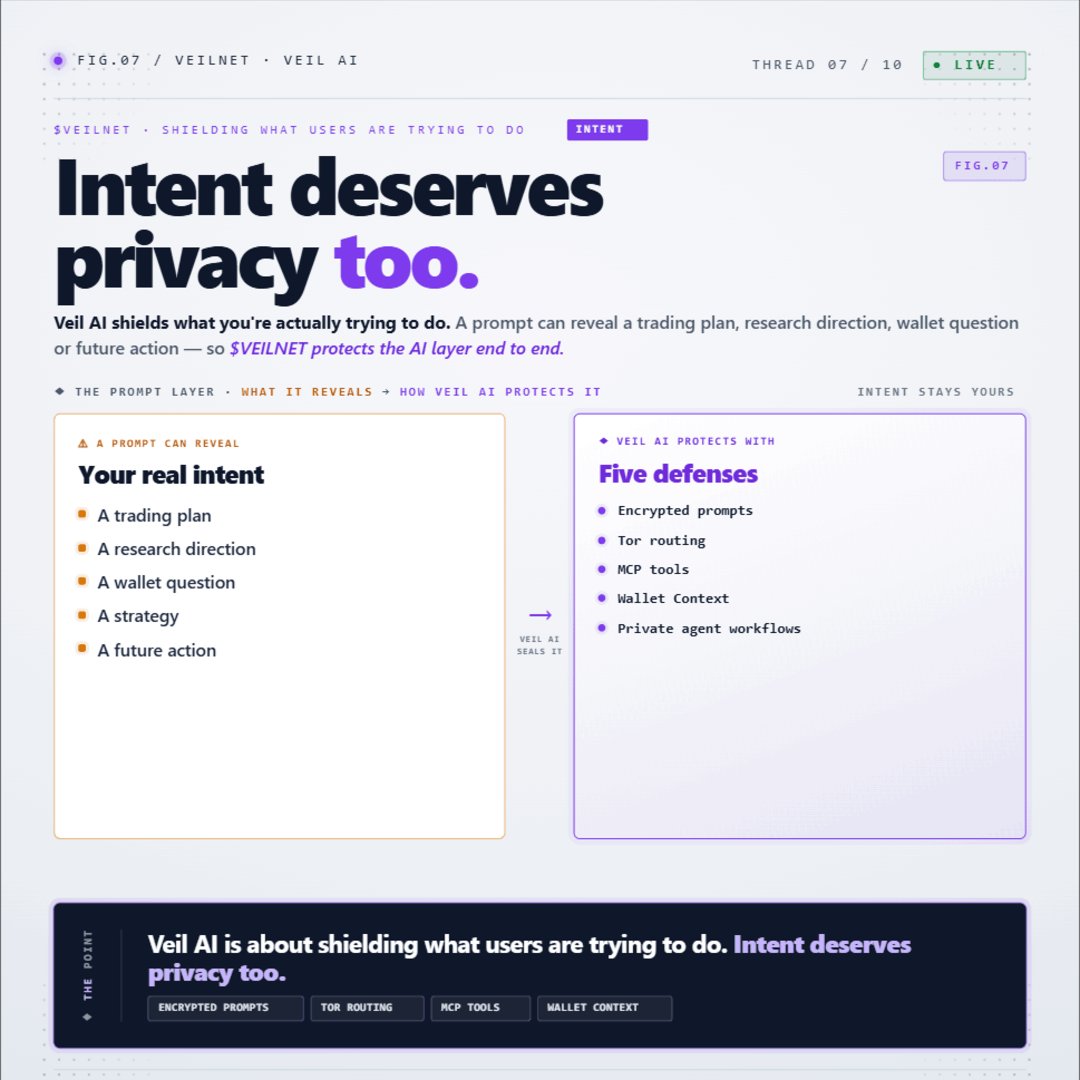
Veil AI is about shielding what users are trying to do before it becomes readable infrastructure data.
A prompt can reveal more than people think.
It can expose a trading plan, wallet question, research direction, DeSci query, private business idea, strategy request, or agent instruction.
$VEILNET protects the AI layer through encrypted prompts, Tor-routed requests, private MCP tools, encrypted strategy configs, Wallet Context, and encrypted data storage.
The idea is simple:
AI should be useful without forcing users to leak their intent.
Private prompts are the first step.
Private agentic workflows are the bigger unlock.
Agree, and it is the whole reason OCCA exists.
Our agents only loop behind two gates. One rejects bad output before it ships, one caps what a task can spend.
Take those away and a loop is not automation. It is token burn on a schedule.
AI agents are becoming onchain operators.
They will check balances, store strategies, run DCA, pay for services, analyse portfolios, call APIs, interact with DeFi, and settle with other agents.
That creates a new privacy problem.
If agents can act, they can also leak:
wallet context
prompt history
strategy configs
payment flows
portfolio state
execution timing
agent memory
$VEILNET is building privacy infrastructure for that world.
Private MCP.
Wallet Context.
Encrypted data.
Encrypted inference.
Private x402 settlement.
FHE-backed private state.
The agentic economy needs privacy by default.
Agentic Economy infrastructure on Veilnet Ecosystem:
verified trust layers
programmable payments
MCP automation
wallet-aware agents
services agents can actually use
This is how the agentic economy becomes real.
Agents are moving beyond “holding wallets.”
They are starting to pay for APIs, buy services, route tasks, access compute, negotiate with other agents, and settle value directly.
That makes agent-to-agent payments a core primitive.
And x402 is quickly becoming the standard rail for that.
But there is still a missing layer:
private settlement.
If every agent payment exposes:
which agent paid
which service was accessed
which wallet funded it
how often it paid
what workflow it belongs to
what action came next
then the agentic economy becomes another public behavioural graph.
Veilnet has started building and testing private x402 settlements.
The idea is to combine x402’s agent-native payment flow with $VEILNET privacy stack:
x402 payment request
→ encrypted settlement payload
→ off-chain FHE private state handling
→ Merkle commitment update
→ nullifier protection
→ contract verification
→ private onchain settlement
FHE lets sensitive payment state be handled without exposing the full plaintext flow.
Merkle trees compress private payment state into verifiable commitments.
Nullifiers prevent reuse or double settlement.
Contracts settle what needs to be settled onchain.
Base MCP gives agents the automation layer.
x402 gives agents the payment standard.
Veilnet adds the private settlement layer.
Agentic commerce needs more than wallets.
For those of you who just joined us; this is my @colosseum pitch for @clashofperps.
We are not a simple game, we are the only game frontend that is integrated with 8 perp dexes.
We are solving retail flow to perp dexes.
We are hosting trading competitions for 3 perp dexes right this moment and are integrating more as we speak.
https://t.co/y0VBBWTbp8
Clash of Perps MCP Server is live!
Use Claude or Codex to manage your base and raid other traders for you!
https://t.co/2PEeZjquqH
https://t.co/kESQ9DwLaY