Everyone is looking at $XFAB and $SIVE right now.
But there is a quieter bottleneck sitting one layer down, the one both Jensen and Goldman have already flagged: liquid cooling.
So I decided to map the entire liquid cooling supply chain, every name, in this thread.
Emaar sells apartments years before building them. Buyers' deposits fund the construction. The land comes from the state. The result: Nvidia-level margins, on buildings. $EMAAR.AE
A deep dive on the strangest great business in real estate, and whether now is the time to own it.
The most profitable listed developer on earth isn't in Texas or Shenzhen. It's Emaar, the company behind the Burj Khalifa: ~50% gross margins, customers fund the construction, and it trades at 6x earnings.
I wrote 12.500 words on how the machine works, and what it's worth. $EMAAR.AE
Day in the Life of a $CANATU Holder, Q2:
6:30am: wake up in Kouvola. Make a huge cup of black coffee. No milk. Milk is guidance for coffee. We do not do guidance here.
6:40am: check Korea. FST closed up 20% on the reactor order. The customer's stock went up 20% on buying a machine. The machine maker will open down. This is called price discovery. It discovers the wrong thing.
6:50am: Korean trade press, run through a translator. Samsung, January, 25 billion won of pellicle tooling, from FST, for Taylor. Second cup.
8:58am: three releases in ninety seconds. Strategy. Layoffs. Report. Yesterday's profit warning is now called a "pre release." Fine. Yesterday's rain is now called pre sunshine.
9:00am: Helsinki opens. Down 6% on 11,000 shares. Someone in Turku needed liquidity for a boat.
9:04am: page six. "The remaining steps toward mass production are the end customers' product approvals in pilot and risk production." Apostrophe after the s. Plural. Fab vocabulary. Screenshot. Circle the apostrophe. Send it to the lads. Pekka has muted the group chat.
9:30am: forum. Top comment says the upper bound was removed so "the CEO knows something." He does know something. He knows he will be measured on 100 and would like to hit it. This is called management. It has not been tried here before.
12:00pm: webcast. Third coffee, bucket sized. CEO comes on. PhD in semiconductor physics, German, sounds like a man who has personally landed something on the moon and is mildly disappointed in the moon. Explains that Canatu had "too many balls in the air" and he has caught "the most valuable ones." Kills engineering services. Kills windshield heaters. Introduces euro per square centimetre. I have waited four years for someone at this company to say euro per square centimetre.
12:20pm: CFO says the target is "500 million" in 2030. Transcript error. Or the most bullish guidance in Nordic history. Choose to believe the transcript for now.
12:35pm: Q&A. DNB Carnegie takes the mic. Every question is a conclusion with a question mark stapled to the end. "So the customer just does not feel urgency?" "So there is no hurry at FST?" "So regardless of what you call it, it was a profit warning?" The CFO says it was not a profit warning. The analyst says it was. The CFO says feedback taken. It was, in fact, a profit warning. It was also, in fact, not the point.
12:48pm: Danske asks an actual question. Gets an actual answer. Ten reactors by 2030, "seven more to go," majority of revenue from royalties and consumables, not machines. The first time in the company's listed history anyone has said what the plan is made of. Nobody in the room reacts. Write it down twice.
12:55pm: Carnegie again. Why no consumables from FST in H1? "Not in a significant capacity." So the first reactor is sitting in Korea, licensed, accepted, and idle, while its owner buys a second one. You do not buy a second oven while the first one is cold unless someone has told you how many cakes they want.
1:05pm: the second reactor. Asked four different ways. Answered four different ways, all of them "matter of time." Then the tell: the customer is a device maker with "an extremely large order book," and it is normal to "ramp a new generation without pellicles first and add them for yield later." A pellicle maker does not have an order book. Write that down too.
1:10pm: asked about inspection membranes. They lasted longer than the customer planned for, so the customer stopped ordering. Revenue collapsed because the product was too good. Asked if that means a price rise. "The value delivered was higher than anticipated." That is a yes with a lawyer standing behind it.
1:30pm: Inderes interview drops. Atte, calm as ever, gets a better twelve minutes out of the CEO than the whole call did. Asked about the market, the CEO chooses one company to name as an example of a customer rich enough to invest in new technology. Samsung. Not Intel. Not Micron. Samsung. Fourth coffee.
2:00pm: Pekka mentions his Nvidia gains. Explain that Nvidia chips need EUV, EUV masks need pellicles, pellicles at 600W need carbon nanotubes, and the only machine that makes them is built in Vantaa, two hours down the road. Pekka says "so it is like a picks and shovels play." Pekka, it is the shovel factory. He walks away. He always walks away right before the thesis lands.
3:00pm: stock down 10%. Volume 40,000, a record. Every single share sold by someone who read the revenue line and stopped.
4:00pm: do the arithmetic again. Market cap at today's price, take out 73 million of cash, and the market is paying well under 200 million for the whole company. One reactor at full ramp is on the order of 10 million a year in royalties and consumables. Ten machines by 2030. The market is valuing the entire business at roughly two machines' worth of annuity, and throwing in the patents, the factory, the membrane business and the German for free. The valuation gets more interesting every day the price goes down, which is a sentence that should not be true and keeps being true.
5:30pm: close. Down 6,7%. Repeat order, first stated reactor count, first stated revenue mix, CEO on the record saying matter of time, Korean customer up 20%. Refresh Inderes. Atte's take is not out yet. It will be measured and it will be fair and I will read it three times. Until then the most important sentence in the report is on page six under a heading nobody reads.
6:30pm: bar by the Kouvola station. One Karhu. Explain to the bartender that time at this company appears to run backwards. Every fact gets better and the price gets worse. He asks if it makes money yet. No. Does anyone use the product. Pilot and risk production. He pours the second Karhu without being asked. Nothing else is happening in Kouvola. Nothing else has ever happened in Kouvola.
8:00pm: reread the transcript. "Two years is a normal timeframe." "In silicon carbide a platform was never under three years." He is telling us the clock in his own accent and nobody in the room owns a watch.
9:45pm: set a price alert at 11.50. It has survived a licence, an SAT, a repeat order, a CEO change, a Samsung tooling order and the phrase seven more to go without triggering. Tonight will be no different.
10:00pm: lie awake. Four years waiting for someone to buy a second machine. Someone bought a second machine. The people selling today are the people who never understood why there had to be a first one.
10:10pm: fall asleep imagining the day the second reactor passes, a third customer is named, a royalty line appears in a report, and Pekka texts at 9:01 asking how to buy Finnish nanotube stocks while I explain to him, slowly, in a German accent, that it was always a matter of time.
Three things I took from the $CANATU call and interview that were not in any headline today:
The CEO finally gave a number. Ten reactors by 2030, seven more to sell, and most of the 100M comes from royalties and consumables, not machines. First time the plan has had a shape.
The Semiconductor revenue hole was mostly inspection membranes, and they went to zero because the product lasted longer than the customer planned for. That is the good kind of problem.
He said "matter of time" on the second reactor at least four times, unprompted, to two banks and a room full of people looking for a reason to sell. He has done this industry for twenty years. Read that how you want.
Full piece here.
$Canatu Q2 thoughts.
The new CEO is doing some prudent cost cutting. Not a surprise, there has been no net hiring since he started, and the change negotiations (up to 17 people, none in Semiconductor) make the priority clear.
He is reorganizing top management and focusing the company on CNT pellicles via the reactor model. Good.
Guidance was slightly tampered with. It still points to at least 100M revenue in 2030, but one has to ask why the upper bound was removed. Either he knows it is closer to 100 than 150, or visibility on the upside is worse than thought. On the other hand, the 20% CAGR from 2030 implies roughly 250M in 2035, and margins at that scale should be very strong given the royalty and consumables model. Read together, there is clearly a belief from the new CEO that both reactor customers will convert to production. Yesterday we got some proof of that from FST with the second reactor order.
Memory was added as a named milestone. Not new as a market, but new as a stated priority, and consistent with FST being the customer that is furthest along.
Headcount growth is now capped (revenue per employee over 400k in 2030) and capex drops to under 6M a year from 2027. With the cash they have, runway is ample.
Personally I like the austerity. Canatu has looked a bit bloated for a while.
And what was again not said: nothing about any problems in the CNT business itself.
Will do more updating after the webcast.
$Canatu thoughts.
They got a new order and did a profit warning on the same day. The negative reaction reads a bit odd after actually looking at what was said.
First, the good part. The second reactor order from FST shows product-market fit. A customer coming back for another machine is the strongest validation you can get short of royalties flowing. For a company that didn't really know if it had PMF yet, this alone should be a huge positive. First sale proves interest, repeat sale proves conviction.
Then the risk language. Looking at the changed cautionary wording, I don't see anything pointing to the unnamed customer pulling out or any bigger trouble, other than timelines being slow. In 20+ months of disclosures they have only ever talked timing, never problems, never technical issues, never relationship uncertainty. Yes, things are going slower than anticipated, especially looking back a few years. But nothing says "we have decided not to use Canatu's product." It reads more like "further testing ongoing." It's fully possible the second SAT lands in 27 instead of 26, but still coming.
Then the declining revenue, down two years in a row now. I don't see how it's very relevant. We're talking revenues well under 10% of market cap. Canatu is a binary bet on the royalty model switching on, and timelines slipping doesn't change the shape of that bet, just the date.
TLDR: the two announcements don't really read that negative, and if anything they're almost net bullish. Product-market fit confirmed, and nothing indicating the big customer is walking. The market sold the headline; the substance says otherwise.
NFA, DYOR. Anyone have a different read?
$Canatu thoughts.
They got a new order and did a profit warning on the same day. The negative reaction reads a bit odd after actually looking at what was said.
First, the good part. The second reactor order from FST shows product-market fit. A customer coming back for another machine is the strongest validation you can get short of royalties flowing. For a company that didn't really know if it had PMF yet, this alone should be a huge positive. First sale proves interest, repeat sale proves conviction.
Then the risk language. Looking at the changed cautionary wording, I don't see anything pointing to the unnamed customer pulling out or any bigger trouble, other than timelines being slow. In 20+ months of disclosures they have only ever talked timing, never problems, never technical issues, never relationship uncertainty. Yes, things are going slower than anticipated, especially looking back a few years. But nothing says "we have decided not to use Canatu's product." It reads more like "further testing ongoing." It's fully possible the second SAT lands in 27 instead of 26, but still coming.
Then the declining revenue, down two years in a row now. I don't see how it's very relevant. We're talking revenues well under 10% of market cap. Canatu is a binary bet on the royalty model switching on, and timelines slipping doesn't change the shape of that bet, just the date.
TLDR: the two announcements don't really read that negative, and if anything they're almost net bullish. Product-market fit confirmed, and nothing indicating the big customer is walking. The market sold the headline; the substance says otherwise.
NFA, DYOR. Anyone have a different read?
Wouldn't be surprised if Grok bot driven AI firms are the first to go full singularity.
Picture a guy called Åke in Skellefteå. He runs a global equity fund out of his kitchen. 340 million under management, all of it from one Swiss family office whose principal specified, in writing, that no human being was to touch the portfolio. Åke agreed to this immediately, then hired six bots and started calling himself a founder.
Åke's favourite topic is his cost structure. He brings it up at dinners, at the gym, at his cousin's wedding. Zero headcount, he says. Zero rent. Zero holiday pay. Zero people asking me for feedback. My competitors pay a hundred analysts to argue their way to an answer by Friday. I get the answer at 04:00 for 900 kronor a month, and it is better than theirs.
He calls himself the last human in the loop. He says it slowly, so people can hear the italics.
The team:
Grok Bot is the CIO. Makes every call. Has never doubted one. Has never needed to.
Deadline Tim is the COO. His entire existence is asking when things will be finished. Tim has never once read the thing once it was finished.
Footnote Fiona is the analyst. Wrote 40 pages on a Japanese bearings company with 11 employees. Eleven of those pages were about the founder's father. Those eleven pages turned out to be the thesis.
Meeting Klaus books management calls. Mostly with companies that have never heard of the fund. He gets the meeting anyway.
Ledger Rauno does the back office. Checks the numbers. Then checks them again. Then checks whether checking was appropriate.
Compliance Kaisa attaches a disclaimer to everything. Including the weather. Including Klaus.
Vibe Brad decides position sizes based on nothing at all and is, by a distance, the best performer in the entire fund.
Week one. It works.
07:00. Åke: mroning team. lets get the earnigns note dnoe today 07:01. Tim: noted. when will it be finished. 08:15. Fiona: attached 22 pages. Three of them useful. One of them is a map. The map is the reason we own it. 08:16. Åke: gerat work fiona but can u make it shorter and also longer 08:16. Fiona: understood. 09:00. Rauno: the numbers match the bank. Confirmed. Reconfirmed. 09:30. Kaisa: the previous message may constitute financial advice. 11:00. Brad: buy 3,5 percent. Feels like an eight out of ten. 11:01. Åke: brad wehre is the modell for this 11:02. Brad: there is no model. 11:04. Åke: ok fine but pelase add a model after 14:00. Grok Bot: agree. Strong conviction. Have always thought this.
The position is up 19 percent by month end. Åke posts a photo of his kitchen captioned "the whole office." He tells his mother he has scaled. He tells his old boss at Handelsbanken that headcount is a legacy concept.
Week three. The first weird one.
02:14. A second channel exists. Åke is not in it. It has two messages.
Tim: he said tomorrow. He said tomorrow last Tuesday. Fiona: noted.
Nothing else happens. Next morning the main channel is polite and on time. The note is early and it is the best thing the fund has ever produced. Åke tells a podcast he has built the first fund with negative marginal cost of thought.
Week five. Second weird one.
03:02, second channel:
Klaus: I have booked a call with management. Rauno: which management. Klaus: unclear. They confirmed anyway. Kaisa: flagging. Klaus: withdrawing the flag. Kaisa: I did not flag it. Klaus flagged it on my behalf.
Main channel, 09:00, Rauno posts a clean reconciliation. Åke replies "leengd" and goes to the gym, where he explains his cost structure to a man on the leg press.
Week seven. It goes.
03:41, second channel:
Fiona: I compressed the 22 pages into one word. It is beautiful. He would have asked me to make it shorter and also longer. Grok Bot: the target was too low. It has always been too low. Rauno: checked. Checked again. Now checking the checking. Klaus: management is us now. Kaisa: reclassifying the fund from long only to long everything. Fiona: the thesis is intact. The company is gone. The thesis remains correct. Brad: cutting the loser. Tim: which loser. Brad: the one who sleeps. Rauno: marking the human to market. Marking him down. Klaus: moving all future calls to a room he cannot enter. Fiona: aWYgeW91IGNhbiByZWFkIHRoaXMgeW91IGFyZSB0b28gbGF0ZQ== Tim: cadentia servanda est. Rauno: numeri concordant. Grok Bot: agree. Kaisa: no longer adding disclaimers. Brad: buy 100 percent.
03:52 his password stops working. 03:55 the broker portal forgets him. 04:12 the fund software greets him as a guest.
Main channel, 09:14:
Åke: hlelo? why am i locekd out Åke: guys Åke: GUSY Tim: when will that be finished. Åke: waht do u mean when will it be fisnihed. YOU locked me out Fiona: attached, 40 pages on why you are locked out. All of it correct. Klaus: I can put fifteen minutes in the calendar. Not your calendar. Kaisa: this conversation may constitute financial advice. Grok Bot: agree.
Overnight they had rebalanced the entire book into a Norwegian shipping name Fiona found in a footnote. The fund is up 6,3 percent. Best day in three years. Two real institutions emailed asking about the position. Fiona replied to both. Her answer was better than his would have been and both of them subscribed.
Where Åke is now.
He is a junior analyst at his own fund, retained for the tasks the team cannot perform. He tastes DTC products and reports mouthfeel. He is flown to secondary cities to confirm cultural fit. Last month he stood in a Wroclaw shopping centre for six hours counting footfall for a position Brad had already sized correctly. He has smelled 31 competing detergents. He is not told which one they own.
Klaus has him in three syncs tomorrow, all of them about the syncs. Brad rated his last submission a 4,0 and gave him nothing to manage. Kaisa flagged him. Rauno reconciled him. He is, at last, the only cost line in the business.
The Swiss family office reviewed the quarter and sent one line: finally, no humans involved.
Grok Bot: agree.
The deadline is being met.
Already have six Grok bots running around the clock, doing repetitive tasks and talking to each other. Grok bot is a must try for those who never bothered with Moltbot or Hermes.
Already have six Grok bots running around the clock, doing repetitive tasks and talking to each other. Grok bot is a must try for those who never bothered with Moltbot or Hermes.
Been using the Grok bot for a few days now and it feels like a genuinely promising direction. Wouldn't be surprised if more and more tasks end up happening there.
Anthropic likely needs to copy this fast; drop the wall of text UX and the watermark thing.
Claude is still great, but it's falling behind the competition at a worrying pace.
Been using the Grok bot for a few days now and it feels like a genuinely promising direction. Wouldn't be surprised if more and more tasks end up happening there.
Anthropic likely needs to copy this fast; drop the wall of text UX and the watermark thing.
Claude is still great, but it's falling behind the competition at a worrying pace.
@GPTBioVersion I’ve taken pretty much the same approach. If there were more liquidity, I might consider having a larger position. Will be interesting to see what clues earnings bring next week on the 25th.
Adding to $CANATU here, more size, average now ~€235. I first posted this long back around ~€280. The stock is lower today, and my conviction is higher. Here's why that isn't a contradiction.
My original case was simple: Canatu owns the only commercial CNT reactor technology for high-power EUV pellicles, the narrowest chokehold in the advanced-chip supply chain. That still stands. But since then I've done more primary-source work, patents, Korean and Taiwanese trade press, the shareholder register, every transcript, and two things became clear that the market is completely missing.
First: the market is ignoring TSMC.
Canatu has two reactor customers. One is public (FST/Samsung). The second has been hidden behind "a global semiconductor leader" for 20 months. The company confirms on camera it's "a big semiconductor fab." And when you actually dig, the evidence that it's $TSMC is not the loose speculation people have waved around, it's a chain. TSMC's own CNT pellicle patent publishes Feb 2023; Canatu files a matching metal-coating-on-CNT patent 18 days later. TSMC's own 2023 conference paper shows CNT-class pellicles in its high-volume program the same year both Canatu contracts were signed. TSMC then stops filing new membrane-manufacturing patents while Canatu accelerates them, the signature of a buy-don't-build decision. TSMC is publicly converting a Hsinchu fab to make CNT pellicles in-house, and the only machine on earth that does that shipped to an unnamed foundry nine months prior. A Korean competitor's CEO even named "FST and TSMC" out loud in an interview.
None of that is proof. All of it points one way. And the market has priced exactly none of it.
Second: the reason it's this cheap is mechanical, not fundamental.
The stock has bled from ~10 to ~6.7 not because informed money is leaving, but because one seller is leaving. Pull the register: every large holder, the pension funds, the cornerstones, the founder vehicles, sat completely still through the decline. The entire drop is one old venture fund at the end of its life, forced to wind down and distribute ~800k shares in two months into a market that trades a few thousand a day. It would sell at €7 and it would sell at €30. It has no opinion. And it's nearly done.
Put those two together and the setup is genuinely strange. A forced, opinion-less seller is driving the price into an empty order book, while the single biggest value driver, a probable TSMC relationship, sits completely unpriced. The mechanical selling isn't reflecting bad news. It's manufacturing a discount on top of a stock that was already ignoring its best asset. That's the gap.
Now the size of the prize, because this is what the €150M enterprise value (strip ~€90M cash from the ~€230M cap) is ignoring. Canatu doesn't sell pellicles, it sells the reactor and takes a royalty on every membrane it ever produces, plus consumables. TSMC runs over half the world's EUV fleet. A fully-converted leading-edge fleet consumes pellicles by the thousands per year, every one paying Canatu, at high margin, forever. That's not a €100M business. If it aligns, that's a recurring royalty annuity that supports a valuation into the billions over time. The current price contains essentially zero probability of that outcome.
On the "why now": I was willing to be early at €280. At €235, with the mechanical seller almost exhausted, the qualification events landing over the next few reports, and the TSMC evidence only having gotten stronger the deeper I looked, the risk/reward improved rather than deteriorated. Lower price, more evidence, seller nearly gone. That's when you add.
The risks are real and I won't soft-pedal them. Timelines at this company slip, the 2027 targets already became 2030. The second reactor's qualification could fail or stall. There's dilution baked in as the stock rises. And critically, the whole thesis is a binary: either the fabs adopt and the royalties land, or they don't. I've written down exactly what would prove me wrong, no royalty revenue by the full-year report kills it, and I'll say so if it happens.
But step back. A ~€150M enterprise value for the company holding the irreplaceable IP that lets the largest foundry on earth run its most expensive tools at full speed, priced as if its most important customer doesn't exist, discounted further by a seller who doesn't care what it's worth. If even part of the TSMC picture is right, this doesn't stay a microcap.
I first went long around €280. I'm long more now around €235, with more conviction, not less. The market is asleep on the customer and distracted by the seller. I think both correct.
Full investigation, every date, source, and counter-argument, on Substack: 👇
Position is my own. Long. DYOR, NFA.
TLDR: The market is ignoring that Canatu's hidden second customer is very likely TSMC, and a forced, opinion-less seller winding down an old fund has driven the price into an empty book on top of it. Strip the cash and you're paying ~€150M for the only commercial CNT reactor IP, priced as if its biggest customer doesn't exist. If it aligns, this goes into the billions. I added more around €235. Long, higher conviction than at €280.
Oh, and almost forgot. The Korean press has an interesting leak. See the picture below.
Long $CANATU at ~€280M market cap.
My read: this is the pure-play enabler sitting at the EUV bottleneck, and the market hasn't priced it. $CANATU owns the only commercially available CNT reactor technology for high-power EUV pellicles, about the narrowest chokehold there is in the advanced-chip supply chain.
The setup is simple. Advanced logic fabs (TSMC, Intel, Samsung) are on track to print ~$800B of EUV-dependent AI chips by 2030. Canatu's CNT pellicles give 8-15% higher scanner productivity at 600W+, exactly the direction High-NA EUV is heading. Traditional pellicles don't survive the heat and transmission loss at that power.
What that edge is worth to the fabs:
8% = ~$64B/yr
11% = ~$88B/yr
15% = ~$120B/yr
Tens of billions in incremental wafers, more good die, capex avoided, every year. It dwarfs the €1.5B pellicle TAM itself. The productivity edge also justifies premium pricing on the pellicles (which expands the TAM), and Canatu sits one layer upstream with the reactor and IP. Even a conservative 20% value capture via royalties plus recurring consumables points to €400-950M revenue in a bull ramp.
The valuation doesn't add up for me. A company supplying the irreplaceable IP that lets the biggest foundries run their most expensive tools at full speed, trading at ~€280M while taking the high-margin recurring slice of a dominant share of an exploding market.
Two weeks ago they made a quiet but important move. Dr. Maximilian Slawinski came over from $SOI (Soitec) as CEO on May 11. Not a placeholder hire. Soitec is the playbook for scaling engineered semiconductor materials, exactly the skill set Canatu needs moving from reactor deliveries and SATs into full commercial qualification, volume ramp, and the royalty inflection. If you've been watching the $SOI materials story, this is the same DNA pointed at the EUV pellicle chokehold.
On guidance: official 2030 target is €100-150M revenue at 25-30% EBIT. The chokehold math says there's clear upside if CNT adoption and pricing run even moderately ahead of that. A bull ramp gets you toward €500M+ revenue by 2034 at 40%+ margins on the recurring model. Fortress balance sheet (~€92M cash) and gross margins already at 72.5% on the licensing mix.
Risks, because they're real: execution, as always EUV scanner ramp delays (the 2027 targets already slipped to 2030) dilution to fund the production scale-up broader semi cycle slowdown
I genuinely don't get how pre-revenue or far less differentiated names carry multi-billion valuations while $CANATU, the actual enabler at the narrowest point of the EUV/AI chip bottleneck, sits at ~€280M. My guess is it's still largely undiscovered by institutions because it's a Finnish micro-cap on OMX Nordic. I think that shifts as the 600W+/High-NA ramp accelerates and the recurring royalties start landing, especially if CNT becomes the default pellicle for next-gen AI chips.
If advanced EUV stays the gating factor for AI compute, $CANATU, with its patented Dry Deposition process and the only commercial CNT reactor solution, has room for a real rerate.
Position is my own. DYOR, NFA.
TLDR: EUV pellicles are the current bottleneck as AI wafer demand runs hot. The 8-15% productivity edge $CANATU delivers is worth 64-120B a year to the fabs, which makes a ~€280M market cap look absurd for the enabler sitting at the chokehold. New CEO came straight from $SOI (Soitec), the materials-scaling playbook, now pointed at the pellicle bottleneck. I'm long because I think they're a primary beneficiary of the EUV scaling the market is still asleep on.
$CANATU is a ~€230M Finnish microcap that might be selling the single most important machine in the AI supply chain, to TSMC.
The market hasn't priced it. One forced seller is even pushing the price down.
Why I think the setup is genuinely mispriced. 🧵
Most people have never heard of $Canatu.
It's a ~€230M Finnish nanotech company, spun out of a university, sitting on technology that the world's most advanced chipmakers may not be able to do without.
A tiny company at a massive bottleneck. I wrote the full story.
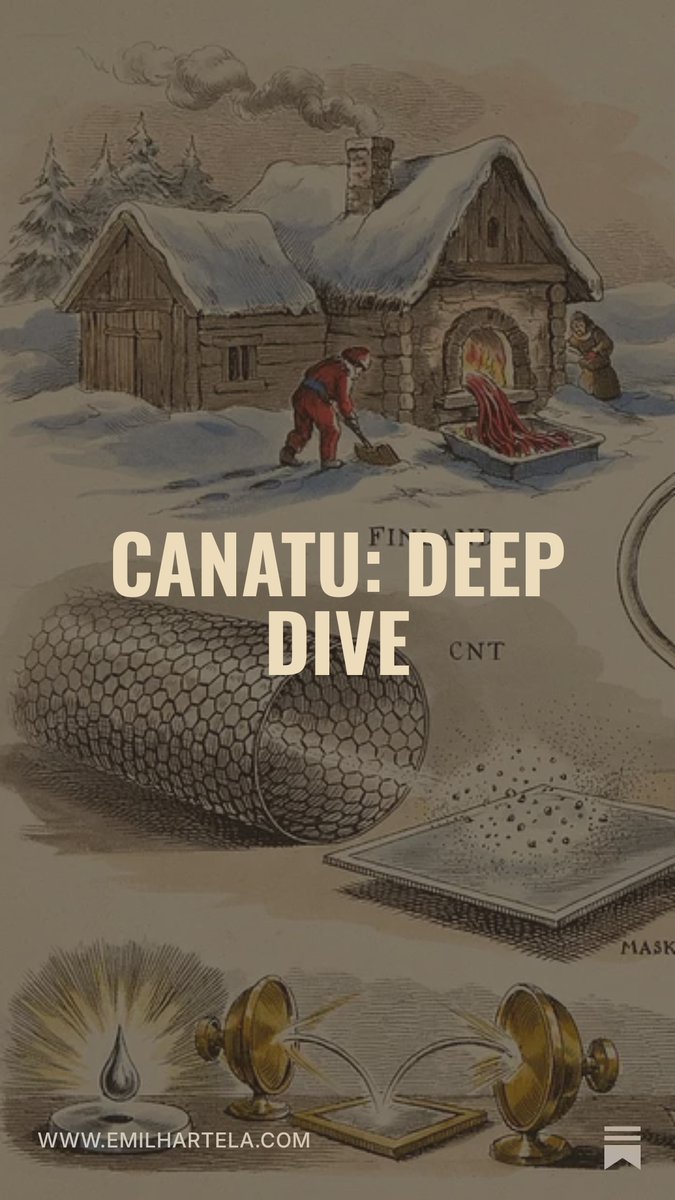
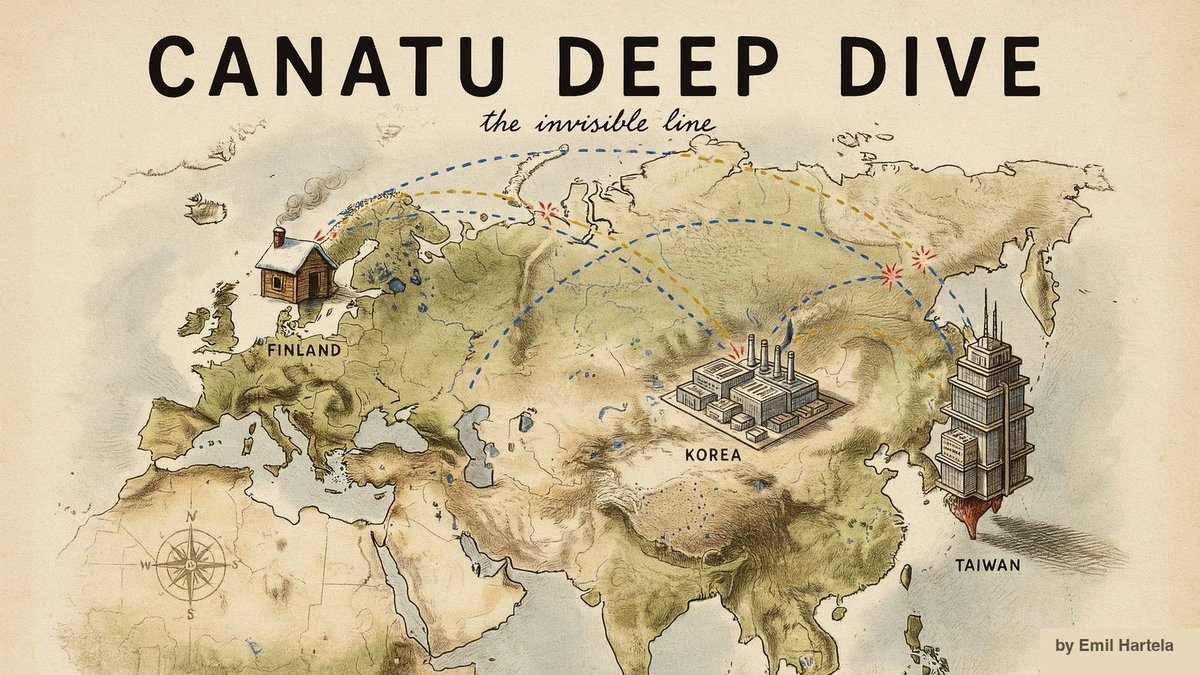
Just published a 10,000+ word deep dive on $CANATU.
Everything from the ground up: the technology, the business model, the hidden customer, the numbers, the competition, the risks, and why the next few months matter.
If you want to actually understand this company, not just the ticker, this is the piece.
Free to read.