The second paper of my PhD is finally out!
Have you ever wanted to account for time-to-event in a GWAS, but not known if you would actually increase power? Then find out here! https://t.co/5UXWbY1d5I
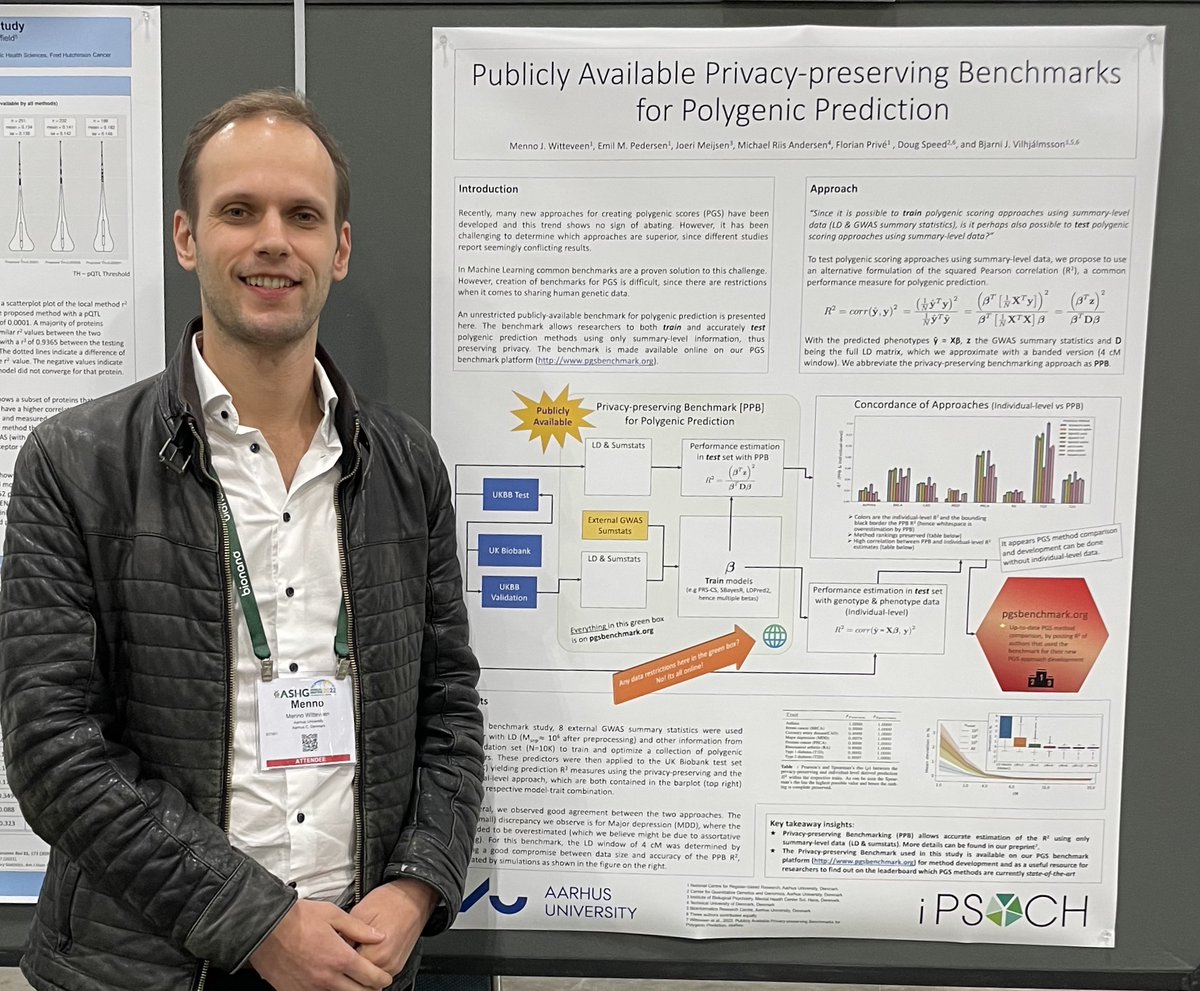
Dozens of cool PGS methods have been proposed, but which is the best? Fortunately @MennoWitteveen came up with an ingenious approach to answer this using a Public Privacy-preserving Benchmark. Check the poster (# 3566) at 3pm today at #ASHG. Also preprint https://t.co/pYwl1eRECh
Fantastic paper by the clever @clara_albi and the productive team led by @bvilhjal at the National Centre for Register-based Research @AarhusUni@GrundforskFond@lundbeckfonden
Multi-PGS enhances polygenic prediction: weighting 937 polygenic scores https://t.co/4meZwPRX7G
@JamesRPriestMD @bvilhjal@privefl@eagerbo The model is essentially a drop-in replacement for a case-control status in your GWAS software of choice. So including PCs in the GWAS should not be a problem for the association test. Estimating the liability does not currently include the PCs however..
It turns out that accounting for age-of-onset information using (efficient) Cox-based GWAS methods may not always result in increased power to detect genetic variants in practice.
Take a look at our new paper @AJHGNews "*Leveraging both individual-level genetic data and GWAS summary statistics increases polygenic prediction*"
Squeeze 🍊 the available data to maximize prediction of polygenic risk scores (PRS)
Summary 🧵
My first preprint is now on biorxiv!
The paper is called:
"Accounting for age-of-onset and family history improves power in genome-wide association studies"
and the method developed is called "LT-FH++"
https://t.co/9U2NQRjHf1
1/4
In short, we have developed a method that can fine-tune the estimate for a genetic liability per individual. The method can be thought of as a survival model, combining principles of survival analysis models with family history, in a GWAS setting.
4/4