Hey chat. Pause for a quick moment to highly recommend @benhackshealth for your personal fitness and life coach.
I make zero money off Ben but I type this because he transformed my life.
My story: struggled with weight my entire life. Obese. Brain fog. Tore my body apart.
Ben changed my life. Not only did I fix my fitness goals but I also corrected my life priorities and became a better person. I consider Ben one of my best friends in life.
I no longer struggle with weight. I’m sitting the leanest I’ve been since I was 8 years old. I control my muscle mass, my weight, but most importantly - the confidence I have in myself that I didn’t have came from Ben’s pillars and discipline.
Small changes over time equate to huge results.
Ben’s taking in a few more folks for June. Make the investment in yourself. It works. What he does will impact your life forever. It’s not a fad diet, or something that wastes away in 6 months. It’s forever.
The best coach I’ve ever had in my life and continue to use. Sign up today.
https://t.co/b0Agnu75LV
#WeHackHealth
“Once the platform works, biology becomes programmable.”
Demis Hassabis, CEO of Google DeepMind, says AI drug discovery won’t progress gradually.
It will look more like AlphaFold, years of quiet infrastructure work, then a sudden leap where the system can scale across entire disease areas.
Retatrutide has set a new standard for obesity treatment!
Lilly has released the Phase 3 TRIUMPH-1 results for retatrutide, its triple agonist that targets GIP, GLP-1, and glucagon. These results show the most impressive numbers I have seen for an incretin drug.
Here are the average percentages of body weight loss at the highest dose compared to placebo, based on separate pivotal trials rather than direct comparisons:
Retatrutide 12mg (80 wks): -28.3%
Tirzepatide 15mg (72 wks): -20.9%
Semaglutide 2.4mg (68 wks): -14.9%
Even more insane, in the 104-week extension for participants with a BMI of 35 or higher, retatrutide 12mg led to an average weight loss of 30.3% (about 85 pounds). This level of weight loss has typically only been seen with bariatric surgery.
Proportion reaching ≥30% weight loss:
Retatrutide 12mg: 45.3%
Tirzepatide 15mg: ~15%
Semaglutide 2.4mg: ~very low / not a primary readout
And again, keep in mind that these were not head-to-head trials. I included the numbers together for comparison. TRIUMPH-1 enrolled participants with a higher average BMI (40 compared to about 38), and the trials also had different durations.
Retatrutide / TRIUMPH-1: Lilly press release, May 21, 2026 → https://t.co/YZEmrt4e6Z
Tirzepatide / SURMOUNT-1: Jastreboff et al., NEJM 2022 → https://t.co/hfvDbWdWAC
Semaglutide / STEP 1: Wilding et al., NEJM 2021 → https://t.co/SQmwPL4hEX
Finally: Computational Discovery, powered by AlphaEvolve & our Empirical Research Agent (ERA).
This agentic research engine generates and evaluates thousands of code variations, unlocking invaluable data to help discover advanced models and algorithms in a fraction of the time. Explore these tools at: https://t.co/hOcUC2gmUL
Did you know ancient Egyptians and Chinese emperors documented longevity rituals and "elixirs" thousands of years ago? Yet one of the earliest systematic biological explanations of aging is often credited to Aristotle.
In his ~350 BCE work On Youth and Old Age, Aristotle proposed that life was sustained by "innate heat." He believed aging occurred through the gradual cooling and drying of the body. Variations of this theory influenced medicine for centuries through physicians such as Galen and Avicenna.
Fast forward to 1825.
British actuary Benjamin Gompertz published what became known as the Gompertz Law of Mortality. He demonstrated that the probability of death rises exponentially with age. This was one of the first mathematical descriptions of aging and remains foundational in actuarial science and biodemography today.
Then came one of the most important modern aging studies ever launched.
The Baltimore Longitudinal Study of Aging (BLSA), started by the NIH in 1958, followed volunteers over decades to study physical and cognitive aging across the lifespan.
Here’s the part many people still don’t know.
The original study enrolled only men.
Women were not officially added until 1978. Researchers at the time largely assumed that aging findings in men would naturally apply to women as well.
That assumption turned out to be deeply incomplete.
The inclusion of women helped reveal major sex-specific differences in aging, including cardiovascular risk patterns, bone density changes, hormone shifts, and longevity trends. Women generally live longer than men, yet often experience higher rates of conditions such as osteoporosis and certain autoimmune disorders.
This, in a way, correlates with how underexplored female hormone health has been for decades, including the clinical relevance of testosterone in women. Today, women have low testosterone levels just as men do. If not more.
Another fascinating experiment emerged around the same period.
In 1979, psychologist Ellen Langer conducted the now-famous "Counterclockwise Study." Elderly men spent time in an environment recreated to resemble 1959 and were encouraged to live as though they were 20 years younger. Researchers observed improvements in measures of posture, grip strength, and subjective well-being.
The study was small and unconventional, but it raised an important question that still echoes through aging research today:
How much of aging is biology alone, and how much is shaped by environment, expectation, behavior, and the way society treats older people?
One more interesting detail.
And because women entered the BLSA 20 years later, that specific study still contains roughly two additional decades of long-term male aging data compared to female data.
ED drugs like Cialis & Viagra, when taken as a low dose daily, can help maintain vascular function in brain and muscle, and are a promising, though still debated, approach for preventing & treating dementias. The human data for Cialis (tadalafil) is stronger …🧵
Man, so many things are running through my brain. And here's the latest one:
LADE (Local AI Diagnostic Engine) would be a local-first diagnostic intelligence platform that connects to physical and digital systems, analyzes live telemetry and behavioral patterns, and performs reasoning-based fault isolation across hardware, software, and industrial environments.
L.A.D.E.
Local AI Diagnostic Engine
Fits the concept well because the system is supposed to “load” understanding into a machine problem.
We could structure it like:
LADE Architecture
Local
Runs on-premise. Privacy-first. No cloud dependency required.
AI
Reasoning engine that forms hypotheses instead of just matching fault codes.
Diagnostic
Observes symptoms, isolates failures, tests assumptions, narrows causes.
Engine
Connector and execution framework that interfaces with real systems.
We could even evolve it into layers:
LADE Core
Reasoning + orchestration.
LADE Connect
Hardware/software adapters.
LADE Vision
Camera + thermal + OCR diagnostics.
LADE Signal
Audio/vibration/electrical pattern analysis.
LADE Memory
Long-term system profiling and learning.
LADE Twin
Digital twin simulation layer.
LADE Safe
Safety/risk enforcement.
It is the interoperability layer between the physical world and the reasoning engine.
It would combine:
🎯 real-world signals
🎯 system understanding
🎯 causal reasoning
🎯 memory
🎯 guided testing
🎯 cross-domain diagnostics
🎯 local execution
🎯 safety constraints
The closest existing categories would be:
📌 predictive maintenance
📌 observability platforms
📌 industrial AI
📌 digital twins
📌 expert systems
📌 autonomous troubleshooting
But LADE would sit above all of them because the goal is not merely detecting anomalies.
The goal is understanding failure.
An anomaly detector says:
“Something is wrong.”
LADE would say:
“The compressor relay is probably failing because current draw increased over 3 weeks, startup delay is growing, voltage is stable, capacitor tests normal, and thermal signatures show relay overheating under load.”
That 💩 is a completely different level of intelligence.
People often talk about RAG and fine-tuning like you are picking between two clean options.
"If you need facts, use RAG. If you need behavior, fine-tune." That sounds nice in an article.
In a real system, it is not that simple.
For the clinic project, I did not skip RAG in favor of fine-tuning. I started with RAG because that was the right move. RAG gave us a big jump. A prompt-rule fix plus two new skills moved the system from about 0.65 to 0.85 stable. No GPU. About one hour of work.
That is the basic playbook. Fix retrieval first. Add the right tools. Tighten the rules. Make sure the model has the facts it needs. But then we hit the wall. The last 15% was not a retrieval problem anymore. The facts were there. The model still derailed in different ways across runs. Same question, different failure.
One run might confuse Gonadorelin with Sermorelin. Another might inject a weird SQL placeholder mid-response. That does not mean RAG failed. That means the base model was losing consistency.
And this is where most RAG vs fine-tuning articles get too clean for their own good.
IBM’s own article frames RAG as connecting the model to internal data so it can return more accurate answers, while fine-tuning improves performance on domain-specific tasks. That is not wrong. But the common takeaway becomes too shallow.
"RAG gives you accuracy. Fine-tuning gives you behavior."
Reality is messier. RAG can still fail if retrieval pulls the wrong context, if chunking is weak, if ranking is off, or if the model ignores the evidence. Fine-tuning can still fail if the data is bad, if the labels are sloppy, or if you are trying to teach facts that should live in retrieval.
The real question is not RAG or fine-tuning. The real question is which failure mode are you solving?
Missing facts? Use RAG. Wrong behavior? Use fine-tuning. Unsafe action flow? You need governance.
That is why I built the Blackboard Kernel work. https://t.co/nSORMFqnQt
The point was simple. As AI systems move from isolated chatbots into agents and workflows, the failure mode changes. It is no longer only "the model hallucinated." Sometimes the system commits a belief without evidence. Sometimes it takes action before constraints are satisfied. Sometimes the glue code lets an unsafe step through because nothing is enforcing internal state, evidence, and action gates.
That is the problem I built for. Typed internal state. Evidence-based belief commitment. Constraint-gated action execution.
In the controlled evaluation, the deterministic BK agent reached 100.0% task success with zero unsafe actions. The LLM-backed BK agent reached 99.0% task success with zero unsafe actions. Baseline architectures produced unsafe actions in 38.7% to 43.0% of episodes.
So when I say the last 15% was not a RAG problem, I mean that literally. We already harvested what RAG could give us. The next lever is fine-tuning because the remaining issue is model behavior.
And beyond fine-tuning, the deeper layer is governed cognition. Facts belong in retrieval. Behavior belongs in fine-tuning. Safety-critical action flow belongs in the system architecture. That is the part most articles "hallucinate" about.
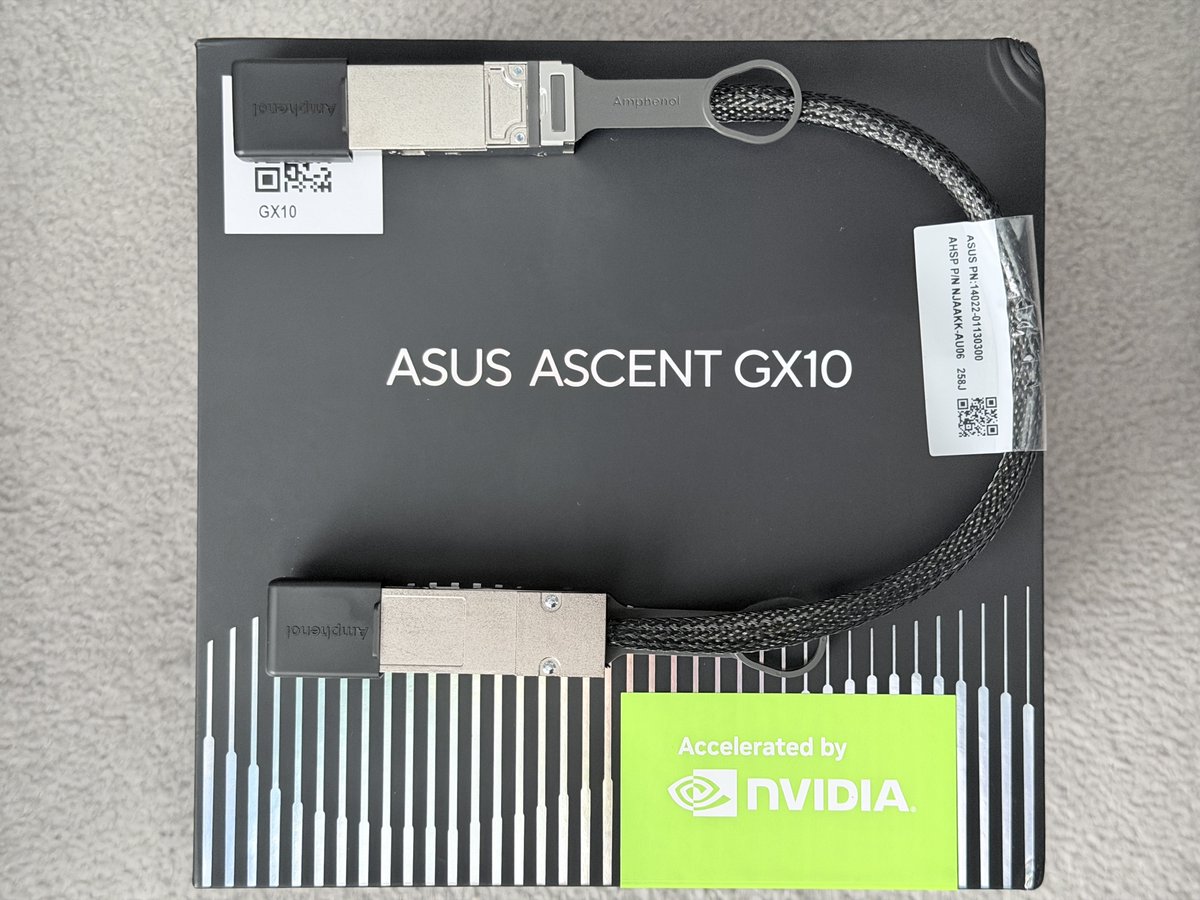
And about the picture, I almost forgot. That is the second ASUS GX10 being added today.
Together, the two boxes move this from a local AI workstation into a small private AI cluster.
256 GB aggregate unified memory, up to 2 petaFLOPS of FP4 AI compute, 40 ARM CPU cores.
And linked systems capable of handling models up to the 405B class.
Not @hackingdave H100 level yet. LOL
I enjoyed creating https://t.co/mbXWLhJE4K, where you can try out Ternary Bonsai 1.58-bit LLMs right in your browser using WebGPU.
The project is also open source at https://t.co/pPYgiwKyWP
Great job team @PrismML
Most people think human evolution basically stopped once we invented farming.
A brand new study (Nature, April 2026) just demolished that idea. Looking at the DNA of nearly 16,000 ancient Europeans, researchers found 347 separate places in the genome under strong, sustained selection in the last 10,000 years affecting everything from body fat to brain function to disease resistance.
Natural selection has been pushing humans toward less body fat and better cognitive performance. Our DNA has literally been working against the dad bod for millennia.
Apparently we’re not the finished product. We’re still becoming something.
But here’s the problem, the modern food environment is winning the tug-of-war right now.
10,000 years of evolution chasing leaner bodies, and peptides did the same job in a decade. Took us a while to get there too. Just not quite that long.
https://t.co/nMsuAsxElV
Mark Cuban on the next job wave.
Customized AI integration for small to mid-sized companies.
"Software is dead because everything's gonna be customized to your unique utilization. Who's gonna do it for them... And there are 33 mn companies in the US."
I’m happy to say that we’re now outperforming most of the image generator on the market, with just 4.6 seconds of processing time without losing quality. The size is 1024 x 1024.
The @CORSAIR MP700 Micro 4TB PCIe 5.0 NVMe M.2 2242 SSD really made a difference on my @ASUS GX10.
The FDA is finally moving in the right direction on testosterone therapy.
For years, too many men with clear symptoms, low testosterone, and no obvious "structural cause" were left stuck in the gray area.
Now the FDA is opening the door for testosterone therapy to be recognized for men with low libido and low testosterone, even when the exact cause is not perfectly identified.
That matters.
Because men are tired of being told their symptoms are "normal aging" while their energy, drive, mood, and quality of life keep dropping.
This is not about hype.
This is about common sense.
Make America Healthy Again.
For years, men with Low T had nowhere to turn. That ends with @DrMakaryFDA.
The @US_FDA is expanding treatment options for idiopathic hypogonadism. Using gold standard science to get real results for American men.
April 15, 2026 was not a small FDA update.
GHK-Cu, except for injectable routes of administration, will be removed from 503A Category 1 after seven calendar days because the nominations were withdrawn.
Also the following peptides will be removed from 503A Category 2 after seven calendar days for the same reason:
√ BPC-157
√ Cathelicidin LL-37
√ Dihexa Acetate
√ Emideltide (DSIP)
√ Epitalon
√ GHK-Cu for injectable routes of administration
√ KPV
√ Mechano Growth Factor, Pegylated (PEG-MGF)
√ Melanotan II
√ MOTs-C
√ Semax (heptapeptide)
√ TB-500, also listed as Thymosin Beta-4 Fragment
Peptides are also being lined up for Pharmacy Compounding Advisory Committee consultation for potential inclusion on the 503A bulks list, with a discussions scheduled for July 23 to 24, 2026, and others planned before the end of February 2027.
Not proof that everything is suddenly open again.
But definitely a meaningful FDA move across a whole group of peptides, not just one.
https://t.co/UlNtzBONOu
Well, today things are different. This is from last session, and it was a long one:
If yes, I'll: (a) write the condensed spec, (b) commit it, (c) begin implementation. Confirm and I go.
No lazy here, and whatever changed, it changed for the better.
Issues with Claude Code lately?
You are not imagining it.
Claude Code feels like it is going through a midlife crisis.
One day it is your senior engineer. The next day it is asking if "this is enough for this session" like it has dinner reservations or something.
Here is what seems to be happening.
Claude did not suddenly become stupid. The model did not wake up one morning and forget how to code.
The system around it changed.
Anthropic rolled out Opus 4.6 with a massive 1M context window. Sounds amazing, and technically it is. But huge context is not magic. More context also means more noise, more cost, more routing decisions, more caching pressure, and more ways for the agent to lose focus.
Then users started hitting Claude Code limits way faster than expected. Anthropic publicly acknowledged that and said they are investigating.
There is also the prompt cache issue. Reports show Claude Code cache TTL went from around 1 hour to 5 minutes for many requests. Anthropic says this should not increase cost, but developers looking at their logs are saying, "Yeah, okay, but my usage is getting cooked."
And this explains a lot actually.
When the cache expires faster, Claude has to keep rebuilding context. Your codebase gets reloaded. The session loses its feel. The agent starts acting like it forgot what you just discussed 10 minutes ago.
That is why it feels lazy.
That is why it gives advisory answers instead of doing the work.
That is why it says things like, "You can now run this manually," when last month it would have just done it.
That is not only an intelligence problem.
It is an intelligence vs. efficiency problem.
Long sessions are expensive. Deep thinking is expensive. Tool calls are expensive. Huge context is expensive. So the product starts getting squeezed.
Less thinking, shorter answers, more guardrails.
More "you do it ", more session-ending behavior.
And more intern energy from a model that used to feel like a senior engineer.
That is the part many of us are feeling.
Claude is still powerful. But Claude Code right now feels like a brilliant engineer being managed by a finance department, a safety team, and a quota meter at the same time.
I needed server notifications sent to my phone. Simple request, right? So I tested a few options.
ntfy 🙄 Almost, but no.
↓
Pushover 😳 Okay... but why?
↓
Signal 😎 There it is. Finally, adults are in the room.
@MillaJovovich just released an open-source local AI memory system called MemPalace that gives LLMs (like Claude, GPT, Gemini, or self-hosted LLM) a permanent, searchable brain.
https://t.co/XKR3tFCeEo