in #French when you have a female cat, you usually say “J’ai un CHAT” and not “j’ai une CHATTE” because “chatte” is, like in english, a way to say “pussy” 🙀
🇫🇷 INSOLITE | Le titre "Du ferme" du rappeur La Fouine a retenti lors du départ de Nicolas Sarkozy vers la prison de la Santé, à Paris. (@HugoCouturier)
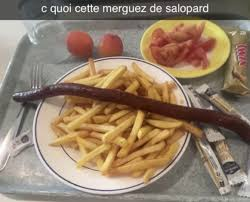
Literally "What is this bastard's spicy sausage"
This #frenchmeme went viral because of the funny caption. Now you can add "de salopard" after any object and use it as a caption for a picture with a unusually big thing.
#merguezdesalopard
Is it true that #french people eat snails and frogs ?
Yes.
Snails are a lot more common than frogs though, and it is mainly on special occasions (like Christmas)
Other ways to say “il pleut” in #french (from the most normal to the most crude):
-il fait moche
-il fait pas beau
-il fait un sale temps
-il fait un temps de chien
-il fait un temps de merde
Here are some of the most famous #books that #french kids read in the 90s 2000s:
Petit Ours Brun (Danièle Bour)
Martine (Gilbert Delahaye and Marcel Marlier)
Arc-en-ciel (Marcus Pfister)
Chien Bleu (Nadja)
The two main grammatical tenses to talk about the past in #french are passé composé and imparfait. You may have heard about passé simple but it is used only when writing and sounds very formal.
Most words become feminine by adding an "e" at the end and it changes pronunciation:
petit → petite (you hear the "t" now)
français → française (you hear a “z” in the end)
BUT sometimes the "e" changes nothing:
jeune → jeune (no changes)
énervé → énervée (same pronunciation)
In spoken #French you will here often other words to replace “très” (=very):
Trop (very common)
Tarpin (in Marseille)
Gavé (in Bordeaux)
Cher (in Lyon)
Do you know other ones ?
So yes — French spelling is beautiful, full of history and poetry…
but it’s also a mirror of hierarchy.
It reflects centuries of class, education, and power.
Each silent letter whispers:
“Knowledge used to be a privilege.”
Why French spelling is so hard — and why it’s not an accident.
If you’ve ever wondered why eau means “o” or why beaucoup needs six letters to say “boh-koo”…
It’s not just tradition.
French spelling was designed to be complex — and that choice was political. 👇
Every time modernizing French spelling is suggested, debates explode.
“L’écriture inclusive” — making French grammar less masculine and more neutral.
People say:
“You’re destroying culture!”
But often, they really mean:
“You’re redefining who belongs — and who doesn’t.”