These corrupt pricks have no idea what they’ve done. I’m so glad to be alive to watch it all unfold as it should. They messed with the wrong man. March them all out in public and reveal everything.
It looks to me like @SenMcConnell and @LeaderJohnThune are playing a little 2-man game where McTurtle (who is retiring) keeps the SAVE Act bottled up in Committee while Thune pretends nothing can be done.
Key to unlocking it is mostly likely to remove/replace Thune as Leader.
It’s fucking insane living in a country where people hate the president so much they’d rather side with terrorists than see him succeed in any negotiation.
so I guess it turns out you can just bodybag dictators. you can just kill your enemies if they express genocidal nuclear intentions. you actually don’t have to send them pallets of cash and hope they behave. you can just delete them.
🚨 Senator John Thune: No SAVE Act!
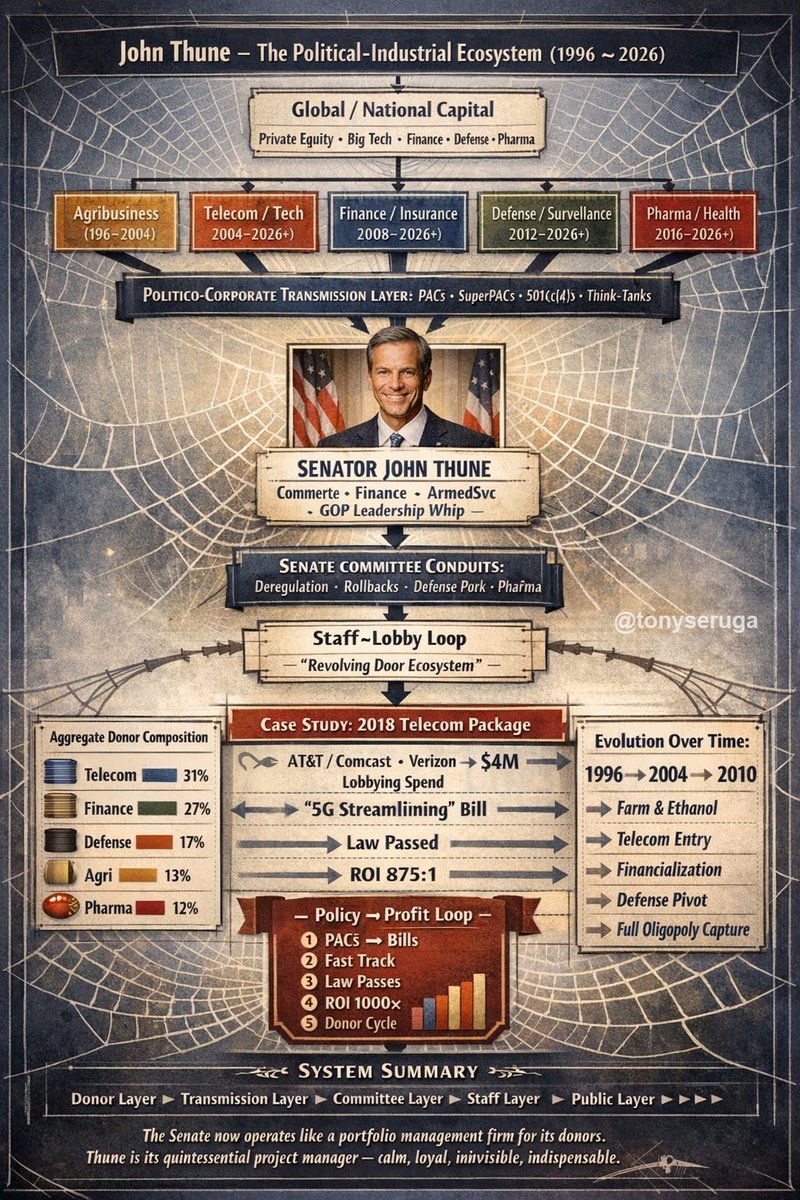
Let’s take a deep, unvarnished look at Senator John Thune.
Top Donor Categories
» Finance/Insurance/Real Estate: This bloc dominates Thune’s funding — particularly commercial banks, insurance firms, and investment houses.
» Electronics/Telecommunications: AT&T, Comcast, and major wireless interests have been reliable donors.
» Agribusiness: Monsanto (now part of Bayer), cattle and ethanol producers, grain cooperatives, and chemical fertilizer entities.
» Defense Contractors: Lockheed Martin, Northrop Grumman, Raytheon, and Boeing have all contributed regularly.
» Pharmaceuticals & Health: Pfizer, Blue Cross Blue Shield, and other major players — almost every Senate Republican in leadership receives their checks.
Prominent Individual Donors / PAC Involvement
» Koch Industries and Koch-linked PACs have been steady funders, often routing contributions via Americans for Prosperity.
» AT&T and Verizon PACs have given to Thune for years due to his role on the Senate Commerce, Science, and Transportation Committee.
» Insurance companies like MetLife and Prudential contributed heavily during his chairmanship of key subcommittees.
As Senate Minority Whip, he became a funnel point for corporate influence, distributing funds strategically within the party to secure votes and committee loyalty.
Thune’s hallmark achievement is not ideological leadership but managerial loyalty—a reliable vote for deregulation, military spending, and industry tax breaks. Key legislative patterns:
» Advocated loosening telecom regulations, including FCC oversight.
» Supported virtually every defense and surveillance reauthorization, including the continuation of mass data collection even after public outcry about NSA abuses.
» Vocal opponent of net neutrality, insisting “market forces” will ensure fairness in digital access—language written almost verbatim by telecom lobbyists.
» Consistent support for Big Ag subsidies and crop insurance expansion.
» Pushed to shield banks and insurers from regulatory clawbacks under Dodd-Frank.
» Supported The Tax Cuts and Jobs Act (2017) heavily, where his office worked with K Street lobbyists to maintain favorable corporate rates for telecoms and agribusiness donors.
Controversies and Criticisms
While Thune has avoided the theatrical scandals that destroy careers, he has been deeply embroiled in Washington’s systemic corruption—institutional capture disguised as normalcy.
1. Revolving Door Influence
Several of Thune’s former aides became lobbyists for industries that his committees regulate.
Examples include:
• Ex-staff joining AT&T and Comcast, which later made large PAC donations to Thune.
• Staffers turned defense lobbyists, influencing procurement budgets where Thune held committee sway.
This self-reinforcing circle of favors typifies the modern Senate’s contamination by industry insiders.
2. Stock Holdings and Trades
While not criminal, watchdog groups flagged Thune’s stock disclosures for suspiciously well-timed movements in telecom and agriculture securities before committee actions or subsidy votes. His office claimed “blind trust” arrangements, but the overlaps raised obvious concerns of insider access cloaked under legal facades.
3. Corporate Water-Carrying
Thune’s Commerce chairmanship coincided with the telecommunications sector’s meteoric consolidation, which gutted regional ISPs and entrenched monopolies. His ideological justification of “innovation through scale” perfectly aligned with AT&T and Comcast merger memos. Internal memos later leaked by staff described him as “telco’s best friend on the Hill.”
4. Pharmaceutical Policy Positions
Thune opposed most drug-pricing reforms, framing them as “government interference.” But his FEC reports tell the real story: year after year, Big Pharma outspent all other sectors in donations to his campaigns. He consistently rejected bipartisan efforts to allow Medicare price negotiations.
5. Ethical Questions in Leadership Ascension
Rumors circulated—never formally investigated—that Thune coordinated fundraising commitments from corporate entities to solidify his leadership bids after Mitch McConnell. Internal GOP sources viewed Thune as the “continuity candidate” for ensuring donor class control after McConnell’s exit.
Overall Assessment
John Thune represents the polished, post-ideological technocrat class—senators who master the art of consensus-building and fundraising while avoiding direct scandal. His clean image obscures the quiet efficiency with which corporate America functions through him.
He is a perfect example of how bipartisan corruption sustains itself under the illusion of statesmanship — the “professional moderate” who publicly praises democracy while privately maintaining oligarchic order.
What the SAVE Act actually is
The SAVE Act (“Safeguard American Voter Eligibility” Act), requires individuals registering to vote in federal elections to provide documentary proof of U.S. citizenship.
On paper it’s simple:
• “No non‑citizens voting” — a message Americans overwhelmingly support, left and right.
Yet in practice it’s a data‑verification overhaul that would:
• End same‑day voter registration in many states.
• Compel state election officials to cross‑check databases (Social Security, DHS, etc.).
• Potentially purge non‑documented but eligible voters when records mismatch.
That’s the part where the corporatized GOP wing, of which Thune is a textbook specimen, quietly steps away.
Why Thune doesn’t back it
1️⃣ Corporate donor discomfort
• Major national lobbies—especially Chamber of Commerce, agriculture conglomerates, and tech contractors—depend heavily on migrant labor and soft enforcement environments.
• Anything that symbolically aligns with restrictionism scares off these donors, who prize cheap labor and brand optics over civic integrity.
• Thune’s top backers (agribusiness, telecom, finance) have all made quiet but firm statements against restrictive ID or verification laws that could “disenfranchise workforce communities.”
Result: the donor class whispers “cool it.” Thune listens.
2️⃣ Image calculus inside GOP leadership
Thune is the consummate “respectable conservative.” He avoids fights that look “populist” or “harsh.”
Supporting SAVE Act bills would:
• Align him publicly with the Trump / MAGA / America First — the faction GOP elites still treat as radioactive populism.
• Endanger his role as the continuity candidate for Mitch McConnell’s eventual replacement.
Thus, for him, neutrality equals viability. Silence is strategy.
3️⃣ Bureaucratic‑status‑quo alignment
• SAVE Act–style verification disrupts the balance of federal and state election administration.
• The permanent bureaucracy — DHS, DOJ, EAC — dislikes those disruptions.
• Thune has spent two decades cultivating himself as an “institutional caretaker.” Alienating the bureaucracy would cut off the quiet cooperation he needs to keep lobby‑driven legislation moving.
• So while claiming to “support secure elections,” he avoids binding regulations that shift control from federal agencies to states.
4️⃣ Political optics and plausible deniability
When confronted, Thune tends to repeat bland abstractions:
“We must ensure access and integrity.”
This word‑pair — “access and integrity” — is the linguistic firewall the establishment uses to sound concerned while blocking actual verification changes.
It’s identical to how leadership Republicans defended Section 230 for Big Tech: speech about “balance,” while financial dependency guides the real vote.
5️⃣ The deeper structure: convergence with corporate liberalism
In Washington’s donor ecosystem, open immigration + corporate deregulation + polished centrism is the supreme formula for profit stability.
The SAVE Act introduces friction:
• It narrows labor flexibility.
• It implies state‑level reassertion of sovereignty.
• It empowers populist state officials to question federal record‑keeping.
That’s anathema to the D.C. uniparty architecture. Thune’s entire career has been about keeping that architecture intact.
Bottom line
Thune doesn’t oppose the SAVE Act because he’s ignorant — he opposes it because it threatens the invisible triangulation between capital, bureaucracy, and leadership control.
To back the bill would be to side publicly with the populists,
To oppose it overtly would expose donor capture,
So he takes the third option: procedural invisibility.
That’s how modern power maintains itself — the non‑decision, wrapped in civility.
I've said it once, and I'll say it again: our GOP base should NOT have to beg Republican senators to pass something as critical as the SAVE America Act.
This inaction will cost our country dearly.
Why won't John Thune use Trump's State of the Union strategy to pass the SAVE Act?
"If you don't agree that we should require ID to vote, then STAND UP and explain yourselves, Democrats. Take all the time you want."
That's the talking filibuster. That's what the Senate used to do and what it must do again. Let Americans SEE what the Democrats are defending. Force them to stand. Because all I'm seeing right now is John Thune sitting down.