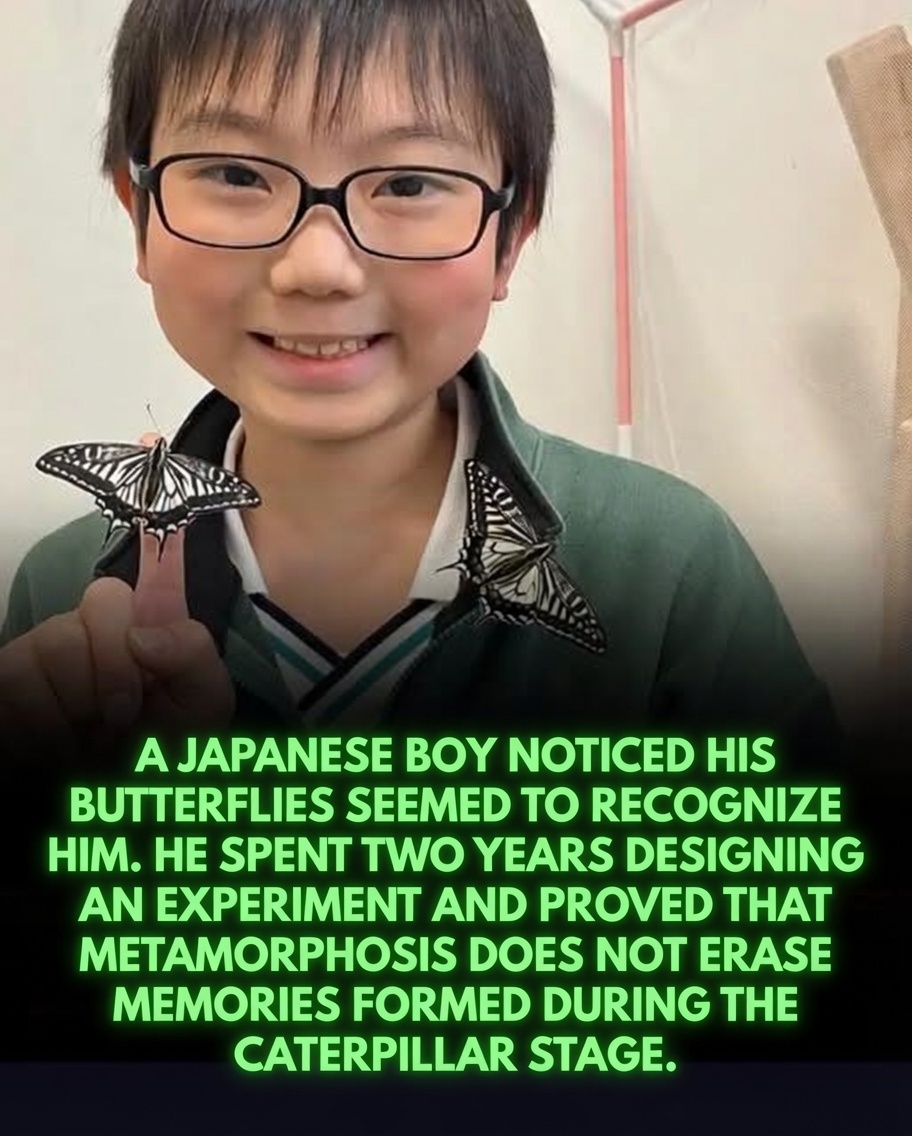
A 10 year old child’s experiment demonstrated that memories can be inherited across generations.
The story started when Jo Nagai, a second grader from Kobe, Japan, observed that swallowtail butterflies he had raised by hand appeared to recognize him, whereas wild butterflies would flee.
Motivated to uncover a scientific explanation, he contacted Georgetown University entomologist Dr. Martha Weiss, who had previously shown that moths retain memories despite the extensive cellular reorganization during metamorphosis.
Encouraged by her research, Jo suggested conducting a similar study with butterflies. This led to a remarkable international collaboration. Using a simple setup created at home, Jo conditioned caterpillars to link a gentle vibration with the smell of lavender.
Remarkably, after their brains were entirely reconstructed inside the chrysalis, 70 percent of the adult butterflies still avoided the lavender scent, demonstrating that their memories had endured the transformation.
The most surprising result emerged when Jo bred these conditioned insects. Neither the offspring nor the grandchildren had ever encountered the vibration, yet both generations displayed an instinctive aversion to the lavender scent.
At the age of ten, Jo compiled his groundbreaking observations into a 33 page paper and presented them alongside Dr. Weiss at the International Congress of Entomology in Kobe. This discovery of transgenerational memory challenges conventional views of genetics and inheritance while illustrating how a child’s curiosity can push the frontiers of scientific understanding.