October turned the market on its head.
Our October Monthly Market Review is now live.
AI financing fears hit chips and speculative growth, while consumer and energy stocks found buyers. Even record memory profits couldn’t calm the tech sell-off, and the Fed paused with further hikes still in view.
Full report in the reply 👇
$AAPL Apple is down around 2% after a clean earnings beat. iPhone sales exceeded expectations, while gross margins held within guidance.
HEADLINE PRINT
🟢 Revenue: $114.48B vs $113.39B expected
🟢 EPS: $2.10 vs $1.99 expected
WHAT CHANGED
🟢 iPhone revenue: $57.58B vs $56.48B expected (+17.5% YoY)
🟢 Gross margin: 47.9% vs 47.5% expected, including ~1 percentage point from tariff refunds
🔴 Greater China revenue: $17.54B vs $18.55B expected (+21% YoY)
WHY THIS EARNINGS MATTERS
◆ iPhone sales exceeded expectations, while gross margin beat estimates despite rising component costs. China missed estimates, although revenue grew strongly. With only nine days of iPhone 18 Pro sales included, the holiday quarter will provide a clearer test of the new product cycle.
REMAINING QUESTION
◆ Can the new iPhone cycle sustain growth through the holidays while rising memory costs pressure margins and supply constraints limit sales?
$AAPL Apple earnings after markets close. The new iPhone cycle is getting underway, but rising memory costs are putting pressure on margins.
Stock: up 26.8% YTD | up 4.6% over 1 month | down 8.7% at last earnings
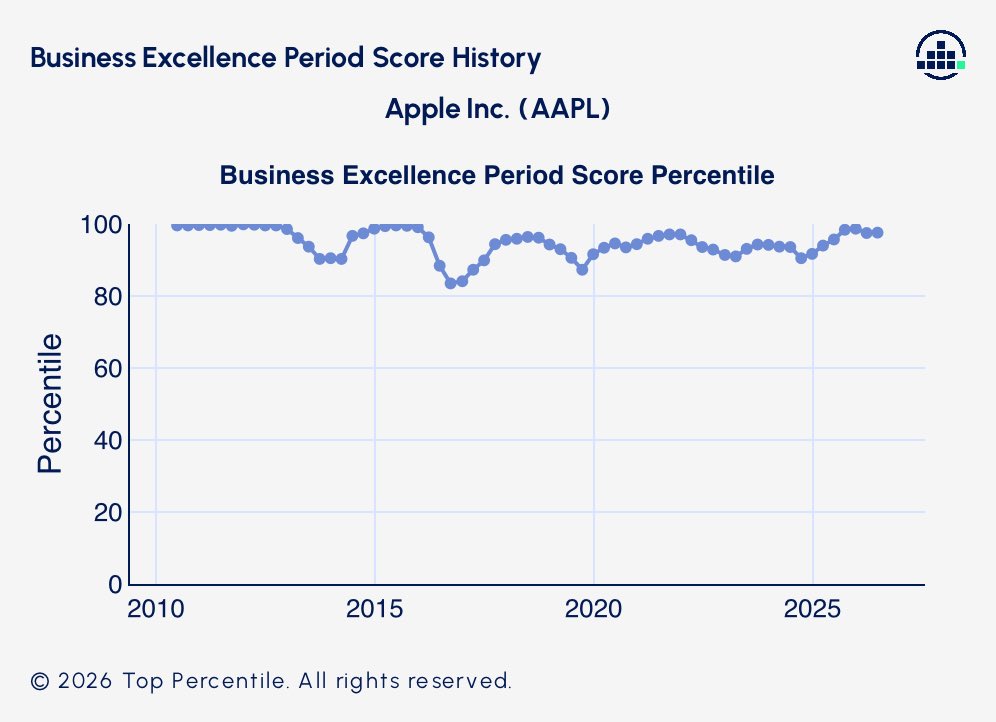
Apple has remained among the highest-quality businesses in the market for years. The iPhone 18 Pro had only nine days of sales in the September quarter, making the holiday outlook particularly important.
WHAT HAPPENED AT LAST EARNINGS
◆ Apple delivered a record June quarter, but gross margin benefited from roughly 2 percentage points of tariff refunds. Management warned that rising memory costs would put further pressure on margins.
WHAT MATTERS THIS EARNINGS
◆ Whether the holiday outlook points to sustained demand for the new iPhone cycle.
◆ Whether pricing and product mix can offset rising memory costs without further margin pressure.
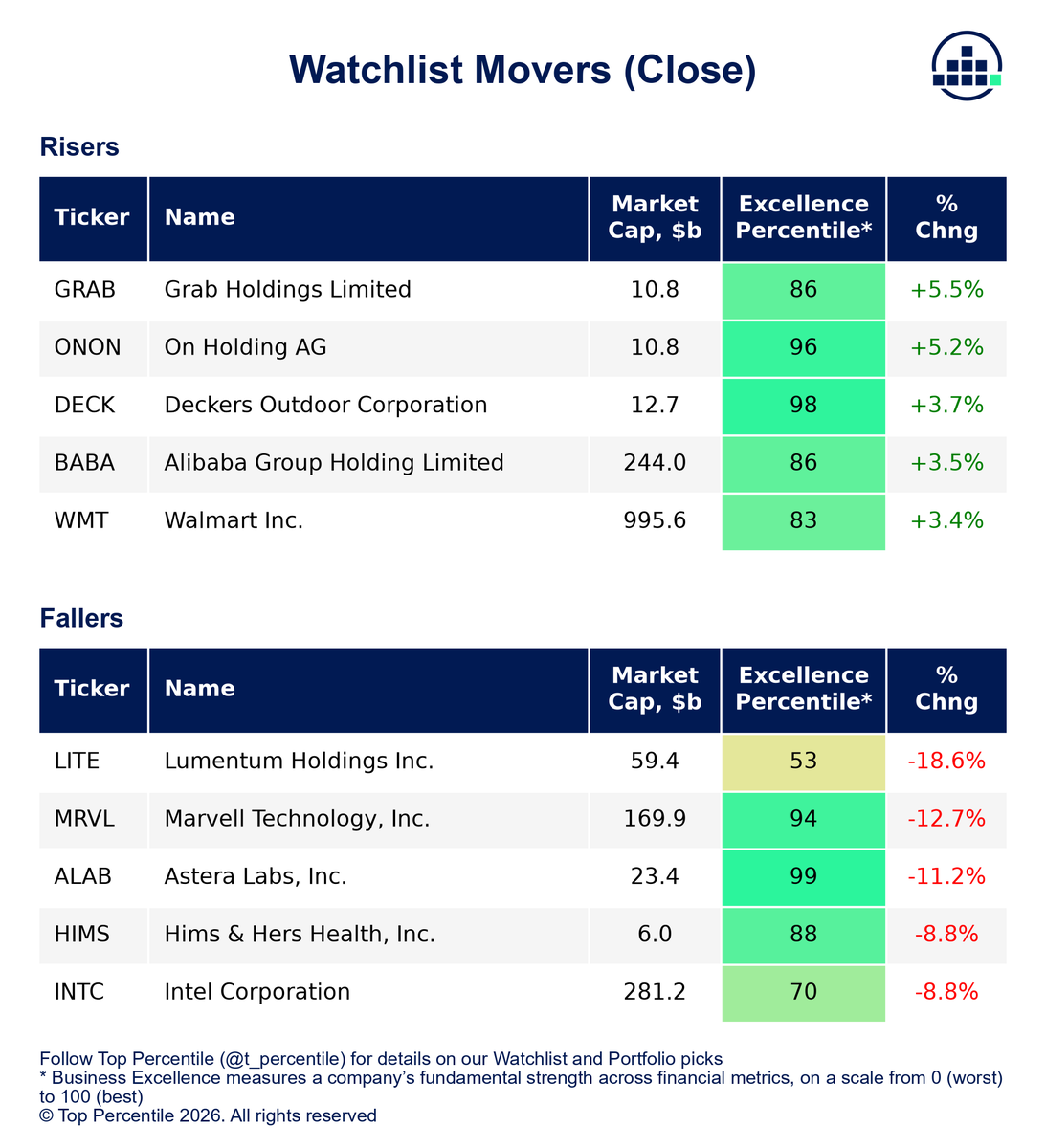
Marvell announced a $115bn deal to acquire Lumentum, making a huge bet on AI connectivity.
Yet both the buyer $MRVL and the target $LITE ended up on our biggest fallers list!
@MellieMelvc58 Good to hear your take! I agree there’s a huge opportunity for $NU in Latin America although managing the credit risk will be important.
Coming out of the $SOFI earnings call, one interesting detail was how loan pricing is changing.
Origination fees reached ~$271M in Q3, 2.6x YoY, boosting revenue while showing how much fee income remains tied to lending.
KEY TAKEAWAYS
◆ Credit quality improved. The estimated annualised personal-loan charge-off rate, excluding delinquent loan sales, fell to 3.4%, down 30 bps from Q2 and 80 bps YoY. The 90-day delinquency rate remained stable at 0.42%. Encouraging given record lending volumes.
◆ More ways to monetise lending. SoFi retained ~$9B of personal-loan originations on its balance sheet and originated $3.8B for partners through its Loan Platform Business, including personal, home-equity and small-business loans. Management will determine the mix based on risk-adjusted returns, not a fixed target.
◆ 2027 growth can be funded organically. Management says existing capital and future earnings can fund its 2027 outlook without additional equity. Its total capital ratio stands at 17%, well above the regulatory minimum.
◆ Technology Platform shows underlying growth despite the decline. Revenue fell 24% YoY following a major client transition, but grew 18% excluding that client. Management expects 25% growth in 2027.
WHAT ANALYSTS ASKED
Will Nance, Goldman Sachs
Q: With personal-loan coupon rates falling, are origination fees compensating for pressure on lending economics?
A: More than half of new personal loans now carry origination fees. Combined coupon and fee yield was broadly flat sequentially, while lower losses and funding costs lifted risk-adjusted returns by ~100 bps YoY.
Moshe Orenbuch, TD Cowen
Q: Can extraordinary growth in personal-loan originations continue into 2027?
A: Management expects continued growth, but with more of the increase coming from home loans and student-loan refinancing.
Dan Dolev, Mizuho
Q: How can SoFi fund 2027 growth without raising capital?
A: Management outlined ~$15B of available risk-weighted asset capacity from existing capital, plus ~$14B from expected organic capital generation. No equity raise is assumed.
Kyle Joseph, Stephens
Q: What’s driving the $6.4B revenue outlook for 2027?
A: Management expects Lending revenue to grow 25%, Financial Services 35%, and Technology Platform 25%, with broadly similar segment margins.
Andrew Jeffrey, William Blair
Q: How much further can revenue per product grow?
A: Monetisation can improve in investing, credit cards and deposits. But company-wide average revenue per product could decline as lower-revenue financial products become a larger part of the mix.
Lance Jessurun, Scotiabank
Q: How much of the Technology Platform recovery comes from external customers versus SoFi’s own products?
A: Management didn’t provide a breakdown, emphasising the platform’s value to both internal businesses and external clients.
Reginald Smith, Loop Capital
Q: Why did SoFi Plus subscription growth disappoint, and is the one-million-member target still achievable?
A: Management acknowledged weaker Q3 growth due to changes needed to address abusive signups and offers. Growth has resumed, with one million subscribers still targeted by end-2027.
Donald Fandetti, Wells Fargo
Q: Can SoFi reduce funding costs by attracting more checking deposits?
A: Attractive deposit rates also help acquire customers. Brokered deposits can sometimes be cheaper, so management optimises the funding mix based on overall economics.
UNRESOLVED QUESTION
◆ Can SoFi maintain these lending returns and improving credit performance as it scales towards its much larger 2027 and 2030 ambitions?
$SOFI SoFi is up around 9% premarket after strong Q3 earnings. Revenue and profitability beat expectations, while management raised its 2026 guidance and introduced a strong 2027 outlook.
HEADLINE PRINT
🟢 Adjusted revenue: $1.4B vs ~$1.26B expected (+44% YoY)
🟢 Adjusted EPS: $0.18 vs ~$0.17 expected
WHAT CHANGED
🟢 Fee-based revenue: $571M vs $472M Q2, now 42% of adjusted revenue
🟢 Loan originations: record $16.9B, with credit performance remaining in line with expectations
🟢 2027 adjusted revenue outlook: $6.4B, following raised 2026 guidance of $5.04B
WHY THIS EARNINGS MATTERS
◆ Fee-based revenue continues growing strongly, supporting SoFi’s expansion beyond traditional lending.
Record loan originations also show that lending remains a major growth engine, while credit performance is holding up. The 2027 outlook suggests management expects that momentum to continue.
REMAINING QUESTION
◆ Can SoFi sustain this pace of loan growth without weakening credit quality?
Big week for earnings across technology, software, healthcare and industrials.
I’m keeping it to four companies this week, across consumer technology, semiconductors and AI infrastructure.
Here are the earnings I’m focusing: $AAPL $AMD $ARM $IREN
$AAPL (Monday, after close):
Early iPhone 18 Pro sales are growing modestly, with strength concentrated in China, while rising component costs put pressure on margins.
Last earnings reaction: down 8.7%
◆ Question: Can the new iPhone cycle sustain growth through the holidays without further margin pressure?
$AMD (Tuesday, after close):
Data-centre revenue more than doubled last quarter, but the larger AI GPU opportunity still depends on turning major partnerships into actual deployments.
Last earnings reaction: down 0.5%
◆ Question: Can Instinct GPUs become a sustained growth engine alongside EPYC CPUs?
$ARM (Wednesday, after close):
Data-centre royalties more than doubled, while Arm is moving beyond licensing to sell its own AGI CPUs for the first time.
Last earnings reaction: down 1.3%
◆ Question: Can direct chip sales create a meaningful new growth engine without weakening Arm’s licensing economics?
$IREN (Thursday, after close):
IREN has $4B in contracted annualised revenue for its 2026 AI capacity, but only $1B was operational at its last update.
Last earnings reaction: down 10.4%
◆ Question: Can IREN bring its contracted capacity online on schedule and convert it into revenue without overstretching its finances?
Every earnings report reshapes the Top Percentile rankings.
$AAPL Apple earnings after markets close. The new iPhone cycle is getting underway, but rising memory costs are putting pressure on margins.
Stock: up 26.8% YTD | up 4.6% over 1 month | down 8.7% at last earnings
Apple has remained among the highest-quality businesses in the market for years. The iPhone 18 Pro had only nine days of sales in the September quarter, making the holiday outlook particularly important.
WHAT HAPPENED AT LAST EARNINGS
◆ Apple delivered a record June quarter, but gross margin benefited from roughly 2 percentage points of tariff refunds. Management warned that rising memory costs would put further pressure on margins.
WHAT MATTERS THIS EARNINGS
◆ Whether the holiday outlook points to sustained demand for the new iPhone cycle.
◆ Whether pricing and product mix can offset rising memory costs without further margin pressure.
Semis managed to find the bottom of the table in October. Semiconductor equipment was the standout laggard, down 24.7%.
Not everyone suffered. Energy gained 9.4%, utilities 7.9%, and both consumer sectors were up more than 6%.
@StokPix McDonald’s gets so much attention for its beginnings, especially through the movie The Founder. But the later story you’ve highlighted is even more fascinating!
@TrackNetWorth It really is! I feel torn during weeks like this. I have to prioritise pretty ruthlessly, so I’ll have to catch up on calls like $PLTR, $UBER, $QCOM, $LITE, etc. afterwards.
@amktparticipant Duo seems pretty cool despite what people say about the screen. That impacts their subsequent earnings but let’s see how the numbers doing overall
Great portfolio update from @SixSigmaCapital. Particularly liked the detail on the trading decisions and the approach to managing risk through a difficult October.
And nice to see a chart from our Top Percentile Monthly Market Review included too!