Emotion Review’s latest impact factor is 6.469. Its 5-year impact factor is 7.404, ranking it 12/140 in the Multidisciplinary Psychology category. Turn to Emotion Review for theory, critique, debate, and conceptual analysis about emotion.
Emotion Review’s latest impact factor is 4.547. Its 5-year impact factor is 5.550, ranking it 9/137 in the Multidisciplinary Psychology category. Turn to Emotion Review for theory, critique, debate, and conceptual analysis about emotion.
The 2018 Impact Factors have been released, and its good news!
Emotion Review’s 2018 impact factor is 4.547, which is an increase over last year's. The journal is ranked 9/137 in Psychology, Multidisciplinary. The five-year impact factor is 5.550.
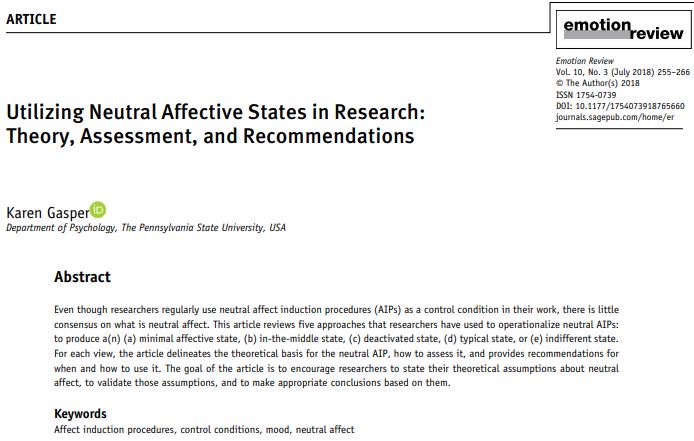
What does it mean to be in a "neutral affective state"? See Karen Gasper's analysis in our latest issue, which considers the implications for experimental research.
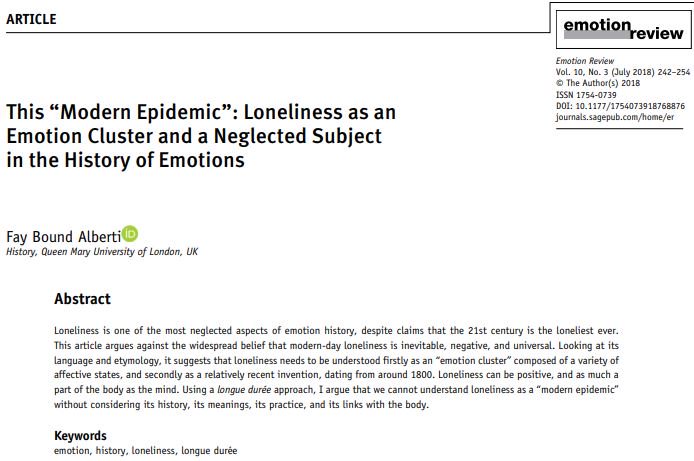
Read about the history of loneliness from the 16th century to the present day! In our current issue, historian Fay Bound Alberti analyzes the complex nature of modern-day loneliness and traces its historical development.
Our Special Feature on Brain and Emotion concludes with an article proposing that five brain networks underlie emotional elicitation and response. Article by David Sander, Didier Grandjean & Klaus Scherer, with commentary by Phoebe Ellsworth, and authors' reply.
In our latest Special Feature on Brain and Emotion, Luiz Pessoa argues that 19th and early 20th century biological approaches cannot account for the brain basis of emotions, which involve large-scale integrated systems. With commentary by Stefan Koelsch, and author's reply.
In our latest Special Feature on Brain and Emotion, Ralph Adolphs and Daniel Adler propose a methodological focus on emotions' functions rather than on feelings or specific neural circuitry. With commentary by Andrea Scarantino, and authors' reply.
Volume 10 Number 3 is in print! See the Special Section on Brain and Emotion, edited by Stephan Hamann, bringing together different perspectives on the brain basis of emotion with the aim of fostering discussion and interaction!
Emotion Review’s latest impact factor is 3.780.
Its 5-year impact factor is 5.129, ranking it 12/135 in the Multidisciplinary Psychology category.
Turn to Emotion Review for theory, critique, debate, and conceptual analysis about emotion.
Also in our latest issue, six articles addressing the following topics:
- Crying at Work
- Emotional Intelligence Training
- Sex Differences in Disgust
- Expectations and Empathy
- A Relational Approach to Emotion Regulation
- Affective Computing and Affect Measurement
Volume 10 Number 2, now in print, includes a Special Section on "Language and Emotion."
- Introduction by A. B. Satpute, with articles by:
- M. Gendron & L. F. Barrett
- D. A. Sauter
- Torre & Lieberman
After the conference #2018SAS, share your ideas with researchers beyond L.A.! Emotion Review welcomes manuscripts on emotion theory, conceptual analysis, and reviews of literature! And please message the editors if you have ideas for special issues! @affectScience
Also in our latest issue:
Jerome Kagan on "Brain and Emotion"
Miners, Côté, & Lievens on "Assessing the Validity of Emotional Intelligence Measures"
A Special Section on "Health and Emotion" is included in Vol. 10, No. 1 of Emotion Review, now in print. Articles on how negative emotions, well-being, appraisal of stress, and relationships affect physical health, plus commentaries!
Emotion Review welcomes manuscripts about the history of emotions! The journal is interdisciplinary and is read by emotion researchers in many fields. Please message the editors if you have ideas for special issues! @sfb1171@emotionshistory@ThinkEmotions
@CERE_Emotion After the conference, share your ideas with researchers beyond Glasgow! Emotion Review welcomes your manuscripts on emotion theory, conceptual analysis, and literature review! And please message the editors if you have ideas for special sections! #CERE2018