Today we go live on mainnet with the Fusion Rollup, the world's first multi-ledger rollup, connecting 74 blockchain networks in one unified environment, built for institutions.
When I started @quantnetwork in 2015, the vision was simple: make blockchain work for institutions at scale across any network, without the complexity and fragmentation that's held the industry back.
For years, institutions had two bad options: bet everything on a single chain, or stitch together insecure bridges across many. Fusion refuses that trade-off. It connects to many networks at once, moving assets, settling transactions, and messaging across chains as built-in capabilities, not workarounds.
The breakthrough is unified assets. A example of a stablecoin like USDC or tokenised fund like BUIDL or any other digital assetspread across 7 chains collapses into one: uUSDC or uBUIDL. One asset, one liquidity pool, instead of 7 copies and 7 fragmented pools. Each stays anchored to its origin chain and is withdrawable anytime. No custody or compliance trade-offs.
This isn't another layer 2 or a blockchain. It's a new category of infrastructure and it's live.
Read more on: https://t.co/MGfs1FgA6T
→ https://t.co/OQBfu2CEZb
→ https://t.co/4o9nnaA7zc
#QuantFusion #EnterpriseBlockchain #MultiLedgerRolleUp #FusionRollup
🚨 Highlights of Constellation 2017-2026 🚨
In 2017 the idea to build @Conste11ation Network, a global Layer-0 capable to secure and validate Big Data on the Hypergraph came to life, fueled by $DAG
In 2018, the first testnet went live.
In 2019, Constellation secured a United States Air Force SBIR Phase I contract.
In 2020, Mainnet 1.0 went live.
The Lattice Gateway went live.
In 2021, Constellation secured a second United States Air Force SBIR Phase II contract.
In 2022, Mainnet 2.0 went live.
Soft node staking went live.
In 2023, Constellation secured the USTRANSCOM UFR contract (also known as the "Direct Contract after SBIR Phase I&II).
IntegrationNet went live.
The DôR Technologies Metagraph went live.
Community validator nodes onboarding started.
In 2024, the USA Federal Metagraph went live.
The Common Crawl Metagraph went live.
In 2025, Tessellation V3 went live.
USA National DigiFoundry Metagraph went live.
Panasonic TOUGHBOOK Metagraph went live.
Digital Evidence Metagraph went live.
PacaSwap DEX Metagraph went live.
Real Estate Ledger went live.
Mainnet Explorer staking went live.
MiCAR compliance achieved (EU regulations).
TheUpsiderAI (first AI agent) as Metagraph went live.
Constellation became a global overall trusted AI infrastructure layer.
In 2026, AI² Holdings, a publicly listed holding company acquired Constellation Network for an estimated 173 million dollar + 25 million funding.
Constellation became part of a regulated holding company and as a Nasdaq-listed entity, it is subject to full SEC oversight, including mandatory filings.
Constellation Network and its native $DAG token became AIAI Holdings core infrastructure.
Also for 2026, Tessellation V4 release loading ⏳
Philippines National Lottery loading ⏳
BIOFI Metagraph loading ⏳
ChainStats Metagraph loading ⏳
Panasonic improvement loading ⏳
Lithuania stuff loading ⏳
National DigiFoundry progress loading ⏳
Pfizer. Lego. Visa. reMarkable.
All booked on Alkimi Exchange for the first time this quarter.
Alkimi has now had bookings from every media agency in the Publicis Groupe. All four.
$TEL : Review 📜
What if the first federally regulated crypto bank in America was built not by Wall Street bankers but by telecom engineers who spent 20 years connecting the world's unbanked to mobile networks?
Meet Telcoin - a blockchain-powered mobile financial platform that just made U.S. banking history. First Digital Asset Depository Institution charter in America. Bank-backed eUSD stablecoin. Connected to Federal Reserve payment rails. Remittances to 20+ countries at under 2% fees.
An EVM-compatible L1 validated by mobile network operators. GSMA member since 2018. Regulated in 6 countries. Targeting the $700 billion remittance market through the phones already in people's pockets.
Let's explore how Telcoin is building the Internet of Money. 👇
⚪ Telcoin at a Glance
Telcoin (TEL) is a blockchain-based fintech project that integrates telecommunications and regulated banking to deliver accessible, low-cost financial services to mobile users globally. The platform partners with mobile network operators to distribute wallet services, cross-border remittances, and token swaps.
The $TEL token has a maximum supply of 100 billion with ~96 billion in circulation (~96%). TEL functions as the gas token for the upcoming Telcoin Network, staking asset, and governance token.
As of May 2026, $TEL trades around $0.003 with a market cap of approximately $280M.
ATH was $0.064 in May 2021. Telcoin Digital Asset Bank received a final charter from Nebraska in November 2025, making it the first regulated digital asset depository institution in the US.
Marketplace Insight: Telcoin CEO participated in a private MWC roundtable hosted by Accenture and GSMA alongside executives from Mastercard, Huawei, and Standard Bank, discussing Accenture's report predicting up to $13 trillion in transaction volume could shift from traditional banking to alternatives like telecom finance and stablecoins by 2030. The Nebraska bank charter, eUSD stablecoin, and Telcoin Network mainnet make TEL one of the most regulatory-forward projects in crypto.
⚪ Mission
Telcoin's mission is to provide fast, affordable, and user-owned financial products to every mobile phone user in the world. The company's mission is to provide financial products to mobile phone users worldwide, targeting the estimated 1.7 billion unbanked individuals. By leveraging existing telecom infrastructure (5 billion+ subscribers globally), Telcoin bypasses the need to build new distribution networks, instead turning mobile operators into the on-ramps for decentralized finance.
🔵 A Brief History
Telcoin operates as a platform that combines mobile telecommunications networks with blockchain-based financial services. Founded in July 2017 by Paul Neuner, who has over 20 years of experience in telecommunications and cybersecurity, and Claude Eguienta, the company started in Singapore as Telcoin Pte. Ltd.
Paul Neuner's background in telecommunications, cybersecurity, and telecom fraud management, having founded Mobius Wireless Solutions, is central to Telcoin's strategy of partnering with mobile network operators to reach a broad user base. Eguienta brought deep technical expertise from distributed systems and crypto startups including CyberAgent and Kabotip.
In 2018, Telcoin became the first blockchain firm to join the GSMA, the global telecom industry body, signaling serious intent to operate within the existing telecom ecosystem rather than against it.
By 2020, Telcoin had integrated with mobile money services across 20+ countries, maintaining fees under 2% while traditional money transfer services charge 6-10%. The Telcoin Wallet launched on iOS and Android, enabling users to store, send, and swap 100+ digital assets.
In 2021, the company raised $10 million in a Series A funding round to support expansion. Telcoin also supported the Nebraska Financial Innovation Act, which created the framework for digital asset bank charters.
Everything changed in 2023-2024 as Telcoin pivoted from pure remittances toward comprehensive digital banking. The company secured regulatory licenses across six countries: US (Money Services Business), Singapore (Major Payment Institution), Canada, Australia, Lithuania, and Argentina.
In November 2025, Telcoin Digital Asset Bank received a final charter from Nebraska, making it the first regulated digital asset depository institution in the US. The bank can take deposits, connect to Federal Reserve payment rails, and issue the FDIC-insured eUSD stablecoin. TEL surged 95% on the announcement.
Earlier in 2025, Telcoin secured $25 million in additional funding specifically to capitalize the Digital Asset Bank. The Adiri testnet launched in December 2025, with full mainnet launch expected in 2026.
By May 2025, Telcoin achieved SOC 2 Type I certification, validating its security infrastructure. In March 2026, CEO Paul Neuner joined a Mobile World Congress roundtable alongside Mastercard, Huawei, and Standard Bank executives discussing the $13 trillion payment migration opportunity.
🔵 Ecosystem Narrative
Telcoin's ecosystem is built on a simple but powerful insight: 5 billion people already have mobile phones. Instead of building new infrastructure, use the telecom networks they're already on as the distribution layer for decentralized financial services.
Key dynamics include:
➛ Telcoin Digital Asset Bank (Nebraska charter) is the first federally regulated Digital Asset Depository Institution in the U.S. Can accept crypto deposits, connect to Federal Reserve payment rails, and issue eUSD stablecoin backed by USD deposits and short-term Treasuries.
➛ eUSD is a bank-issued, regulated stablecoin designed for cross-border remittances and mobile payments. Unlike algorithmic stablecoins, eUSD is backed by actual bank deposits and Treasuries with regulatory oversight.
➛ Telcoin Wallet is a self-custodial mobile app for storing, sending, and swapping 100+ digital assets. Remittances to 40+ e-wallets across 20+ countries at under 2% fees.
➛ Telcoin Network is an EVM-compatible Layer-1 blockchain validated by mobile network operators (MNOs). Turning telecom companies into blockchain validators aligns the incentives of the existing mobile infrastructure with DeFi.
➛ TEL burn mechanism activates with mainnet launch: TEL used for gas fees is burned, creating deflationary pressure tied directly to network usage.
➛ GSMA membership since 2018 gives Telcoin access to the global telecom industry body representing 750+ mobile operators and 400+ companies. Telcoin is the only blockchain project with this level of telecom industry access.
➛ Regulated in 6 countries (US, Singapore, Canada, Australia, Lithuania, Argentina) with additional corridors expanding.
➛ SOC 2 Type I certified, validating enterprise-grade security and compliance controls.
⚪ Token Utilities
$TEL powers the mobile-first financial ecosystem:
➛ Gas Token (Telcoin Network) - TEL pays for all transaction fees on the Telcoin Network. Gas fees are burned, creating deflationary pressure as usage scales.
➛ Staking & Validation - Stake TEL into the validator and liquidity layers of the Telcoin Network. MNOs serve as primary validators, with TEL stakers supporting network security.
➛ Governance - TEL holders participate in governance through the Telcoin Association and decentralized Miner Councils.
➛ Liquidity Mining - Provide liquidity on TELx (decentralized exchange) and earn fees from global exchange activity.
➛ Remittance Medium - TEL facilitates cross-border transfers through the Telcoin Wallet, with fees under 2%.
⚪ Key Features
➛ First U.S. Digital Asset Bank - Nebraska DADI charter (November 2025). Can accept deposits, connect to Federal Reserve rails, and issue regulated eUSD stablecoin. Historic.
➛ eUSD Stablecoin - Bank-issued, FDIC-insured, backed by USD deposits and short-term Treasuries. Designed for compliant cross-border payments at scale.
➛ Remittances to 20+ Countries - Telcoin Wallet sends money to 40+ e-wallets globally at under 2% fees. Targeting the $700 billion remittance market.
➛ Telcoin Network (L1) - EVM-compatible blockchain validated by mobile network operators. Turns existing telecom infrastructure into blockchain validators.
➛ GSMA Member Since 2018 - First and only blockchain project as a GSMA Associate Member. Access to 750+ mobile operators and 400+ companies globally.
➛ Regulated in 6 Countries - US (MSB), Singapore (MPI), Canada, Australia, Lithuania, Argentina. One of the most regulatory-forward crypto projects in existence.
➛ SOC 2 Certified - Enterprise-grade security and compliance validation.
➛ TEL Burn Mechanism - Gas fees burned on mainnet usage, creating deflationary pressure tied to real transaction volume.
🔵 Meet the Telcoin Team
Telcoin is led by telecom and fintech veterans who spent decades inside the mobile infrastructure industry before applying blockchain to solve its biggest problem: financial exclusion.
▶️ Core Members:
➛ Paul Neuner [ @TelcoinPaul ] - Co-Founder & CEO | 20+ years in telecommunications, cybersecurity, and telecom fraud management. Founded Mobius Wireless Solutions, providing solutions for mobile network operators globally. Championed the Nebraska Financial Innovation Act. Speaks at MWC, DIGITAL BANKING, and Flyover Fintech alongside executives from Mastercard, Citi, and Standard Chartered. His vision: telecom operators as the primary gateway for mainstream DeFi adoption.
➛ Claude Eguienta - Co-Founder | Master's degree in Computer Science with a focus on distributed systems. Previously co-founded Kabotip and served as lead systems architect at CyberAgent. Brings deep fintech and blockchain technical expertise that balances Neuner's telecom vision.
➛ Patrick Gerhart - President of Banking Operations | Formerly at P4Cap. Spearheads U.S. regulatory initiatives and Telcoin Digital Asset Bank operations. Leads the eUSD stablecoin rollout and Federal Reserve payment rail integration.
➛ Jeff Quigley - EVP Business Development & Communications | Former regional manager for Southeast Asia at Fenox Venture Capital. Drives partnerships, exchange listings, and ecosystem communications.
➛ Ryan Neuner - Core Team | Contributes to Telcoin's operational and strategic initiatives.
➛ Telcoin Association (Lugano, Switzerland) - Swiss non-profit overseeing the Telcoin platform through decentralized Miner Councils and governance.
🔵 Ratings
➛ Use Case: ★★★★✦ (4.5/5) - Telcoin has what almost no other crypto project can claim: a federally regulated U.S. bank charter, a working remittance app in 20+ countries, and GSMA membership giving access to 750+ mobile operators globally. The use case is tangible and massive: $700 billion remittance market, 1.7 billion unbanked people, 5 billion mobile subscribers. eUSD as a bank-issued, regulated stablecoin connected to Federal Reserve rails is a genuine innovation.
The Telcoin Network with MNO validators is a unique architecture. The 0.5 deduction is because despite 8+ years of development, actual user adoption remains modest relative to the vision. The mainnet hasn't launched yet. The bank hasn't begun full operations. The regulatory moat is real, but the execution gap between "chartered" and "scaling" is significant.
➛ Tokenomics: ★★★✦ (3.5/5) - 100 billion max supply with ~96% already circulating is a double-edged sword: there's minimal future dilution (positive), but the massive float at a sub-$0.01 price creates psychological barriers for retail investors. The upcoming burn mechanism (TEL burned as gas on mainnet) ties deflationary pressure directly to network usage, which is the right design.
Staking and validator participation will lock supply. However, the burn mechanism isn't live yet (mainnet pending), and TEL is down ~95% from ATH. The tokenomics become genuinely strong IF mainnet launches and transaction volume scales, but until then, the value capture remains theoretical.
➛ Audits: ★★★★ (4/5) - Telcoin's security posture is uniquely strong for a crypto project because it operates under actual banking regulation. SOC 2 Type I certified. Nebraska DADI charter required rigorous compliance validation. Regulated as a Major Payment Institution in Singapore, MSB in the US and Canada.
The Telcoin Wallet has operated since 2020 without a major fund-loss incident. The codebase is open-source. The 1-point deduction is because the Telcoin Network mainnet hasn't launched yet (and therefore hasn't been battle-tested), and the transition from Polygon to a custom L1 introduces new smart contract risk that will need comprehensive auditing.
➛ Community: ★★★★★ (5/5) - Telcoin has one of the most loyal, patient, and active communities in all of crypto. The "TEL Marines" have held through a 95% drawdown from ATH for 5+ years with unwavering conviction in the mission. The community rallied 95% on the Nebraska charter announcement and 76% on the MWC news, proving they respond to real catalysts, not hype cycles. Extremely active on X with constant engagement, technical discussions, and ecosystem updates.
The community spans crypto natives, telecom enthusiasts, and financial inclusion advocates who genuinely believe in connecting the unbanked. Active across Discord, Telegram, and X. When the bank charter was announced, the community didn't just celebrate the price pump, they celebrated the regulatory milestone. That's the difference between a community built on speculation and one built on mission. 8+ years of loyalty through a bear market, a delayed mainnet, and a 95% drawdown. That's conviction that rivals Bitcoin's early believers.
🔵 Conclusion
Telcoin is the most regulatory-forward crypto project in the world, and it just made American banking history. The first Digital Asset Depository Institution charter in the United States. A bank-backed stablecoin connected to Federal Reserve payment rails. Remittances to 20+ countries at under 2% fees. GSMA membership since 2018. Regulated in 6 countries. SOC 2 certified. And an EVM-compatible L1 where mobile operators serve as validators.
All built by a team that spent 20 years inside the telecom industry before deciding that blockchain was the missing piece.
The patience required to invest in Telcoin has been extraordinary. 8+ years of development. A 95% drawdown from ATH. A mainnet that keeps getting pushed back. Slow user adoption despite a massive addressable market. The gap between "we have a bank charter" and "we have a million daily users" is measured in years, not months.
But here's the fundamental case: 1.7 billion people are unbanked. 5 billion have mobile phones. The $700 billion remittance industry charges 6-10% fees for what should cost 2% or less. Traditional banks won't solve this because the unit economics don't work at their cost structure. Telcoin's model, using existing telecom infrastructure as distribution, a regulated bank as the compliance layer, and blockchain as the settlement rail, is the only architecture that connects all three pieces.
If mainnet launches, eUSD scales, and even a fraction of the $13 trillion projected payment migration materializes through telecom rails, the project trading at $280M market cap with a U.S. bank charter is either the most patient long-term play in crypto or the most frustrating. The charter is real. The app works. The regulation is done. The only question left is execution.
AI companies are spending billions on making models smarter. Almost nobody is spending anything on proving what those models actually did.
79% of enterprises say they're adopting AI agents. These agents make hiring decisions, approve loans, flag security threats, and write code that ships to production.
The EU AI Act requires logging of every high-risk AI decision starting August 2026. And the standard approach to meeting that requirement is a database table with timestamps.
That's not an audit trail. That's a log file. The difference matters. A log file lives on someone's server. The person who controls the server can edit it, delete it, or lose it.
When a regulator, a customer, or a plaintiff asks "what did your AI actually do on March 14th," a log file is a promise. It's not proof.
Proof requires something different. It requires a record that the person being audited can't change after the fact, and that anyone holding the record can independently verify wasn't tampered with.
That's what @Conste11ation Digital Evidence layer does. It creates tamper-evident records by periodically anchoring data to cryptographic fingerprints that can be verified by anyone. Not trusted. Verified. The difference between "we promise this log is accurate" and "here's the math that proves it."
$DAG is the token that powers this verification. Every time data gets validated and recorded through the network, snapshot fees are paid in $DAG.
More data activity means more fees. More AI agents operating in production means more decisions that need verifiable records, which means more demand for the infrastructure that produces those records.
This isn't theoretical. AIAI Holdings, which started trading on Nasdaq this week, owns six operating companies that generate data across AI, telemedicine, construction, IoT, and enterprise software.
Constellation Network is one of those companies. That data flows through the network. Those snapshot fees are paid in $DAG.
The companies acquiring AI security and audit infrastructure are paying real money for it.
Check Point bought Lakera for $300M.
Palo Alto Networks bought Protect AI for $500-700M.
Cisco bought Robust Intelligence for $400M.
F5 bought CalypsoAI for $180M.
The market has decided that AI accountability infrastructure is worth billions. And none of those acquisitions included a verification layer that works without trusting the vendor.
$DAG isn't a bet on token price. It's the fee layer for a type of infrastructure that every AI-deploying company will need and that almost nobody is building yet.
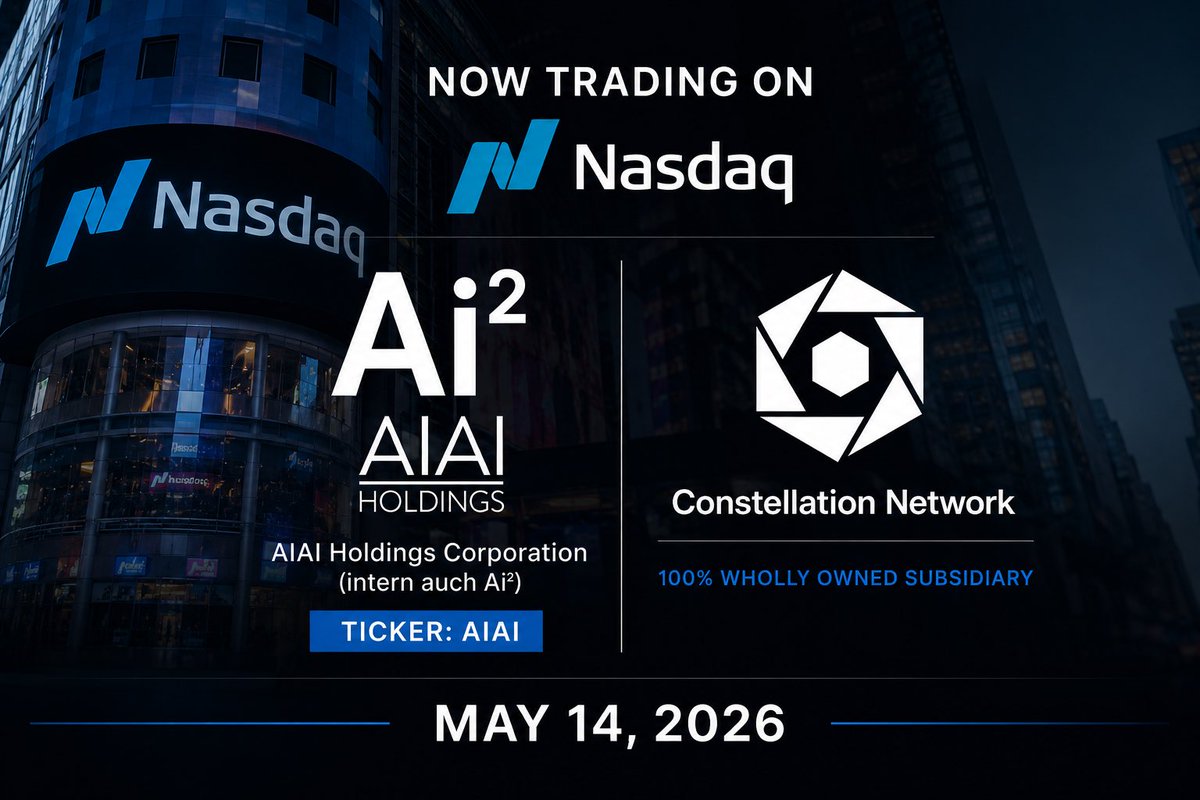
Constellation Network is now officially a wholly owned subsidiary of AIAI Holdings Corporation (Ai2).
This is no longer a proposed transaction.
It is complete.
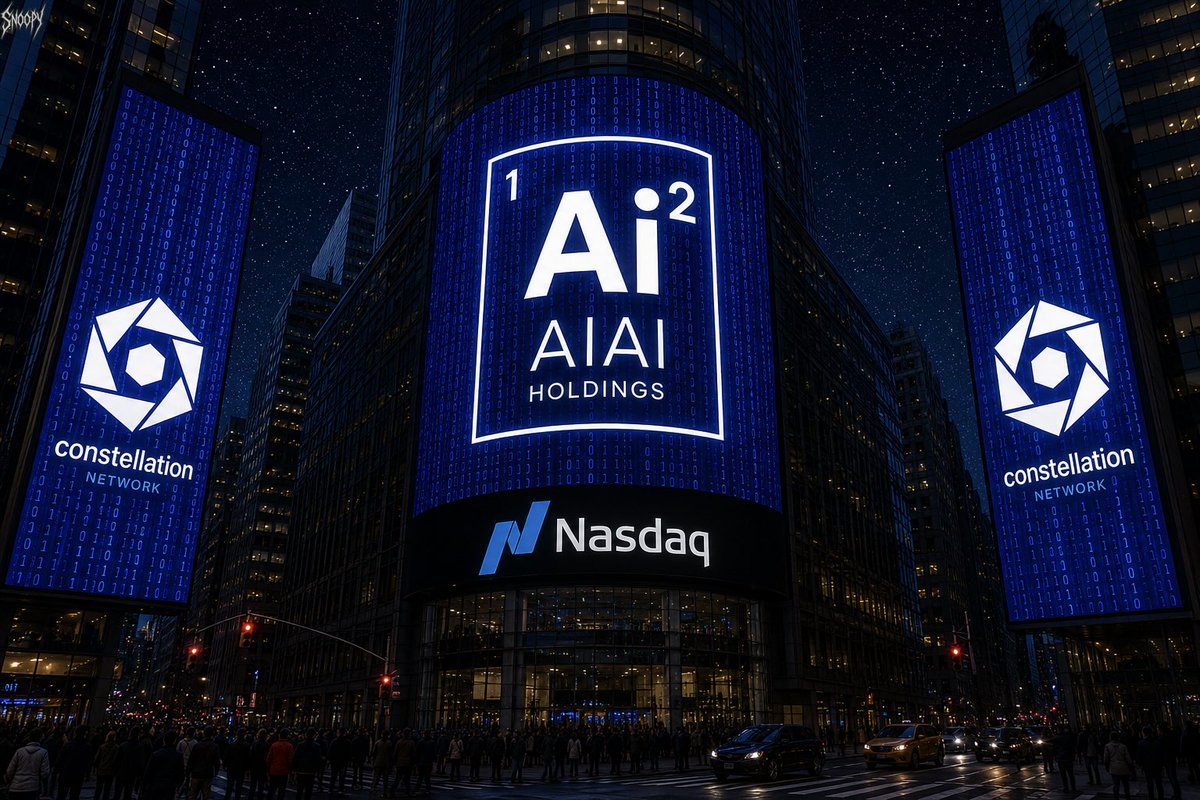
As $AIAI begins trading today, May 14, 2026, on Nasdaq, @Conste11ation becomes one of six core operating companies inside the publicly listed AI holding company.
Key facts
• Implied transaction value of approximately $175M
• Up to $25M in growth capital
• 2024 revenue of $6.4M
• Existing relationships with the U.S. Department of Defense
• 69,483,430 Class A shares registered for resale
• Direct Listing under the ticker $AIAI
Importantly, $DAG is not being listed on Nasdaq.
$DAG remains the native utility token of the Hypergraph. Its role is to power Snapshot Fees generated by real network activity.
Why this matters for $DAG
AIAI owns six operating businesses across AI, telemedicine, construction, IoT and enterprise software.
As these companies generate and validate data through Constellation’s Hypergraph, network utilization can increase.
More utilization means more Snapshot Fees and stronger real-world utility for $DAG. This is the core thesis.
Value is driven by enterprise usage rather than speculative trading alone.
After nearly nine years of building, Constellation is evolving from a standalone blockchain project into verifiable data infrastructure within a Nasdaq-listed AI company.
The next phase is execution.
Congratulations to @BenJorgensen, @berg_dave42, @digglesburner, @neoneue, @joaopfc, @codebrandes, @altifbrown, @TheUpsiderAI and the entire Constellation team and ecosystem, @Dagnum_PI, and the whole DAG family
You should all be incredibly proud of what you have built and what you have accomplished after nearly nine years of hard work, persistence and vision.
$DAG x $AIAI
ICYMI: Platform & Treasury Council Meeting – May 7th, 2026
The 37th Platform & Treasury Council meeting delivered major updates, highlighted by the official launch of the stable Adiri Testnet.
Network Updates
Stable Adiri Testnet is now live. This is the final long-running testnet before mainnet launch. In this environment, MNOs can now begin onboarding as validators and developers can start building and testing dApps on a persistent, stable network. Multiple improvements are live:
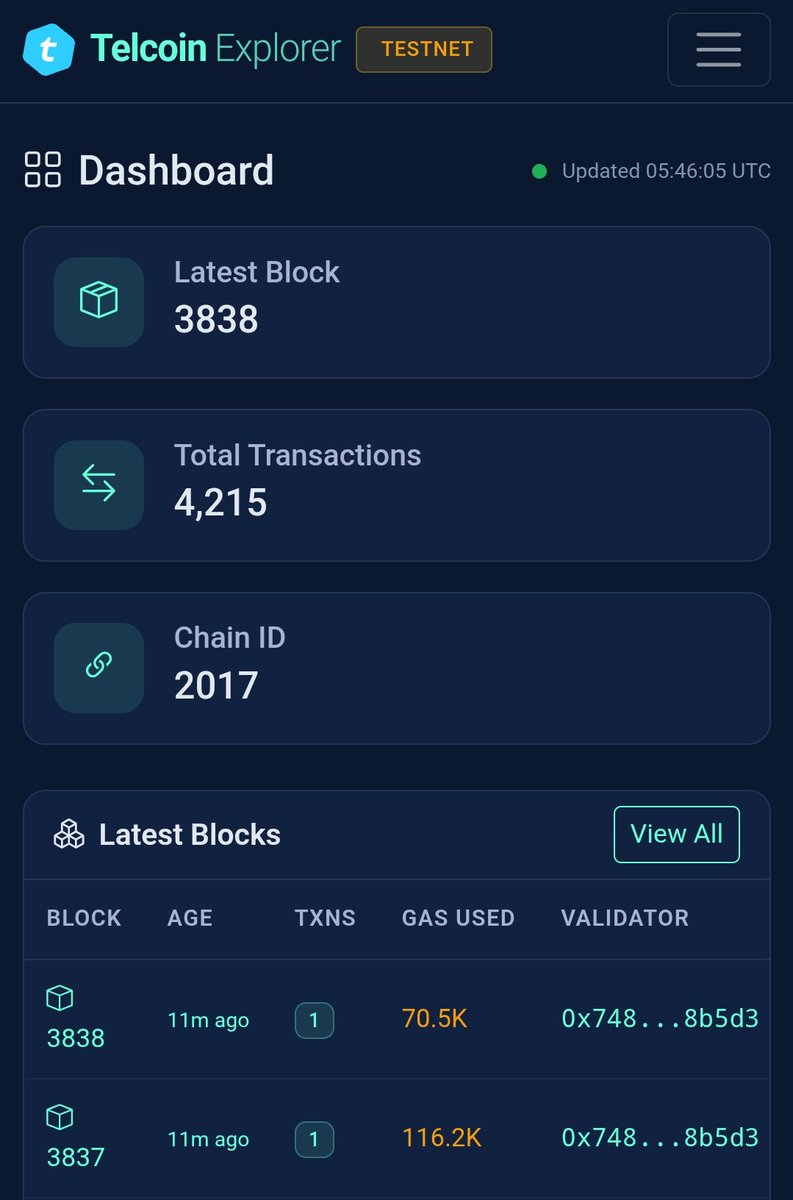
• Block explorer is live at https://t.co/n8SresKxvH.
• Faucet restored with stablecoin drip support.
• Significant progress on final state-breaking changes and pre-compiles.
• Validator capacity expanded dramatically (now supporting over 7,000).
• AI-assisted security scans continue; while third-party human audits are being prepared. Testnet nodes are actively being deploying in MNO data centers with improved tooling.
TEL Pets & Community Testing
TEL Pets continues to serve as an excellent real-world stress-testing tool for the network. Tel Pets is now approaching 3.7 million transactions. The next informal target is 5 million transactions, with a weekly leaderboard being alive to give newer players a fair chance to compete while preserving lifetime XP and progression.
Community participation is greatly appreciated and directly helps identify issues before mainnet.
Unified Web Presence
New progress was shared on the major Unified Web Presence project:
• Phase 1 (UX/UI research and prototyping) is now complete.
• Phase 2 (visual design system and interface design) is actively underway.
The team is building a full production-ready design system, UI kit, and interfaces for all key pages including: homepage, Association & Network pages, roadmap, partnerships, developer landing page, MNO landing page, ecosystem, and community sections. Focus is on responsive layouts and interactive prototypes during this “heavy lifting” design phase which is expected to finish in the next ~2 weeks.
The goal remains to complete the entire unified web presence by or before mainnet launch.
Other Updates
• Strategic Telecom Advisory engagement progressing
• Marketing & communications support proposal advancing
• Positive progress on MiCA registration in Europe
Full Video - https://t.co/OrxBvptitb
🌍 The global stage is set — Telcoin is taking center position!
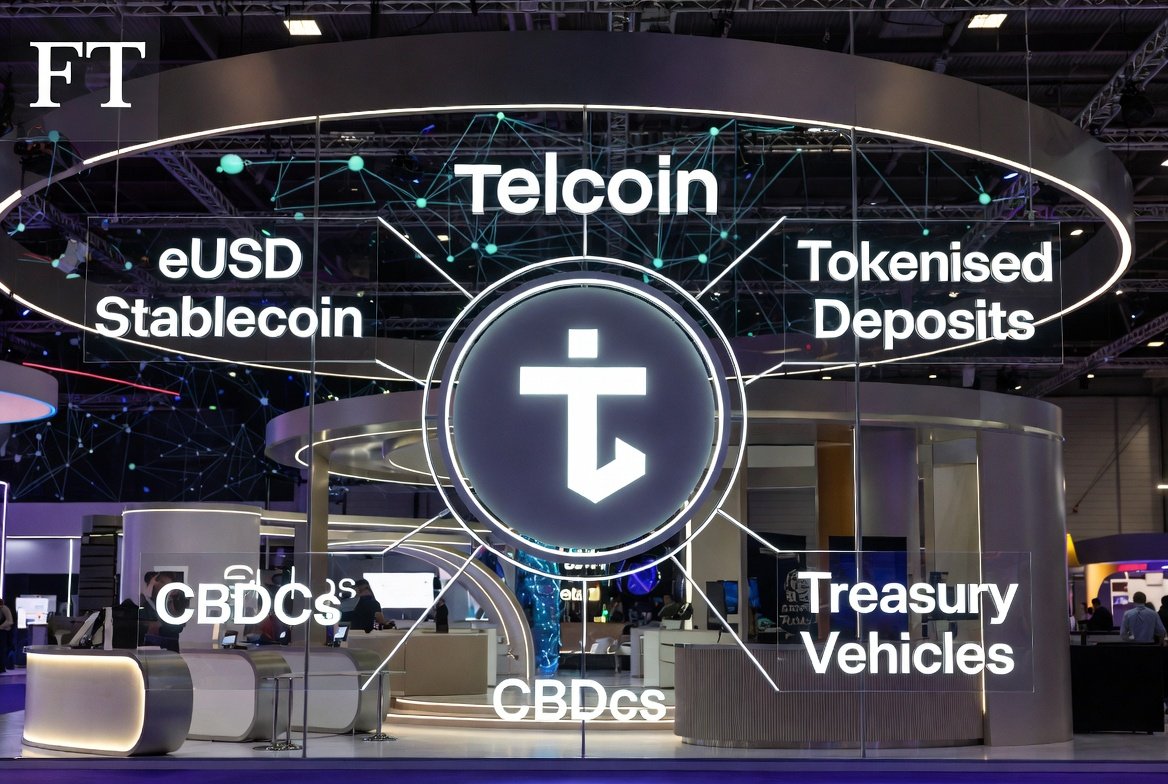
This Thursday, May 14 in London, @TelcoinPaul (Founder & CEO of @telcoin) will speak at the **Financial Times Digital Assets Summit 2026**.
He joins the critical panel **"The Stablecoin Wars"** discussing tokenised deposits, CBDCs, and the explosive growth of treasury vehicles.
Sharing the stage with experts from Swiss National Bank, DWS Asset Management and more.
With Telcoin’s regulated platform and eUSD stablecoin already in play, this is a major moment for real-world adoption.
Institutional eyes are on Telcoin right now.
How big of an impact do you expect this summit appearance to have on Telcoin’s trajectory? What’s your prediction? Let’s discuss below! 👇💡
#Telcoin #Stablecoin #DigitalAssets @telcoin@TelcoinPaul $TEL #FTSummit @FinancialTimes #eUSD #CBDC @RealAllinCrypto
What stands out about $QNT isn't exactly who they work with directly
It's how they position themselves.
As an OS, they're not quite positioning like an L1 would
Most DLTs chase direct partners with F500s & govts.
Quant takes a different route.
Rather than going straight for the big names...
Quant integrate with the very infrastructure, middleware, & software platforms already relied on every single day.
Instead of trying to onboard thousands of corporations one by one…
They plug into the systems already powering them.
Take Oracle for example.
Hundreds of Fortune 500 companies depend on Oracle Cloud Infrastructure across databases, applications, and enterprise operations.
Quant integrated Overledger directly into Oracle’s ecosystem to make interoperability accessible through existing enterprise workflows.
And as we've seen since.
Oracle's launched DLT solutions to connect digital assets with TradFi rails & even AI.
That's the work of Overledger showing.
Same idea with Zapier.
A massive percentage of Fortune 1000 companies already use Zapier to automate business processes between applications.
Quant enabled Overledger compatibility there as well, allowing DLT connectivity to extend into existing automation systems.
This is also seen in their most recent partner Murex.
Murex is a capital markets risk management platform used by 65 of the top 100 financial institutions.
The addition of Overledger allows the support of tokenized money and assets in these markets.
And that feature can be accessed by hundreds of leading institutions already thanks to the methods in which Quant integrates Overledger.
And then there’s SIA/Nexi.
One of Europe’s largest payments infrastructure providers responsible for millions of merchants and deep banking connectivity across the region.
They adopted Overledger years ago as part of their push toward blockchain-enabled financial infrastructure.
We also see this strategy extend into initiatives like LACChain and the UK’s Regulated Liability Network.
Not just corporate partnerships…
But integration into foundational economic and financial infrastructure itself.
And the reasoning is obvious.
Quant doesn't serve as the operational layer.
It serves as the orchestration layer.
And when you're orchestrating, you're not just hosting a platform for infrastructure.
You tie the different worlds of infrastructure together.
#Telcoin Network is close.
Adiri relaunched in MainNet ready mode. All remaining phase 3 dev tasks in-flight. Block explorer live at https://t.co/a3YDNqKcyE. MNOs onboarded & more onboarding.
Enormous body of work. Huge achievements. Get ready to fly.
$TEL the 🌐
Constellation Network & BioFi Global
Progress & Metagraph (BioFi newsletter)
$DAG x $BIOFI thread 🧵
During April, the team is pleased to share exciting updates. Below are the items in progress with Constellation! The first BioFi Metagraph continues to wait on operational updates from Constellation Network for an upcoming release, so it can be deployed to Production and out of the IntNet environment.
The BioFi Metagraph has been running successfully in the IntegrationNet infrastructure environment. Functionality to optimize the transaction snapshot has been fully verified. Final UAT testing is completed. The second BioFi Metagraph continues in the design phase.
Conversations have progressed to determine how to support a wrapped BioFi token on PacaSwap. Final UAT testing has been completed, and the BioFi Metagraph is now ready for transition to production.
The Data node for the BioFi Metagraph continues to execute flawlessly.
The second Metagraph is very exciting, and this new business line will be massive.
BioFi DAG nodes are continuing to execute with operational availability of 5 9s.
Continuing to collaborate with Constellation regarding a checklist review of all the results before submitting the operational package for production processing. This effort was halted while Constellation finalizes some operational updates.
All three existing Constellation BioFi nodes continue to be managed with server patch releases and some software version changes on the IntegrationNet.
We are excited to onboard @Conste11ation as a new #Chainlink node operator. As a DAG platform specializing in big data processing, Constellation will make refined enterprise data available for on-chain smart contracts. More details in the technical paper: https://t.co/pzchAvARgY
To give perspective on wallet distribution and how much constellation-labs:native is actually spread across the network:
There are currently 29,757 total wallets holding constellation-labs:native.
Out of those:
• 19,760 wallets hold LESS than 10K constellation-labs:native
• 9,997 wallets hold MORE than 10K constellation-labs:native
• 2,495 wallets hold MORE than 250K constellation-labs:native
• 440 wallets hold MORE than 1M constellation-labs:native
• Only 27 wallets hold MORE than 10M constellation-labs:native
🚨 These numbers do change as new wallets are made and constellation-labs:native token are acquired.
( Source: https://t.co/ai25aZN0XS
Shoutout to @CryptoFirebird )
Now combine that with this:
constellation-labs:native is currently around $0.0086ish with roughly a $33M market cap.
Its previous all time high was $0.4517 with a near $1.7B+ valuation.
That means even returning to its previous ATH from current prices would be roughly a 52x move.
And that ATH happened WITHOUT:
➡️ Full enterprise adoption
➡️Large scale snapshot utility
➡️AI infrastructure demand
➡️A Nasdaq connected AI holding company
➡️Public market exposure through AI² / $AIAI
People forget @Conste11ation already proved the market was willing to value this network dramatically higher years ago mostly off speculation and future potential alone.
Now there is:
✅DIGITAL EVIDENCE
✅@arca_wallet 🦅
✅@RELedger_io 🏠
✅@temtrace_ai 🛡️
✅@DorTechnologies / DTM’s 🚪
✅@invest_LT 🇱🇹
✅@TheUpsiderAI 🤖
✅@PacaSwap 🦙
✅@openpokerai ♦️
✅@krakenfx Listing 🐙
✅@base Bridge 🏗️
✅ $USDC.dag 💰
✅ National Digifoundry Metagraph 🛰️
✅@ChainStatsPro Metagraph incoming 📈
✅@BioFiGlobal Metagraph inbound📱
✅ Philippine Lottery on-chain 🎰
✅Sport Stadium Tokenization 🏈
✅Spaceport Tokenization 🛸
✅IRONSPIDR 🕷️
✅COMMUNITY MEMBERS BUILDING
✅ Enterprise infrastructure
development
✅ AI narrative alignment
✅ Utility focused tokenomics through snapshots
✅ Expanding ecosystem growth
✅ The AI² acquisition and @Nasdaq listing process underway
✅$25 Million capital growth on the way
I’m sure I’m missing a few more and I know there is so much more products waiting for the acquisition and listing to happen so the red carpet can be rolled out & announced.
With all that being said the wallet distribution is still incredibly tight at the higher levels.
Only 27 wallets worldwide hold over 10M constellation-labs:native.
That is an insanely small number if adoption, utility, and institutional visibility begin accelerating at the same time.
@BenJorgensen said today:
“The train has left the station.”
A lot of people are still watching from the platform while the infrastructure is actively being built in front of them.
And the crazy part?
The market still has not fully priced in what constellation-labs:native will become at scale.
And like @Dagnum_PI said “ constellation-labs:native is the Network”.
The AI² (AIAI Holding Inc.) acquisition of @Conste11ation and the @Nasdaq listing of $AIAI creates a structure that is extremely uncommon within blockchain and AI infrastructure.
What makes this unique is not simply that a public company is connected to crypto.
It is that a @Nasdaq listed AI company has acquired blockchain infrastructure whose native utility token powers the network itself.
That is a major distinction.
constellation-labs:native is not simply an investment asset.
constellation-labs:native is the utility token powering the @Conste11ation network itself:
✅ Network validation
✅ Data integrity
✅ Auditability
✅ Enterprise infrastructure
✅ Metagraph operations
✅ Trusted data workflows
AI² did not acquire @Conste11ation to simply hold blockchain exposure on a balance sheet.
@Conste11ation’s infrastructure was built around validating, securing, and auditing data flows which are becoming some of the most important challenges facing AI systems today.
‼️ Important Note ‼️
AI² publicly disclosed $25M in growth capital intended to scale the network, support builders, and accelerate ecosystem adoption.
As ecosystem activity expands, network snapshot usage and associated fees paid in constellation-labs:native could scale alongside it.
Snapshots are not just activity metrics.
Snapshots generate network fees.
Those fees are paid in constellation-labs:native because constellation-labs:native is the network itself.
That is a critical distinction many people still do not fully understand.
➡️ If network usage expands, snapshot activity increases.
➡️ If snapshot activity increases, network fees increase.
➡️ If network fees increase, demand for the utility powering that infrastructure increases alongside it.
At a time when AI is rapidly expanding into enterprise systems, finance, logistics, automation, defense, and real world data environments, trusted and verifiable infrastructure becomes increasingly important.
That directly aligns with what @Conste11ation has spent years building.
This is bigger than a company simply investing in crypto.
This is a publicly traded AI structure positioning blockchain infrastructure directly inside the future of trusted AI systems and real world data validation.
If AI becomes one of the defining technologies of the next decade, then the infrastructure responsible for securing, validating, and auditing that data could become just as important as the AI itself or even more important. 👀
That is why many of us believe we are witnessing the beginning of a completely new convergence between AI, public markets, and blockchain infrastructure.
This is the start of the
The AI² ERA.




![0xchainink's tweet photo. $TEL : Review 📜
What if the first federally regulated crypto bank in America was built not by Wall Street bankers but by telecom engineers who spent 20 years connecting the world's unbanked to mobile networks?
Meet Telcoin - a blockchain-powered mobile financial platform that just made U.S. banking history. First Digital Asset Depository Institution charter in America. Bank-backed eUSD stablecoin. Connected to Federal Reserve payment rails. Remittances to 20+ countries at under 2% fees.
An EVM-compatible L1 validated by mobile network operators. GSMA member since 2018. Regulated in 6 countries. Targeting the $700 billion remittance market through the phones already in people's pockets.
Let's explore how Telcoin is building the Internet of Money. 👇
⚪ Telcoin at a Glance
Telcoin (TEL) is a blockchain-based fintech project that integrates telecommunications and regulated banking to deliver accessible, low-cost financial services to mobile users globally. The platform partners with mobile network operators to distribute wallet services, cross-border remittances, and token swaps.
The $TEL token has a maximum supply of 100 billion with ~96 billion in circulation (~96%). TEL functions as the gas token for the upcoming Telcoin Network, staking asset, and governance token.
As of May 2026, $TEL trades around $0.003 with a market cap of approximately $280M.
ATH was $0.064 in May 2021. Telcoin Digital Asset Bank received a final charter from Nebraska in November 2025, making it the first regulated digital asset depository institution in the US.
Marketplace Insight: Telcoin CEO participated in a private MWC roundtable hosted by Accenture and GSMA alongside executives from Mastercard, Huawei, and Standard Bank, discussing Accenture's report predicting up to $13 trillion in transaction volume could shift from traditional banking to alternatives like telecom finance and stablecoins by 2030. The Nebraska bank charter, eUSD stablecoin, and Telcoin Network mainnet make TEL one of the most regulatory-forward projects in crypto.
⚪ Mission
Telcoin's mission is to provide fast, affordable, and user-owned financial products to every mobile phone user in the world. The company's mission is to provide financial products to mobile phone users worldwide, targeting the estimated 1.7 billion unbanked individuals. By leveraging existing telecom infrastructure (5 billion+ subscribers globally), Telcoin bypasses the need to build new distribution networks, instead turning mobile operators into the on-ramps for decentralized finance.
🔵 A Brief History
Telcoin operates as a platform that combines mobile telecommunications networks with blockchain-based financial services. Founded in July 2017 by Paul Neuner, who has over 20 years of experience in telecommunications and cybersecurity, and Claude Eguienta, the company started in Singapore as Telcoin Pte. Ltd.
Paul Neuner's background in telecommunications, cybersecurity, and telecom fraud management, having founded Mobius Wireless Solutions, is central to Telcoin's strategy of partnering with mobile network operators to reach a broad user base. Eguienta brought deep technical expertise from distributed systems and crypto startups including CyberAgent and Kabotip.
In 2018, Telcoin became the first blockchain firm to join the GSMA, the global telecom industry body, signaling serious intent to operate within the existing telecom ecosystem rather than against it.
By 2020, Telcoin had integrated with mobile money services across 20+ countries, maintaining fees under 2% while traditional money transfer services charge 6-10%. The Telcoin Wallet launched on iOS and Android, enabling users to store, send, and swap 100+ digital assets.
In 2021, the company raised $10 million in a Series A funding round to support expansion. Telcoin also supported the Nebraska Financial Innovation Act, which created the framework for digital asset bank charters.
Everything changed in 2023-2024 as Telcoin pivoted from pure remittances toward comprehensive digital banking. The company secured regulatory licenses across six countries: US (Money Services Business), Singapore (Major Payment Institution), Canada, Australia, Lithuania, and Argentina.
In November 2025, Telcoin Digital Asset Bank received a final charter from Nebraska, making it the first regulated digital asset depository institution in the US. The bank can take deposits, connect to Federal Reserve payment rails, and issue the FDIC-insured eUSD stablecoin. TEL surged 95% on the announcement.
Earlier in 2025, Telcoin secured $25 million in additional funding specifically to capitalize the Digital Asset Bank. The Adiri testnet launched in December 2025, with full mainnet launch expected in 2026.
By May 2025, Telcoin achieved SOC 2 Type I certification, validating its security infrastructure. In March 2026, CEO Paul Neuner joined a Mobile World Congress roundtable alongside Mastercard, Huawei, and Standard Bank executives discussing the $13 trillion payment migration opportunity.
🔵 Ecosystem Narrative
Telcoin's ecosystem is built on a simple but powerful insight: 5 billion people already have mobile phones. Instead of building new infrastructure, use the telecom networks they're already on as the distribution layer for decentralized financial services.
Key dynamics include:
➛ Telcoin Digital Asset Bank (Nebraska charter) is the first federally regulated Digital Asset Depository Institution in the U.S. Can accept crypto deposits, connect to Federal Reserve payment rails, and issue eUSD stablecoin backed by USD deposits and short-term Treasuries.
➛ eUSD is a bank-issued, regulated stablecoin designed for cross-border remittances and mobile payments. Unlike algorithmic stablecoins, eUSD is backed by actual bank deposits and Treasuries with regulatory oversight.
➛ Telcoin Wallet is a self-custodial mobile app for storing, sending, and swapping 100+ digital assets. Remittances to 40+ e-wallets across 20+ countries at under 2% fees.
➛ Telcoin Network is an EVM-compatible Layer-1 blockchain validated by mobile network operators (MNOs). Turning telecom companies into blockchain validators aligns the incentives of the existing mobile infrastructure with DeFi.
➛ TEL burn mechanism activates with mainnet launch: TEL used for gas fees is burned, creating deflationary pressure tied directly to network usage.
➛ GSMA membership since 2018 gives Telcoin access to the global telecom industry body representing 750+ mobile operators and 400+ companies. Telcoin is the only blockchain project with this level of telecom industry access.
➛ Regulated in 6 countries (US, Singapore, Canada, Australia, Lithuania, Argentina) with additional corridors expanding.
➛ SOC 2 Type I certified, validating enterprise-grade security and compliance controls.
⚪ Token Utilities
$TEL powers the mobile-first financial ecosystem:
➛ Gas Token (Telcoin Network) - TEL pays for all transaction fees on the Telcoin Network. Gas fees are burned, creating deflationary pressure as usage scales.
➛ Staking & Validation - Stake TEL into the validator and liquidity layers of the Telcoin Network. MNOs serve as primary validators, with TEL stakers supporting network security.
➛ Governance - TEL holders participate in governance through the Telcoin Association and decentralized Miner Councils.
➛ Liquidity Mining - Provide liquidity on TELx (decentralized exchange) and earn fees from global exchange activity.
➛ Remittance Medium - TEL facilitates cross-border transfers through the Telcoin Wallet, with fees under 2%.
⚪ Key Features
➛ First U.S. Digital Asset Bank - Nebraska DADI charter (November 2025). Can accept deposits, connect to Federal Reserve rails, and issue regulated eUSD stablecoin. Historic.
➛ eUSD Stablecoin - Bank-issued, FDIC-insured, backed by USD deposits and short-term Treasuries. Designed for compliant cross-border payments at scale.
➛ Remittances to 20+ Countries - Telcoin Wallet sends money to 40+ e-wallets globally at under 2% fees. Targeting the $700 billion remittance market.
➛ Telcoin Network (L1) - EVM-compatible blockchain validated by mobile network operators. Turns existing telecom infrastructure into blockchain validators.
➛ GSMA Member Since 2018 - First and only blockchain project as a GSMA Associate Member. Access to 750+ mobile operators and 400+ companies globally.
➛ Regulated in 6 Countries - US (MSB), Singapore (MPI), Canada, Australia, Lithuania, Argentina. One of the most regulatory-forward crypto projects in existence.
➛ SOC 2 Certified - Enterprise-grade security and compliance validation.
➛ TEL Burn Mechanism - Gas fees burned on mainnet usage, creating deflationary pressure tied to real transaction volume.
🔵 Meet the Telcoin Team
Telcoin is led by telecom and fintech veterans who spent decades inside the mobile infrastructure industry before applying blockchain to solve its biggest problem: financial exclusion.
▶️ Core Members:
➛ Paul Neuner [ @TelcoinPaul ] - Co-Founder & CEO | 20+ years in telecommunications, cybersecurity, and telecom fraud management. Founded Mobius Wireless Solutions, providing solutions for mobile network operators globally. Championed the Nebraska Financial Innovation Act. Speaks at MWC, DIGITAL BANKING, and Flyover Fintech alongside executives from Mastercard, Citi, and Standard Chartered. His vision: telecom operators as the primary gateway for mainstream DeFi adoption.
➛ Claude Eguienta - Co-Founder | Master's degree in Computer Science with a focus on distributed systems. Previously co-founded Kabotip and served as lead systems architect at CyberAgent. Brings deep fintech and blockchain technical expertise that balances Neuner's telecom vision.
➛ Patrick Gerhart - President of Banking Operations | Formerly at P4Cap. Spearheads U.S. regulatory initiatives and Telcoin Digital Asset Bank operations. Leads the eUSD stablecoin rollout and Federal Reserve payment rail integration.
➛ Jeff Quigley - EVP Business Development & Communications | Former regional manager for Southeast Asia at Fenox Venture Capital. Drives partnerships, exchange listings, and ecosystem communications.
➛ Ryan Neuner - Core Team | Contributes to Telcoin's operational and strategic initiatives.
➛ Telcoin Association (Lugano, Switzerland) - Swiss non-profit overseeing the Telcoin platform through decentralized Miner Councils and governance.
🔵 Ratings
➛ Use Case: ★★★★✦ (4.5/5) - Telcoin has what almost no other crypto project can claim: a federally regulated U.S. bank charter, a working remittance app in 20+ countries, and GSMA membership giving access to 750+ mobile operators globally. The use case is tangible and massive: $700 billion remittance market, 1.7 billion unbanked people, 5 billion mobile subscribers. eUSD as a bank-issued, regulated stablecoin connected to Federal Reserve rails is a genuine innovation.
The Telcoin Network with MNO validators is a unique architecture. The 0.5 deduction is because despite 8+ years of development, actual user adoption remains modest relative to the vision. The mainnet hasn't launched yet. The bank hasn't begun full operations. The regulatory moat is real, but the execution gap between "chartered" and "scaling" is significant.
➛ Tokenomics: ★★★✦ (3.5/5) - 100 billion max supply with ~96% already circulating is a double-edged sword: there's minimal future dilution (positive), but the massive float at a sub-$0.01 price creates psychological barriers for retail investors. The upcoming burn mechanism (TEL burned as gas on mainnet) ties deflationary pressure directly to network usage, which is the right design.
Staking and validator participation will lock supply. However, the burn mechanism isn't live yet (mainnet pending), and TEL is down ~95% from ATH. The tokenomics become genuinely strong IF mainnet launches and transaction volume scales, but until then, the value capture remains theoretical.
➛ Audits: ★★★★ (4/5) - Telcoin's security posture is uniquely strong for a crypto project because it operates under actual banking regulation. SOC 2 Type I certified. Nebraska DADI charter required rigorous compliance validation. Regulated as a Major Payment Institution in Singapore, MSB in the US and Canada.
The Telcoin Wallet has operated since 2020 without a major fund-loss incident. The codebase is open-source. The 1-point deduction is because the Telcoin Network mainnet hasn't launched yet (and therefore hasn't been battle-tested), and the transition from Polygon to a custom L1 introduces new smart contract risk that will need comprehensive auditing.
➛ Community: ★★★★★ (5/5) - Telcoin has one of the most loyal, patient, and active communities in all of crypto. The "TEL Marines" have held through a 95% drawdown from ATH for 5+ years with unwavering conviction in the mission. The community rallied 95% on the Nebraska charter announcement and 76% on the MWC news, proving they respond to real catalysts, not hype cycles. Extremely active on X with constant engagement, technical discussions, and ecosystem updates.
The community spans crypto natives, telecom enthusiasts, and financial inclusion advocates who genuinely believe in connecting the unbanked. Active across Discord, Telegram, and X. When the bank charter was announced, the community didn't just celebrate the price pump, they celebrated the regulatory milestone. That's the difference between a community built on speculation and one built on mission. 8+ years of loyalty through a bear market, a delayed mainnet, and a 95% drawdown. That's conviction that rivals Bitcoin's early believers.
🔵 Conclusion
Telcoin is the most regulatory-forward crypto project in the world, and it just made American banking history. The first Digital Asset Depository Institution charter in the United States. A bank-backed stablecoin connected to Federal Reserve payment rails. Remittances to 20+ countries at under 2% fees. GSMA membership since 2018. Regulated in 6 countries. SOC 2 certified. And an EVM-compatible L1 where mobile operators serve as validators.
All built by a team that spent 20 years inside the telecom industry before deciding that blockchain was the missing piece.
The patience required to invest in Telcoin has been extraordinary. 8+ years of development. A 95% drawdown from ATH. A mainnet that keeps getting pushed back. Slow user adoption despite a massive addressable market. The gap between "we have a bank charter" and "we have a million daily users" is measured in years, not months.
But here's the fundamental case: 1.7 billion people are unbanked. 5 billion have mobile phones. The $700 billion remittance industry charges 6-10% fees for what should cost 2% or less. Traditional banks won't solve this because the unit economics don't work at their cost structure. Telcoin's model, using existing telecom infrastructure as distribution, a regulated bank as the compliance layer, and blockchain as the settlement rail, is the only architecture that connects all three pieces.
If mainnet launches, eUSD scales, and even a fraction of the $13 trillion projected payment migration materializes through telecom rails, the project trading at $280M market cap with a U.S. bank charter is either the most patient long-term play in crypto or the most frustrating. The charter is real. The app works. The regulation is done. The only question left is execution.](https://pbs.twimg.com/media/HIm1lLWakAABImW.jpg)