In practice, it’s unimpressive/unimportant to build a VMM that can “start N lightweight Sandboxes fast”. An LLM can oneshot that!
IMO, the hard, unsolved, problem is thinking about tasteful primitives to enable real apps at scale:
What I/O surfaces do I expose?
How do I let my users secure their own data?
What does it mean to build homes for agents at scale?
How do my Sandboxes compose intuitively with other systems?
etc.
@shinzui it’s abstract enough to not concern itself with any real practicality. don’t think the hard problem is the pie in the sky architecture. the tactics is where all of the difficulty is sitting. https://t.co/FAPWOpTzHn
the tug of war between vertical domain specific systems and horizontal platforms is as old as time.
https://t.co/gO5lr7611c was the first serious contender for the “one and only application layer software to exist”. many more like https://t.co/uP6IYrqOGF, palantir ontology, puter.js and more recently cloudflare OS follow in its footsteps.
the genesis of all these platforms coincides with a paradigm shift (ie web, cloud, mobile). every new era starts with enthusiasm about what is possible, and ends with acceptance of what is viable.
you could argue that the reason we haven’t reached this idealistic state so far is due to the weakness of the technology. https://t.co/gO5lr7611c required integrators, a custom IDE, a proprietary language etc. surely AI coding is different.
the problem is that no matter how you spin it, specialized problems are always better served by specialized solutions. it’s not that the technology is bad, it’s that the customer expectations shift with each turn.
good interfaces and primitives are not just UI/UX. delivering a good experience may seem simple on the surface, but getting under 100ms response, under diverse conditions and at a scale that most apps require, most often requires solving hard systems problems.
yes RSI is around the corner, and software is created literally on the request path, but collaboration is a socio-technical concept that transcends the technical. auditing, relational data models, versioning are all there not because they’re technical necessities, they are there to solve knowledge organization problems.
and the thing is, AI doesn’t magically evaporate user expectations or the need for informational structure. easier, maybe, but there are still constraints that make generalized platforms inferior to specialized apps.
it’s easy to dismiss everything above as “not sufficiently AGI-pilled”, but then why have “inboxes”? why have RBAC? why apps?clearly the infinite agent drive app canvas is the end game in the long term, but in the short term, we still have to build specialized, token efficient, “traditional” software.
I think the post is more RSI-pilled than you are. At this rate the models will be giving the guarantees you’re talking about.
It’s also kind of abstract, which allows it to gloss over prosaic things such as “does spending tokens to build vs acquire make sense?”. There is still a cost to tokens and we are very far away from $20 in tokens being able to offer the product, support and guarantees on the market today.
the tug of war between vertical domain specific systems and horizontal platforms is as old as time.
https://t.co/gO5lr7611c was the first serious contender for the “one and only application layer software to exist”. many more like https://t.co/uP6IYrqOGF, palantir ontology, puter.js and more recently cloudflare OS follow in its footsteps.
the genesis of all these platforms coincides with a paradigm shift (ie web, cloud, mobile). every new era starts with enthusiasm about what is possible, and ends with acceptance of what is viable.
you could argue that the reason we haven’t reached this idealistic state so far is due to the weakness of the technology. https://t.co/gO5lr7611c required integrators, a custom IDE, a proprietary language etc. surely AI coding is different.
the problem is that no matter how you spin it, specialized problems are always better served by specialized solutions. it’s not that the technology is bad, it’s that the customer expectations shift with each turn.
good interfaces and primitives are not just UI/UX. delivering a good experience may seem simple on the surface, but getting under 100ms response, under diverse conditions and at a scale that most apps require, most often requires solving hard systems problems.
yes RSI is around the corner, and software is created literally on the request path, but collaboration is a socio-technical concept that transcends the technical. auditing, relational data models, versioning are all there not because they’re technical necessities, they are there to solve knowledge organization problems.
and the thing is, AI doesn’t magically evaporate user expectations or the need for informational structure. easier, maybe, but there are still constraints that make generalized platforms inferior to specialized apps.
it’s easy to dismiss everything above as “not sufficiently AGI-pilled”, but then why have “inboxes”? why have RBAC? why apps?clearly the infinite agent drive app canvas is the end game in the long term, but in the short term, we still have to build specialized, token efficient, “traditional” software.
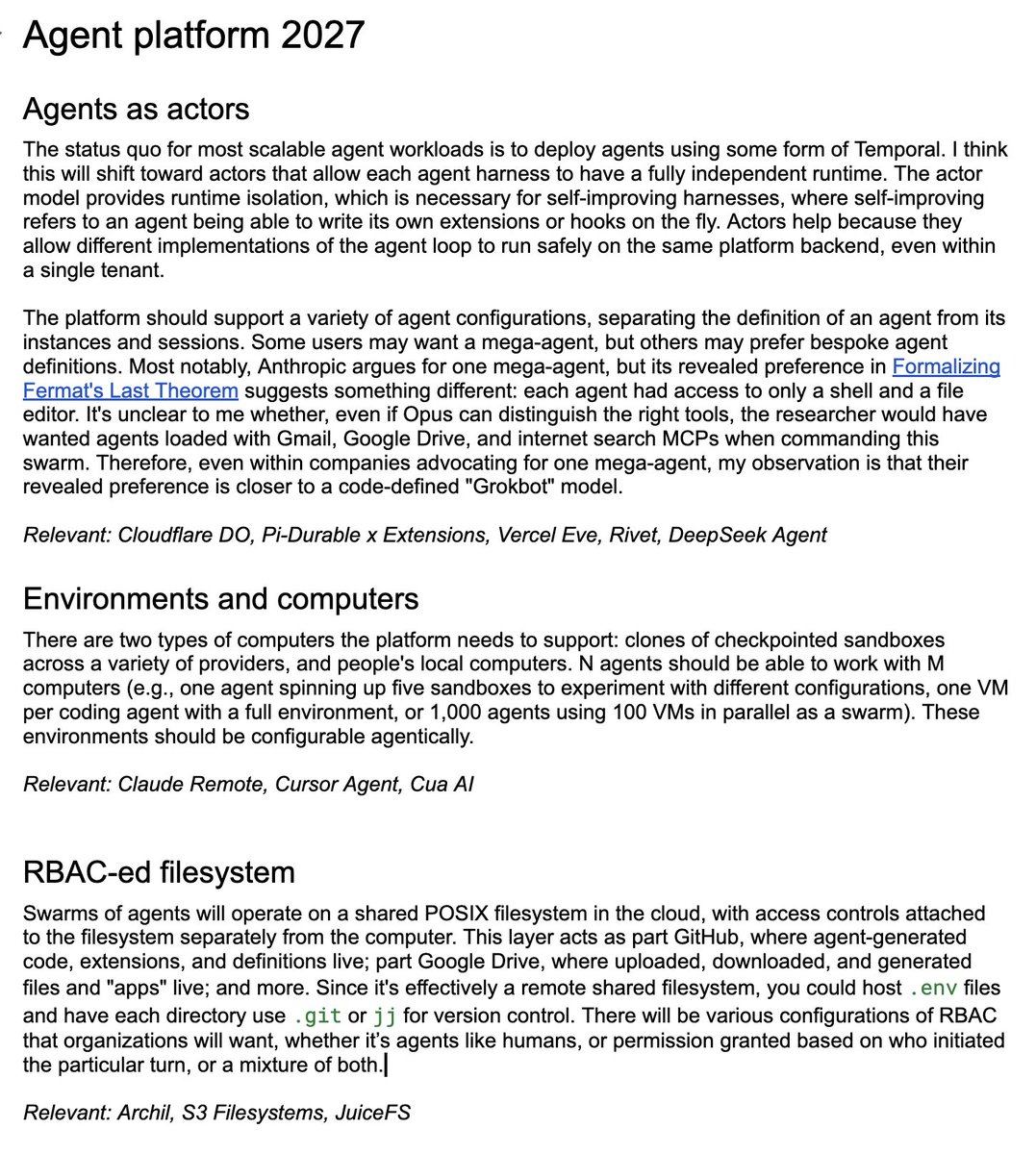
Agent platform of 2027.
This is the end game. This is the blueprint for the one and only application layer software that will exist. Every other software will effectively become databases for this layer, the everything agentic operating system for the million agent swarm to work on top of.
This is obviously the end game vision for the application layer of ChatGPT and Claude. I have reasons to believe that an independent company will own this product layer. But most ADE, "enterprise agent platform", or vertical saas companies, are focused on the wrong things far too narrowly, not technically competent, and do not have the product / technical vision to see this inevitable future.
The correct agent platform that wins will function like the base of a garden, from which customers will plant their unique "seeds" to grow their own plants and trees, managed and evolved by agents, humans, and signals from the sensors of the business. This presents a clearer picture than "factory of a factory" imo.
@michaellatulip i think most people see interface as an easy thing to replicate. of course that’s idiotic. interface choices can require significant tech behind the scenes that can’t just be spawned on-demand.
@gonzalo__nunez I don’t think this is monetizeable. This is just a framework. No one monetized Ruby on Rails directly. Value capture was add on services and applications that offered a superior experience because they were built on RoR.
good post, but it skims over a very important part. filesystems don’t have a good way of representing relationships and data invariants. duck-taping a database on top of a filesystem is fragile. you need a posix-like filesystem that is built on top of database.
Agent platform of 2027.
This is the end game. This is the blueprint for the one and only application layer software that will exist. Every other software will effectively become databases for this layer, the everything agentic operating system for the million agent swarm to work on top of.
This is obviously the end game vision for the application layer of ChatGPT and Claude. I have reasons to believe that an independent company will own this product layer. But most ADE, "enterprise agent platform", or vertical saas companies, are focused on the wrong things far too narrowly, not technically competent, and do not have the product / technical vision to see this inevitable future.
The correct agent platform that wins will function like the base of a garden, from which customers will plant their unique "seeds" to grow their own plants and trees, managed and evolved by agents, humans, and signals from the sensors of the business. This presents a clearer picture than "factory of a factory" imo.
@chirpingalex@john_ssuh thats why u need a good version control system that can maintain one canonical "master" version and many different branches that can evolve independently.
oh and @john_ssuh i know everyone is saying "this is exactly what we're building at _ " but im curious what u think of this as an embodiment of what u described.
@john_ssuh hierarchy is just a tool for coordination. id be curious how you handle this. append only logs is certainly one way to do this but you still have to materialize some sort of view on top of them. again whether it’s implicit or explicit it exists.
@deansacoransky@john_ssuh i think there is a distinction between how you specify and how you enforce. you can express it any way you want, but guardrails depend on deterministic enforcement.
the ontology can be implicit or explicit, but it will exist no matter what. companies operate around strict models even where the underlying data is unstructured. you should always be able to evolve your strict model, but at any given point there is a canonical model that gives u the ability to coordinate between multiple actors.
see below
this sort of pitch would have gotten you laughed out of a room in 2020. most people believed that all important classifiers were already built.
if you needed a classifier that didn’t exist, you were most likely solving a problem that didn’t really matter economically. ie building a classifier cost more than the $ made from selling it.
turns out solving for the long tail of classifiers can actually be very valuable when the value greatly exceeds the cost. solving millions of small problems is as valuable as solving a few big problems.
in fact u can throw classifiers in to solve any problem. they are the logic gates of computation.
so the total nr of classifiers the world needs grows as more people are able to create them.
this is, in many ways, the story of AI as a totally new computation substrate. it’s more helpful to forget all you know about computer science today and re-learn it based on all the new primitives AI brings in.
Jev is just a classifier.
It enables a software engineer to create and use a bert-style classifier within minutes, replacing what use to take a specialized ML team often months to do (create a dataset, train a model, serve it themselves).
@PatrickToulme i think this is the most awful sentence ive ever read:
wouldn’t be shocked if they don’t start releasing a public version of their models that is RLed to speak normal English but use an information dense model internally.
how did u pack in 3 negations like that
🚨 JUST NOW: Elon Musk is holding NOTHING BACK at people suggesting he's a Russia apologist
"Let me anticipate your questions! 'Is Russia the aggressor?' Russia IS the aggressor, but it's also true that WE as America staged a COUP to overthrow the democratically-elected pro-Russian President of Ukraine."
"SpaceX has resulted in 2/3rds reduction of Russian space activity...I'm not exactly someone who has AIDED Russia. We have no business in Russia. We have NOTHING in Russia."
Some "Russian asset" who helped Ukraine against a total collapse after the invasion and has enabled Starlink while Zelensky attacks him anyway!
Elon just wants the war to end. That's the truth.