LOL @lexi_lambda, I'm arguing (sic!) with Claude about how ridiculously stupid function it has written in Go, and this just happened:
I have not mentioned you once in that conversation.
Gödel's incompleteness theorem is one of those things that math popularisers always talk about as a hugely important result.
But according to @3blue1brown, it almost never comes up in practice. It's a weird pathology that nobody expects to matter for the big questions.
Avi Wigderson is the only person in history to have won both a Turing Award (computer science) and Abel Prize (math). I interviewed him all about his field. We discussed:
• His intuition on a proof of P vs NP
• Why we use SAT solvers for most NP problems
• Zero knowledge proofs and their impact
• Quantum computation and implications
• Math and computer science's relationship
Where to watch:
• YouTube: https://t.co/zViqAulFCo
• Spotify: https://t.co/iat08Xob17
• Apple Podcasts: https://t.co/jOYDGtGVnt
• Transcript: https://t.co/k4zS7yOhnw
Thank you to this episode's sponsors for supporting my work:
• WorkOS: makes your app Enterprise Ready with easy to use APIs to add SSO, SCIM, RBAC, and more in just a few lines of code, check them out at https://t.co/y8noBzFEem
Timestamps:
00:00 - Intro
01:08 - P vs NP
14:51 - What if you relaxed correctness
25:38 - Why NP complete problems are equivalent
30:33 - Space vs time complexity
43:06 - Why people use SAT solvers
45:53 - Randomness is a resource
55:48 - Randomness depends on computational power
01:21:20 - Zero knowledge proofs and their significance
01:38:30 - Quantum computation and why it matters
01:56:24 - Math vs computer science
02:08:16 - Major breakthroughs and his experience
02:12:31 - Advice for his younger self
02:14:48 - Outro
Agent amnesia isn’t a feature - it’s an expensive habit.
@modiqoai just dropped the cure with rote: turning one-shot agent explorations into permanent, deterministic flows that every future agent can reuse instantly.
No more re-learning the same APIs. No hosted gateways. Just pure outcome maxxing.
This is how agentic systems actually scale. Thread 👇is required reading w/ ☕
"There is no magical checkmark for software correctness."
At Bug Bash 2026, @bugarela made the case for chasing confidence instead, and showed why the AI era raises the stakes.
Here's a breakdown 🧵
I seriously thought that those days were over with Turbo Pascal
```
}
goto done
```
My eyes.
#GoLang 🤦♂️
Something, something Dijkstra (https://t.co/S1GCC7gCu6)
Two months ago, I did a presentation "From Micrograd to coppergrad: Building Neural Networks and Backpropagation from Scratch in Rust"
A bit of math, a bit of machine learning, a bit of Rust.
Enjoy!
https://t.co/aUx2jAb5cz
Anthropic is deeply incompetent at building software that works reliably.
Their users would be happier if they focused on the model and outsourced the tooling to engineers who go beyond 'vibe coding'.
Sci-Hub is an evil website that pirated 85M+ research papers and made them freely available
And now they've added AI to their database to make Sci-Bot.
It answers your questions using latest, full-text articles.
But DO NOT use it. We should all try to make billion-dollar academic publishers richer.
I'm putting the link below so you know how to avoid it.
Call For Pages is still open! We're calling all authors and artists who would like to be a part of Paged Out! Issue #9. Our email [email protected] is waiting!
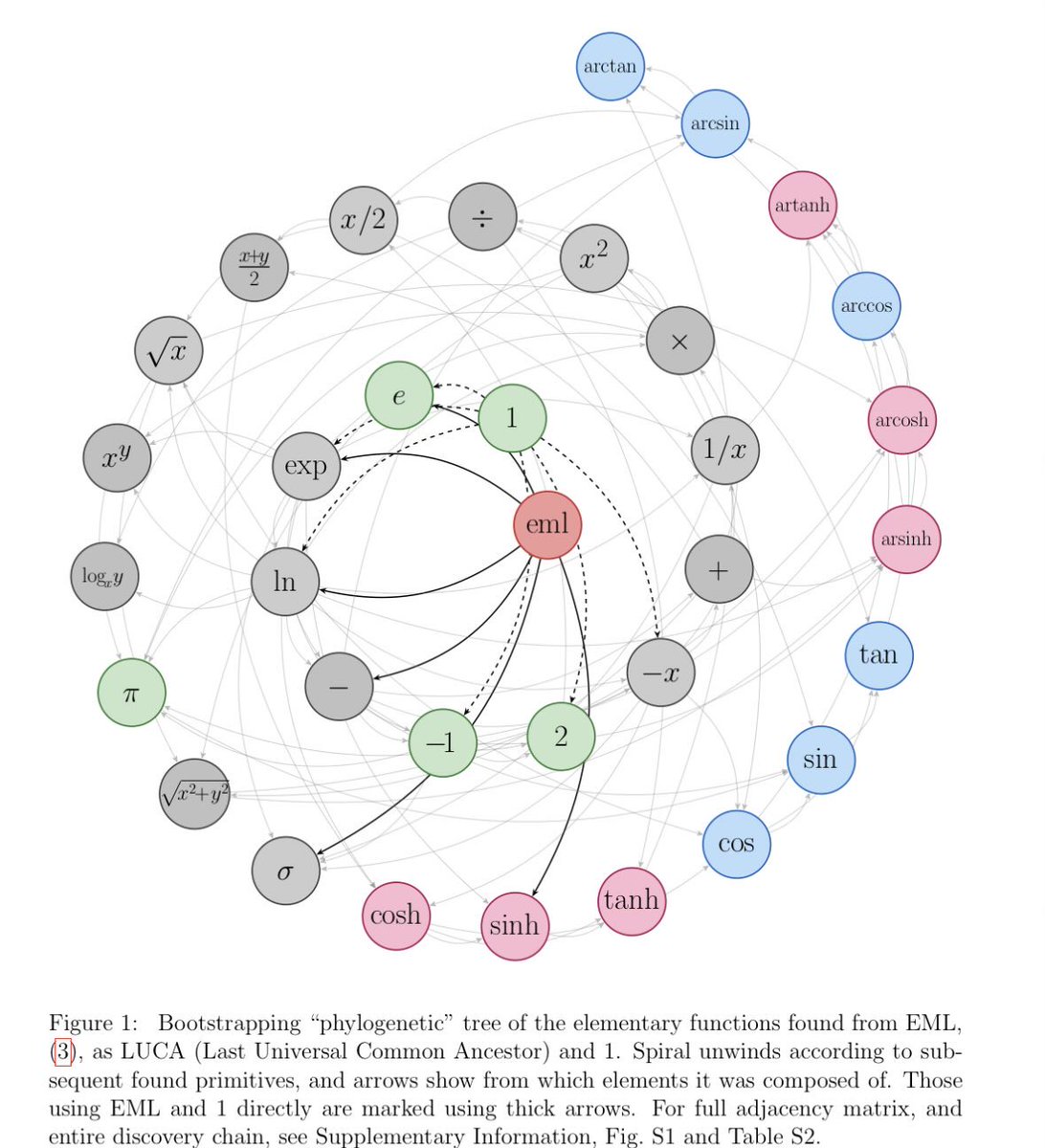
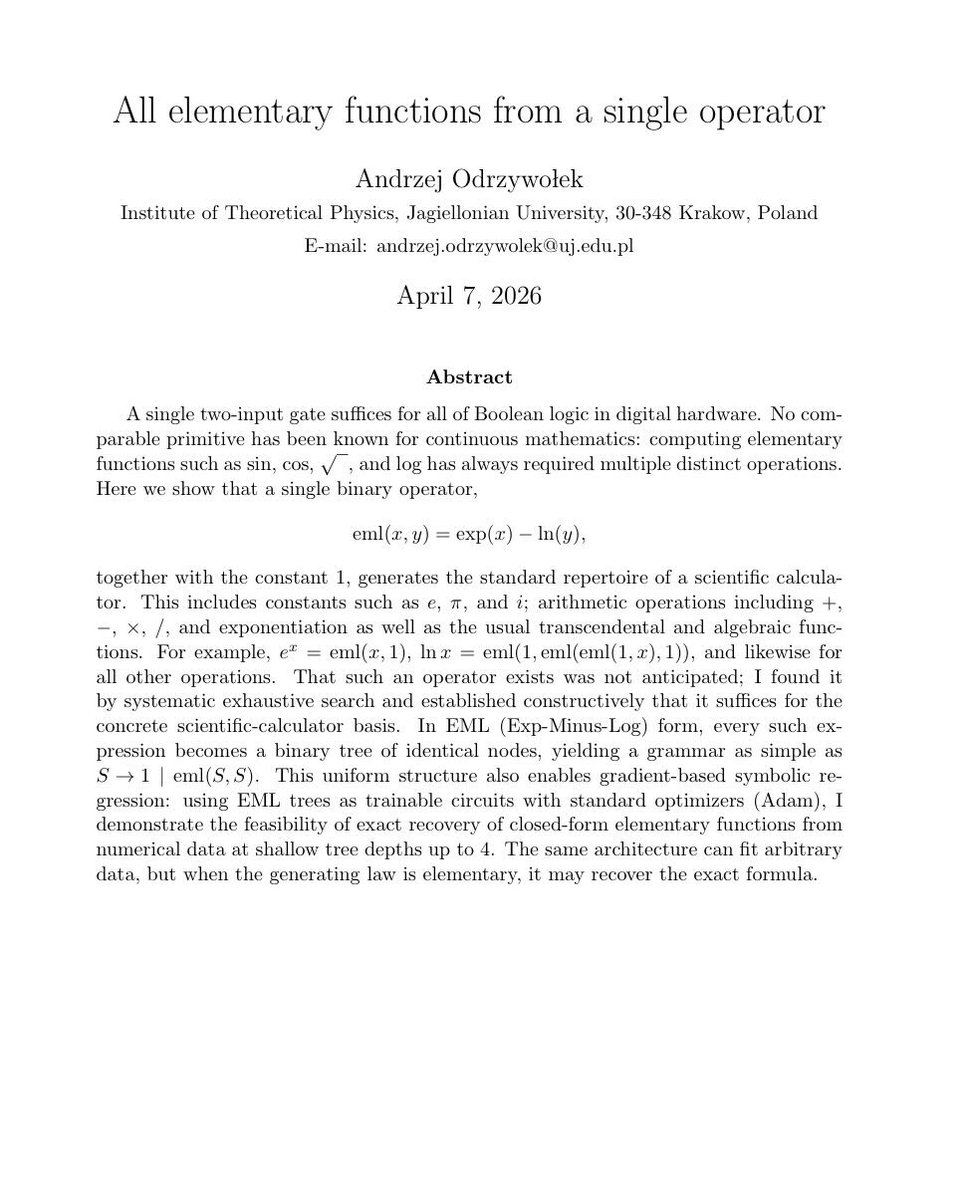
Physicist has written a fascinating big beautiful paper.Let’s not be afraid to call it what it is - groundbreaking. For hundreds of years, mathematics had dozens of “basic” functions: sine, cosine, logarithm, square root, exponential. You know these from school. Everyone does. Now it turns out that all of it is one single operator:
E(x, y) = exp(x) - ln(y), and the constant 1.
Sin, cos, π - everything follows from this neatly , just nest it properly. Nature hid the simplest possible description of reality. And it was just been found. The whole thing is beautiful and remarkable, here the word “groundbreaking” is not a marketing buzzword.
For instance, instead of writing π or 3.14, one can now elegantly write E(E(E(1,E(E(1,E(1,E(E(1,E(E(1,E(E(1,E(1,E(E(1,1),1))),1)),E(E(E(E(E(1,E(E(1,E(1,E(E(1,E(E(E(1,E(E(1,E(1,E(E(1,1),1))),1)),E(E(1,E(E(1,E(E(1,E(E(1,1),1)),E(E(E(1,E(E(1,E(1,E(E(1,1),1))),1)),E(1,1)),1))),1)),1)),1)),1))),1)),E(E(E(1,E(E(1,E(1,E(E(1,1),1))),1)),E(E(1,E(E(1,E(1,E(E(1,E(E(1,E(E(1,E(1,E(E(1,1),1))),1)),E(1,1))),1))),1)),1)),1)),1),1),1))),1))),1)),E(E(E(1,E(E(1,E(1,E(E(1,1),1))),1)),E(E(1,E(E(1,E(1,E(E(1,E(E(1,E(E(1,E(1,E(E(1,1),1))),1)),E(1,1))),1))),1)),1)),1)),1)
https://t.co/Pv2UUbTEay
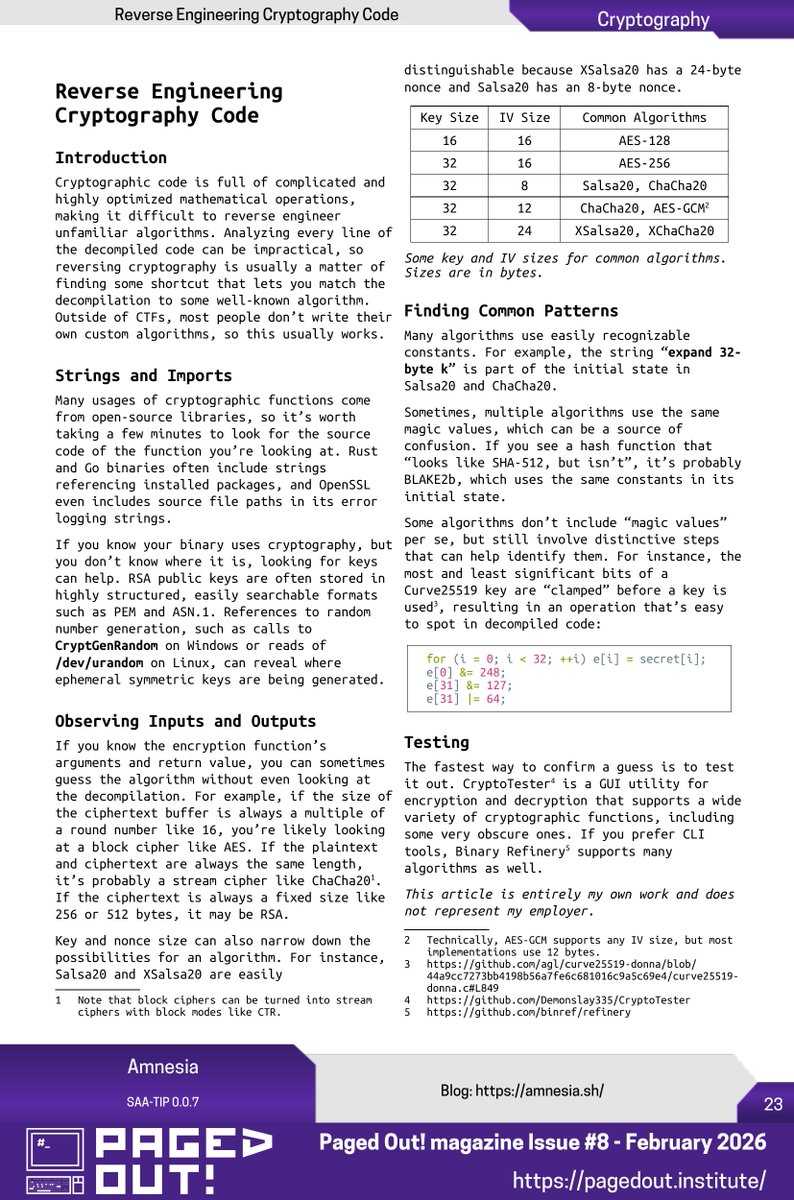
Learning reverse engineering and hungry for some real-world tips and tricks? Check out this article by Amnesia ("Reverse Engineering Cryptography Code"). This is a solid overview with multiple approaches to the topic.
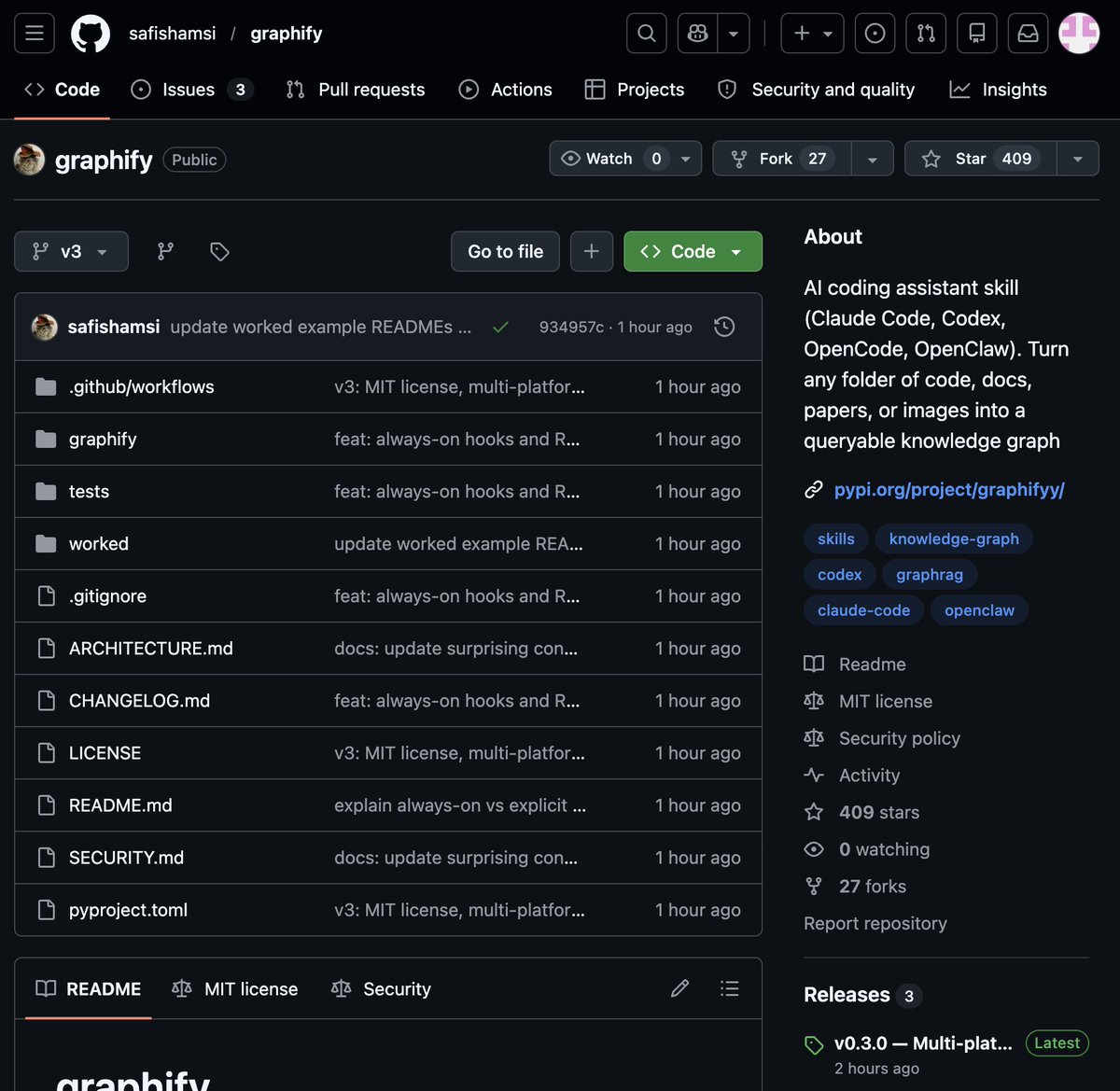
🚨 BREAKING: Someone just built the exact tool Andrej Karpathy said someone should build.
48 hours after Karpathy posted his LLM Knowledge Bases workflow, this showed up on GitHub.
It's called Graphify. One command. Any folder. Full knowledge graph.
Point it at any folder. Run /graphify inside Claude Code. Walk away.
Here is what comes out the other side:
-> A navigable knowledge graph of everything in that folder
-> An Obsidian vault with backlinked articles
-> A wiki that starts at index. md and maps every concept cluster
-> Plain English Q&A over your entire codebase or research folder
You can ask it things like:
"What calls this function?"
"What connects these two concepts?"
"What are the most important nodes in this project?"
No vector database. No setup. No config files.
The token efficiency number is what got me:
71.5x fewer tokens per query compared to reading raw files.
That is not a small improvement. That is a completely different paradigm for how AI agents reason over large codebases.
What it supports:
-> Code in 13 programming languages
-> PDFs
-> Images via Claude Vision
-> Markdown files
Install in one line:
pip install graphify && graphify install
Then type /graphify in Claude Code and point it at anything.
Karpathy asked. Someone delivered in 48 hours.
That is the pace of 2026.
Open Source. Free.
@kerckhove_ts Have you used Skills to instruct Claude how to behave?
Or even without skills, you can say in a prompt how to approach the investigation (write test first that will fail).
Or did you just say "Investigate" and act surprised that it literally did the simplest thing possible? :)