Experienced corporate managers & directors have expertise worth $100-150/hr outside the office, most don't know it. Less hype. More income. Not financial advice
I spent 30+ years inside corporate watching smart, experienced managers do two things simultaneously:
Build real expertise. And quietly worry it won't be enough for retirement.
This account is about fixing the second part.
This week's Encore Income Insider is in inboxes this morning.
The full one-paragraph offer template is in there - four components, three worked examples across finance, HR, and legal operations, and why the offer is a pricing instrument as much as a positioning one.
If you're not yet subscribed, https://t.co/6lgv9epOw3. Thursdays at 8 AM. Free.
Not financial advice. Example only. Your results will vary.
A few things that hold consistently across corporate professionals who've written a one-paragraph offer that actually produces client conversations:
The first draft always sounds like a job description.
The translation takes multiple passes.
The problem description is always the hardest component to get right - and the most important.
And the offer that finally works is almost always more specific than felt comfortable to write.
The right offer doesn't feel safe.
It feels like it might exclude someone.
That's how you know it's specific enough.
Not financial advice. Example only. Your results will vary.
Most offer descriptions end at the deliverable.
The full template ends at the outcome.
Not 'I build financial models' but 'so the CFO stops apologizing for the numbers in board meetings.'
Not 'I design onboarding systems' but 'so the founder isn't managing employment law on the weekend.'
The outcome is what changes for the client when the problem is solved. It's also the part that most clearly tells them whether their specific situation is one you can fix.
Not financial advice. Example only. Your results will vary.
Same expertise. Two descriptions.
Very different conversations.
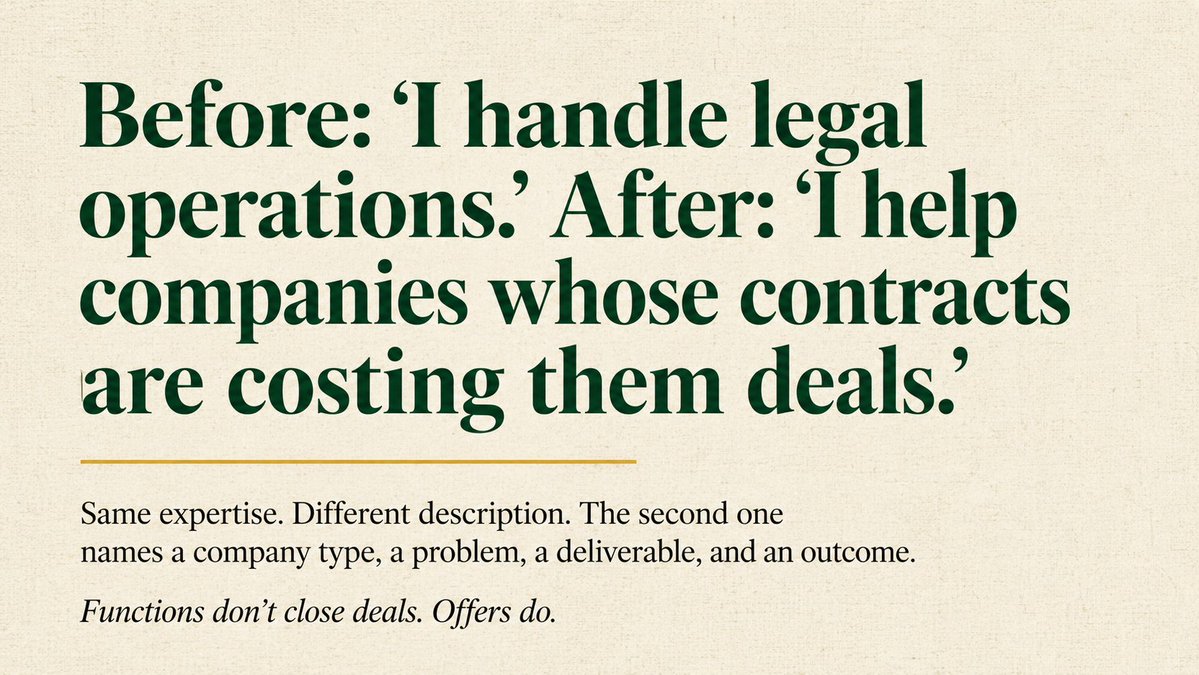
Before: 'I handle legal operations.'
After: 'I help companies with a growing contract backlog and no legal ops function, by building the workflow that gets contracts reviewed in days, so the sales team stops losing deals to slow legal review.'
The second version names a specific company type, their problem, a deliverable, and an outcome.
The first version names a function.
Functions don't close deals.
Not financial advice. Example only. Your results will vary.
Most offer descriptions fail on the deliverable.
'Guidance' is not a deliverable.
'Consulting support' is not a deliverable.
These are categories of service.
A deliverable has edges.
A three-statement financial model the team can maintain.
A contract review workflow that closes deals in days rather than weeks.
A documentation system that passes an employment audit.
Something with a beginning and an end is something a client can budget for.
Not financial advice. Example only. Your results will vary.
There's a simple test for whether your offer description is in your language or the client's.
Read it out loud and ask: would a client use these words to describe their problem at 11 PM when it's costing them something?
'Lack of financial visibility' is your language.
'Making investment decisions using numbers that didn't exist on Monday morning' is theirs.
The gap between those two descriptions is the whole translation problem.
Not financial advice. Example only. Your results will vary.
The one-paragraph offer has four components.
A specific company type.
The problem in the client's language.
A deliverable with edges.
An outcome that sounds like relief.
One paragraph. That's the whole structure.
Most people get stuck on 'the client's language' - which means describing the problem the way the client would describe it at 11 PM when it's actively costing them something, not the way it appears in a job description.
The full template with worked examples is in Thursday's Encore Income Insider. https://t.co/6lgv9epOw3.
Not financial advice. Example only. Your results will vary.
The function description feels accurate because it is accurate.
Inside the building, everyone understands what legal operations means.
Outside the building, nobody describes their problems in function language.
They describe them in cost language: 'we're losing deals because contracts take six weeks to close.'
The expertise is the same.
The translation is the work.
Not financial advice. Example only. Your results will vary.
When you describe your expertise as a function - 'I do FP&A' - you invite comparison to everyone else who does FP&A.
When you describe it as a problem - 'I help companies making investment decisions without reliable financial models' - you invite comparison to the cost of that problem.
Same expertise. Different comparison class.
Very different rate conversation.
Not financial advice. Example only. Your results will vary.
Ask a corporate professional to describe what they'd offer a consulting client and almost every answer starts with the same mistake.
Not a skills gap. A language gap.
They describe their function.
Clients need to hear about their problem.
Those are completely different conversations, and the gap between them is where most first consulting engagements stall.
The one-paragraph offer template - and three worked examples across finance, HR, and legal operations - is in Thursday's Encore Income Insider. https://t.co/6lgv9epOw3 if you're not yet subscribed.
Not financial advice. Example only. Your results will vary.
Week one of the mechanics month.
Pricing floor this week - the formula that tells you where the rate conversation should start.
Next week: the one-paragraph offer.
How to describe what you do in a single paragraph a potential client can act on.
August is the most specific month of the year.
Everything up to now cleared the wrong beliefs.
This month is what you actually do.
Comfortable is expensive. Not immediately. Over time.
The Encore Income Insider goes deeper on the pricing framework every Thursday - including how to present the rate without apologizing for it.
Free at https://t.co/6lgv9epOw3. If someone you know is about to underprice their first engagement - this thread is worth forwarding.
Not financial advice. Example only. Your results will vary.
https://t.co/6lgv9epOw3
Most corporate professionals price their first consulting engagement 30-40% below what the market would actually pay.
Here's the formula that fixes that. (thread)
The rate that feels comfortable when you first set it almost never matches the formula output.
Comfortable anchors to what seems safe to ask - which is a different calculation from what the expertise is actually worth.
Holding the floor rate when it feels uncomfortable is the skill.
The formula is just the anchor.