FHE is amazing, it provides fully end-to-end encryption during data transmission and calculation. Based on these interesting directions, Mind Network @mindnetwork_xyz provides a solution for proof of intelligence FHE secure computation for AI or DePIN networks. It exactly uses threshold FHE for decryption to preserve the key privacy. This new scheme brings security and privacy for validators in the network.
Vitalik “Reaching the Limits of Protocol Design” talk 101:
He mentioned “BLS key aggregation is actually a technique that's at the heart of modern state consensus proof theory”, but what is the BLS key aggregation?
A: The design core of aggregate signatures revolves around two concepts, "batching" and "compression":
- “batching" refers to the correctness of signature results from multiple nodes being batch-verified, completing signature verification in one operation;
- “compression" means that signatures from multiple nodes can be transformed into a unique digital signature, reducing storage consumption while establishing a data foundation for batch verification.
BLS key aggregation brings us efficiency, scalability and security for aggregation / consensus.
- Efficiency: This aggregation is crucial in state consensus protocols where numerous participants (nodes or validators) contribute their signatures to validate a particular state transition or operation.
- Scalability: using BLS key aggregation significantly reduces the size of the proof or signature needed to validate the consensus.
- Security: BLS key aggregation maintains the security properties of individual signatures while enabling their combination.
Curious about HTTPz in Web3? 🌐
Web2 relies on HTTP for data location via unique web addresses. In contrast, Web3, powered by blockchain, distributes data across networks and integrates AI into zero-trust HTTPS.
Enter HTTPz by ZAMA: it adds end-to-end encryption to HTTPS, enhancing security. HTTPz is the epitome of future internet encryption. This evolution from HTTP to HTTPS to HTTPz underscores the criticality of privacy and security. 🔒#zama #security #Web3
AI x FHE
In machine learning, there are two crucial processes: training and inference. AI now leverages Fully Homomorphic Encryption (FHE) for secure inference over encrypted data in a client/server deployment mode. Training happens over non-encrypted data, utilizing frameworks like concreteML. #MachineLearning #AI #FHE"
Unveiling the power of machine learning models! 🚀 Three categories dominate the scene:
- Tree-based models: decision trees, random forest, XGBoost
- Linear Models: linear regression, logistic regression, SVM, elasticNet, Lasso, Ridge
- Neural networks: Multi-layer perception, custom networks, torch, tensorflow. 🤖💡 #MLModels #AI #DataScience"
The key question is how to convert a machine learning model into the FHE equivalent, and the key steps are as follows:
- Convert every parameter to integer
- Convert operations to integer operation (keep the mapping between integers and floating points)
- Write the model inference using a FHE library
- Chose the crypto parameters and expose key generation, quantization, encryption, decryption
- Repeat the process for any change in the model
More details please follow the next post!
Q: Can Zero-Knowledge Proof be supported in physical chips? 🧐
The answer is YES! Introducing the Accseal LEO Chip.
Accseal Ltd. has just unveiled a groundbreaking achievement - the world’s first Zero-Knowledge Proof (ZKP) System-on-Chip (SoC) acceleration chip!
Scheduled for mass production in Q1 2024, the Accseal LEO Chip utilizes cutting-edge 12nm processing, enabling intricate MSM and NTT operations. What's exciting is its flexibility - with programmable design, it can adapt to various ZK-SNARK algorithms like Aleo, Scroll, zkSync, Taiko, Aztec, Linea, and more. Plus, it's applicable to DePIN projects.
Stay tuned for the future of secure data processing! 🔒 #ZeroKnowledgeProof #TechInnovation #AccsealLEOChip
Thank you for your interest in the robustness of our scheme. Please feel free to consult our academic article at the following link: https://t.co/fWanMgUGVe
Within the article, you will discover the key generation algorithms, as well as rigorous proofs of the security properties pertaining to data confidentiality, unlinkability, and CPA security.
@greyypoet Hahahah! True! Because in our cryptography, we always start two parties with Alice and Bob, and Alice is the sender while Bob is the recipient here.
Encryption 101!
🔐 A high level of Elliptic Curve Cryptography (ECC) explanation:
A thread 🧵👇
#ECC#Crypto
1. Based on Complex Math: ECC uses the properties of elliptic curves in its calculations. These properties come from advanced mathematics.
2. Key Pairs for Security: ECC works by generating pairs of keys: one public and one private. The public key can be shared with anyone, while the private key is kept secret. These keys are linked mathematically, but it's extremely difficult to figure out the private key from the public key.
3. Encrypting and Decrypting Data: Data is encrypted (made unreadable) using the public key and can only be decrypted (made readable again) with the corresponding private key. This ensures that only the intended recipient, who possesses the correct private key, can access the information.
4. Used in Digital Signatures and Secure Communications: ECC is not just for encrypting data. It's also used for digital signatures, which are a way to verify the authenticity of digital messages or documents. This is crucial in many online transactions and communications.
3/ The difficulty of the Elliptic Curve Discrete Logarithm Problem is the basis for the security of ECC. The ECDLP is considered hard to solve, which means, given a point on the curve and a scalar multiple of that point, it is computationally infeasible to determine the scalar.
2/ An elliptic curve is a type of curve defined over a field (which can be the field of real numbers or a finite field) that satisfies a specific cubic equation.
3/3 Adjusting Encryption Settings: Some encryption algorithms allow for tuning settings like block size or key size. Adjusting these settings can sometimes reduce overhead, but it's important to ensure that security is not compromised.
Fully homomorphic encryption (#FHE) brings a larger size of ciphertext. From an engineering point of view, effectively reducing the storage requirements for ciphertext becomes crucial. Here are some strategies:
2/3 Efficient Encryption Algorithms: Choosing an encryption algorithm that doesn't significantly expand the size of the plaintext can also help. In FHE, if it does not care about the accuracy of the results, approximate FHE always has less ciphertext storage.
Happy to help review this article from Hashkey. https://t.co/2zbbsY1P1j
Recommend it to everyone who wants to go deeper with Fully homomorphic Encryption (#FHE) regardless of academic or industrial implementation!
3/3 However, TFHE library written in C++ is not as well-maintained as the Rust version. The industry is seeking more implementations of the FHE library on Java script and C/C++.
Encryption 101: #FHE smart contract
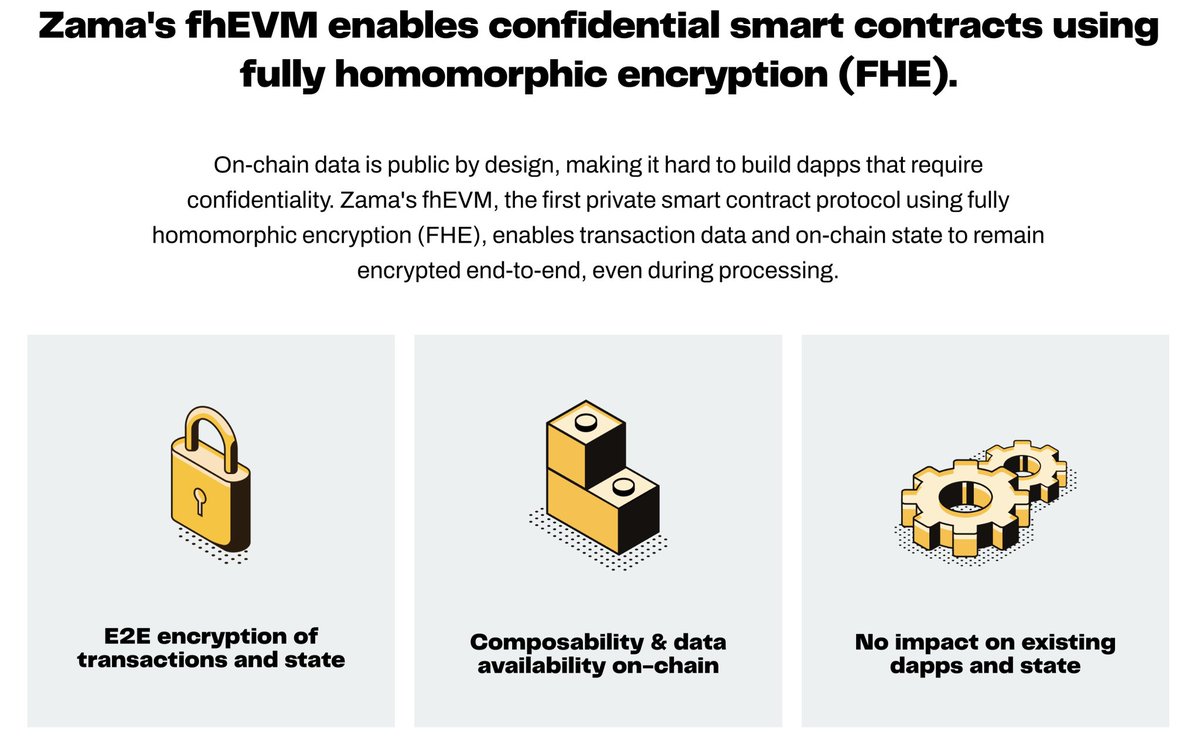
1/3 @zama's fhEVM makes it possible to run confidential smart contracts on encrypted data, and developers can just write solidity code like in other EVM environments. TFHE solidity library is behind this scene.
2/3 Although TFHE-rs can support exportation of C/C++, C++ developers have to write their own version of TFHE library if they want to have more compatibility and better performance.
@X_Orthodox@mindnetwork_xyz - For some fundamental understanding of FHE, here I recommend “A decade of lattice cryptography” and also lecture series https://t.co/FM35mZUFzH
- For CKKS, the detailed explained series can be found here: https://t.co/743W6R66K4
Encryption 101: Fully Homomorphic Encryption (#FHE)
Discover Fully Homomorphic Encryption (FHE) schemes and their distinct features, along with the best use cases!
Dig deeper into the details in the attached pic!