Where is new U.S. natural gas storage being built?
Our new tracker follows 27 projects, mostly Gulf Coast salt caverns: 164.3 Bcf of working gas stated under construction, every figure from a named source. #natgas#lng
https://t.co/nL5hDrGh3x
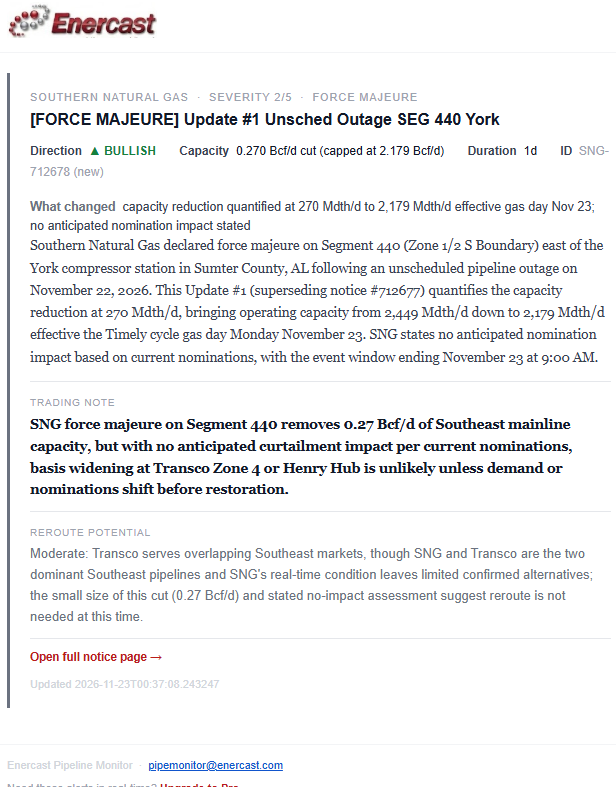
SNG pipeline explosion on Segment 440 removes 0.27 Bcf/d of Southeast mainline capacity, but with no anticipated curtailment impact per current nominations
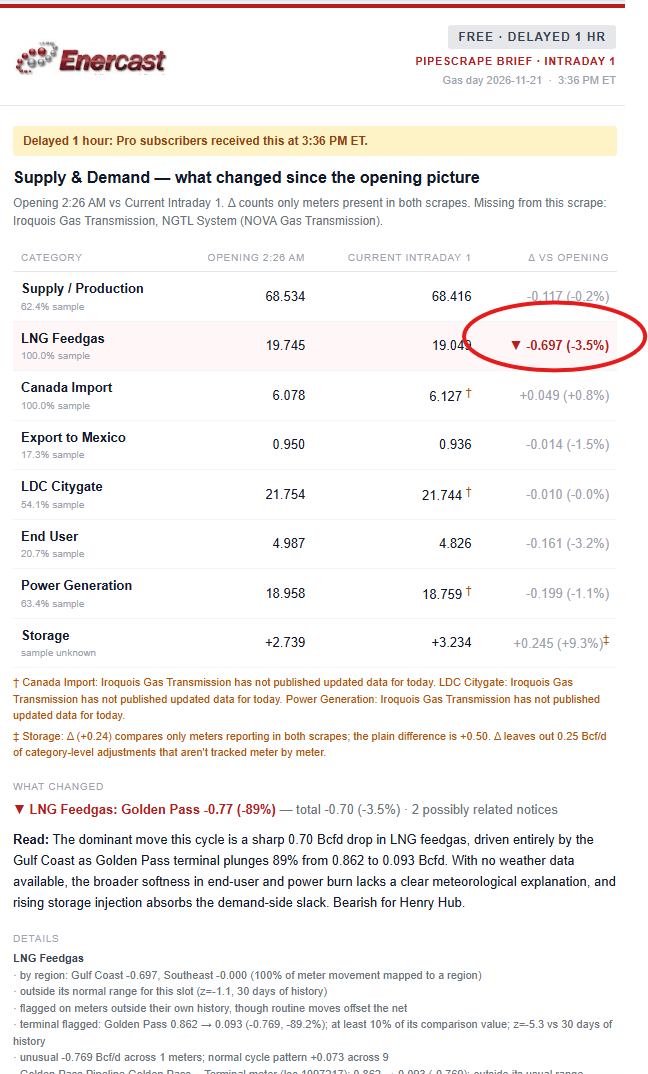
Golden Pass failed to take delivery of scheduled feedgas quantities, causing total LNG export to declilne by -0.697 bcf from the timely cycle.
#natgas#lng
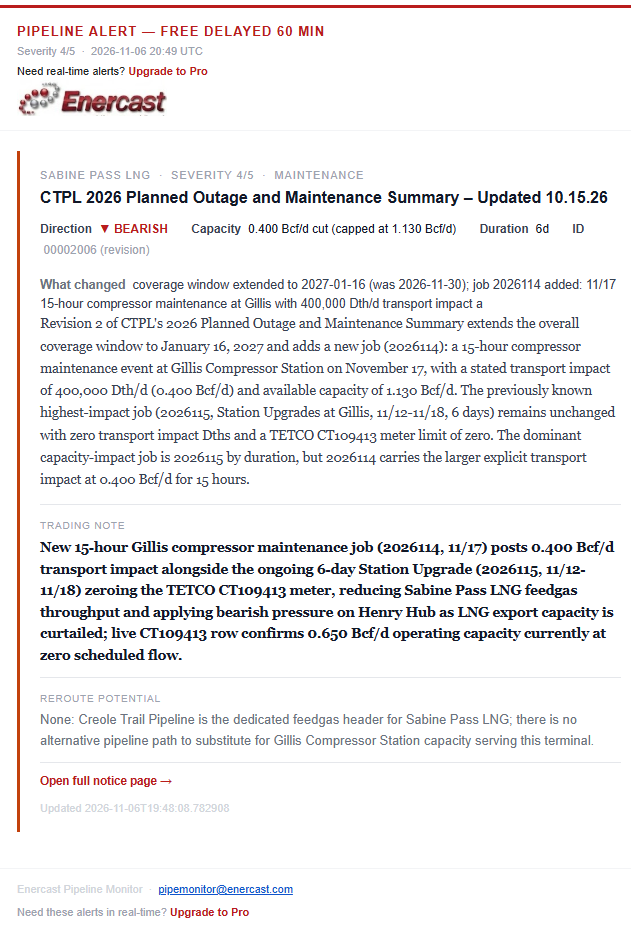
Updated maintenance schedule on Gills compresor station removes 0.65 bcf/d of capacity to Sabine Pass #LNG Nov30-Dec10. However, recent flows on this meter have been averaging only 0.023-0.10 bcf/d, so the total impact on feedgas is likely minimal.
#natgas
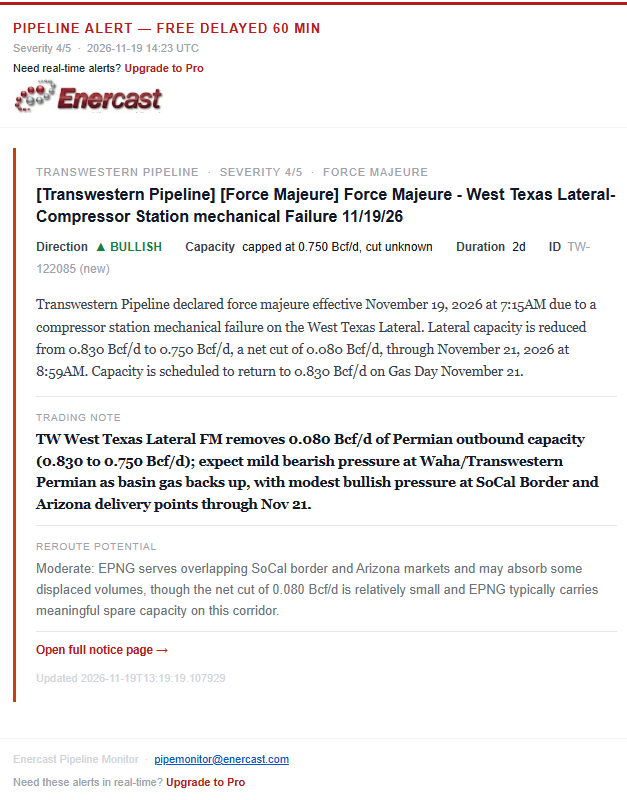
Transwestern Pipeline declared force majeure effective November 19, 2026 due to a compressor station mechanical failure on the West Texas Lateral.
#natgas
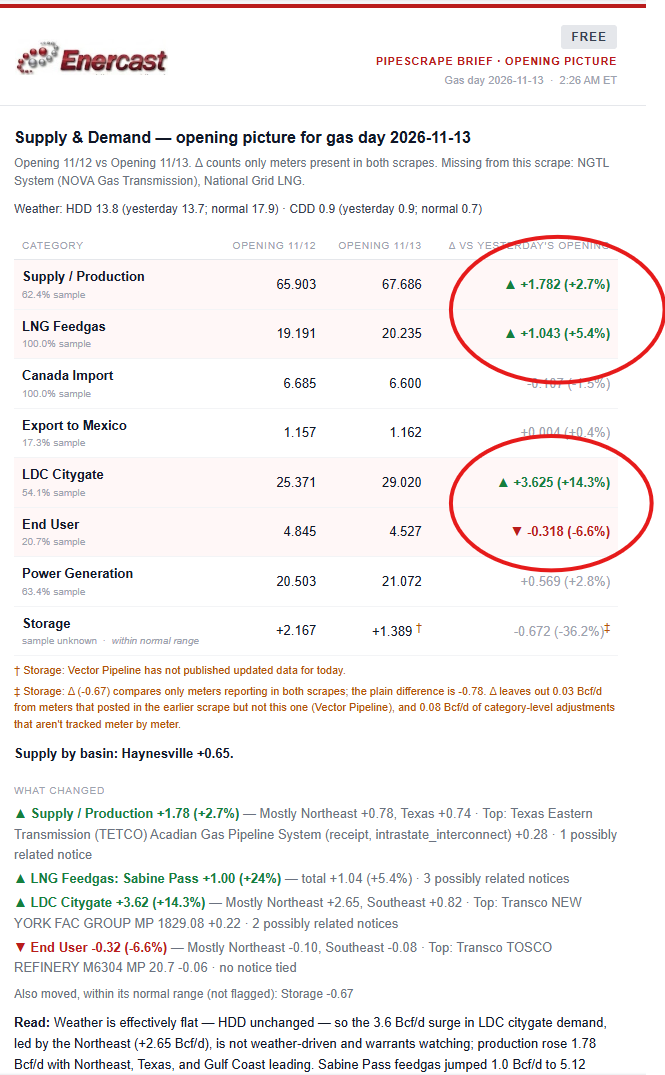
U.S. gas supply bounced back.
Pipeline receipts: 69.14 Bcf/d Nov 14–17, up 2.4 Bcf/d from the early-November dip. 69.64 on Nov 15 was the highest November day in our data.
Appalachia +1.2, Haynesville +0.8. Pipeline maintenance is nearly done.
https://t.co/mpUEVLEYgu
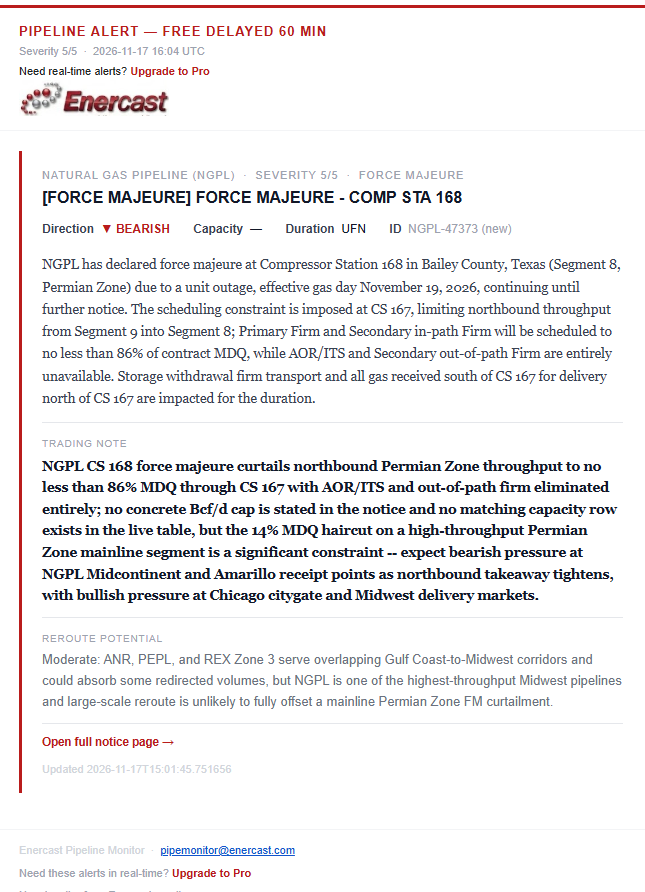
NGPL has declared force majeure at Compressor Station 168 in Bailey County, Texas (Segment 8, Permian Zone) due to a unit outage, effective gas day November 19, 2026, continuing until further notice.
#natgas
Which U.S. gas pipelines are actually getting built?
New: Enercast tracks 99 pipeline projects of 0.2 Bcf/d+, from announcement to in service. 40.1 Bcf/d of stated capacity is under construction.
Each status and date sourced to FERC, EIA or the sponsor.
https://t.co/A6Ivn2QzH4
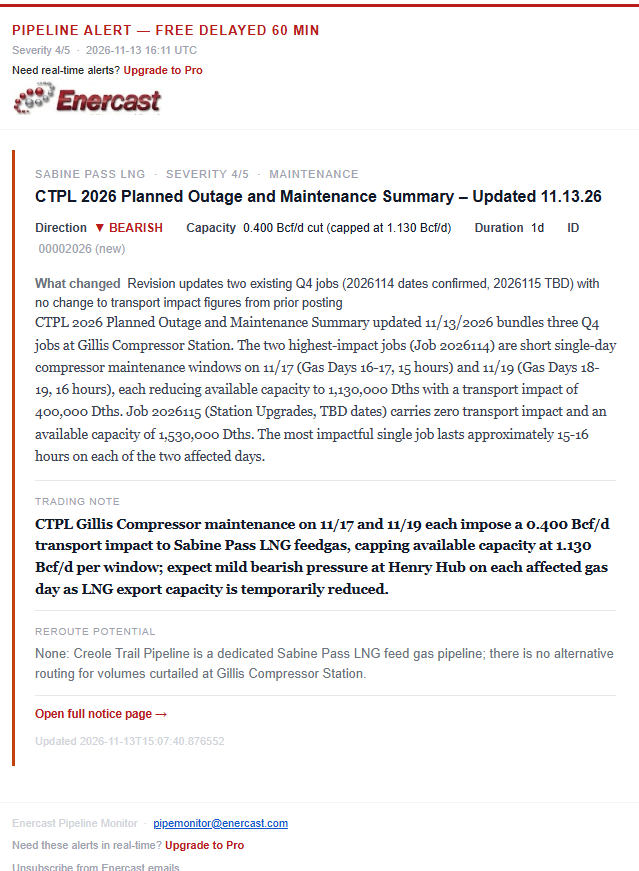
CTPL Gillis Compressor maintenance on 11/17 and 11/19 each impose a 0.400 Bcf/d transport impact to Sabine Pass LNG feedgas, capping available capacity at 1.130 Bcf/d per window #natgas#lng
Getting some inquiries on this one so wanted to clarify:
There are 4 lines feeding Sabine Pass (Creole Trail being one of them). This work only caps the Creole Trail leg at 1.13bcf. So it would be a 0.4bcf reduction from their current (today's) 1.51 levels
Canada is sending less gas south.
Net U.S. pipeline imports from Canada: 5.66 Bcf/d Jan–Oct, down 13% on the year. Every month of 2026 is below 2025.
Same period: LNG Canada took an estimated ~1.4 Bcf/d more gas at Kitimat.👇
https://t.co/l7UGQI6ljg
Cove Point LNG critical operational alert with no stated cap or curtailment volume; pre-event feedgas delivery was running ~0.86 Bcf/d (loc 10001 D:DPQ, 93.3% utilized, only 0.061 Bcf/d headroom), so any reduction is bearish for Appalachian supply demand and bearish for the LNG export arb #natgas
Pipeline maintenance season is over. Unplanned outages aren’t.
Planned outages on U.S. interstate gas pipelines: 18 in August → 5 in October.
Unplanned: 23–28 every month since June, with no seasonal letup.
Capacity offline peaked at 4.18 Bcf/d on Oct 28.
Charts + what’s still scheduled into December 👇
https://t.co/8Y3JtvhotJ
U.S. gas supply, now by basin. Daily.
Appalachia, Haynesville, Permian and 8 more, from actual pipeline nominations. Rows add up to the national total, so you can see where a move came from.
Free on #enercast 👇
https://t.co/ZQ0STGEjrL