A lot of people think TVL is the most important metric for a DeFi protocol.
But, it's not. It's actually revenue.
For example, ethereum:0x808507121b80c02388fad14726482e061b8da827's TVL dropped from the bull market like a lot of other protocols. So did revenue.
But, revenue held up a lot better that's why we saw a slight increase in revenue/TVL ratio as TVL dropped.
This means that PENDLE is actually more profitable per unit of $ that is on the platform.
Ofc, declining revenue is still a bad thing.
But, we're still in the bear market imo and so the current metrics matter much less than what the potential metrics could be in the future.
In the bull run, there will be a lot of yield bearing products that offer an attractive yield or airdrop points.
Pendle allows farmers to either speculate on the yield and get airdrop points by buying YT.
Or they could buy PT and enjoy a nice fixed yield. (The r/r for fixing yield is also better in the bull as well since we can lock in much higher rates).
Anyways, my point is to say that revenue is still the most important metric.
If TVL declines, but revenue rises it doesn't matter.
But if revenue declines while TVL rises, it doesn't help investors or the team at all.
Pendle Is Switching Engines: From Ethena to RWA
Throughout 2025, Ethena was one of the primary growth drivers behind Pendle.
On September 19, 2025, Pendle's TVL reached an all-time high of $13.39 billion, with Ethena-related assets accounting for 72.6%, while RWA represented just 11.3%.
Entering 2026, Pendle's asset composition began to shift.
---
May 2026 marked a turning point, as RWA's share reached 53.2%, surpassing Ethena at 38.3%.
By November 1, 2026, the composition had shifted even further:
+ RWA + other stablecoins: 87.2%
+ Ethena (USDe family): 7.9%
+ ETH, BTC, and other assets: 4.9%
Within the RWA segment, capital was also distributed across several asset categories:
+ Reinsurance (https://t.co/TG3h6QDN5M): 38%
+ Treasury-backed dollars: 30%
+ STRC preferred stock: 18%
+ Private credit: 9%
+ Infrastructure / AI compute: 3%
This shift reflects a broader change in yield trading demand on Pendle.
Rather than relying primarily on USDe and incentive-driven yields, Pendle is expanding toward yield sources backed by financial activities outside the crypto market.
Through its PT/YT mechanism, users can lock in fixed yields or trade exposure to future yield fluctuations from tokenized RWA assets.
Still, a rising RWA share does not necessarily mean Pendle's total TVL is increasing.
In TradFi, the interest rate swaps market is ~$500T notional, bigger than the bond market it sits on.
Tokenized assets like treasuries, credit, commodities... are going to need the same utility and market onchain, a place to fix the rate or trade it.
$PENDLE 🫡
New milestone for $PENDLE 🔥
Total buyback has exceeded 3 million PENDLE, just ~8 months after the launch of sPENDLE.
Buyback is also outpacing V2 emission by 6x.
For every PENDLE emitted, 6 more gets bought back from the open market and distributed to sPENDLE stakers
Janus Henderson’s core US fund is over $30B and it used to be out of reach unless you had direct relationships with global banks and issuers.
Tokenizing it was a natural next step for them to open access to a wider group of investors.
Full RWA Insights interview with Nick Cherney, Head of Innovation at Janus Henderson below 👇
Since many have asked:
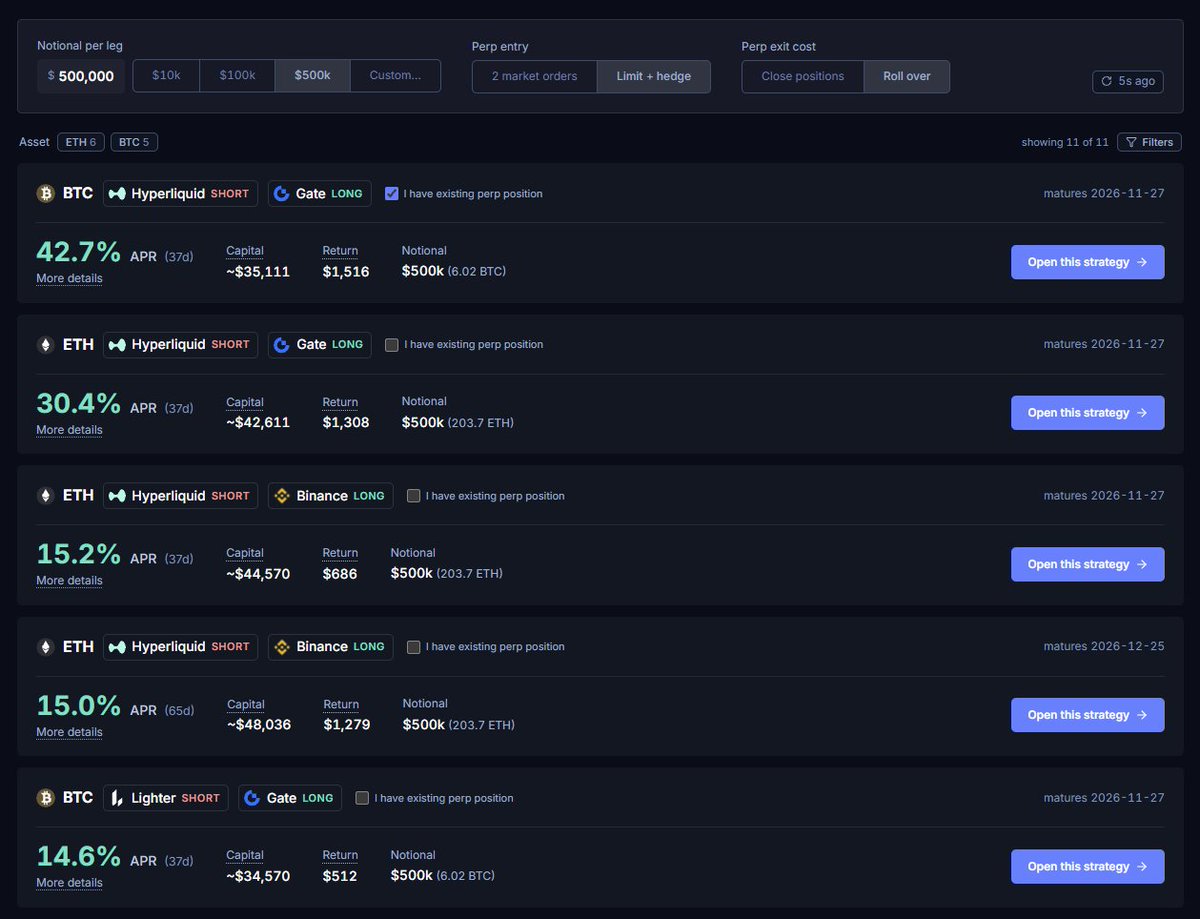
🔹Liquidation can still be a risk, but your main concern is largely negated since CrossEx lets you use shared collateral for the 2 perp legs (Long $ETH on Gate + Short $ETH on HL), so any $ETH price movements cancel out each other's collateral changes
🔹Setup is a one-time thing, including installing the Terminal (open source, so you can double-check with AI) + setting up a Gate account + funding Gate + Boros accounts
🔹Subsequently, opening positions are straightforward, requiring 2 clicks
🔹Rollovers are also 1-2 clicks
🔹No, you don't need $1M capital to start, there are many opportunities, there's no minimum entry
according to @DefiLlama PENDLE is trading at a 310,451% discount from where the price will be in 10 years
that's $6,411 per ethereum:0x808507121b80c02388fad14726482e061b8da827
it's literally math
One of DeFi’s biggest advantages is enabling use cases that have no equivalent in TradFi.
Pendle’s yield infrastructure has proven itself on crypto-native assets. The next step is running it on assets coming onchain, from high yield corporate bonds to natively issued funds like @FranklnTempletn’s Benji.
@tn_pendle in our RWA Insights conversation with Chetan Karkhanis of @FTDA_US.
Full interview and summary in the thread below 👇
RWA markets that Pendle runs yield markets for:
1. Tokenized stocks
2. Private equity funds
3. Reinsurance
4. Treasuries
5. Structured credit.
6. AI infrastructure
7. Private credit
8. HELOC
In less than 4 years, Morgan Stanley expects the global tokenized RWA market to reach $3 trillion to $10 trillion.
We're so, so early.
Two of the most valuable stocks in the world are now on Pendle.
🔹$GOOGLc (24 Dec 2026)
🔹$NVDAc (7 Jan 2027)
@Coinbase Tokenized Stocks are now live as yield markets on @Base, with $20K in USDC LP incentives for each pool.🔥
In their latest report, Citrini names Pendle a second-order RWA trade. Tokenized assets need an interest rate market, and Pendle has built this, with ~$1.3B in RWA TVL and 80% of protocol fees going to $PENDLE buybacks.
From Jul to Sep 2026 that meant $1.61M bought back against $0.42M emitted, roughly $3.8 back for every $1 out.
Citrini argues the market is rewarding revenue-accruing tokens with strong buyback mechanics.
Franklin Templeton’s high yield corporate bond ETF, now on Pendle.
Introducing @Ondo FLHYon (10 Dec 2026 maturity).
Bond desks have traded coupons separately from principal since the 80s, and now you can do the same onchain for RWA corporate credit on Pendle.
I'm getting increasingly bullish on @pendle_fi.
A few days ago, I talked about how Pendle has reduced its dependence on individual pools, making its TVL much more diversified and sustainable.
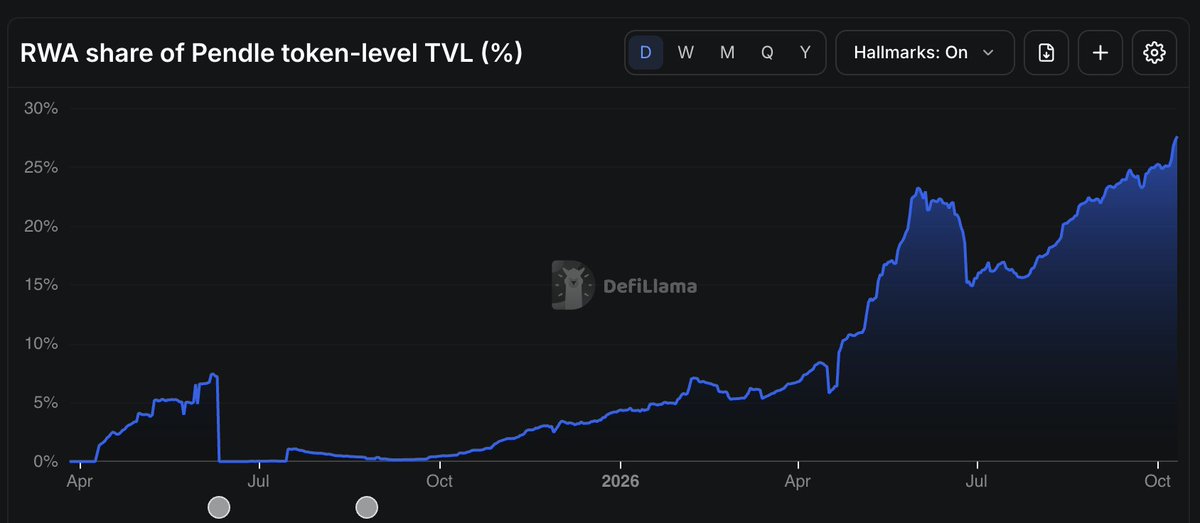
But there's another trend I find even more interesting: RWAs.
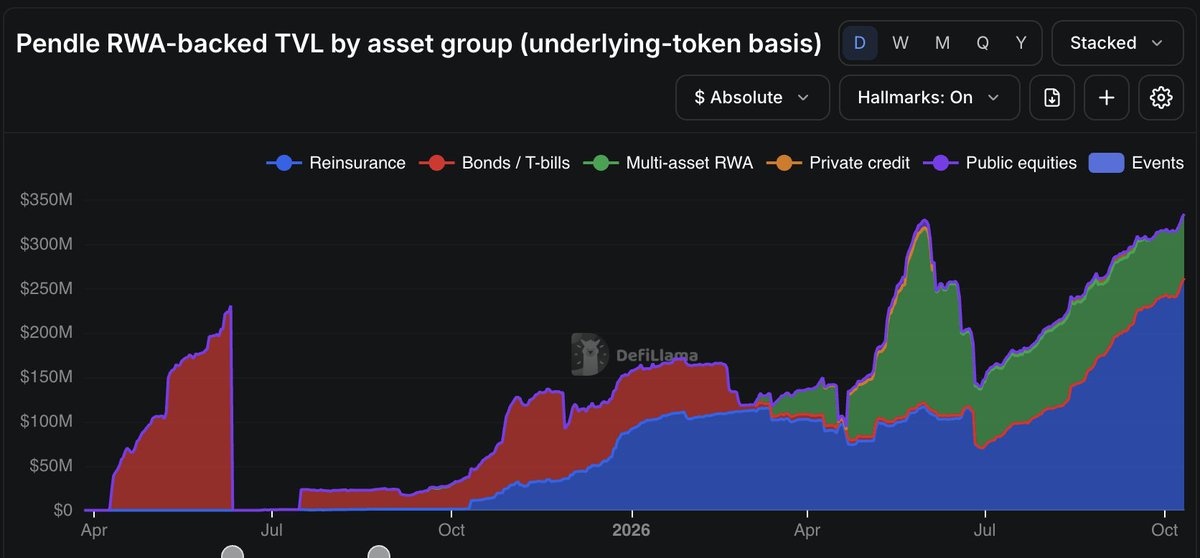
Pendle started exploring this sector in 2025, but growth has really accelerated in 2026.
> Early 2026: ~4%
> Today: 27.6%
Reinsurance has been one of the biggest drivers, largely thanks to @re.
And this matters a lot. Pendle is no longer relying on crypto-native yield opportunities. It's expanding into entirely different sources of yield.
I've always said Pendle moves incredibly fast, but the execution over the last few months has been impressive.
Over $1B in RWA TVL and growing 🔥
94 of the markets we’ve launched this year are RWAs, from $STRC and T-bill dollars to stock tokens on @RobinhoodCrypto and Partners Group’s NGI+.
In the works now - permissioned instance for KYC products, RWAs directly from issuers (e.g. Franklin Templeton, SBI, Fidelity)
RWAs coming onchain are inevitable, but for the asset class to scale, the tokens need utility beyond distribution.
@tn_pendle speaks with Vincent Ng, MD and Head of Asia at @partnersgroup, a global private markets firm with $186B in AUM, and Bridget Li, Co-Founder and CEO of @AssetoFinance, on why a firm of that scale is bringing infrastructure onchain, what makes a tokenized asset useful, and where RWAs go next.
Full interview and written summary below 👇