“This is insane!” — A new vaccine is on the market called VAXELIS lt has 6 VACCINES in ONE SHOT for 6-WEEK-OLD BABIES...6 Infants Died In Trials.
How can this be allowed to happen ?
Dr. Jeff Barke
This was filmed at Animal Shelter in Springfield, Illinois on a Tuesday afternoon. The man is Glen, 50 years old. A high school shop teacher from the north side of Springfield. He came to Animal Shelter on his lunch break because his daughter had been asking him for months to at least go and look. He told himself he was just browsing. Just getting it out of the way so he could honestly tell her he had tried. Glen spent about twenty minutes in one of the meet rooms with a three-year-old brown mixed breed named Hector. Hector had been at Animal Shelter for seven months. He had been returned to the shelter twice. The notes in his file said he was too attached. Followed people too closely. Didn't do well with being lett alone. Glen sat on the floor with Hector. Let the dog climb into his lap. Scratched his ears. It was pleasant. Normal. The kind of interaction Glen figured would happen. Then Glen stood up to leave. Hector went straight up with him. Not barking. Not jumping in the usual sense. He climbed. Both front legs wrapped around Glen's midsection. Face pressed hard into Glen's chest. Completely quiet. Just holding on. Glen stumbled back a half step. Looked down. Hector looked up at him. The shelter hallway went completely quiet. The staff member near the door told us she stopped moving. Glen tried to lower Hector gently. Hector pressed in harder. Glen stood there for a long moment. Then something in him changed. His shoulders dropped. He sat back down on the floor with Hector still attached to him, both of them landing together. Glen held the dog for a long time without saying anything. Eventually he looked up at the staff member and said: "What do I need to fill out?" He adopted Hector that afternoon. Glen's daughter called the shelter two days later, laughing and crying at the same time. She said her dad, who had said for years he wasn't a dog person, was now sleeping on the couch with Hector on his chest because he didn't want to wake him up by moving. The shelter coordinator told us: "Hector gets called too attached in every return note. But Glen didn't see a problem. He saw a dog who needed someone to stay. And he stayed.
A doctor was already zipping the body bag shut when the soldier spit in his face.
It was the only way he had left to say he was still alive.
Six hours earlier, on May 2, 1968, he had been safe back at base camp in South Vietnam.
Then the radio came alive with the desperate voices of twelve American reconnaissance soldiers trapped in the jungle.
More than one thousand enemy troops had them surrounded.
When you hear your friends over a radio knowing they might not make it out, you do not wait for someone else to go.
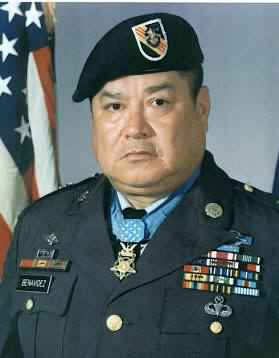
His name was Roy Benavidez.
He did not even grab a rifle.
He picked up a medical bag and a knife, then jumped onto a rescue helicopter.
Heavy fire kept the chopper from touching the ground, so he leaped from hovering height and ran seventy five yards through bullets to reach them.
Before he even got to the men, he took rounds to his leg, his face, and his head.
He kept running.
For the next six hours, he pulled wounded men into defensive positions, called in air strikes, and dragged them one by one toward the extraction chopper.
When the first helicopter went down, he pulled the survivors out of the wreckage and fought off enemy troops at close range.
Bullets, shrapnel, and a bayonet cut into him thirty seven separate times.
By the time the final helicopter lifted off, he had helped save eight men.
Back at base, his body finally gave out.
He could not move.
He could not speak.
A doctor checked him, found no signs of life, and began zipping him into a body bag.
Roy had no strength left to raise a hand.
So he gathered every bit of air left in his lungs and spit straight into the doctor's face.
The doctor stopped cold and shouted that he was alive.
In 1981, President Ronald Reagan placed the Medal of Honor around his neck.
Roy Benavidez lived to sixty three and passed away in 1998.
Shot in the head, bleeding from thirty seven wounds, and holding only a knife and a medical bag, one Texas sergeant showed every soldier on that radio what a brother does: you call for help, I am coming.
U.S. Army Master Sergeant Roy Benavidez (Official U.S. Army Portrait). 出典: Wikipedia
In December 1941, Japanese troops captured an American surgical nurse in the Philippines.
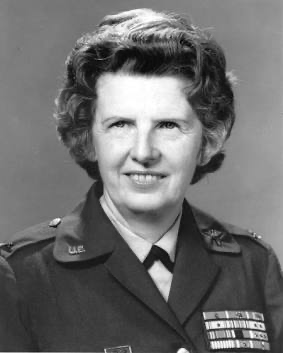
Colonel Ruby Bradley, United States Army Nurse Corps.
For the next 37 months, she ran an operating room inside a prison camp while starving alongside her patients.
Her name was Ruby Bradley.
Born in West Virginia in 1907, she taught school before joining the United States Army Nurse Corps in 1934.
In 1943, the Japanese Army locked her inside the Santo Tomas Internment Camp in Manila with thousands of prisoners.
Food was scarce and people were dying in the barracks every week.
Ruby refused to leave the hospital ward.
As starvation stripped the weight from her bones, her uniform hung loose on her frame.
She used the empty space under her clothes to smuggle surgical tools, soap, and medicine past armed guards into the clinic.
Whenever she saw starving children crying in the dirt, she gave them her own small food ration and went to sleep hungry.
Over three years in captivity, she assisted in 230 major surgeries and helped deliver 13 babies behind barbed wire.
The prisoners called her one of the Angels in Fatigues.
On February 3, 1945, American tanks smashed through the camp gates and set them free.
Ruby walked out weighing just 86 pounds.
Everyone expected her to go home and leave the military forever.
She refused to quit.
Then war broke out in Korea in 1950.
At age 42, Ruby volunteered for the front lines as Chief Nurse of the 171st Evacuation Hospital.
In one afternoon in November 1950, her team treated 780 wounded soldiers in the bitter cold.
Days later, 100,000 Chinese troops surrounded her hospital in Pyongyang.
With enemy artillery shelling the city, commanders told Ruby to take an early flight to safety.
She refused to board a plane while wounded men were still lying in the snow.
With shells exploding nearby, she stayed on the freezing runway and loaded every injured soldier onto transport planes first.
She was the last one out.
Seconds after she stepped onto the final plane, an enemy shell blew up the ambulance she had just left behind.
She later led 500 combat nurses across Korea and became the third woman in United States Army history to reach the rank of Colonel.
She retired in 1963 with 34 medals for bravery, died in 2002 at age 94, and was buried at Arlington National Cemetery.
Across two wars, three years in a prison camp, and an enemy siege, she never once left a patient behind.