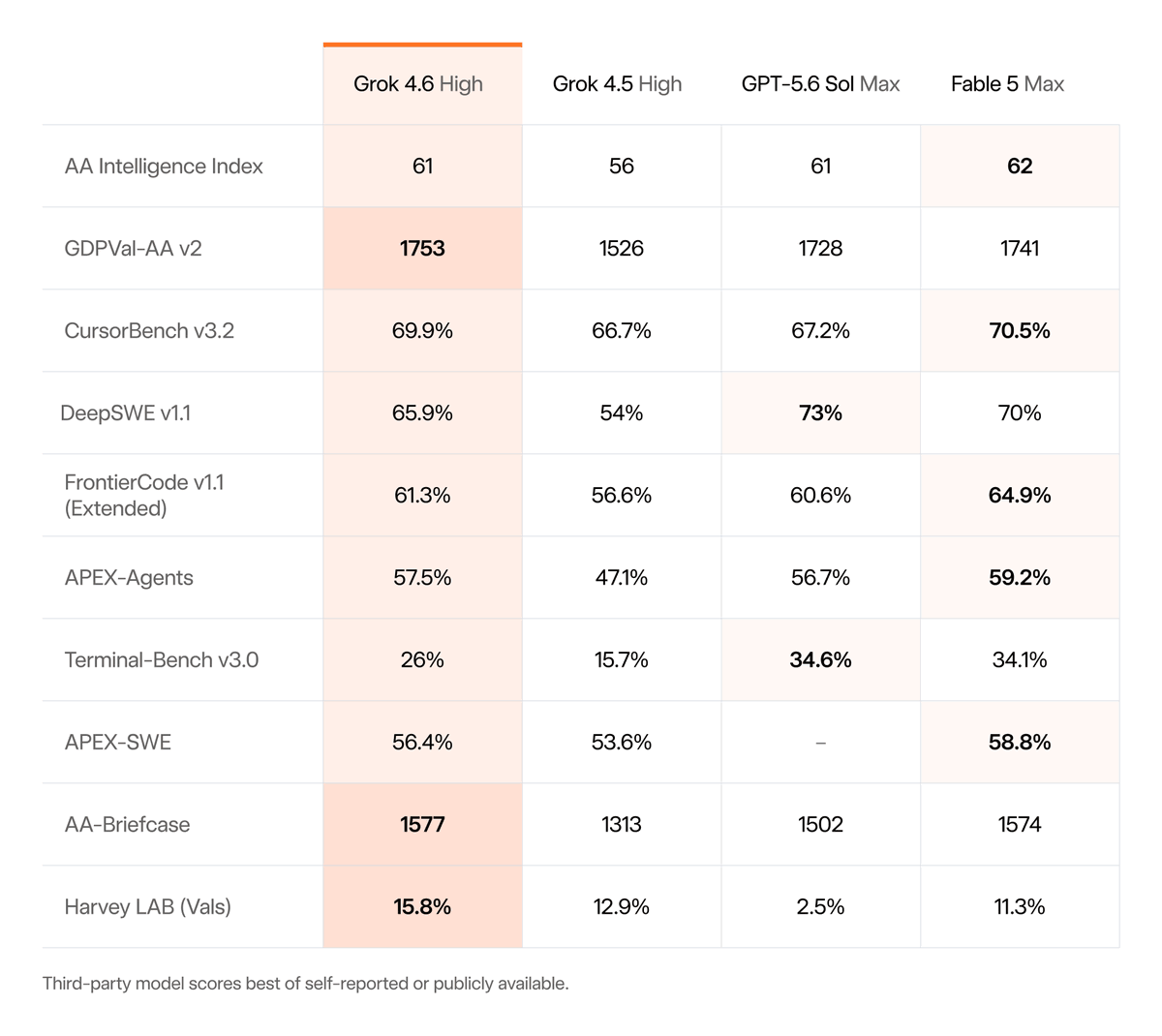
@kimmonismus All this at 1.5T is wild. Same size as 4.5.
They’re writing the training + inference stack in C/C++ closest you get to the metal without assembly deleting the extra layers and exact-mapping Grok to GB300. That’s the own-infra bet. And those efficiency gains are still coming.
@ericzakariasson Really good on the short prompt + verify loop. That matches how I want to work.
The part I still get stuck on is skills. I end up writing most of them myself so the agent stays good next session, not just this one. Has 4.6 made a thin skill enough, or is that still mostly on us?
@poteto Curious how 4.6 feels on this from your side.
Biggest bottleneck for me is still writing most of the skills/prompts myself so the agent actually does a good job. If 4.6 is better at following a thin skill or drafting one that’s the upgrade I care about.
@elonmusk Love to see it. Yesterday when Grokbook launched I immediately noticed the LLM felt on another level compared to 4.5. Guessing that was 4.6 running under the hood before today's official release? Can you confirm?
So hyped for this new model, Grok 4.5 have served me well so far especially the speed. Something I hope is improved is the writing of model. I'am sooo tired of re prompting every time on how the skills/md files should be written.
@SpaceXAI Amazing job to both Cursor and SpaceXAI engineers. I'am very hyped for this release! Grok 4.5 have been taking well care of me, what do you guys think we will notice in this newly released model? I hope for much better writing for my own skills.
@sanjeed_i Guilty. Cursor, and lately Grok CLI with it.
I push it on everyone I know, even non-coders. Half of them didn't ask. Still think I'm right.
You pushing it only to engineers, or normies too?
@garyoneill Yeah, correct though that's Elon's timeline, which is its own thing. He also posted that 4.6 is still the 1.5T with significantly improved SFT & RL. Same size, more post-training.
Curious how big that jump feels day one and what "significant" actually means on real work.
Anthropic cut most of Claude Code’s system prompt for the new models. Something like 80%+. Evals didn’t fall over.
A lot of takes went straight to “great, we can stop caring about prompts.” I don’t think that’s the story.
That’s the part I keep running into in practice skills, thin AGENTS.md / CLAUDE.md, what loads every session vs on demand, even how Claude Code stacks multiple CLAUDE.md files into one context.
If you’ve already thinned your always-on file after a model jump, curious what you refused to delete.
“More agents is not a strategy, the shape of the work decides everything” is the line.
Parallel independent work → fan out. Step-by-step full picture → one agent. Uncoordinated merge → you amplify wrong findings.
Curious how you enforce “one owner of the merge” in real agency graphs day to day.
This is the “why” behind the interview-not-one-shot design.
If the knowledge lives in company data and minds, one-shot eval gen skips the only source of ground truth.
Still curious from the chat-langchain work: what did people push back on first directions, sim vs live tools, or the verifier
@Vtrivedy10 Interviewing the user instead of oneshot eval gen feels like the key design choice.
When you tested on chat-langchain, what did users usually push back on first the eval directions, the live-vs-simulated tools, or the verifier?
Curious which of those ate the most iteration.