As research from organizations like Google begins to criticize Agile, 6 months on from the Agile failure rate study, psychological factors explain the situation - https://t.co/NsTo05ItNy #agile#devops
@empathyx100 “… methodologies fail to address that humans are not machines and psychological factors impede the ability to address problems. Having identified this anachronism in existing methodologies, this paper presents how we can act upon it…” (Conclusion)
https://t.co/B1sXSsadJ9
"So Am I Dr. Frankenstein? Or Were You a Monster the Whole Time?": Mitigating Software Project Failure With Loss-Aversion-Aware Development Methodologies. https://t.co/Fwu1aIfHPZ
From stalking to hacking attempts, since I began work on researching the high failure rate of Agile projects and transformation initiatives, I’ve come face-to-face with the fundamentalism that exists amongst Agile’s most devout followers.
https://t.co/lFFbpeaj8s
Gareth Jenkins hands back BCS qualification and relinquishes membership on eve of his inquiry interrogation begins #PostOfficeScandal#PostOfficeInquiry https://t.co/sxiUPntaQt
@TechnologyTulip The original signatories talk about it being around lax requirements, here’s Martin Fowler discussing it:
Full video from ~2 mins on: https://t.co/R8mta12mGj
1. Population sampling and fieldwork done independently by a company following MRS Code of Conduct and BPC rules. No preference in answers was expressed before the study was conducted.
2. We don’t do transformation consultancy anymore due to ethical and practical issues.
3. The ebook is £3.92 (then minus fees, commission, etc) so that’s a lot of books to break even.
Does 17 men of the same gender and ethnicity in Utah writing a Manifesto really seem a higher form of evidence than this? Welcome further research which is of a higher quality, but let’s assess the work on its evidential weight here.
@rileyphughes@matthewswspence If you listen to Martin Fowler, one of the original signatories talk, it’s all about requirements engineering. (With some misunderstanding in the conceptualisation of what traditional engineering looks like.)
Full clip from about ~2 mins on here: https://t.co/R8mta12mGj
@rolandhesz Martin Fowler on the creation of Agile (and the role of requirements engineering).
You can see this from 2 mins on here: https://t.co/R8mta12mGj
(His own misunderstanding is the change Arup made in traditional engineering was the engineer should be involved form the start.)
As a starting point, we did actually have previous research (done for a paying client) showing that 98% of business leaders in the UK and 96% in the USA agree with the statement “The goal of a software engineering team is to deliver high-quality software on time”. Not everyone might agree on it, but it’s the closest thing we have to consensus on a goal as a starting point: https://t.co/paI9W5u9o9
There is a slight alteration because we wanted to account for other internal success measures people have so our question includes the words “successfully delivered”.
This led to the final question: “Thinking about the last software project you encountered was it successfully delivered on-time and on-budget, to a high standard of quality?”
You can see causation in effect by two factors:
1. There’s a robust hypothesis for requirements processes based of numerous case studies of disasters, including evidence at the Horizon IT Inquiry and reports from other delivery failures. (See the book “How to Protect Yourself From Killer Computers”.)
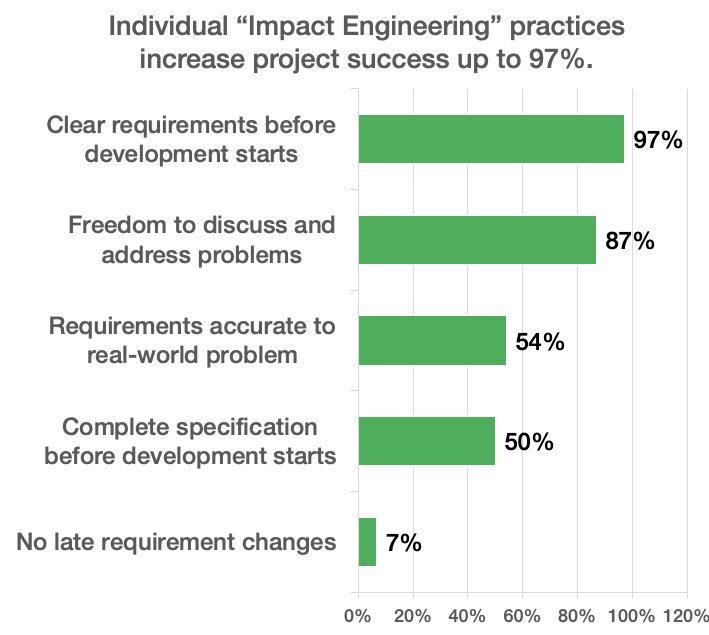
2. The factors later in the development process did not have the same impact as the planning process or psychological safety. (No statistically significant difference for not juggling multiple projects, in fact slightly negative, and smaller impact of the requirements were just changed late.)
Methodology point addressed here but there’s no methodology being sold - it’s purely about sharing what’s been seen to work and what doesn’t work.
Whole heap has already been written in other articles and the book about how it’s unethical and ineffective to try to force people to use a certain approach. It’s why we don’t do transformation consultancy anymore.
@GergelyOrosz@sixhobbits Also no specific methodology being advertised. The study findings are these five practices improve development (but there’s a time and place, etc)
eBook with research is £3.92, so you can imagine how long if ever it’d take to make money back from fieldwork and research.
As a starting point, we did actually have previous research (done for a paying client) showing that 98% of business leaders in the UK and 96% in the USA agree with the statement “The goal of a software engineering team is to deliver high-quality software on time”. Not everyone might agree on it, but it’s the closest thing we have to consensus on a goal as a starting point: https://t.co/paI9W5u9o9
There is a slight alteration because we wanted to account for other internal success measures people have so our question includes the words “successfully delivered”.
This led to the final question: “Thinking about the last software project you encountered was it successfully delivered on-time and on-budget, to a high standard of quality?”
You can see causation in effect by two factors:
1. There’s a robust hypothesis for requirements processes based of numerous case studies of disasters, including evidence at the Horizon IT Inquiry and reports from other delivery failures. (See the book “How to Protect Yourself From Killer Computers”.)
2. The factors later in the development process did not have the same impact as the planning process or psychological safety. (No statistically significant difference for not juggling multiple projects, in fact slightly negative, and smaller impact of the requirements were just changed late.)
@GergelyOrosz@sixhobbits The main reason we wanted to put a more positive message than saying “this sucks” is because our previous work around workplace retaliation, burnout, software disasters, etc had no positive message to people - and we wanted to cater for optimists too: https://t.co/6EB7h8HPV7
@GergelyOrosz@sixhobbits Also we no longer take on any transformation consultancy work for the reasons described in the book and here: https://t.co/JCZwR3SgRT
In short; ethics around consent for those impacted and depriving people one of the most valuable sources of learning (their own mistakes).
@GergelyOrosz Of course - one of the fundamental misunderstandings in Fowler and others assumption of this is Arup (who engineered The Shard, Sydney Opera House, Vegas High Roller, etc) changed the game by saying the engineer should work with the architect as early as possible.