PI NETWORK: ARE WE BUILDING OUR OWN ECONOMY OR JUST USING PI WITH EXTERNAL MARKET PRICES?
Fellow Pioneers, we need to understand something fundamental.
If merchants price their goods in dollars and simply convert those prices into Pi using the CEX exchange rate, then our internal economy remains dependent on external markets.
A real Pi economy must go beyond using Pi as a payment method. We need real goods, services, liquidity, demand, and an economic framework in which Pi plays a meaningful role as a unit of account.
This is especially important for Real-World Assets (RWA). Tokenizing houses, land, commodities, and businesses is not enough. We must also address price volatility, asset valuation, and the protection of buyers and sellers.
The question is not whether CEX and DEX should exist. The real question is whether Pi's internal economy will always follow external prices or develop its own economic reference through genuine commercial activity.
Pi must be more than a payment option in its own ecosystem. Its economic utility must be demonstrated through real transactions, real demand, and sustainable economic activity.
Fellow Pioneers, this is a conversation we need to have.
#PiNetwork #PiUtility #RWA
@PiCoreTeam
A very interesting economic pathway for Pi is emerging.
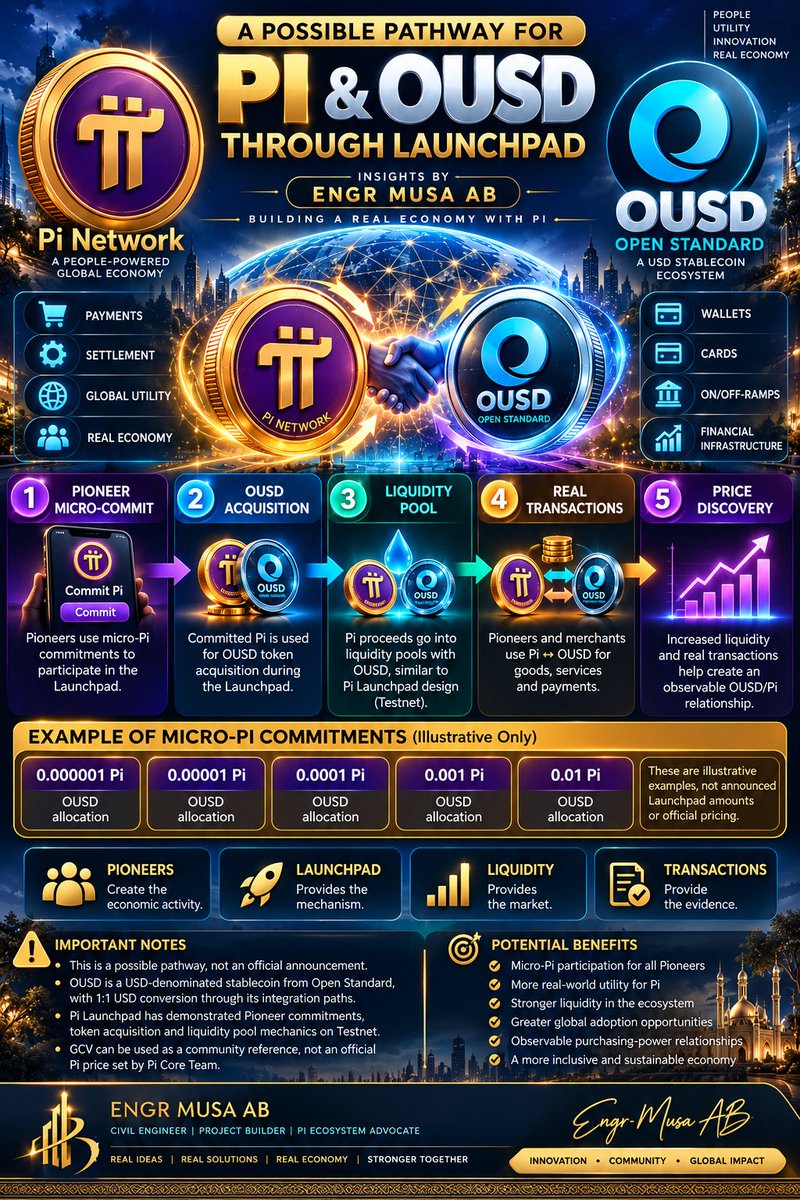
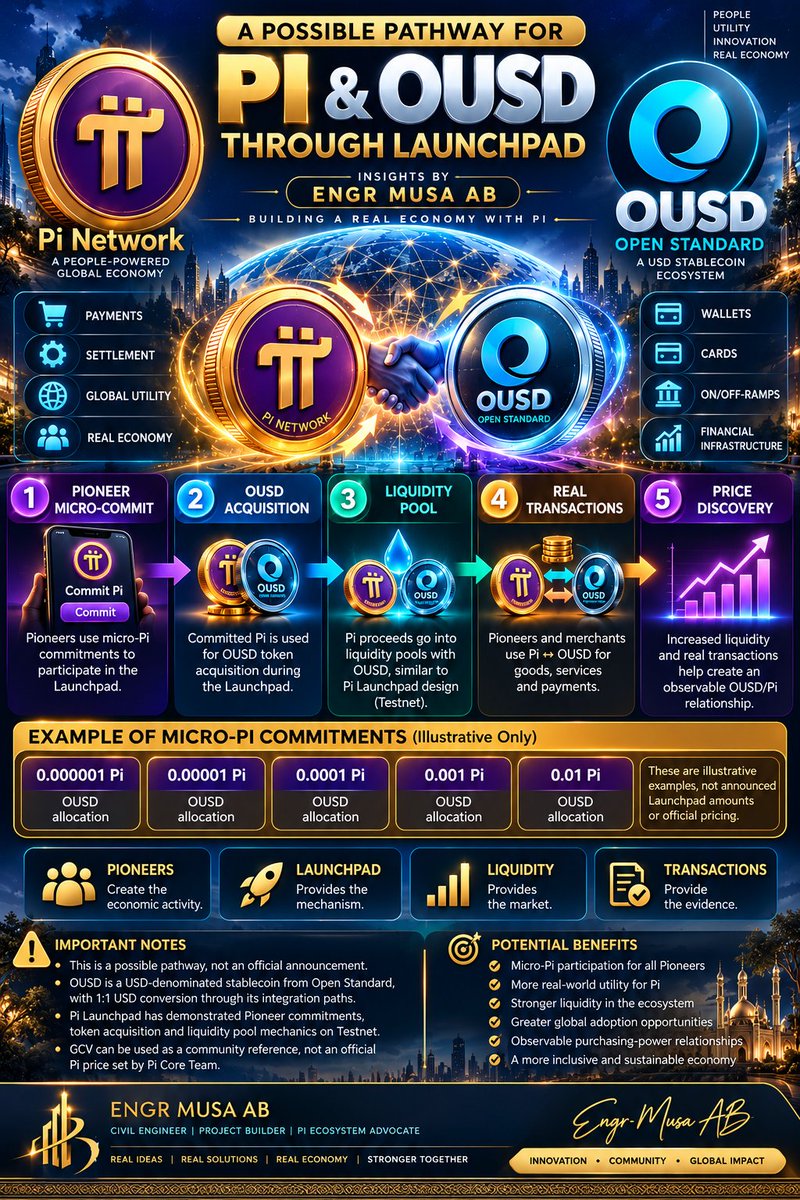
If OUSD eventually becomes part of the Pi ecosystem through the Launchpad, Pioneers could potentially use Pi commitments to participate in its token launch and help establish an observable OUSD/Pi relationship.
The mechanism could look like:
Pioneer Commitment → OUSD Acquisition → Pi Liquidity → OUSD/Pi Market → Real Transactions → Price Discovery
Pi’s Launchpad already demonstrates the concept of Pioneer commitments, token acquisition and liquidity pools on Testnet. Pi also organizes its DEX around Pi-denominated pairs, using Pi as a common base for price relationships.
OUSD is now live as a USD-denominated stablecoin infrastructure from Open Standard, with 1:1 USD conversion through its integration paths.
The interesting question is what happens if Pioneers use a community reference such as GCV to think in micro-Pi, while real Pioneer participation, liquidity and transactions provide the market evidence.
GCV could be the reference.
Pioneer participation could provide the economic activity.
Liquidity could provide the market mechanism.
Real transactions could provide the evidence.
This is not a claim that Pi Core Team has adopted GCV as an official price. It is a possible economic pathway worth watching.
Pi → Micro-Pi → Real Utility → Liquidity → Price Discovery.
Could OUSD become an interesting test case for Pi’s micro-economy?
If OUSD eventually enters the Pi ecosystem through Launchpad, imagine Pioneers using micro-Pi commitments to participate:
• 0.000001 Pi → OUSD allocation
• 0.00001 Pi → OUSD allocation
• 0.0001 Pi → OUSD allocation
• 0.001 Pi → OUSD allocation
• 0.01 Pi → OUSD allocation
These are illustrative examples, not announced Launchpad amounts or official pricing.
The mechanism could potentially become:
Pioneer Micro-Commit → OUSD Acquisition → Pi/OUSD Liquidity → Real Swaps → Price Discovery
Pi Launchpad has already tested the basic concept: Pioneers commit Test-Pi toward token acquisition, and the Pi proceeds from launches are designed to go into liquidity pools with the ecosystem token.
For example, the SLICE test launch had 15.92M Test-Pi committed toward 10M SLICE, with a post-launch liquidity pool and Test-Pi-relative price tracking.
Now imagine that concept applied to a USD-denominated asset such as OUSD, which Open Standard says supports 1:1 USD mint/burn and is built for payments, settlement, FX and other financial infrastructure.
If Pioneers also use a community reference such as GCV when thinking about micro-Pi values, the interesting question becomes:
Can Pioneer participation + micro-Pi + real liquidity + real transactions create an observable purchasing-power relationship for Pi?
That is the part I’m watching.
Pioneers create the economic activity.
Launchpad provides the mechanism.
Liquidity provides the market.
Transactions provide the evidence.
Pi → Micro-Pi → Utility → Liquidity → Price Discovery.
Exactly, Doris.
This is the key point: Pi should be understood from its original economic design, not judged only by the standards of traditional crypto markets. Pi’s own Whitepaper says its utility is intended to grow from goods, services, and contributions within the ecosystem, with Pioneers playing a central role.
That also makes the role of Pioneers very important: Core Team builds the infrastructure, but real Pioneer participation creates the economic activity that gives Pi practical purchasing-power relationships.
This is why concepts such as micro-Pi, Pioneer commitments, Launchpad liquidity, real transactions and community reference frameworks like GCV deserve to be studied together—without confusing a community reference with an official Pi price.
Understand the design first. Then judge the outcome. 🟣💜
@dorisyincpa@NoncePadja@PiCoreTeam
Shin ko kasan cewa OUSD na iya zama wani muhimmin gwaji ga Micro-Economy na Pi?
Idan a nan gaba OUSD ta shiga cikin Pi Ecosystem ta hanyar Launchpad, ka yi tunanin Pioneers zasu iya amfani da ƙananan commitments na Pi (Micro-Pi) domin shiga cikin ƙaddamar da token ɗin:
Misali:
0.000001 Pi → rabon OUSD
0.00001 Pi → rabon OUSD
0.0001 Pi → rabon OUSD
0.001 Pi → rabon OUSD
0.01 Pi → rabon OUSD.
Waɗannan misalai ne kawai na bayar.
Tsarin zai iya kasancewa:
Pioneer Micro-Commit → Samun OUSD → Pi/OUSD Liquidity → Real Swaps → Price Discovery.
Pi Launchpad ta riga ta gwada irin wannan tsarin a Testnet: Pioneers sun yi commitment da Test-Pi domin samun tokens, sannan Pi da aka samu daga launch an tsara shi domin shiga liquidity pools tare da ecosystem token.
N/A
Misali, a gwajin SLICE, an yi commitment na 15.92M Test-Pi domin samun 10M SLICE.
Yanzu ka yi tunanin irin wannan tsarin idan aka yi amfani da shi da wani asset mai alaƙa da USD kamar OUSD.
Idan Pioneers kuma suka yi amfani da GCV a matsayin community reference wajen tunanin darajar Micro-Pi,
Tambayar da ta fi ban sha'awa ita ce:
Shin Engr Musa Ab Pioneer participation + Micro-Pi + real liquidity + real transactions za su iya samar da relationship mai iya auna tsakanin purchasing power na Pi da sauran assets?
Amsar itace Eh.
A nan ne abin yake zama mai ban sha'awa:
Pioneers → suna samar da economic activity.
Launchpad → yana samar da mechanism.
Liquidity → yana samar da market.
Real transactions → suna samar da evidence.
Pi → Micro-Pi → Utility → Liquidity → Price Discovery.
Engr Musa Ab
The missing piece is the Pioneers themselves.
Core Team builds the infrastructure, but Pioneers create economic value through actual usage.
If Pioneers collectively use GCV as a community reference for goods, services and ecosystem assets, then real transactions can turn that reference into observable purchasing-power relationships.
In this model, GCV does not need to be a Core Team-declared price; it can function as a community reference, while real Pioneer activity, liquidity and transactions provide the economic evidence.
🪷📖 GCV PIONEER EDUCATION #128 — PART 2 · PAGE 2 📖🪷
🌍 Pi’s Future Requires a Complete Ecosystem
We must understand:
DEX is not the destination.
CEX is not the destination.
Stablecoins are not the destination.
Wallets are not the destination.
No single technology can represent the entire Pi ecosystem.
What truly matters is building a global ecosystem that can serve users worldwide, support real economic activities, and create real Utility.
---
🪷 Regarding the Pi Network & Open Standard Partnership
We should remain open-minded, rational, and willing to learn about this partnership.
Let us continue to follow the details that will be announced and see whether these partnerships can bring:
🔹 Real products
🔹 Reward mechanisms
🔹 Ecosystem applications
🔹 Real business use cases
🔹 Global partnership opportunities
We should not blindly hype one tool, nor should we reject other parts of the ecosystem because of one technology.
What we need is a complete ecosystem — not a single technology.
---
🌍 What We Really Need
📖 Learn the correct information
🧠 Understand the ecosystem
🔧 Use ecosystem products and tools
🤝 Build real applications and business use cases
🌎 Connect Pioneers and partners globally
---
🪷 Remember:
Technology is a Tool.
🪷 Utility is the Goal.
🤝 Ecosystem is the Foundation.
---
💜 Every Pioneer Can Participate in Ecosystem Building
We do not need to simply wait for others to build the ecosystem.
Every Pioneer can:
✅ Learn accurate information
✅ Educate and help other Pioneers
✅ Support real-world business applications
✅ Use ecosystem products
✅ Connect Pioneers globally
✅ Share accurate and valuable information
✅ Build long-term trust and consensus
Pioneers are not spectators.
Every Pioneer can become part of building the ecosystem.
---
🌍 Don’t Wait for Others to Build the Ecosystem for Us!
Let us put more of our energy into:
Real Utility · Real Usage · Real Business · Real Ecosystem Development
—not simply focusing on price, one exchange, or one particular technology.
🪷 One Goal · One Vision · One GCV
Global GCV Movement
Doris Yin (东方紫莲)
Founder & Chairperson
Global GCV Movement
Exactly, Mario. This distinction is very important.
GOOD/PI is not the same thing as PI/USD.
A Pioneer and a merchant can voluntarily agree that a product, service, or asset represents a certain amount of Pi. That economic relationship can exist without first establishing an official USD quotation for Pi.
And this becomes even more interesting with Pi’s Pi-centric DEX design, where Pi is used as the common base for ecosystem trading pairs. Pi Network itself has described the Testnet DEX as being organized around Pi-denominated pairs.
So the deeper question is not only:
“What is Pi worth in USD?”
but also:
“How much Pi does the Pi economy assign to a good, service, or ecosystem token?”
That is where community-defined GCV can be discussed as a reference of purchasing power, without claiming that $314,159 is an official Pi Core Team price.
Pi/USD is one external market relationship.
GOOD/PI is an internal economic relationship.
TOKEN/PI is an ecosystem price-discovery relationship.
These three concepts should not be confused.
The most important thing now is building real utility, real commerce, real liquidity, and real participation around Pi.
Pi as the common base.
Utility as the foundation.
DEX as a tool.
Real transactions as the evidence.
And the community as an active participant in the economy.
The question is no longer only “What is Pi in dollars?” — we should also ask “What can the Pi economy value in Pi?”
Engr Musa AB
Thank you, Doris Yin, for this important message. 🙏💜
I strongly agree that DEX is a tool, not the destination. The real destination is the realization of Pi’s broader vision: utility, education, ecosystem growth, adoption, and meaningful participation by Pioneers.
Pi Network itself has designed the DEX around Pi-denominated pairs, with Pi serving as a common base, while the Launchpad is being developed to bring product-first ecosystem tokens with real utility and liquidity into the ecosystem.
This means we should not look at DEX only as a place for speculation or token trading. We should see it as one piece of a much larger economic infrastructure.
DEX + Education + Real Utility + Ecosystem + Adoption + Pioneer Participation = a stronger Pi economy.
And I believe Pioneers have an important responsibility: to learn before participating, understand the mechanisms, support genuine utility, and help build an ecosystem where Pi is actually used for real goods, services and applications.
Pi’s own materials emphasize that real goods and services, rather than speculation alone, are central to Pi’s utility.
The DEX is the tool.
Utility is the engine.
Education is the foundation.
Adoption is the growth.
Pioneers are the participants.
And Pi’s vision is the destination. 🌍💜
One Goal. One Vision. One Global Pi Community.
Engr Musa Ab
🪷📖 GCV PIONEER EDUCATION #123 📖🪷
🪷 WHY DO PIONEERS KEEP WAITING WITHOUT GETTING THE RESULT THEY WANT? — PAGE 2
Think about this carefully:
If everyone keeps desperately consuming false information and spreading false information, do you think the result you want will come closer—or farther away?
You want Pi to achieve real value.
You want your Pi to have value.
You want Pi to eventually become a real, usable currency.
Then you cannot hope for Pi to succeed while simultaneously doing things that damage its ability to succeed.
If you continuously spread incorrect information, create misunderstanding, and mislead other Pioneers, you are not ultimately hurting someone else.
You are hurting yourself.
Because what you do today affects the understanding of the entire Pioneer community.
If Pioneer understanding does not improve, the ecosystem cannot develop.
If the ecosystem cannot develop, Pi's vision as a currency becomes much harder to achieve.
And if the vision is not achieved, the result you are waiting for will only move farther away.
So every Pioneer should seriously ask themselves:
“What am I doing today—is it helping Pi achieve its vision, or is it hurting Pi's ability to achieve its vision?”
🪷 DO NOT WAIT FOR PI TO SOLVE YOUR LIFE
I have always emphasized:
Every Pioneer must work. Every Pioneer should find a job and have their own source of income.
Do not depend on Pi to solve your immediate financial problems.
You need to support yourself and your family, so you must build your own real-world income.
At the same time, if you truly want Pi to succeed, then you must also contribute to its success.
Learn.
Study the White Paper.
Improve your understanding.
Understand Pi's real mission.
Build the ecosystem.
Support real usage.
Share correct information.
Do not simply sit and wait.
Pi's success will not come from waiting.
It must be built.
If you want Pi to realize its value, and you want your Pi to have value, then you must participate in building that value.
🪷 FINALLY, I WANT EVERY PIONEER TO UNDERSTAND THIS
Do not only ask:
“When will Pi become cash?”
You should also ask:
“What am I doing today to help Pi become a real currency?”
If you want a certain result, you must make an effort toward that result.
You cannot lie down, wait, consume false information, spread false information, and expect to receive the result you want.
The more false information you consume and spread, the farther your understanding can move away from the real direction—and the farther you may move from the result you are hoping for.
Therefore:
🪷 Do not wait for a result while doing things that push that result farther away.
🪷 Do not wait for Pi to change your life.
🪷 Improve yourself, improve your understanding, and at the same time work together to build Pi's future.
Because:
PI'S SUCCESS CANNOT BE WAITED FOR.
IT MUST BE BUILT TOGETHER.
One Goal · One Vision · One GCV
🌍🪷 Global GCV Movement 🪷🌍
---
🪷📖✨ DORIS YIN ✨📖🪷
Founder, Chairperson
Global GCV Movement
“Education · Unity · Responsibility · Value”
🪷 One Goal · One Vision · One GCV 🪷
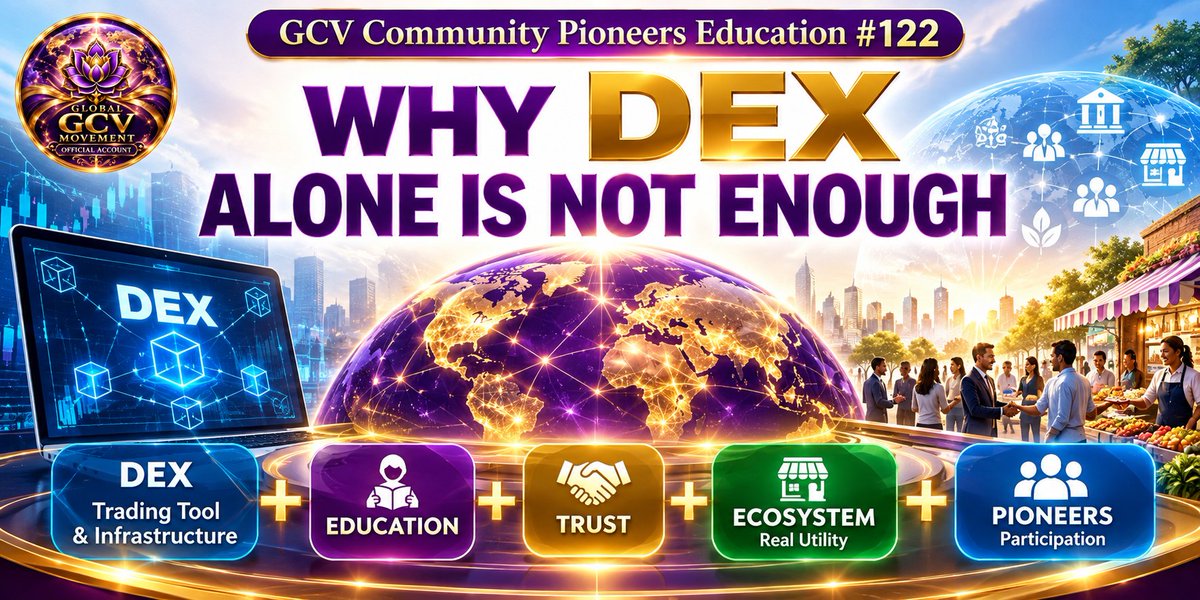
GCV COMMUNITY PIONEERS EDUCATION #122
WHY DEX ALONE IS NOT ENOUGH
There is a misleading idea spreading in the community:
“As long as the DEX is successfully developed, Pi can succeed. Pioneers do not need to do anything. Just wait for the technology.”
This is a very wrong and dangerous way of thinking.
First, we need to understand what a DEX is.
DEX — Decentralized Exchange — is a tool and infrastructure.
It can provide a decentralized mechanism for exchanging assets and creating liquidity.
But DEX cannot replace community education, community trust, ecosystem development, or Pioneer participation.
1. DEX CAN PROVIDE TRADING, BUT IT CANNOT CREATE TRUST
If a community is filled with misinformation, speculation, scams, short-term thinking, and distrust, can a DEX solve these problems?
No.
Technology can execute transactions, but technology cannot educate people's minds.
A sustainable economic ecosystem requires people who understand what they are doing, trust the ecosystem, understand their responsibilities, and have a long-term vision.
That is why community education is essential.
2. DEX CAN EXCHANGE ASSETS, BUT IT CANNOT CREATE REAL DEMAND
A DEX cannot automatically create merchants.
It cannot automatically create products and services.
It cannot automatically bring businesses, consumers, banks, financial institutions, and other outside organizations into the ecosystem.
Without real goods, services, applications, and economic activity, people may simply be exchanging assets with each other.
Exchange ≠ Ecosystem.
A real ecosystem requires people to use the currency, merchants to accept it, and businesses to create real utility.
3. TECHNOLOGY ANSWERS “HOW TO EXCHANGE.”
COMMUNITY ANSWERS “WHY AND WHERE TO USE.”
These are completely different functions.
DEX answers:
How can we exchange?
Community education and ecosystem development answer:
Why should people use it?
Where can people use it?
What can people use it for?
Why should people trust it?
Without these foundations, even excellent technology remains only a tool.
4. “PIONEERS DO NOT NEED TO DO ANYTHING” IS THE MOST DANGEROUS IDEA
If people continuously tell Pioneers:
“You don't need to do anything. Just wait for the DEX.”
What happens?
Everyone continues waiting.
Nobody educates.
Nobody builds trust.
Nobody develops real utility.
Nobody brings merchants and outside businesses into the ecosystem.
Then who is going to build the economy?
DEX cannot educate the market by itself.
DEX cannot build community trust by itself.
DEX cannot bring merchants into the ecosystem by itself.
DEX cannot do the work that Pioneers must do.
This is why I have repeatedly said:
Technology is one leg.
Community is the other leg.
One leg alone cannot take us very far.
Of course we need technology.
Of course we need DEX.
But we also need:
EDUCATION + TRUST + UTILITY + ECOSYSTEM + PIONEER PARTICIPATION
Do not turn support for DEX into denial of the importance of the community.
The correct direction is not:
DEX OR COMMUNITY
It is:
DEX + EDUCATION + TRUST + ECOSYSTEM + PIONEERS
Technology provides the infrastructure.
Community education builds understanding and trust.
The ecosystem creates real utility.
Pioneers help drive adoption.
Technology cannot replace the community, and the community cannot replace technology. We need both legs to move forward.
— Doris Yin
Founder & Chairperson
Global GCV Movement
Assalamu Alaikum
Engr Musa Ab
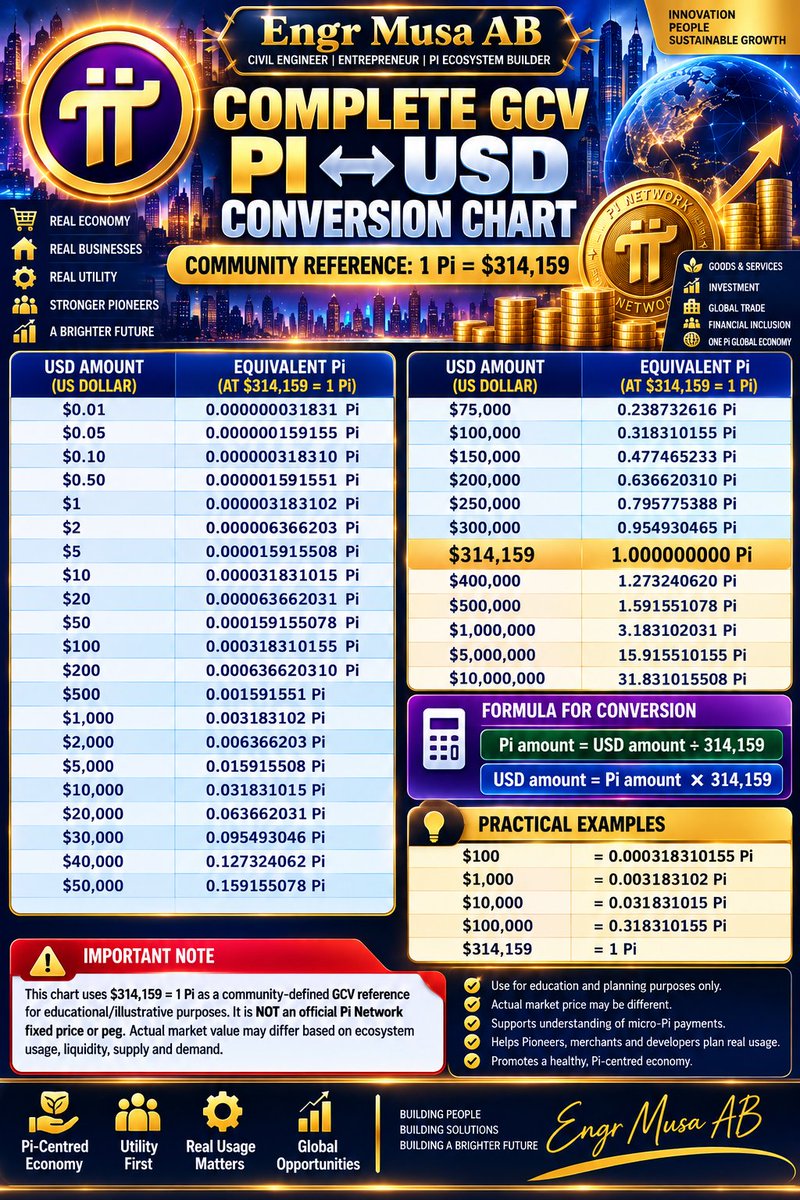
Here is the complete chart in written form, based on the GCV reference we are using:
GCV Reference: 1 Pi = $314,159
Formula:
Pi = USD ÷ 314,159
USD = Pi × 314,159
Important Note: This chart uses the community-defined GCV reference for calculation and educational purposes. It does not mean that Pi Core Team has officially confirmed $314,159 as Pi’s fixed price or official peg. Pioneers should rely on Pi Network’s official channels for official information.
Pi Network has stated that its long-term approach focuses on utility, real-world use cases, ecosystem development, and adoption, including the use of Pi in ecosystem products and services.
---
📊 $0.01 to $1,000
USDPi @ GCV
$0.010.000000031831 Pi
$0.050.000000159155 Pi
$0.100.000000318310 Pi
$0.250.000000795776 Pi
$0.500.000001591551 Pi
$10.000003183102 Pi
$20.000006366203 Pi
$50.000015915508 Pi
$100.000031831015 Pi
$200.000063662031 Pi
$500.000159155078 Pi
$1000.000318310155 Pi
$2000.000636620310 Pi
$5000.001591551078 Pi
$1,0000.003183102031 Pi
---
📊 $2,000 to $50,000
USDPi @ GCV
$2,0000.006366203101 Pi
$5,0000.015915507755 Pi
$10,0000.031831015510 Pi
$15,0000.047746523265 Pi
$20,0000.063662031020 Pi
$25,0000.079577538775 Pi
$30,0000.095493046530 Pi
$40,0000.127324062040 Pi
$50,0000.159155077550 Pi
---
📊 $75,000 to $314,159
USDPi @ GCV
$75,0000.238732616325 Pi
$100,0000.318310155100 Pi
$125,0000.397887693875 Pi
$150,0000.477465232650 Pi
$175,0000.557042771425 Pi
$200,0000.636620310200 Pi
$250,0000.795775387750 Pi
$300,0000.954930465300 Pi
$314,1591.000000000000 Pi
---
📊 Above 1 Pi
PiUSD @ GCV
1 Pi$314,159
2 Pi$628,318
3 Pi$942,477
5 Pi$1,570,795
10 Pi$3,141,590
20 Pi$6,283,180
50 Pi$15,707,950
100 Pi$31,415,900
200 Pi$62,831,800
500 Pi$157,079,500
1,000 Pi$314,159,000
10,000 Pi$3,141,590,000
100,000 Pi$31,415,900,000
1,000,000 Pi$314,159,000,000
---
📌 Practical Examples
A $100 item:
$100 ÷ 314,159 = 0.000318310155 Pi
A $1,000 item:
$1,000 ÷ 314,159 = 0.003183102031 Pi
A $10,000 item:
$10,000 ÷ 314,159 = 0.031831015510 Pi
A $100,000 item:
$100,000 ÷ 314,159 = 0.318310155100 Pi
A $314,159 item:
$314,159 ÷ 314,159 = 1 Pi
---
🌐 Why Micro-Pi Matters
This is one reason why, if someone chooses to use the $314,159 GCV reference purely as a reference model, everyday goods could theoretically be priced using micro-Pi amounts rather than large whole-Pi amounts.
For example:
$100 → 0.000318310155 Pi
$1,000 → 0.003183102031 Pi
$10,000 → 0.031831015510 Pi
This fits with Pi Network’s stated emphasis on building a utility-driven ecosystem, where Pi is used within real products, services, and transactions.
GCV Reference ≠ Official Pi Price
Pi Utility + Real-World Transactions + Ecosystem Adoption = The Practical Economic Use of Pi
Engr Musa Ab
Assalamualaikum
Engr Musa Ab.
Ga cikakken chart a rubuce, bisa ma'aunin da muka ɗauka na GCV reference: 1 Pi = $314,159.
Formula:
Pi = USD ÷ 314,159
USD = Pi × 314,159
Wannan chart ɗin community-defined GCV reference ne don lissafi/ilimi; ba wai Pi Core Team ta tabbatar da $314,159 a matsayin official fixed price ba. Pi ta umurci Pioneers su dogara da official channels ɗinta don irin waɗannan bayanai.
📊 $0.01 zuwa $1,000
USDPi @ GCV
$0.010.000000031831 Pi
$0.050.000000159155 Pi
$0.100.000000318310 Pi
$0.250.000000795776 Pi
$0.500.000001591551 Pi
$10.000003183102 Pi
$20.000006366203 Pi
$50.000015915508 Pi
$100.000031831015 Pi
$200.000063662031 Pi
$500.000159155078 Pi
$1000.000318310155 Pi
$2000.000636620310 Pi
$5000.001591551078 Pi
$1,0000.003183102031 Pi
📊 $2,000 zuwa $50,000
USDPi @ GCV
$2,0000.006366203101 Pi
$5,0000.015915507755 Pi
$10,0000.031831015510 Pi
$15,0000.047746523265 Pi
$20,0000.063662031020 Pi
$25,0000.079577538775 Pi
$30,0000.095493046530 Pi
$40,0000.127324062040 Pi
$50,0000.159155077550 Pi
📊 $75,000 zuwa $314,159
USDPi @ GCV
$75,0000.238732616325 Pi
$100,0000.318310155100 Pi
$125,0000.397887693875 Pi
$150,0000.477465232650 Pi
$175,0000.557042771425 Pi
$200,0000.636620310200 Pi
$250,0000.795775387750 Pi
$300,0000.954930465300 Pi
$314,1591.000000000000 Pi
Sama da 1 Pi
PiUSD @ GCV
1 Pi$314,159
2 Pi$628,318
3 Pi$942,477
5 Pi$1,570,795
10 Pi$3,141,590
20 Pi$6,283,180
50 Pi$15,707,950
100 Pi$31,415,900
200 Pi$62,831,800
500 Pi$157,079,500
1,000 Pi$314,159,000
10,000 Pi$3,141,590,000
100,000 Pi$31,415,900,000
1,000,000 Pi$314,159,000,000
Misalan amfani
Kaya $100:
$100 ÷ 314,159 = 0.000318310155 Pi
Kaya $1,000:
$1,000 ÷ 314,159 = 0.003183102031 Pi
Kaya $10,000:
$10,000 ÷ 314,159 = 0.031831015510 Pi
Kaya $100,000:
$100,000 ÷ 314,159 = 0.318310155100 Pi
Kaya $314,159:
= 1 Pi
Wannan shi ne dalilin da ya sa, idan mutum yana amfani da wannan reference kawai, ƙananan abubuwa za su iya amfani da micro-Pi amounts maimakon manyan adadin Pi. Pi Network kanta tana bayyana manufarta a matsayin ecosystem mai amfani da Pi wajen real-world utility da transactions.
https://t.co/VfIeAhYRFB
Engr Musa Ab.
Thank you, Doris. I believe this is where Pioneers can play a very important role in shaping the Pi ecosystem.
If the GCV community wants to maintain GCV as a community-defined reference, Pioneers should understand how their commitments can influence the initial Token/Pi relationship in Launchpad.
Look at the Testnet examples:
👇🏼👇🏼👇🏼👇🏼👇🏼👇🏼👇🏼
IRRA: 10M IRRA tokens, with 11.71M Test-Pi applied toward token acquisition → approximately 1 IRRA ≈ 1.171 Test-Pi.
SLICE: 10M SLICE tokens, with 15.92M Test-Pi committed toward acquisition → approximately 1 SLICE ≈ 1.592 Test-Pi.
These examples show why Pioneer participation matters. The amount of Pi committed and actually applied toward token acquisition can establish an initial Token/Pi relationship, while liquidity and real swaps can subsequently change the displayed market price. Pi’s DEX design also organizes liquidity around Pi-denominated pairs, with Pi serving as the common base.👇🏼👇🏼👇🏼👇🏼
https://t.co/R9LF8dCV7G
https://t.co/NmX6lzSUbA
Therefore, if Pioneers want ecosystem tokens to launch with a balanced relationship to Pi, the community should understand the economics before committing.
GCV should be treated as a community reference—not an official Pi price—and Pioneer commitment should be used thoughtfully to support a healthy Pi-centric economy.
Pioneer Commitment → Token Acquisition → Initial Token/Pi Relationship → Liquidity → Real Swaps → Price Discovery.
Let’s educate Pioneers, participate wisely, and help build a strong Pi ecosystem.
Engr Musa AB
@dorisyincpa@PiCoreTeam@NoncePadja@piman320@2000Rocker@Diazag3
Pi Network Launchpad:
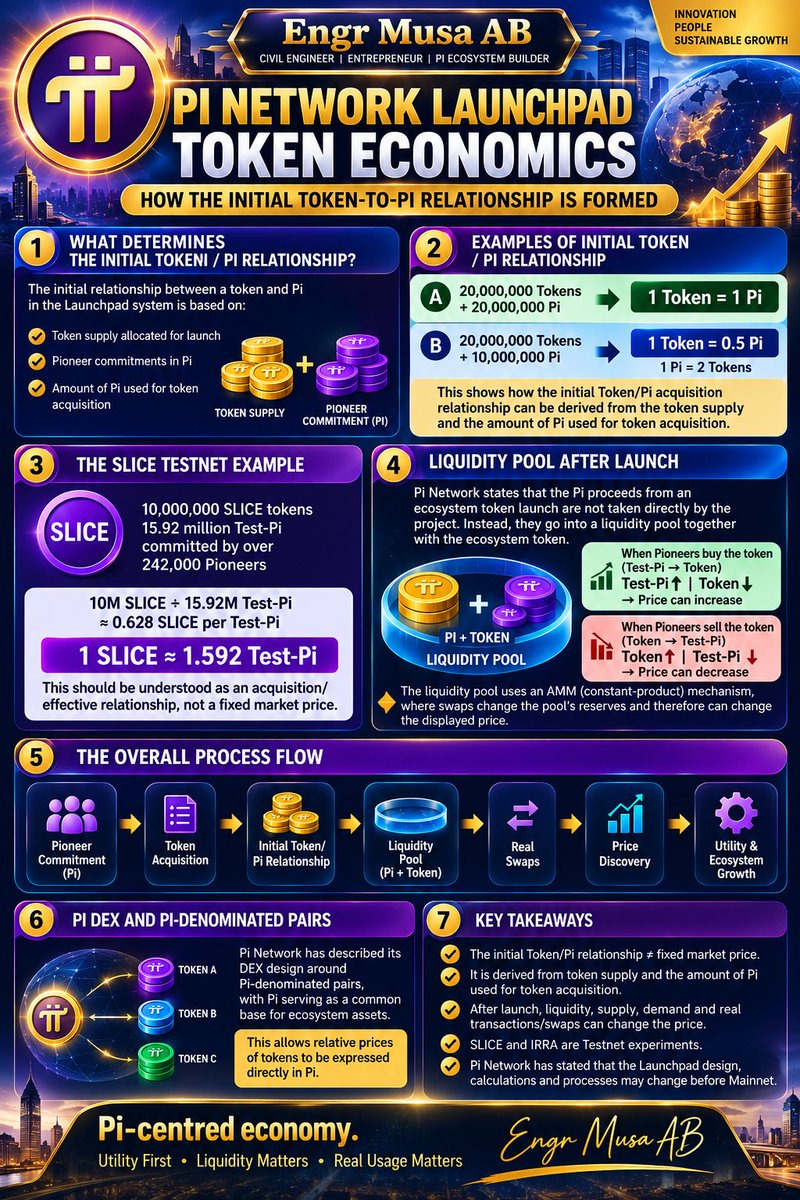
How Is the Initial Token-to-Pi Relationship Formed?
One of the important concepts in the Pi Launchpad design is how token supply, Pioneer commitments, and the amount of Pi used for token acquisition can establish an initial relationship between the token and Pi.
For example:
20,000,000 Tokens + 20,000,000 Pi
��️ 1 Token = 1 Pi
Or:
20,000,000 Tokens + 10,000,000 Pi
➡️ 1 Token = 0.5 Pi
➡️ 1 Pi = 2 Tokens.
This illustrates how an initial Token/Pi acquisition relationship can be derived from the token supply and the amount of Pi used for token acquisition.
However, this does not mean that the relationship becomes a permanent market price.
After launch, the token can enter a Pi + Token Liquidity Pool, where real swaps, liquidity, supply, and demand can change the displayed market price.
The SLICE Example
In the SLICE Testnet launch, more than 242,000 Pioneers committed a total of 15.92 million Test-Pi toward the acquisition of 10 million SLICE tokens.
From this, we can calculate the acquisition relationship:
10M SLICE ÷ 15.92M Test-Pi ≈ 0.628 SLICE per Test-Pi
Therefore:
1 SLICE ≈ 1.592 Test-Pi
However, this should be understood as an acquisition/effective relationship, not as proof that SLICE has a fixed market price of 1.592 Test-Pi.
Then Comes the Liquidity Pool
Pi Network states that the Pi proceeds from an ecosystem-token launch are not taken directly by the issuing project. Instead, they go into a liquidity pool together with the ecosystem token. �
Pi Network
For SLICE, the pool contains:
SLICE + Test-Pi
If a Pioneer uses Test-Pi to acquire SLICE:
Test-Pi ↑ | SLICE ↓
➡️ The displayed price of SLICE can increase.
If SLICE is sold in exchange for Test-Pi:
SLICE ↑ | Test-Pi ↓
➡️ The displayed price of SLICE can decrease.
Pi Network explains that the liquidity pool uses an AMM/constant-product mechanism, where swaps change the pool’s reserves and therefore can change the displayed price.
🔄 The Process Can Be Summarized As:
Pioneer Commitment
⬇️
Token Acquisition
⬇️
Initial Token/Pi Relationship
⬇️
Liquidity Pool
⬇️
Real Swaps
⬇️
Price Discovery
⬇️
Utility & Ecosystem Growth.
Pi Network has also described its DEX design around Pi-denominated pairs, with Pi serving as a common base for ecosystem assets.
🔑 The Key Distinction
Initial Token/Pi Relationship ≠ Fixed Market Price
The initial relationship can be derived from the token supply and the amount of Pi applied toward token acquisition in the Launchpad mechanism.
But after launch, liquidity, supply, demand, and actual transactions/swaps can change the token’s market price.
And importantly, SLICE and IRRA are Testnet experiments.
Pi Network has stated that the Launchpad product is still being tested and that its design, calculations, and processes may change before the Mainnet version.
Pi-Centred Economy.
Utility First.
Liquidity Matters.
Real Usage Matters.
Engr Musa AB
Exactly. But I believe Pioneers also have an important role to play here.
If the Pi community chooses to use GCV as a community-defined reference value, Pioneer commitments could help establish an initial Token/Pi relationship that is more aligned with that reference.
The goal would be to avoid launching ecosystem tokens with an initial relationship that places the token above Pi from the very beginning.
In a Pi-centric market, the question is not only “How many Pi is this token worth?” — it is also how much Pi are Pioneers collectively willing to commit to acquire that token?
Pioneer Commitment → Token Acquisition → Initial Token/Pi Relationship → Liquidity → Real Swaps → Price Discovery.
So Pioneers are not merely participants; their collective commitments can be an important part of shaping the initial economic relationship between ecosystem tokens and Pi.
GCV as a community reference.
Pi as the common base. Real participation as the market mechanism.
Engr Musa AB
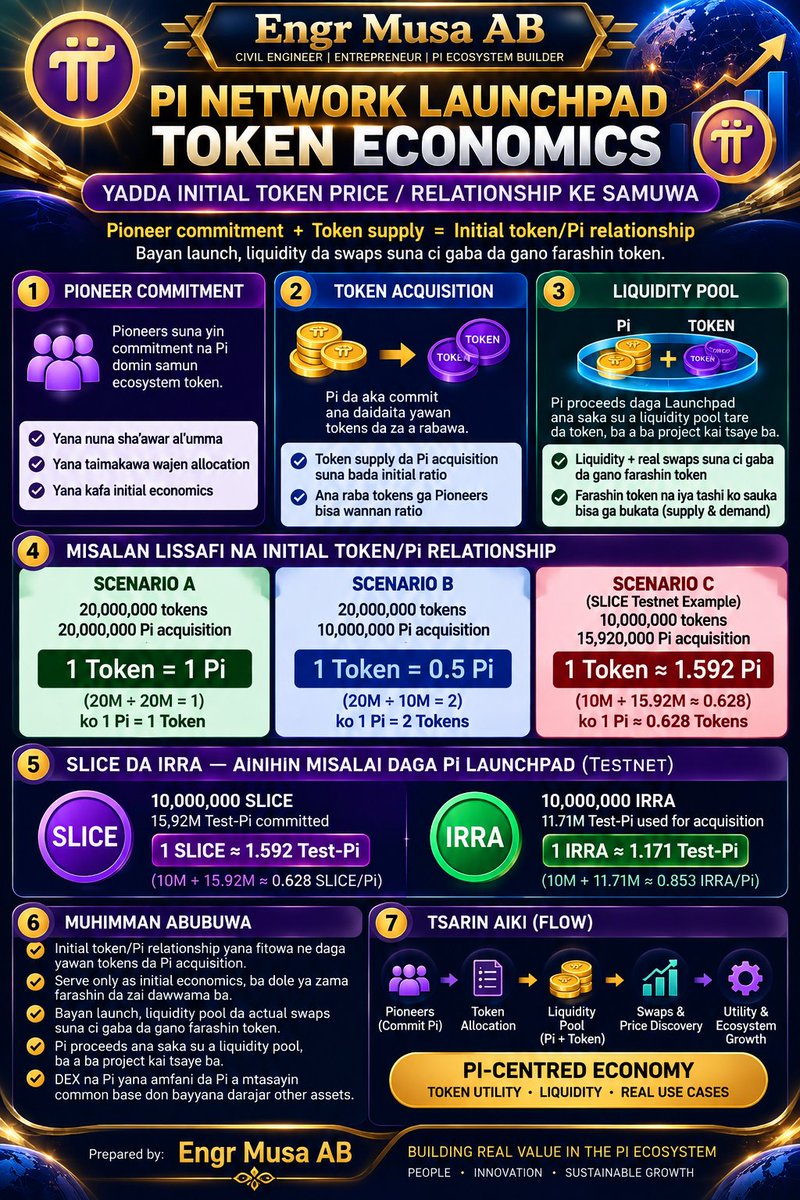
Pi Network Launchpad: Ta yaya ake samar da farkon alaƙar Token da Pi?
Ɗaya daga cikin muhimman abubuwa a tsarin Pi Launchpad shi ne yadda adadin token, commitment na Pioneers, da Pi da aka yi amfani da shi wajen samun token suke samar da alaƙar farko tsakanin token da Pi.
Misali:
20,000,000 Tokens + 20,000,000 Pi
➡️ 1 Token = 1 Pi
Ko kuma:
20,000,000 Tokens + 10,000,000 Pi
➡️ 1 Token = 0.5 Pi
➡️ 1 Pi = 2 Tokens
Wannan yana nuna yadda za a iya samun farkon alaƙar Token/Pi daga adadin token da kuma adadin Pi da aka yi amfani da shi wajen acquisition.
Amma wannan ba yana nufin cewa wannan zai zama farashin token na dindindin ba.
Bayan ƙaddamarwa, token zai iya shiga cikin Liquidity Pool na Pi + Token. A nan, ainihin swaps, liquidity, supply da demand na iya sauya farashin da ake nunawa.
Misalin SLICE
A gwajin SLICE Testnet, sama da 242,000 Pioneers sun yi commitment na jimillar 15.92 million Test-Pi domin samun 10 million SLICE.
Daga wannan za mu iya lissafa alaƙar acquisition:
10M SLICE ÷ 15.92M Test-Pi ≈ 0.628 SLICE per Test-Pi.
Wato:
1 SLICE ≈ 1.592 Test-Pi
Amma wannan ya kamata a fahimta a matsayin acquisition/effective relationship, ba wai cewa an tabbatar da SLICE yana da wannan fixed market price ba.
Bayan haka Liquidity Pool ce ke shiga
Pi Network ta bayyana cewa Pi da aka samu daga ƙaddamar da ecosystem token ba ya shiga kai tsaye hannun project ɗin; ana sanya shi cikin liquidity pool tare da ecosystem token.
A SLICE Testnet, pool ɗin yana ɗauke da:
SLICE + Test-Pi
Idan Pioneer ya yi amfani da Test-Pi ya sayi SLICE:
Test-Pi ↑ | SLICE ↓
→ displayed price na SLICE zai iya ƙaruwa.
Idan kuma aka sayar da SLICE domin Test-Pi:
SLICE ↑ | Test-Pi ↓
→ displayed price na SLICE zai iya raguwa. Pi Network ta bayyana cewa wannan yana amfani da constant-product AMM formula.
🔄 Don haka tsarin zai zama:👇🏼👇🏼👇🏼👇🏼
Pioneer Commitment
⬇️
Token Acquisition
⬇️
Farkon Token/Pi Relationship
⬇️
Liquidity Pool
⬇️
Real Swaps
⬇️
Price Discovery
⬇️
Utility & Ecosystem Growth.
Haka kuma Pi Network ta bayyana cewa Pi DEX Testnet an tsara shi ne da Pi a matsayin common base, wato ana tsara liquidity a kan Pi-denominated pairs.
🔑 Muhimmin bambanci
Farkon Token/Pi relationship ≠ fixed market price.
Farkon alaƙar na iya fitowa daga token supply da Pi da aka yi amfani da shi wajen acquisition a tsarin Launchpad. Amma bayan haka, liquidity, supply, demand da ainihin transactions/swaps na iya sauya farashin token.
Kuma mu tuna: SLICE da IRRA gwaje-gwaje ne na Testnet, yayin da Pi ta ce tsarin Launchpad na iya ci gaba da canzawa kafin Mainnet.
Pi-centred economy.
Utility first.
Liquidity matters.
Real usage matters.
Engr Musa AB