$GEV - THE AI BOTTLENECK ISN'T CHIPS, IT'S THE GRID — AND GE VERNOVA OWNS THE GATE
GE Vernova's backlog hit $163B and management is steering toward $200B by 2027. In Q1 alone its Electrification arm booked $2.4B of data-center equipment orders — more than all of last year — with full-year data-center orders guided +29% to $24.8B. Gas-turbine backlog plus slot reservations are tracking to 110 GW by year-end.
The mechanism: AI compute is increasingly power-constrained, not silicon-constrained. Transformers, switchgear and turbines carry multi-year lead times, so GEV's backlog is the real-economy gate on every data center the chip names are racing to fill.
$FN - FABRINET BUILDS THE OPTICS NVIDIA'S SWITCHES CAN'T SHIP WITHOUT
Fabrinet is the contract manufacturer assembling the high-speed optical transceivers behind the AI buildout, with a dominant lead in 1.6T it projects to ~$5.4B of revenue by 2028. It posted record results again in its March quarter and is raising a 2 million sq ft plant by year-end 2026 purely to feed the 1.6T transition for hyperscale customers like Nvidia and Cisco.
The mechanism: as co-packaged optics ramps, system-level optical assembly becomes a bottleneck, and Fabrinet is the outsourced capacity the whole optical complex routes through — not a name whose backlog moves on a payroll surprise.
$GLW - NVIDIA IS PAYING CORNING TO REPLACE COPPER WITH GLASS INSIDE THE AI RACK
Corning's multiyear pact commits Nvidia to invest up to $3.2B — including $500M of warrants — to 10x Corning's US optical-connectivity capacity and lift US fiber output more than 50% across three new plants. The pull: Nvidia's Spectrum-X Ethernet Photonics, its first co-packaged-optics switch, entered production May 31, and CPO swaps copper cabling for glass fiber from rack down to the chip.
The mechanism: CPO doesn't kill optical content, it moves the dollars from the pluggable module into the fiber layer Corning owns — a structural socket the Friday selloff treated as just another chip-beta name.
$ANET - ARISTA RAISED ITS AI NUMBER WHILE THE TAPE WAS PRICING AI-DEMAND DEATH
Arista guided 2026 AI fabric sales to $3.5B — more than double last year — and lifted full-year revenue to $11.5B (+27.7%) after Q1 grew 35% to $2.71B. Its problem isn't demand; it's supply: persistent broad-based component shortages are forcing multiyear purchase commitments just to lock allocation.
The mechanism the selloff missed — back-end AI clusters are migrating from proprietary interconnect to Ethernet, and Arista is supply-constrained, not order-constrained. A jobs-print rate scare doesn't change who builds the switch fabric.
$FLEX - THE AI-RACK BUILDER JUST PICKED UP AN S&P 500 INDEX BID NOBODY'S TALKING ABOUT
Flex joins the S&P 500 before June 22's open, replacing Campbell's — forced passive buying into the company that builds the power shelves and racks inside AI data centers. Its data-center-heavy CPI segment grew 38% to $6.61B in FY26, now 24% of a $27.9B top line, and its 800 VDC power rack was co-developed with Nvidia for the Vera Rubin platform.
The kicker: Flex plans to spin its power-and-cloud unit into a separate public company by early 2027 — an index-inclusion bid stacked on top of a pending sum-of-the-parts catalyst.
$MRVL - MARVELL JOINS THE S&P 500 ON JUNE 22, AND THE INDEX BID IS MECHANICAL
S&P Dow Jones is adding Marvell (and Flex) to the 500 before Monday June 22's open, bumping Pool Corp — every S&P index fund then has to buy the name regardless of price. The inclusion was earned on profitability driven entirely by AI revenue: the custom-silicon + 1.6T optical-DSP franchise the Street spent Friday's jobs-scare chip selloff dumping.
The mechanism: reconstitution forces billions of passive demand into a name the active crowd just de-risked — a rare setup where the marginal buyer is a robot with a calendar, not a view on the May payroll print.
President Trump has said that the White House may take equity stakes in American AI companies, after it was revealed they might take a stake in OpenAI, per Reuters
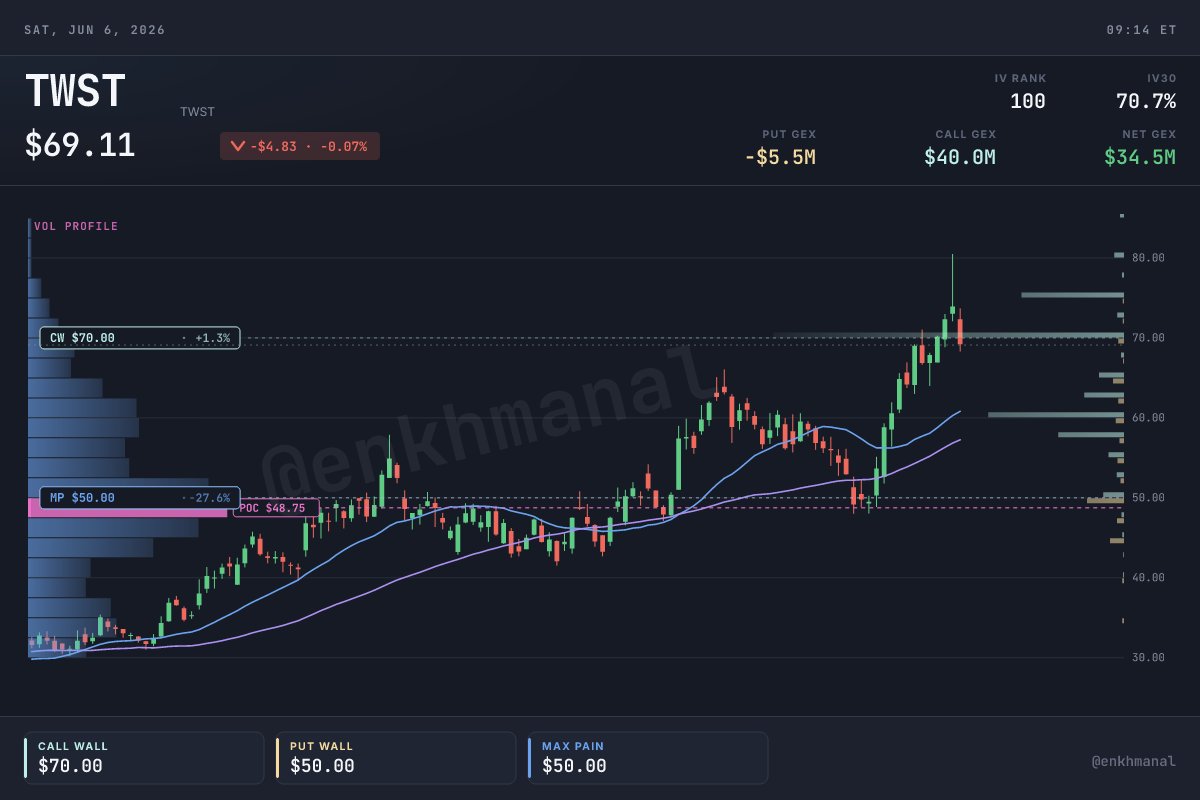
$TWST - TWIST BIOSCIENCE, THE "SILICON FAB OF DNA," SLIPS TO $69 OFF ITS $79 HIGH — THE MARKET STILL CAN'T VALUE IT
Twist closed near $69 Friday, −6.5%, pulling back from a $79 52-week high after a +142% YTD run. The business is firing: 13 straight quarters of sequential growth, a full-year guidance raise management called "double the beat," and a credible path to its first adjusted-EBITDA breakeven by Q4 FY26 — synthesis volume on its silicon chip compounding into share gains across genes, proteins and antibodies.
The whole debate is price, not platform: even after the dip the stock sat above the ~$64 consensus target, and ARK was trimming into the strength. AI-driven drug discovery multiplies order sizes — "100 sequences becomes thousands" — so the execution-layer thesis is intact; the question is how much growth is already baked into an ~11x EV/sales multiple.
$KOPN - KOPIN SLIDES AFTER A Q4 REVENUE DECLINE — A REAL DEFENSE TURNAROUND CARRYING A SPECULATIVE AI CALL OPTION
Kopin closed near $5.45 Friday after reporting another quarter of falling revenue. The substance underneath is a genuine US-defense microdisplay franchise: sole-source on the F-35 helmet display, a fresh $21.5M thermal-imaging follow-on and a $15.4M Army MicroLED award, with defense ~74% of sales.
The hype is the other leg — a "Neural I/o" plan to turn MicroLED pixels into GPU-to-GPU optical interconnects, signed as a $15M JDA with a twice-rebranded going-concern shell and zero published specs. At ~25x trailing sales with a $399M accumulated deficit and insiders selling into the run, this is a speculative call-option on a year-end-2026 demo, not a fundamentals trade.