It’s going unnoticed because so much other news is happening, but the war drums are beating again in D.C. The warmongers worry this is their last chance to get the white whale they’ve been chasing for thirty years, an all-out regime change war against Iran.
A new Middle East war would be a catastrophic mistake. Our military stockpiles are depleted from three years of backing Ukraine. Our effort to reshore manufacturing has only just begun and will take years to bear fruit. War would worsen our already immense deficit and national debt. Iran is larger than Iraq, Syria, and Afghanistan combined. A war would not be easy and could easily become a calamity.
Thanks to President Trump’s restraint during his first term, America has a golden opportunity to pull away from Middle East quagmires for good. We shouldn’t throw that opportunity away so that sone D.C. has-beens can feel tough by sending young Americans to die yet again.
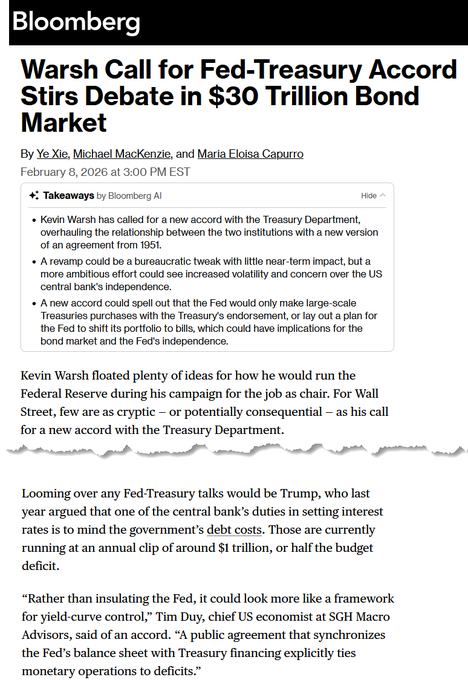
Warsh, the next Fed chair, will inflate the debt away.
He is in favor of yield curve control.
- This means pegging US short-term interest rates to an artificially low level
- The Fed commits to buying unlimited amounts above that level to push interest rates down
This would be reminiscent of the WWII period.
Back then, US debt-to-GDP was 125% vs 121% now.
YCC enabled the government to borrow vast amounts of USTs without blowing out interest expenses.
Those costs were pushed onto citizens via inflation.
From 1945-1980, the US gradually brought debt-to-GDP down to 30%, which later enabled Volcker to raise rates to 20% to kill inflation. This seems to be Warsh’s playbook.
The idea that Trump would nominate someone more hawkish than Powell, after attacking him for over a year for being too hawkish, was ridiculous to begin with.
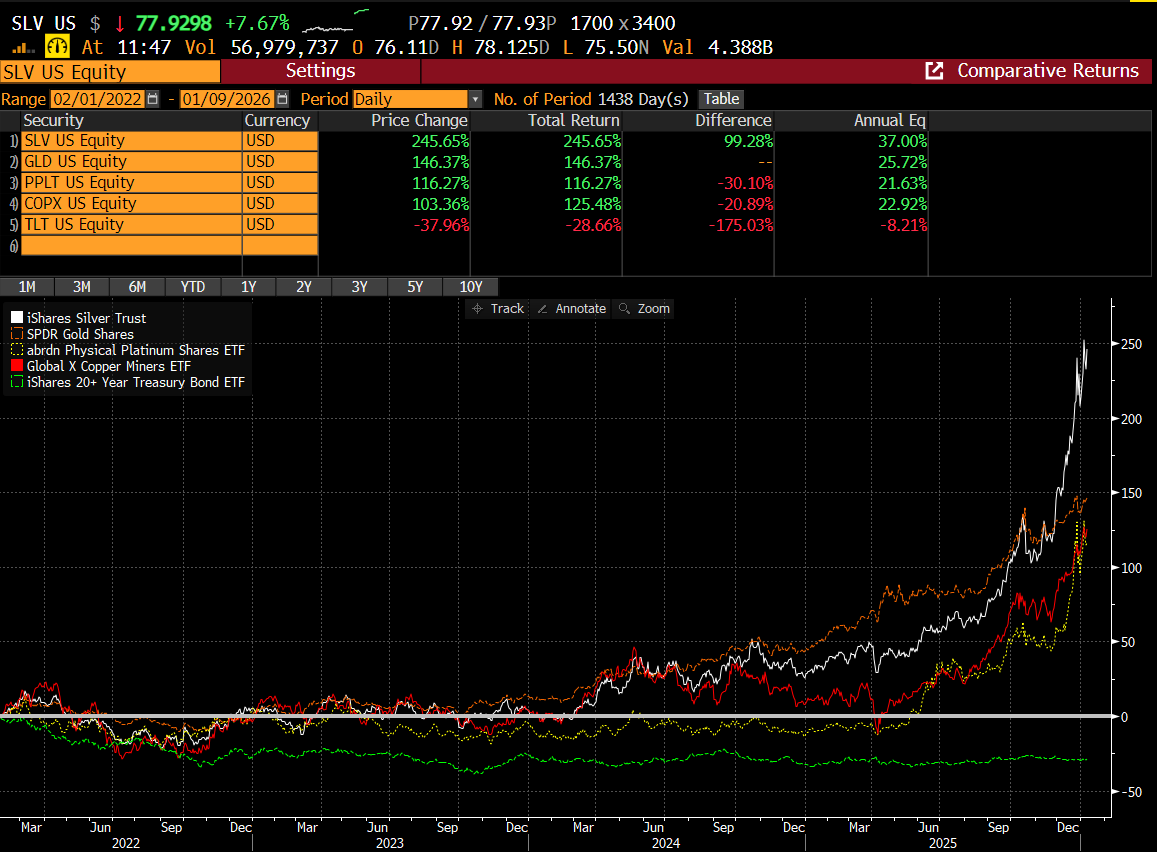
Inflating the debt away was always the plan… needless to say, hard assets outperform during inflationary periods.
You can also see the shift when Biden froze Russian assets on Feb 28, 2022 how money started relatively seeking stores of value.
That may have been the "oh sh*t" moment when global investors realized that fiat assets could be confiscated and asked themselves, "what exactly is a store of value."
This is when the short volatility insurance model really got screwed and the long-volatility frontier boom took off.
I could make the argument that Warren Buffett’s “short volatility” value-investing ushered in an era of lower growth as it brainwashed several generations into financial arbitrage & efficiency rather than pursuing new breakthroughs that would benefit humanity.
An interesting difference between thousands of years of Prime Movers was the Robber Barons like Rockefeller and Carnegie would be constantly reinvesting in very risky frontiers rather than value investing and donating their wealth to charity.
Satoshi will go down as a way more important figure than Buffett and it’s possible that Buffett’s legacy will change over time from hero to someone not as admirable….