Why India's Candy Export Is Poor
1. Candy is not semiconductor
2. India #1 sugar producer; 100-yr candy mfg; just 1% share in global candy exports
3. Parle sold even Thums Up, Limca to Coca-Cola
4. Sell only domestic; ₹ gets hit; structural demand drag; growth stalls
FACTS:
India’s Export Insignificance
a. Commerce Ministry Data FY14 to FY26: 166% “toffee” export growth is reported in “rupees”. In $ terms, exports grew only 64% ($8M in FY14 to $13M in FY26). CAGR: 4.1%
Rupee CAGR does not account for rupee depreciation. Export has no meaning in rupees.
b. India is the world’s largest producer of sugar. India pioneered global sugar refining in 500 BC. Automated candy manufacturing with imported German machines began in 1929.
c. Despite these historic strengths, India’s global sugar confectionery export share is negligible. Total sugar confectionery global exports @ $17.5B; India’s share @ $203M (1.2% of global exports).
d. India’s sugar confectionery export growth YoY @ 1.7% (global growth @ 3.03%). At this growth rate, just to double the export volume from $203M to $406M, India needs 41 years.
Personal Wealth Over Global Ambition
a. Indian family-controlled business empires traditionally counted their success in terms of personal wealth accumulation, and not in terms of “conquering the world.”
b. Domestic market was the low-hanging fruit waiting to be exploited. You can enjoy maximum return on capital (ROC) in a monopolistic environment where regulation favours a few large domestic players.
c. The moment you choose exports as your battleground, you are forced to fight in a level-playing field. Now you need massive, long-horizon capital investments in technology, R&D, world-class manufacturing facilities and best practices to compete and win. Stock markets hate it.
d. Without exports, India entirely avoided the need to invest in technology, R&D, and world-class manufacturing.
While the rest of the world was competing in Olympics with best preparation, India chose to skip participation. The rupee’s value erosion on global stage is the prize for this bravery.
e. The Indian confectionery business model, and the entire Indian food processing ecosystem (from QC to innovation to cold-chain logistics) is optimized to service millions of local kirana stores, and not fit for global scale.
Killing the Domestic Goose
a. Demand-Constrained Growth Model: When GDP growth relies almost entirely on domestic consumption, a nation binds its destiny to the purchasing power of the local population.
b. India’s family-run conglomerates focus not exactly on domestic consumption, but primarily on the creamy layer to maximize return on capital and maximize shareholder value (promoters are themselves the biggest shareholders.)
c. Asymmetric Growth: As a result, India’s economic growth model is structurally configured to produce goods and services for the top 15 crore consumers (top 10% of the income pyramid.)
d. Structural Demand Drag: In absence of investments in technology and a massive export manufacturing base, the remaining 90% of the population has been left far behind.
They face poor job opportunities, stagnated real wages (inflation-adjusted), and no large-scale transition from agriculture to manufacturing (like China).
ENDPIECE
By abandoning an innovation-led export economy while proudly building personal empires on domestic protectionism, Indian industrialists are killing the goose that lays golden eggs. But they don’t mind it until the last egg is taken.
@arabicatrader
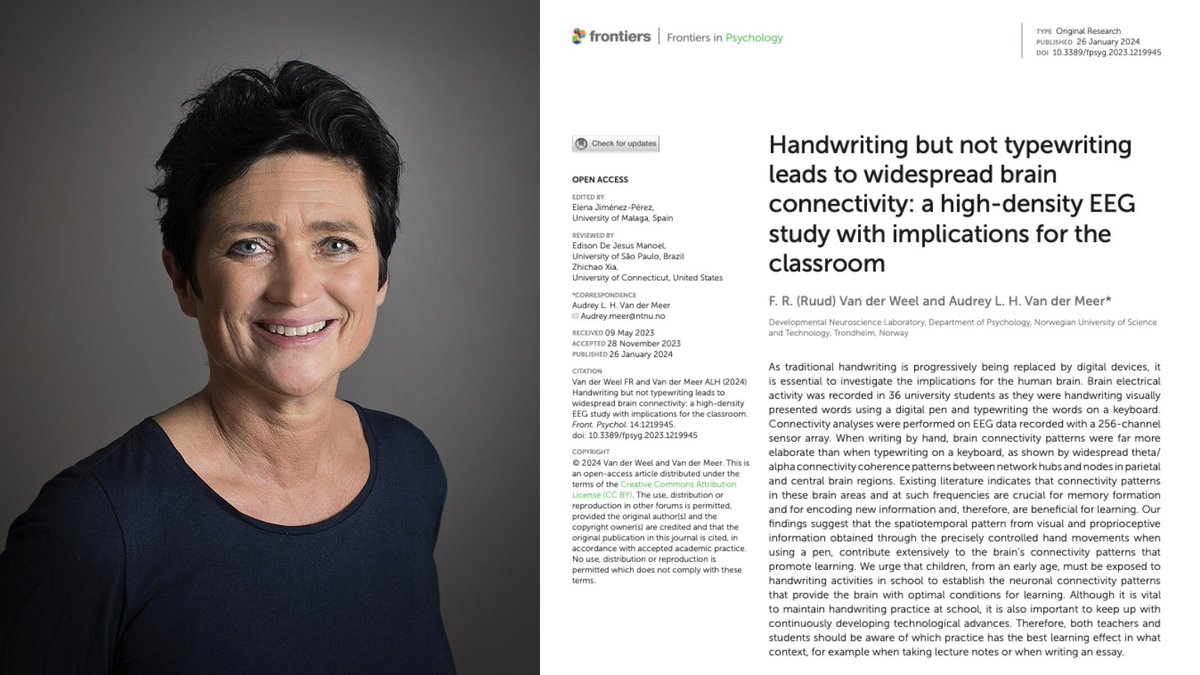
A Norwegian neuroscientist spent 20 years proving that the act of writing by hand changes the human brain in ways typing physically cannot, and almost nobody outside her field has read the paper.
Her name is Audrey van der Meer.
She runs a brain research lab in Trondheim, and the paper that closed the argument was published in 2024 in a journal called Frontiers in Psychology. The finding is brutal enough that it should have changed every classroom on Earth.
The experiment was simple. She recruited 36 university students and put each one in a cap with 256 sensors pressed against their scalp to record brain activity. Words flashed on a screen one at a time.
Sometimes the students wrote the word by hand on a touchscreen using a digital pen, and sometimes they typed the same word on a keyboard. Every neural response was recorded for the full five seconds the word stayed on screen.
Then her team looked at the part of the data most researchers had ignored for years, which is how different parts of the brain were communicating with each other during the task.
When the students wrote by hand, the brain lit up everywhere at once.
The regions responsible for memory, sensory integration, and the encoding of new information were all firing together in a coordinated pattern that spread across the entire cortex. The whole network was awake and connected.
When the same students typed the same word, that pattern collapsed almost completely.
Most of the brain went quiet, and the connections between regions that had been alive seconds earlier were nowhere to be found on the EEG.
Same word, same brain, same person, and two completely different neurological events.
The reason turned out to be something nobody had really paid attention to before her work. Writing by hand is not one motion but a sequence of thousands of tiny micro-movements coordinated with your eyes in real time, where each letter is a different shape that requires the brain to solve a slightly different spatial problem.
Your fingers, wrist, vision, and the parts of your brain that track position in space are all working together to produce one letter, then the next, then the next.
Typing throws all of that away. Every key on a keyboard requires the exact same finger motion regardless of which letter you are pressing, which means the brain has almost nothing to integrate and almost no problem to solve.
Van der Meer said it plainly in her interviews.
Pressing the same key with the same finger over and over does not stimulate the brain in any meaningful way, and she pointed out something that should scare every parent who handed their kid an iPad.
Children who learn to read and write on tablets often cannot tell letters like b and d apart, because they have never physically felt with their bodies what it takes to actually produce those letters on a page.
A decade before her, two researchers at Princeton ran the same fight using a completely different method and ended up at the same answer. Pam Mueller and Daniel Oppenheimer tested 327 students across three experiments, where half took notes on laptops with the internet disabled and half took notes by hand, before testing everyone on what they actually understood from the lectures they had watched.
The handwriting group won by a wide margin on every question that required real understanding rather than surface recall.
The reason was hiding in the transcripts of what the two groups had actually written down.
The laptop students typed almost word for word, capturing more total content but processing almost none of it as they went, while the handwriting students physically could not write fast enough to transcribe a lecture in real time, which forced them to listen carefully, decide what actually mattered, and put it in their own words on the page.
That single act of choosing what to keep was the learning itself, and the keyboard had quietly skipped the choosing and skipped the learning along with it.
Two studies. Two countries. Same answer.
Handwriting makes the brain work. Typing lets it coast.
Every note you have ever typed instead of written went into your brain through a thinner pipe. Every meeting, every book highlight, every idea you captured on your phone instead of on paper was processed at half depth.
You did not forget those things because your memory is bad. You forgot them because typing never woke the part of the brain that would have made them stick.
The fix is the thing your grandmother already knew.
Pick up a pen. Write the thing down. The slower road is the faster one.
Amrutanjan went to Burma from Madras with the Tamil traders (who maintained a large community there for thousand years.) In Burma, some 30 years after Amrutanjan reached there, a Chinese trader copied it to create the Tiger Balm. Which Indians now import from South East Asia without knowing its true origins. Of course, the Chinese from SE Asia will never accept the blatant copy that Tiger Balm is. Because Camphor, Clove oil, and Menthol aren't used in their traditional medicine like Ayurveda and Amrutanjan. And Tiger Balm was first made in Rangoon where Amrutanjan was already popular, not in China or Malaya.
#ONEPIECE1181
😭😭
*Honestly, Kaido will always be special to me, alone because of chapters like 795 and 923, but Loki is simply a top-tier character for me.
Now that the 131st Amendment Bill failed, allocation of Lok Sabha seats will be based on 2026 census data.
As per current estimates, seven States will likely lose 35 seats: AP (-5), Telangana (-3), TN (-10), Karnataka (-2), Kerala (-7), Odisha (-4), and WB (-4).
Four States will likely gain 34 seats: UP (+12), Bihar (+10), MP (+5), and Rajasthan (+7).
BJP is widely believed to be the potential beneficiary of redistribution of seats to States based on 2026 population.
In a stunning act of self-denial, the NDA government came forward to freeze the current share of States based on the 1971 census data. There could be many reasons for BJP committing to such a freeze - putting the nation above the party, paving the way for expanding their footprint in the South, or avoiding a divisive issue when the nation has to focus on growth and prosperity in the face of global challenges. Whatever be the motivation of BJP, the seven States that lost share of population are offered an unexpected gift. You don't look a gift horse in the mouth!
Surprisingly, the parties which have great stakes in the South and East have scored a spectacular self goal. This is a classic case of cutting the nose to spite the face.
In 2001, as the freeze in seats was expiring, I was deeply involved in persuading the then Vajpayee government to continue the freeze in the number of seats allocated to States for another 25 years. An unwieldy coalition and the economic challenge posed by external sanctions after the Pokharan explosion demanded national unity, and the parties responded with the 84th Amendment. Now again a priceless opportunity arose, and the Opposition squandered it without any strategic thinking.
If political animosity makes you oblivious of your own interest, or larger interests of fostering unity and focusing on growth and harmony, it is a sign of dysfunctional politics.
I appeal to all parties to come together and find a harmonious solution to the thorny problem of seats allocation in the face of demographic imbalances. National unity and our quest for opportunity and prosperity for all demand a fair and swift resolution.
In the long run migration will resolve the imbalances. Already millions of migrant workers are building and sustaining the economies of several States in the South, West and North. That is why, despite low fertility rate, Maharashtra's share of the population is increasing.
In the US, dramatic internal migration changed the demography and representation over the years. People move freely to States where there is growth and jobs are created. In a century, Florida increased its representation in the US Congress from 4 to 28, California from 11 to 52, Texas from 18 to 38, and Washington from 5 to 10. Owing to outward migration, New York lost seats, from 43 to 26, Pennsylvania from 36 to 17, Illinois from 27 to 17, Ohio from 22 to 15, and Missouri from 16 to 8.
We should make it easy for people to migrate to other States and recognize and respect their constitutional rights everywhere and make their life easier and safe. That will resolve our demographic challenges. Most states reached low fertility levels, and Bihar, UP, MP, Rajasthan and Jharkhand too are going to reach there in a few years.
We need a reasoned and pragmatic approach to grow together and become strong. Let us persuade parties to shed inflammatory and divisive rhetoric and focus on quality education and skills and opportunities for all.
The world is transitioning to a compute-powered economy.
The field of software engineering is currently undergoing a renaissance, with AI having dramatically sped up software engineering even over just the past six months. AI is now on track to bring this same transformation to every other kind of work that people do with a computer.
Using a computer has always been about contorting yourself to the machine. You take a goal and break it down into smaller goals. You translate intent into instructions. We are moving into a world where you no longer have to micromanage the computer. More and more, it adapts to what you want. Rather doing work with a computer, the computer does work for you. The rate, scale, and sophistication of problem solving it will do for you will be bound by the amount of compute you have access to.
Friction is starting to disappear. You can try ideas faster. You can build things you would not have attempted before. Small teams can do what used to require much larger ones, and larger ones may be capable of unprecedented feats. More and more, people can turn intent into software, spreadsheets, presentations, workflows, science, and companies.
People are spending less energy managing the tool and more energy focusing on what they are actually trying to create. That shift brings a kind of joy back into work that many people haven’t felt in a long time. Everyone can just build things with these tools.
This is disruptive. Institutions will change, and the paths and jobs that people assumed were stable may not hold. We don’t know exactly how it will play out and we need to take mitigating downsides very seriously, as well as figuring out how to support each other as a society and world through this time. But there is something very freeing about this moment. For the first time, far more people can become who they want to become, with fewer barriers between an idea and a reality. OpenAI’s mission implies making sure that, as the tools do more, humans are the ones who set their intent and that the benefits are broadly distributed, rather than empowering just one or a small set of people.
We're already seeing this in practice with ChatGPT and Codex. Nearly a billion people are using these systems every week in their personal and work lives. Token usage is growing quickly on many use-cases, as the surface of ways people are getting value from these models keeps expanding.
Ten years ago, when we started OpenAI, we thought this moment might be possible. It’s happening on the earlier side, and happening in a much more interesting and empowering way for everyone than we’d anticipated (for example, we are seeing an emerging wave of entrepreneurship that we hadn’t previously been anticipating). And at the same time, we are still so early, and there is so much for everyone to define about how these systems get deployed and used in the world.
The next phase will be defined by systems that can do more — reason better, use tools better, plan over longer horizons, and take more useful actions on your behalf. And there are horizons beyond, as AI starts to accelerate science and technology development, which have the potential to truly lift up quality of life for everyone. All of this is starting to happen, in small ways and large, today, and everyone can participate. I feel this shift in my own work every day, and see a roadmap to much more useful and beneficial systems. These systems can truly benefit all of humanity.
If you are a senior journalist, an editor, you should know the difference between a nation & a country. The 2 words are not interchangeable. Pakistan was a geographical entity carved out of a nation by a colonial power. It became a country in 1947. Gyan for today. You r welcome