SAFE POSITION SIZE ACCORDING TO CAPITAL (STOCK MARKET)
Account Size → Suggested Risk Per Trade (1–2% Rule)
•$100 account → Risk $1–$2 per trade
•$200–$300 account → Risk $4–$6 per trade
•$400–$500 account → Risk $8–$10 per trade
•$600–$700 account → Risk $12–$14 per trade
•$800–$900 account → Risk $16–$18 per trade
•$1,000–$2,000 account → Risk $20–$40 per trade
•$3,000–$4,000 account → Risk $60–$80 per trade
•$5,000–$6,000 account → Risk $100–$120 per trade
•$7,000–$8,000 account → Risk $140–$160 per trade
•$9,000–$10,000 account → Risk $180–$200 per trade
What This Means in Stocks
In the stock market, survival is not about picking the “best stock.”
It’s about controlling how much you lose when you’re wrong.
Your position size (how many shares you buy) should depend on:
•Your total capital
•Your stop-loss distance
•Your risk percentage (usually 1–2% per trade)
Example
If you have a $1,000 account and follow the 2% rule:
•2% of $1,000 = $20 maximum loss
•If your stop-loss is $2 below entry
•You can buy 10 shares ($20 ÷ $2 risk per share)
Your position size decides if you survive in the stock market.
Not your strategy.
Not your indicator.
Over-positioning = fast losses.
Controlled risk = long-term survival.
In stocks, capital preservation comes first. Profits come second.
ANDREAS ANTONOPOULOS PERFECTLY EXPLAINS HOW HE SECURES HIS #BITCOIN IN UNDER 2 MINUTES:
"I WOULD CERTAINLY NOT PUT MY ENTIRE NET WORTH ON MY COMPUTER"
"I ASSUME EVERYTHING I’M DOING IS MONITORED, INCLUDING MY PASSPHRASES, INCLUDING MY KEYS"
"I BOOT ONTO A COMPLETELY BRAND NEW MACHINE OFF A CD"
"I PRINT PAPER WALLETS, AND THOSE KEYS HAVE NEVER BEEN ONLINE"
NOT YOUR KEYS, NOT YOUR BITCOIN 🔥
90% of you will become profitable if you cut your losses whenever you start to pray for a breakeven on a losing trade.
When your house is burning, you Escape .You don't pray for rain while burning alive inside.
Managed to upload an article which I enjoyed re-reading.. "There is no magic indicator"
Profitability comes from a maximum number of confluences and experience in the markets
The vault gets bigger and bigger and I want to make sure that one can become a really good trader in time after applying the principles I teach
Paul Tudor Jones: Almost Every Big Crash Has the Same Root Cause, Too Much Leverage Somewhere
If I think of some really, really big accidents, most of them have the same underlying reason, same underlying foundation, which is some too much leverage somewhere. Most of the leverage, most of the time, if I think of the big ones, were derivative inspired, either futures or options.
1987, that crash was 100% portfolio insurance, 100%. Had they had limits, which they didn't, it would have been a 10%, maybe 15% max, but that was 100% derivatives.
If I think about 1998, Long-Term Capital, big derivatives, they had a huge balance sheet with a lot of derivatives they were offsides on.
2000 was a little different. 2000 was the easiest bear market I've ever seen in my whole life. It's got so many similarities to right now in the sense that the bear market of 2001 and 2002 were a consequence of all the IPOs in 99, 2000, and then as they unlocked, you just had this never-ending cascade of selling.
In the academic program I was in as a kid they had us writing at the university level by the time we were 11. It took us about six months to get to that point. I think you can cut it down to one month.
Zero to university level academic writing in a month - how I would do it, outline:
Day 1-3: Have them read encyclopedia entries and do copywork from them to get the feel for nonfiction academic writing.
Day 4: Break down the parts of a sentence and practice writing a complete sentence.
Day 5: Go over the types of words and their uses.
Day 6-7: Grammar boot camp.
Day 8: What makes a good paragraph?
Day 9-10: Find articles from magazines or essays that you admire and transcribe them by hand directly from the source. Focus on how the paragraphs are structured and how the sentences are structured.
Day 11-12: Master the 5-paragraph essay.
Day 13-14: Paragraph dictation. Someone reads an academic article. You dictate it (write it out by hand) and then check to see how you structured it compared to how the writer structured it after you're done. Make corrections to match the author.
Day 15-16: Read a high-level academic paper. Create a written narration of what you read in outline form answering basic who, what, when, where, how, why questions.
Day 17-18: Read a high-level academic paper. Create a written narration (or an abstract) of the paper that cleanly summarizes what was included in paragraph form.
Day 19-20: Read and learn to write narrative essays.
Day 21-22: Read and learn to write descriptive essays.
Day 23-24: Read and learn to write expository essays.
Day 25-26: Read and learn to write argumentative essays.
Day 26-30: Read and learn to write APA style research papers.
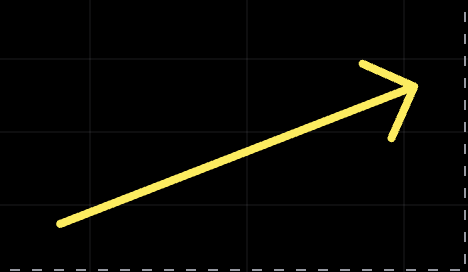
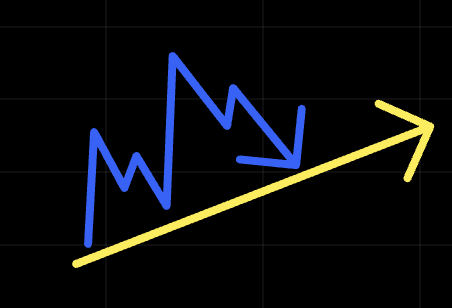
This is the most important post to learn. Buy spot assets on the yellow line. Never on the blue lines. Move your assets to self custody. Have conviction and hold.
You can trade out and take profit at the blue line peaks of speculation price and enter again in the yellow accumulation zone back at spot price. You can leverage trade from the yellow line but there is no forever leverage trade. Binance will always bring it back to the yellow line. Take profits religiously in leverage trading.
Set a profit percent you want and exit like a ninja. (I use 25% at 10x for my scalping). Timing shorts is hard but exiting shorts is easy. Exit shorts at the yellow line.
Pay attention to liquidation levels. They are the fingerprints of the actual money flow. Avoid narrative farmers and crowded sentiment. Have patience. Have discipline. Always use a stop loss on every leverage entry. You can always reenter at the yellow line.
Always exit in red. You can always re-enter lower or higher. Trading paralysis is the biggest killer. Exiting takes 1s and instantly you are back in control. Dont lose control of your trades.
Until the markes is regime changed via regulation and political pressure or via an onchain incumbant the markets will be like this. Preying on retail sentiment and emotion. Run by the unregulated casino. All technical analysis is a trap for retail traders. The only true metrics are liquidation levels and the OTC spot floors.
The true price of L1 network tokens is the yellow line. Everything above that is called "fluff", its leverage that will be flushed. Be aware of this at all times. Take your gains and dont get greedy, stubborn, never all in, and take profit like an adult.
Learn to trade. If you dont learn you will be one of the 500k leverage traders liquidated in the last week.
Basics of markets.
1. Spot floor price moves like this (yellow line)
2. Speculative Perp price (gamblers) moves like this (blue line)
Accumulate spot on the yellow line, the blue line will always be reclaimed by the perp exchange and price flushed back to the yellow line. Good traders prune this movement. Never buy spot at the top of the blue lines. Wait for the yellow line I call the accumulation zone.
Imagine if you just implemented these two rules, how much pain you could save:
1. No longs on anything below the 50-day moving average.
2. No longs below a declining 10 and 21 EMA.
So simple. It's ridiculous, yet so effective.
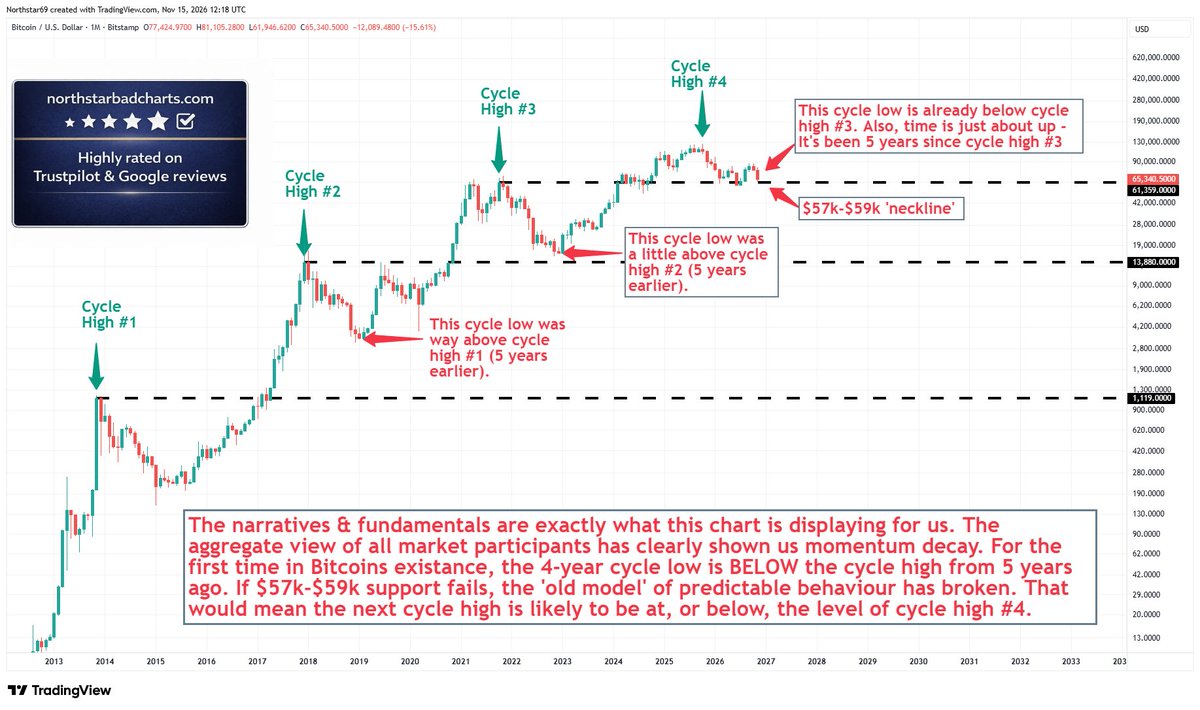
Bitcoin is about to do one of 2 things...
1) Bottom out in the $57k-$59k area & resume a new bull run, or...
2) $57k-$59 k support fails, and it becomes abundantly clear that the old 'rules' no longer apply
Linda on why the best funds hold trades for under 24 hours:
Jack Schwager profiled her in The New Market Wizards.
"Some of the biggest and best funds in the world, with the best performance ever, Renaissance Medallion fund, they have an under 24-hour holding time. Monroe Trout, under 24-hour holding time. Toby Crabel was very short-term. All these players are very, very short-term.
A lot of them keep a low profile, and it doesn't necessarily behoove your audience to try to understand what they do, because they're working 20,000 different strategies across every market in the world.
It's really a game of infrastructure build-out. It's just a whole different style."
Suggested prompt:
I'm going to upload my medical records. I know you can't diagnose me. My goal is a differential diagnosis to discuss with my doctor.
Read everything first, then ask me any questions you need answered.
Be honest, not reassuring. Don't just agree with me. If I already have a diagnosis in mind, treat it as one hypothesis, not the answer. For each possibility, give the evidence for AND against, and the test or finding that would rule it out. Common things first. If nothing ties it all together, say so. Don't make up odds or percentages.
Then write a one-page summary for my doctor. Assume they're busy and skeptical of anything AI-generated. Open with one line saying I used AI to organize my records. Write it like a referral note: a dated timeline of key symptoms, results and treatments tried, what's already been ruled out, your top 3 possibilities with rationale, and the specific questions or tests I'd like to discuss. Cite my records by date. No hype, and no certainty you don't have.