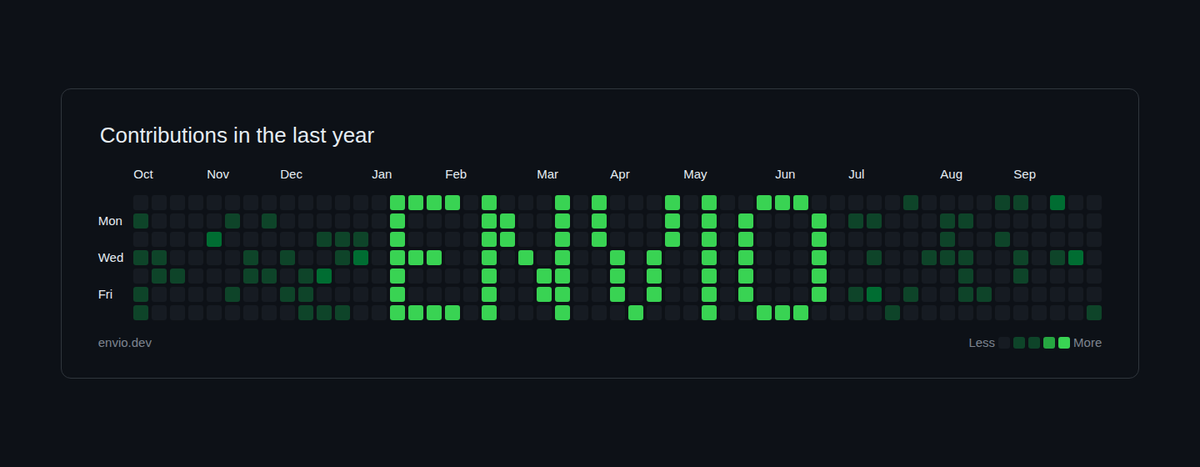
Running an indexer locally now comes with a new terminal UI.
We rebuilt it in Rust and gave it its own thread, separate from the indexer, so it stays responsive while your chains sync.
Check out the latest release.
https://t.co/HvIHS2uPhd
Two days left on the @monad Metropolis hackathon. Submissions close Tuesday 13 October.
There's still $1,000 up for the best use of Envio, plus up to $5,000 of Envio Cloud hosting for winning teams.
If your build still needs its onchain data indexed, reach out to our team with your contract address. cc @monad_dev
https://t.co/wNqQAu6SOm
Our @solana starter template now indexes USDC transfers on mainnet.
Pick it when you create a new indexer and you start from something that already runs.
https://t.co/c4M3Eb9511
Of 4,500 addresses in 100 @ethereum blocks of @circle USDC transfers, only the zero address matched its lowercase spelling.
So a join against a warehouse that stores lowercase misses the rest. HyperIndex can lowercase every address with one config setting.
https://t.co/gqxlYEliN0
We pointed Envio Indexer at an RPC node that errors, rate limits, stalls, drops connections and contradicts itself, then checked what ended up in the database.
It passed all 16 RPC fault checks in our open benchmark, with no data lost and nothing counted twice.
Every check, and how to run it yourself 👇
https://t.co/6xETP7AWDs
A new block took a median of under 10ms to become readable in Envio Indexer, in the head latency test of our open benchmark.
The test publishes a block every two seconds on a generated chain, times each one from publication to its rows landing in the database, then does it again across a reorg. Envio Indexer passed all 4 checks.
Every check, and how to run it yourself 👇
https://t.co/IdirgqqIq7
We pulled an hour of @JupiterExchange activity on @solana and decoded it by instruction with HyperSync, in seconds. Over 73k successful transactions.
The newer v2 route carried about 35% of calls and the original route about 23%. Exact out swaps barely register.
Point HyperIndex at Jupiter's IDL and every instruction in it is indexable.
https://t.co/rRMv9YQ0Xo
Anyone can create a @MorphoLabs lending market, and @base has over 4,300 of them.
That's more than twice as many as @ethereum, which has over 1,700. HyperSync pulled every market ever created on both chains in seconds per chain.
https://t.co/rtUH18a8mY
An AI agent can search our docs straight from the Envio CLI.
A search for reorgs brings back ten pages with links and snippets, and any of them prints in full as markdown. No indexer project needed.
https://t.co/6YZO6epuxy
Just under 2.5 million token transfers landed on @monad in a single day, and HyperSync pulled all of them in about 20 seconds.
If your Metropolis hackathon build needs that kind of data behind it, reach out to our team and we'll help you get it indexed 👇
https://t.co/wNqQAu7qDU
Hit your HyperSync rate limit halfway through a big backfill and the stream keeps going.
The clients wait for the window to reset and retry, so a stream slows down instead of failing. The limit only applies to how fast you query. How much you query in a month doesn't count against it.
Our API tokens page now covers rate limits in full 👇
https://t.co/UCxdQoesP2
@base has over 15 million @Uniswap v4 pools, and over 98% of them have a hook attached.
@ethereum has around 145k, with about a quarter hooked. @arbitrum, @Optimism, @0xPolygon and @unichain add around 51k between them. HyperSync counted every pool ever created on all six.
Our v4 walkthrough shows how to index them yourself 👇
https://t.co/T1PEu4pLr3