Hoy hace un año, Jon González publicaba este gráfico.
Como cada vez se habla menos de pensiones y del drama de los jóvenes españoles por aquí, qué mejor homenaje que volver a ponerlo.
“Por cada 930€ que recaudamos de vuestros impuestos y cotizaciones, 310€ los dedicamos a pensiones, 138€ a sanidad, 97€ a ayudas sociales, 91€ a educación... y 11€ a vivienda.
Además, tenemos que pedir 70€ prestados que incrementan los 55€ que ya pagamos por intereses.”
🚨 Si se confirma que se expedienta a agentes por investigar al poder político, se estaría cruzando una línea gravísima.
Hay policías y guardias civiles sin despacho ni foto oficial… pero con honor y dignidad para mirar a cualquier compañero a los ojos.
Y luego están quienes, por proteger al poder, venden el honor del uniforme a cambio de un despacho más grande.
⚖️ Si esto ocurre en Policía Nacional o contra la UDEF, iremos hasta el final. Sin miedo. Sin excepciones. #AVISAMOS
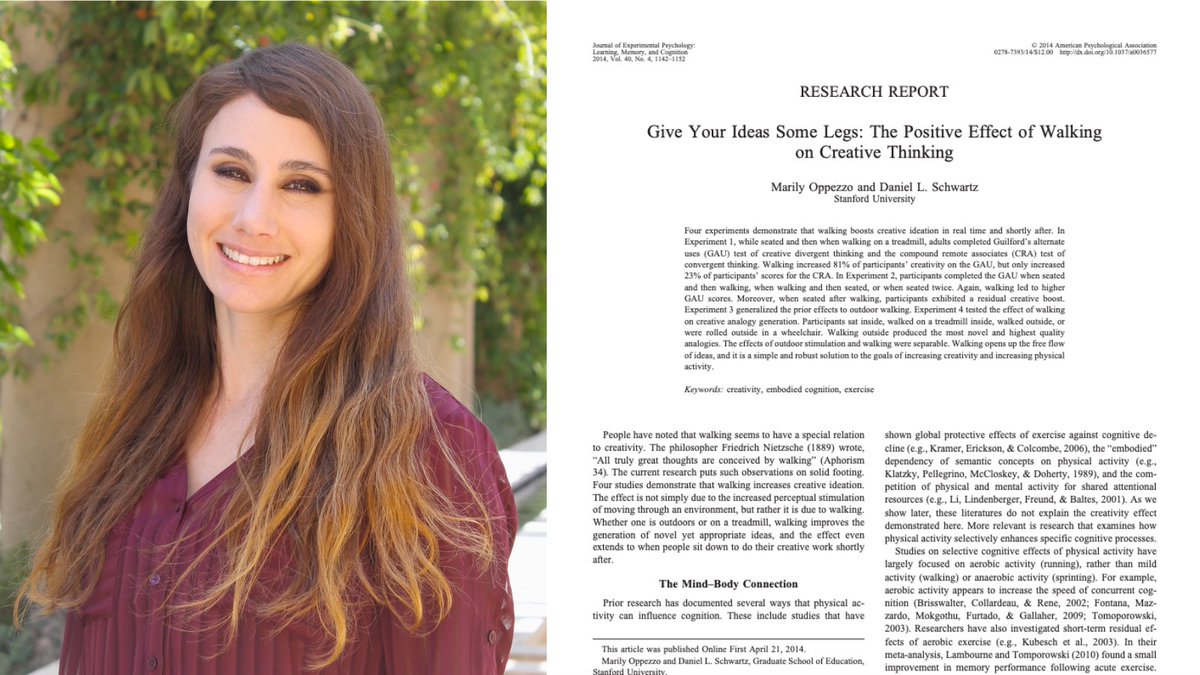
A Stanford psychologist spent 4 years proving that the simple act of walking generates 60% more creative ideas than sitting, and the experiment she designed to kill every alternative explanation is one of the most decisive findings in modern psychology.
Her name is Marily Oppezzo.
She got the idea for the study while walking with her advisor at Stanford to discuss her thesis topic, and the paper she eventually published in the Journal of Experimental Psychology in 2014 is sharp enough that it should have ended the seated meeting on the day it came out.
She ran 4 experiments on 176 people. Same person tested twice. Once sitting, once walking. The creativity tasks were the standard ones psychologists have used for decades to measure how good a brain is at generating novel useful ideas.
The result was almost too clean to publish.
81% of participants in the first experiment produced more creative ideas while walking than while sitting. In the second experiment, 88%. In the third, 100%. Every single person walked into a more creative version of themselves.
On average, people generated 60% more novel useful ideas the moment their legs started moving.
The skeptical question is the obvious one. Maybe it was the fresh air. Maybe it was the scenery passing by. Maybe it was the change of environment doing the work, not the walking itself.
Oppezzo killed every one of those explanations with one experimental decision.
She put people on a treadmill facing a blank wall. No scenery. No fresh air. No environmental change. Just legs moving in place while staring at white drywall. The 60% boost held.
Then she ran the experiment that closed the case completely. She took participants outside in two conditions. Half of them walked through a Stanford courtyard. The other half were pushed through the exact same courtyard in a wheelchair. Same outdoor stimulation. Same scenery passing at the same speed. The only difference was whether the legs were moving.
The walkers produced dramatically more novel high-quality ideas than the wheelchair group. The outdoors did almost nothing on its own. The walking did everything.
This is the part of the study that hit hardest when I read it the first time.
She also tested the opposite kind of thinking. Convergent thinking. The kind where there is one right answer and you have to narrow down to it.
Word puzzles where 3 words share a hidden fourth word that connects them. The seated participants did slightly better on these. Walkers got slightly worse.
Walking is not a general intelligence enhancer. It does one specific thing. It opens up the divergent search inside your brain. The part that generates options. The part that produces unexpected connections. The part that takes a problem and finds five ways into it instead of one.
When you need to converge on the single right answer, sit down. When you need to find the answer in the first place, get up.
The mechanism is now well understood. Walking selectively activates what neuroscientists call the default mode network, the system inside your brain that runs when you are not consciously focused on anything. The DMN is where mind-wandering happens. Where memories cross-reference each other. Where ideas that have been sitting in separate folders inside your head finally bump into each other.
When you sit at a desk and force yourself to concentrate, you suppress the DMN. When you walk at a natural pace, the executive part of your brain gets just busy enough handling the walking that the DMN comes online and starts doing the work that focus was blocking.
The most useful finding in the entire paper is the one almost nobody quotes.
The boost did not turn off the moment people stopped walking. Participants who walked first and then sat back down stayed elevated. Their next round of seated creativity work was still significantly better than people who had been sitting the whole time. The rest lingered for at least several minutes after the legs stopped moving.
You do not need to do creative work while walking. You need to walk before the creative work. The brain holds the state.
The history of this is the part that should haunt anyone who still does meetings in chairs.
Charles Darwin built a gravel loop behind his house in Kent called the Sandwalk and walked it 3 times a day for the rest of his life. The theory of evolution was developed one lap at a time on that path.
Nietzsche walked up to 10 hours a day during the years he wrote his most important books and openly said the work was conceived on his feet.
Beethoven composed for the morning and walked for 5 hours every afternoon with a pencil in his pocket for when something landed.
Kahneman said the best thinking of his Nobel Prize-winning career happened on leisurely walks with Amos Tversky. Steve Jobs refused to take important conversations sitting down. He held them on foot.
Every one of them was using the system Oppezzo would not measure until 2014. They just did not know what to call it.
The question worth sitting with is the one almost nobody asks.
Every meeting you have ever attended sitting around a table was a meeting held at a fraction of the brain power that was actually available to the people in the room. Every brainstorm that got stuck inside a conference room. Every problem you tried to solve at a desk and gave up on. Every idea you could not quite get to.
The intervention is the easiest one in modern science. No supplement. No app. No subscription. No training program. Just a pair of legs and 15 minutes.
The Stanford lab proved it. The philosophers knew it. The neuroscience explains it.
And almost everyone reading this is still trying to think their way out of problems sitting completely still.
Ahora que está tanto de moda por la peli de los Javis y el poema que encontró Poveda vengo a reivindicar que el mejor homenaje a Lorca fue hace años en una de las mejores series que se han hecho en este país, el ministerio del tiempo.
¿Cuál es el club más grande del fútbol español que jamás ha ganado un título oficial? No valen títulos de Segunda División ni Intertotos.
Yo digo el Celta de Vigo.
@ruggerisme @CandyFulcrum2 Y por qué pensas que obligaron a J.K. Rowling a escribir así su nombre en vez de Joanne, su verdadero nombre?
La respuesta es: para que no se dieran cuenta que la autora era mujer, ya que eso le haría perder ventas.
Conclusión? Te la dejo para vos.
Now that Artemis II has launched we have 10 days to get everyone on Earth a Planet of the Apes costume so we can do something hilarious when the astronauts return 😁
Lectura poco afortunada de lo que propone Frank Herbert (algo mediocre como escritor a mi juicio, por otro lado).
Dune no trata sobre lo que dice el citado. Se cimenta sobre 2 ideas: la profecía como esclavitud y que los líderes carismáticos son mal camino para una sociedad sana
JRR Tolkien odiaba Dune porque su ética es fundamentalmente errónea.
El Señor de los Anillos ofrece una visión profundamente diferente del Bien y del Mal, y de cómo vivir una vida moral.
He aquí el motivo… (hilo) 🧵
> be me, Capitán Bitcoin
> 32 años, criptobro
> tiburón de las finanzas
> estoy en mi ático alquilado de Dubai (pago a pachas con otros 4 bros que hacen dropshipping de fundas de móvil)
> es sábado por la noche
> estoy preparándome un batido de proteínas sabor éxito
> de repente el cielo se ilumina más que una vela verde de Dogecoin cuando tuitea Elon Musk
> empiezan a sonar sirenas antiaéreas a 120 decibelios
> miro por la cristalera panorámica
> parece una partida del MW2 con WillyRex soltando la MOAB
> ¿pánico? el pánico es de pobres
> los visionarios FACTURAMOS
> toca monetizar la geopolítica, hora de grabar
> enciendo el aro de luz de Amazon al máximo para contrarrestar el destello térmico de las explosiones
> saco el iPhone 17 Pro Max
> "Ey bros, en Dubai se nota la tensión. El aeropuerto no está operativo. Literalmente acaba de volar el balcón del vecino..."
> pongo cara de tipo duro que controla de geopolítica
> que se note el resumen del Arte de la Guerra de Sun Tzu a velocidad x2 en YouTube y haber escuchado a Margallo en el programa de Risto
> "Que no os pueda el miedo. Donde los NPC ven el apocalipsis, los alfas vemos OPORTUNIDADES"
> les digo a mis seguidores que compren ORO como valor refugio (me llamo Capitán BITCOIN)
> "Escribe REFUGIO y te mando el link para el directo del 2 de marzo."
> le doy a publicar
> la onda expansiva de un dron interceptado me revienta la cristalera en la cara
> salgo volando y me lleno de trozos de pladur, cristales rotos y polvo de creatina
> me levanto tosiendo sangre y mentalidad de abundancia
> miro las notificaciones
> chavales de 16 años de Móstoles con fotos de perfil de Thomas Shelby responden "REFUGIO 🚀"
> hoy se cena familia
Tú dices: "Me caes fatal".
Cervantes decía: "Mira cuán mal me hallo en tu compañía, que mil veces me ha venido al pensamiento de arrojarme al mar y si lo he dejado de hacer es por no llevarte conmigo, que si en el infierno pudiera estar sin ti, se me aliviaran las penas".
Os cuento una historia de casualidades terribles, de esas que, como dicen en Magnolia (P.T. Anderson, 1999) "si las ves en una película no te las crees".
Recordemos que Montero nació en el 88. Cuando terminó el último gobierno de Gonzalez en el 96 ella tenía 8 años. Por poner en perspectiva que esté dandole clases de historia a los demás.
¿Sabéis quién enriqueció mucho el vocabulario de la chavalada española en los 70, 80 y 90 a través de la lectura?
Pues Ibáñez y su Mortadelo, su Sacarino, su Pepe Gotera, su…