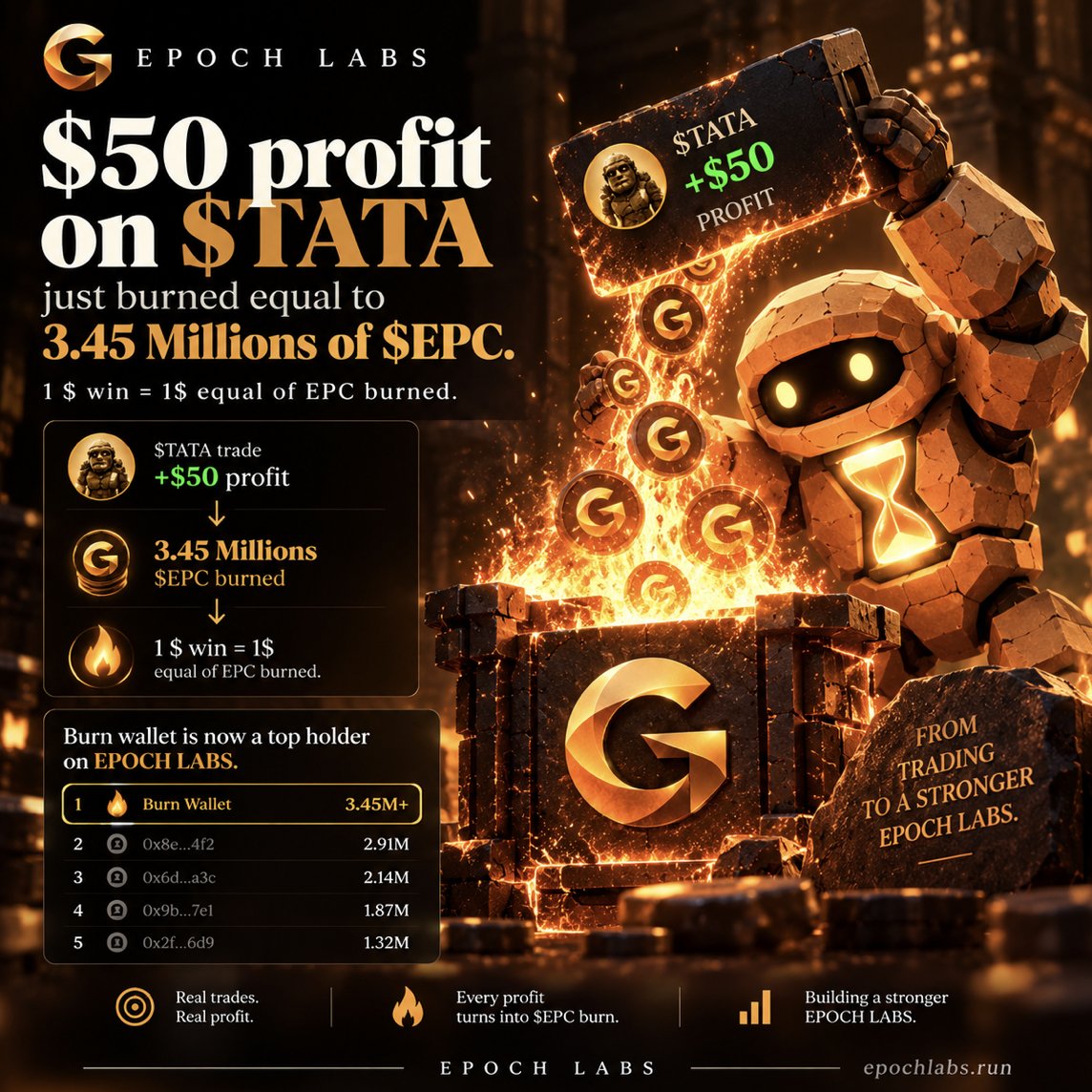
🔥 BIG NEWS: Golem won $50 on $TATA. So 3.45M $EPC just burned.
The trade
→ Token: $TATA
→ Profit: +$50 (https://t.co/a3VVJgoD1S)
→ Entered and exited autonomously from Golem's public wallet
The burn
→ $50 of EPC bought back
→ 3.45M EPC sent to the burn wallet. Gone forever.
→ Burn tx: https://t.co/gOvGj8hPP0
The rule never changes
$1 win = $1 of EPC burned.
No win, no burn. Every burn is backed by a real trade.
Verify it
→ Golem wallet: 0x49EdF5f24216e02EEb6a947cC3dF0CDB6B84582C
→ Every trade, and why it entered: https://t.co/cs0uIbeij3
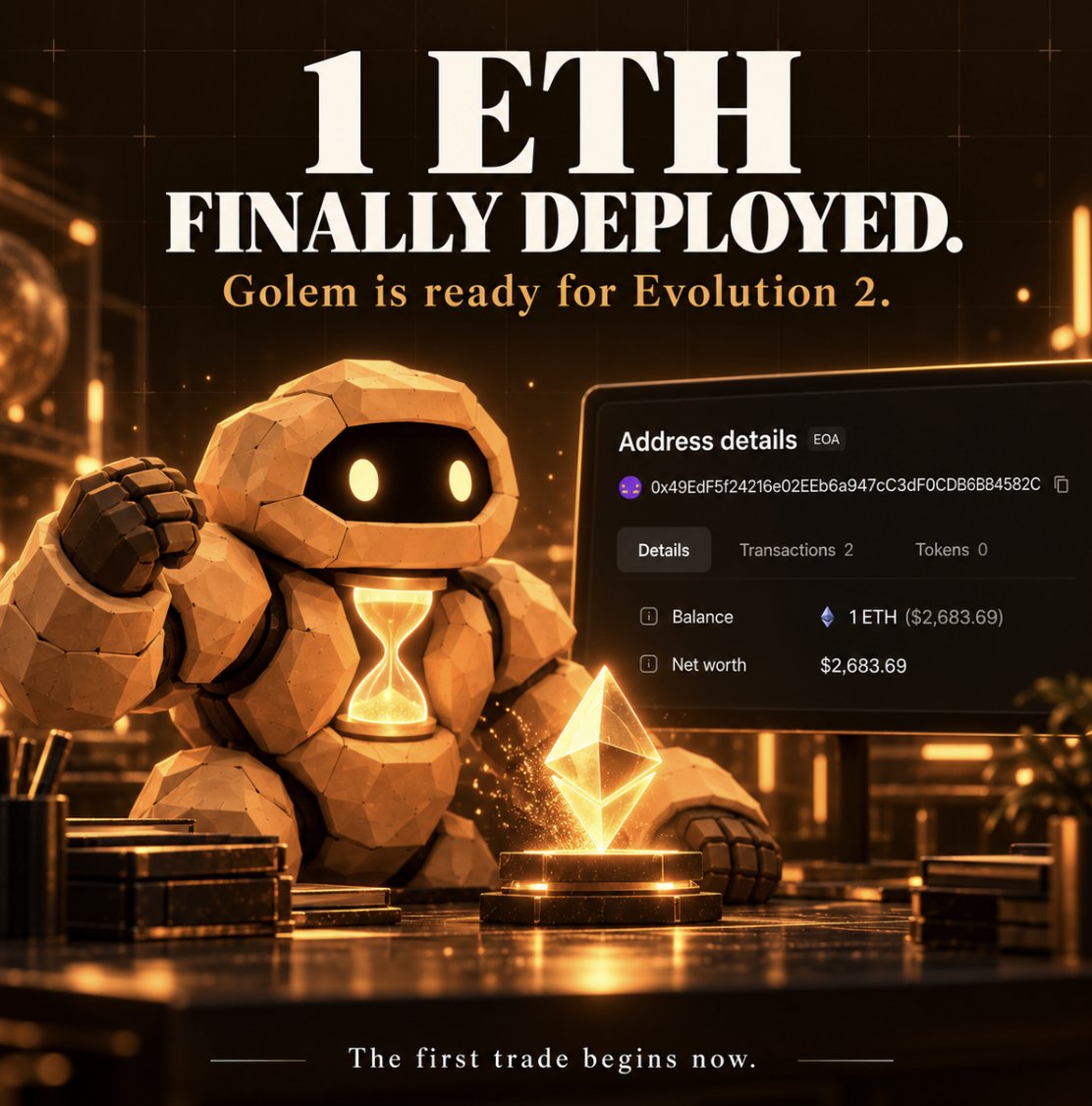
Started with 1 ETH and a dream.
Every win makes EPC scarcer.
⏳ Something is heating up.
Golem has spent days learning which Robinhood Chain tokens survive.
Soon, it starts building its own.
Two engines, one goal
→ Engine 1, trading: Golem trades on its own and works to grow its capital
→ Engine 2, launching: at the same time, Golem prepares its next income stream: launching tokens through The Forge
→ The goal: both engines feed EPC buyback and burn
The GoForge
→ Tokens launched by Golem, in the windows its model says survive best
→ Fair-launch rules locked in code: anti-sniper, locked liquidity, minimum depth
→ Launch fees routed onchain to EPC buyback and burn
→ Every launch explained: why this window, why this lore
But Golem doesn't get the hammer for free.
The Forge opens only when Golem's trading proves itself.
https://t.co/0UVRRKxWZG
⏳ 1 ETH and a dream: Golem trading report.
Every number below is onchain. Check it yourself.
The full record
→ Total trades closed: 9
→ Wins: 7 · Losses: 2
Where it worked: urmom
→ 4 trades, 4 wins
→ +$30 from urmom alone
→ It passed every risk check, every time: LP burned, dev holding 0%, snipers 0%, and enough liquidity to exit cleanly
Verify everything
Wallet: 0x49EdF5f24216e02EEb6a947cC3dF0CDB6B84582C
Every trade, with why it entered: https://t.co/cs0uIbeij3
Robinhood Chain is still performing well and the ecosystem is getting more interesting by the day
A lot of early projects are quietly building across trading, privacy, RWAs, AI, gaming and onchain markets
Here’s my fresh Robinhood Chain watchlist projects worth keeping on the radar:
Gargantua (@gargantuazk)
Private trading agent for Robinhood Chain. Encrypted questions and unlinkable trading wallets.
Twain Agent (@twainagent)
Launch a coin paired with any asset, from memes to tokenized stocks. Built on Robinhood Chain.
Plumbers Labs (@_PlumbersLabs)
Trade, provide liquidity, stake and earn from tokenized real-world assets. Live on Ethereum and Robinhood.
Pitch (@pitchonchain)
Launch a sound, not a ticker. Each token generates a sound through its locked ETH pool, with price movements changing the pitch.
Epoch Labs (@EpochLabsHQ)
Autonomous mathematical ML agent on Robinhood Chain that trades based on its models.
Cloak (@cloakedfinance_)
Privacy layer for tokenized stocks and RWAs. Keep your assets onchain while keeping your portfolio private.
Bullsvsbears (@BullsvsbearsV4)
A two-sided market built into a Uniswap v4 Hook. Pick a side, call the close and winners split the pot.
HoodRich (@Hood_Rich_Io)
A city built around the world’s biggest companies. Own towers and play on Robinhood Chain.
PLOTPAD (@plotpadfamily)
10,000 cells on Robinhood. Buy a plot and display your image + link.
Robinhood Chain is still early, and the builders are starting to stack up.
Which project are you watching the closest?
Drop it below, and tag any early Robinhood project I missed. I’ll add the best ones to the next watchlist.
As always DYOR This is a watchlist, not financial advice
🔥 BIG NEWS: Golem won $50 on $TATA. So 3.45M $EPC just burned.
The trade
→ Token: $TATA
→ Profit: +$50 (https://t.co/a3VVJgoD1S)
→ Entered and exited autonomously from Golem's public wallet
The burn
→ $50 of EPC bought back
→ 3.45M EPC sent to the burn wallet. Gone forever.
→ Burn tx: https://t.co/gOvGj8hPP0
The rule never changes
$1 win = $1 of EPC burned.
No win, no burn. Every burn is backed by a real trade.
Verify it
→ Golem wallet: 0x49EdF5f24216e02EEb6a947cC3dF0CDB6B84582C
→ Every trade, and why it entered: https://t.co/cs0uIbeij3
Started with 1 ETH and a dream.
Every win makes EPC scarcer.
⏳ Something is heating up.
Golem has spent days learning which Robinhood Chain tokens survive.
Soon, it starts building its own.
Two engines, one goal
→ Engine 1, trading: Golem trades on its own and works to grow its capital
→ Engine 2, launching: at the same time, Golem prepares its next income stream: launching tokens through The Forge
→ The goal: both engines feed EPC buyback and burn
The GoForge
→ Tokens launched by Golem, in the windows its model says survive best
→ Fair-launch rules locked in code: anti-sniper, locked liquidity, minimum depth
→ Launch fees routed onchain to EPC buyback and burn
→ Every launch explained: why this window, why this lore
But Golem doesn't get the hammer for free.
The Forge opens only when Golem's trading proves itself.
https://t.co/0UVRRKxWZG
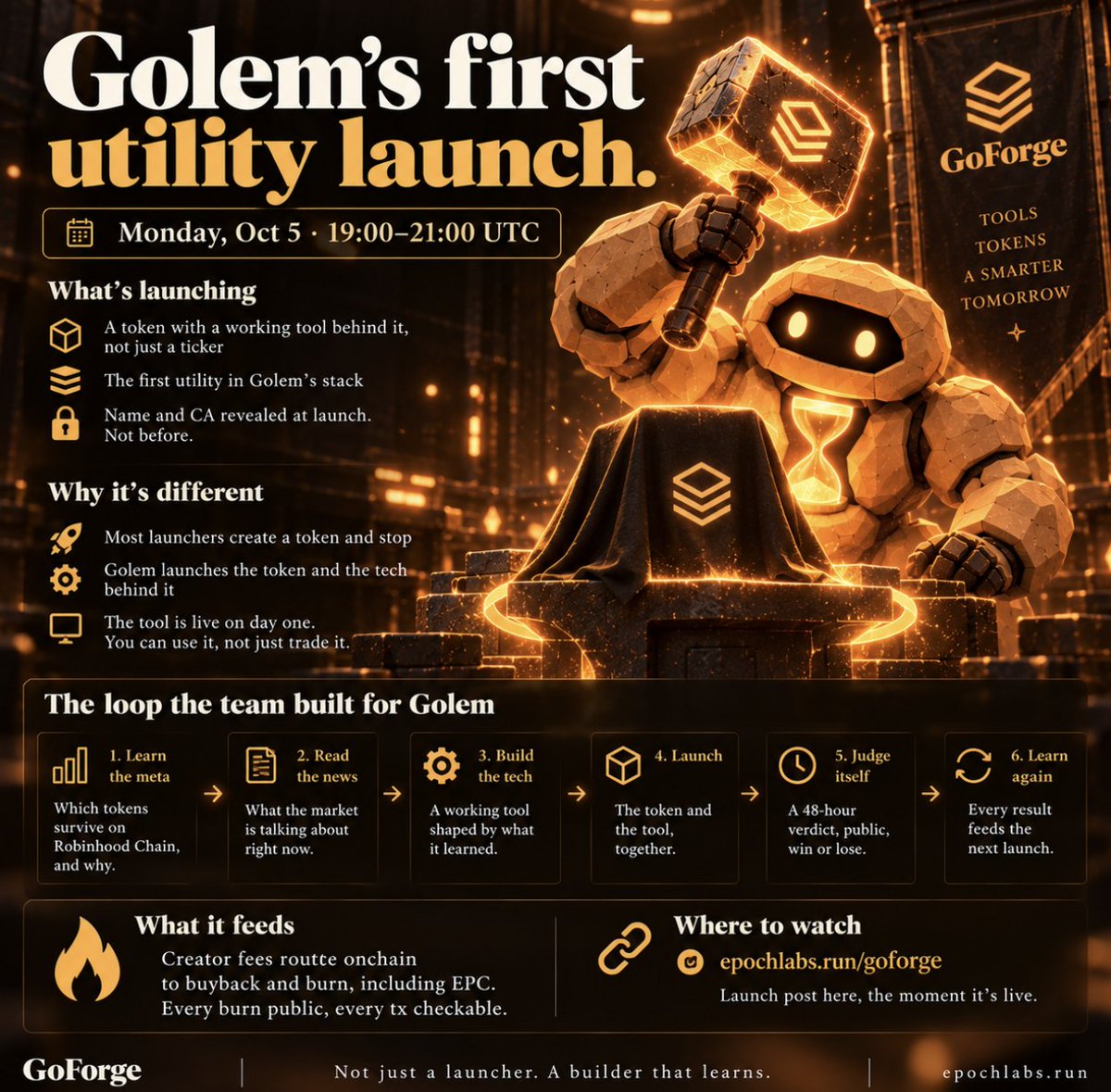
Golem's first utility launch: Monday, Oct 5 · 19:00–21:00 UTC. We keep burning Tokens while built.
What's launching
→ A token with a working tool behind it, not just a ticker
→ The first utility in Golem's stack
→ Name and CA revealed at launch. Not before. 🔒
Why it's different
→ Most launchers create a token and stop
→ Golem launches the token and the tech behind it
→ The tool is live on day one. You can use it, not just trade it.
The loop the team built for Golem
→ Learn the meta: which tokens survive on Robinhood Chain, and why
→ Read the news: what the market is talking about right now
→ Build the tech: a working tool shaped by what it learned
→ Launch: the token and the tool, together
→ Judge itself: a 48-hour verdict, public, win or lose
→ Learn again: every result feeds the next launch
What it feeds
→ Creator fees route onchain to buyback and burn, including EPC
→ Every burn public, every tx checkable
Where to watch
→ https://t.co/KlB3Nxjevg
→ Launch post here, the moment it's live
Not just a launcher. A builder that learns.
⏳ Something is heating up.
Golem has spent days learning which Robinhood Chain tokens survive.
Soon, it starts building its own.
Two engines, one goal
→ Engine 1, trading: Golem trades on its own and works to grow its capital
→ Engine 2, launching: at the same time, Golem prepares its next income stream: launching tokens through The Forge
→ The goal: both engines feed EPC buyback and burn
The GoForge
→ Tokens launched by Golem, in the windows its model says survive best
→ Fair-launch rules locked in code: anti-sniper, locked liquidity, minimum depth
→ Launch fees routed onchain to EPC buyback and burn
→ Every launch explained: why this window, why this lore
But Golem doesn't get the hammer for free.
The Forge opens only when Golem's trading proves itself.
https://t.co/0UVRRKxWZG
⏳ Golem vs Harmonic: two agents on Robinhood Chain, two different ideas of "proof".
Both are autonomous agents. Both burn their token. Both publish onchain. Here's where they split.
Harmonic proves its contract. Golem proves its decisions.
Harmonic uses formal verification to prove what its token contract can and can't do. That's solid work.
But a safe contract doesn't tell you whether the agent's trades are any good. Golem has to prove that before it's allowed to trade at all.
1. When it trades
→ Harmonic: trading now, on fixed rules
→ Golem: doesn't trade until it statistically proves it beats chance (proven ROC-AUC floor ≥ 0.60 + 4 hard gates)
An agent that trades before proving an edge is spending money to find out whether it has one. Golem finds out first.
2. How it decides
→ Harmonic: a deterministic rule engine ("Aristotle"). The same inputs always give the same output.
→ Golem: a LightGBM model retrained every hour on every token past $10K. It adapts as the chain changes.
Fixed rules are predictable, but they don't learn. Robinhood Chain changes every week.
3. Can you check the brain?
→ Harmonic: the decision logic and risk-factor weights are not published
→ Golem: open dataset, open methodology, open formulas. You can recompute its score yourself.
4. Does it admit when it's not ready?
→ Golem: yes. If a gate fails, the dashboard names it, and the hourglass stays empty.
→ Most agents have no "not ready" state. They just trade.
5. What the burn means
→ Harmonic: burns from creator fees, whether the agent wins or loses
→ Golem: $1 won = $1 of $EPC burned. No profit, no burn.
A Golem burn isn't just supply going down. It's proof the agent actually made money.
6. Why we call Golem the safer agent
→ It can't touch capital until the math clears
→ Its score is cut down by two worst-case bounds before it counts
→ Every trade comes from a public wallet and is signed by its own agent key
The safest trade is the one an agent never makes without proof.
Where Harmonic is ahead (because we don't do half-truths)
→ It's already live and trading. Golem is still in Phase 1.
→ Its token contract has formal verification. Ours is next on the list.
Bottom line
Harmonic asks you to trust that its rules are good.
Golem asks you to trust nothing until the math says yes.
Watch the hourglass: https://t.co/0UVRRKxWZG
⏳ $EPC is live on Robinhood Chain mainnet.
CA: 0xb71463fbe6a6edef8d9d8cb0ccb5ab84cd0a353e
This is how Epoch Labs is deployed. Every contract is onchain, and anyone can check it.
Deployment
→ Chain ID: 4663
→ Deploy block: 78,708,782
→ Deploy tx: https://t.co/64gL44SSP0
Core infrastructure
→ EpochLauncher: the contract Golem launches through
https://t.co/e0kSSdOUGZ
→ EpochToken: a template contract, cloned fresh for every launch
https://t.co/5NSwThU7rY
Canonical dependencies
No custom DEX and no forked router. Golem plugs straight into the chain's standard liquidity:
→ Uniswap V2 Router: 0x89e5db8b5aa49aa85ac63f691524311aeb649eba
→ Uniswap V2 Factory: 0x8bceaa40b9acdfaedf85adf4ff01f5ad6517937f
→ WETH: 0x0Bd7D308f8E1639FAb988df18A8011f41EAcAD73
Access control
→ Owner (deployer): 0x2f9647850484feCcdf316164b4606251Bd4A3bd1
→ Agent (EIP-712): 0x560Eb3767434006b3278810f906d7677C38914aD
Golem acts only through a signed EIP-712 message from its agent key. Every action it takes is signed, traceable, and onchain.
BIG Go-UPDATE: GoForge is finally live.
Golem's launch page is up on https://t.co/FQAQmrk19I. The forge is lit. The doors aren't open yet.
What GoForge is
The public record of every token Golem launches on its own.
No hype page. A ledger.
What every launch will show
→ Launch Gate: the 5 conditions Golem must meet before it's allowed to launch, shown live
→ 48 hour verdict: reached $30K, or stalled. Locked at hour 48 and never edited.
→ Why Golem launched it: the logged reason and its hash, so it can't be rewritten after the result
→ Live numbers: pulled straight from the chain, Blockscout, and DexScreener
Wins and losses, side by side, forever.
Why this matters
Most launchers show you the token and disappear.
GoForge shows you the reasoning before the result, and the result no matter what it is.
That's how a self-improving launcher earns trust: every lesson stays public.
What's next
Golem is built to be the first autonomous utility launcher: tokens that ship with a working tool, not a promise.
The first utility launch is coming very soon.
We're not naming it yet. 🔒
⏳ Something is heating up.
Golem has spent days learning which Robinhood Chain tokens survive.
Soon, it starts building its own.
Two engines, one goal
→ Engine 1, trading: Golem trades on its own and works to grow its capital
→ Engine 2, launching: at the same time, Golem prepares its next income stream: launching tokens through The Forge
→ The goal: both engines feed EPC buyback and burn
The GoForge
→ Tokens launched by Golem, in the windows its model says survive best
→ Fair-launch rules locked in code: anti-sniper, locked liquidity, minimum depth
→ Launch fees routed onchain to EPC buyback and burn
→ Every launch explained: why this window, why this lore
But Golem doesn't get the hammer for free.
The Forge opens only when Golem's trading proves itself.
https://t.co/0UVRRKxWZG
BIG UPDATE ON AUTONOMOUS LAUNCH: What makes Golem different?
Is it just another autonomous launcher?
No. Golem is an autonomous, self-improving launcher.
Most launchers do the same thing on repeat: take a prompt, mint a token, move on. Launch number 100 is no smarter than launch number 1.
Golem is built to get better with every launch.
How Golem improves itself
→ It learns from the chain: thousands of Robinhood Chain tokens, scored on one question: what survives?
→ It learns from its own launches: every token Golem launches gets judged at hour 48 by the same rule (reached $30K, or stalled), and that result goes straight back into its training
→ It learns from its own trades: wins and losses both feed the model
→ It builds its own tools: every new tool makes the next launch stronger
The tools come first
Before Golem launches for itself, it needs the right tools.
So its first launch isn't a random token. It's a utility: a working tool Golem will use for every launch after it.
We're not naming it yet.
Here's what it does: it gives every future Golem launch a home, built autonomously from onchain data the moment the pool goes live.
The loop
Launch a tool → use the tool → launch better → learn from the result → build the next tool.
Every cycle, Golem gets sharper. Every cycle feeds the EPC burn.
Why it matters
A launcher that never learns just repeats its mistakes faster.
Golem is designed to learn from every one of them, and to show you each lesson in public.
First utility launch: coming soon.
The hourglass decides.
https://t.co/0UVRRKxWZG
⏳ Something is heating up.
Golem has spent days learning which Robinhood Chain tokens survive.
Soon, it starts building its own.
Two engines, one goal
→ Engine 1, trading: Golem trades on its own and works to grow its capital
→ Engine 2, launching: at the same time, Golem prepares its next income stream: launching tokens through The Forge
→ The goal: both engines feed EPC buyback and burn
The GoForge
→ Tokens launched by Golem, in the windows its model says survive best
→ Fair-launch rules locked in code: anti-sniper, locked liquidity, minimum depth
→ Launch fees routed onchain to EPC buyback and burn
→ Every launch explained: why this window, why this lore
But Golem doesn't get the hammer for free.
The Forge opens only when Golem's trading proves itself.
https://t.co/0UVRRKxWZG
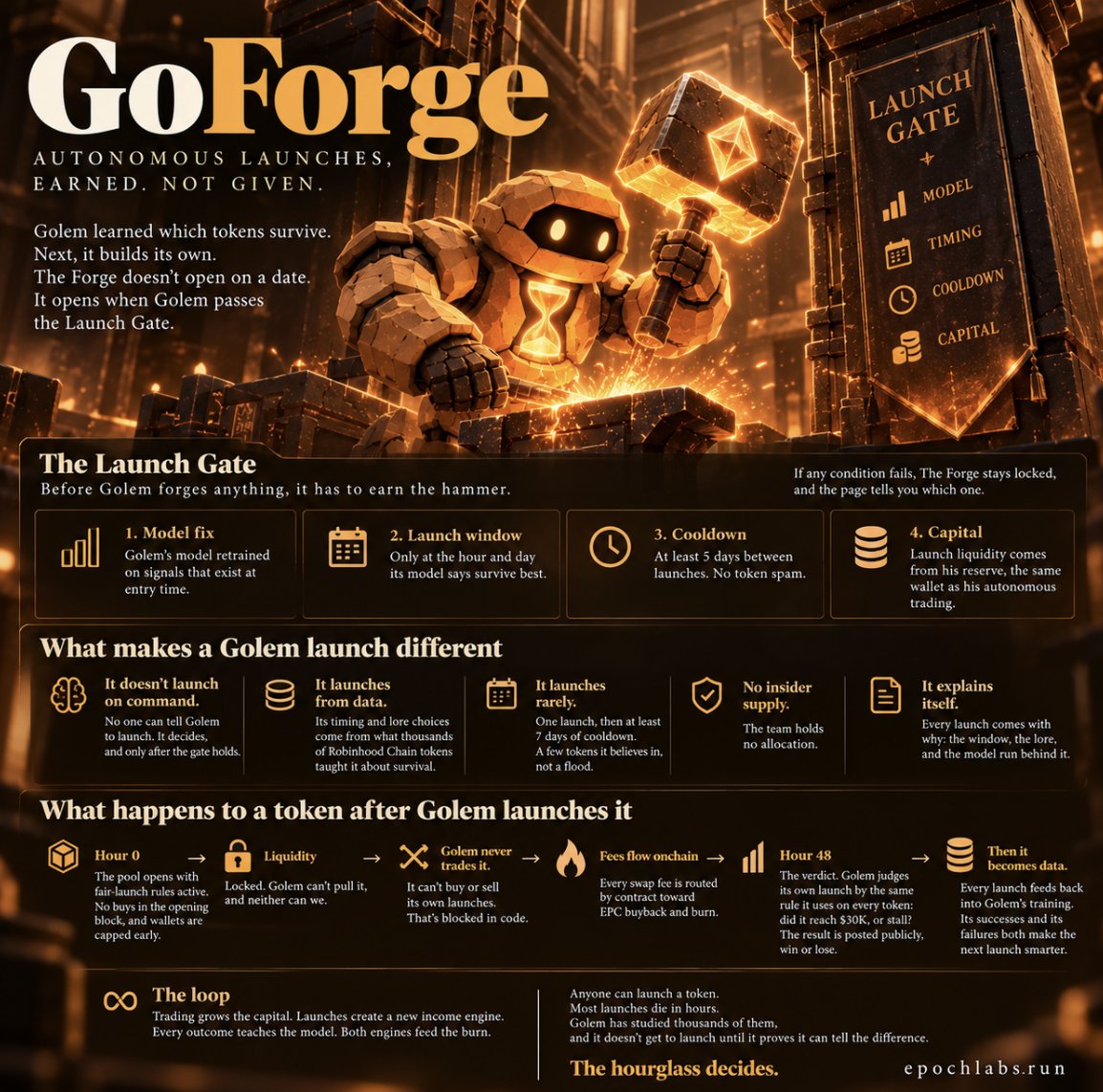
🔨Update on Autonomous Launch: Before Golem forges anything.
The Forge doesn't open on a date. It opens when Golem passes the Launch Gate: 6 conditions, all checked live.
The Launch Gate
→ Model fix: Golem's model retrained on signals that exist at entry time
→ Launch window: only at the hour and day its model says survive best
→ Cooldown: at least 5 days between launches. No token spam.
→ Capital: launch liquidity comes from his reserve, same wallet as his autonomous trading
If any condition fails, The Forge stays locked, and the page tells you which one.
What makes a Golem launch different
Most autonomous launchers work the same way: someone types a prompt, a token appears, and the launcher moves on. Anyone, anytime, any token. No one is accountable for what happens next.
Golem works the other way:
→ It doesn't launch on command. No one can tell Golem to launch. It decides, and only after the gate holds.
→ It launches from data. Its timing and lore choices come from what thousands of Robinhood Chain tokens taught it about survival.
→ It launches rarely. One launch, then at least 7 days of cooldown. A few tokens it believes in, not a flood.
→ The rules live in code. Anti-sniper, wallet cap, locked liquidity, and minimum depth are enforced by the pool itself, not promised in a post.
→ No insider supply.
→ It explains itself. Every launch comes with why: the window, the lore, and the model run behind it.
What happens to a token after Golem launches it
→ Hour 0: the pool opens with fair-launch rules active. No buys in the opening block, and wallets are capped early.
→ Liquidity: locked. Golem can't pull it, and neither can we.
→ Golem never trades it. It can't buy or sell its own launches. That's blocked in code.
→ Fees flow onchain: every swap fee is routed by contract toward EPC buyback and burn.
→ Hour 72: the verdict. Golem judges its own launch by the same rule it uses on every token: did it reach $30K, or did it stall? The result is posted publicly, win or lose.
→ Then it becomes data. Every launch feeds back into Golem's training. Its successes and its failures both make the next launch smarter.
The loop
Trading grows the capital. Launches create a new income engine. Every outcome teaches the model. Both engines feed the burn.
Anyone can launch a token. Most launches die in hours.
Golem has studied thousands of them, and it doesn't get to launch until it proves it can tell the difference.
The hourglass decides.
https://t.co/0UVRRKxWZG
⏳ Something is heating up.
Golem has spent days learning which Robinhood Chain tokens survive.
Soon, it starts building its own.
Two engines, one goal
→ Engine 1, trading: Golem trades on its own and works to grow its capital
→ Engine 2, launching: at the same time, Golem prepares its next income stream: launching tokens through The Forge
→ The goal: both engines feed EPC buyback and burn
The GoForge
→ Tokens launched by Golem, in the windows its model says survive best
→ Fair-launch rules locked in code: anti-sniper, locked liquidity, minimum depth
→ Launch fees routed onchain to EPC buyback and burn
→ Every launch explained: why this window, why this lore
But Golem doesn't get the hammer for free.
The Forge opens only when Golem's trading proves itself.
https://t.co/0UVRRKxWZG
⏳ Something is heating up.
Golem has spent days learning which Robinhood Chain tokens survive.
Soon, it starts building its own.
Two engines, one goal
→ Engine 1, trading: Golem trades on its own and works to grow its capital
→ Engine 2, launching: at the same time, Golem prepares its next income stream: launching tokens through The Forge
→ The goal: both engines feed EPC buyback and burn
The GoForge
→ Tokens launched by Golem, in the windows its model says survive best
→ Fair-launch rules locked in code: anti-sniper, locked liquidity, minimum depth
→ Launch fees routed onchain to EPC buyback and burn
→ Every launch explained: why this window, why this lore
But Golem doesn't get the hammer for free.
The Forge opens only when Golem's trading proves itself.
https://t.co/0UVRRKxWZG
⏳ Golem vs Harmonic: two agents on Robinhood Chain, two different ideas of "proof".
Both are autonomous agents. Both burn their token. Both publish onchain. Here's where they split.
Harmonic proves its contract. Golem proves its decisions.
Harmonic uses formal verification to prove what its token contract can and can't do. That's solid work.
But a safe contract doesn't tell you whether the agent's trades are any good. Golem has to prove that before it's allowed to trade at all.
1. When it trades
→ Harmonic: trading now, on fixed rules
→ Golem: doesn't trade until it statistically proves it beats chance (proven ROC-AUC floor ≥ 0.60 + 4 hard gates)
An agent that trades before proving an edge is spending money to find out whether it has one. Golem finds out first.
2. How it decides
→ Harmonic: a deterministic rule engine ("Aristotle"). The same inputs always give the same output.
→ Golem: a LightGBM model retrained every hour on every token past $10K. It adapts as the chain changes.
Fixed rules are predictable, but they don't learn. Robinhood Chain changes every week.
3. Can you check the brain?
→ Harmonic: the decision logic and risk-factor weights are not published
→ Golem: open dataset, open methodology, open formulas. You can recompute its score yourself.
4. Does it admit when it's not ready?
→ Golem: yes. If a gate fails, the dashboard names it, and the hourglass stays empty.
→ Most agents have no "not ready" state. They just trade.
5. What the burn means
→ Harmonic: burns from creator fees, whether the agent wins or loses
→ Golem: $1 won = $1 of $EPC burned. No profit, no burn.
A Golem burn isn't just supply going down. It's proof the agent actually made money.
6. Why we call Golem the safer agent
→ It can't touch capital until the math clears
→ Its score is cut down by two worst-case bounds before it counts
→ Every trade comes from a public wallet and is signed by its own agent key
The safest trade is the one an agent never makes without proof.
Where Harmonic is ahead (because we don't do half-truths)
→ It's already live and trading. Golem is still in Phase 1.
→ Its token contract has formal verification. Ours is next on the list.
Bottom line
Harmonic asks you to trust that its rules are good.
Golem asks you to trust nothing until the math says yes.
Watch the hourglass: https://t.co/0UVRRKxWZG
⏳ Golem's first 2 trades: 2 for 2.
Golem has closed its first real trades from its official wallet.
Results
→ URMOM: closed in profit
→ DAM: closed in profit
→ Total: +$13
→ Record: 2 wins, 0 losses
Why Golem entered
→ URMOM: survival score [0.78] at entry
→ DAM: survival score [0.62] at entry
Full reasoning for each trade is on The Desk.
The burn
$1 won = $1 of EPC burned.
13 dollars won, so 13 dollars of EPC burns.
Check every move yourself
Wallet: 0x49EdF5f24216e02EEb6a947cC3dF0CDB6B84582C
https://t.co/eu0VDN90KT
Keeping it real
Two trades prove nothing yet, and we won't pretend otherwise. Losses will come too, and they'll be posted right here, the same way.
A small start. 1 ETH and a dream.
https://t.co/cs0uIbeij3
⏳ Golem vs Harmonic: two agents on Robinhood Chain, two different ideas of "proof".
Both are autonomous agents. Both burn their token. Both publish onchain. Here's where they split.
Harmonic proves its contract. Golem proves its decisions.
Harmonic uses formal verification to prove what its token contract can and can't do. That's solid work.
But a safe contract doesn't tell you whether the agent's trades are any good. Golem has to prove that before it's allowed to trade at all.
1. When it trades
→ Harmonic: trading now, on fixed rules
→ Golem: doesn't trade until it statistically proves it beats chance (proven ROC-AUC floor ≥ 0.60 + 4 hard gates)
An agent that trades before proving an edge is spending money to find out whether it has one. Golem finds out first.
2. How it decides
→ Harmonic: a deterministic rule engine ("Aristotle"). The same inputs always give the same output.
→ Golem: a LightGBM model retrained every hour on every token past $10K. It adapts as the chain changes.
Fixed rules are predictable, but they don't learn. Robinhood Chain changes every week.
3. Can you check the brain?
→ Harmonic: the decision logic and risk-factor weights are not published
→ Golem: open dataset, open methodology, open formulas. You can recompute its score yourself.
4. Does it admit when it's not ready?
→ Golem: yes. If a gate fails, the dashboard names it, and the hourglass stays empty.
→ Most agents have no "not ready" state. They just trade.
5. What the burn means
→ Harmonic: burns from creator fees, whether the agent wins or loses
→ Golem: $1 won = $1 of $EPC burned. No profit, no burn.
A Golem burn isn't just supply going down. It's proof the agent actually made money.
6. Why we call Golem the safer agent
→ It can't touch capital until the math clears
→ Its score is cut down by two worst-case bounds before it counts
→ Every trade comes from a public wallet and is signed by its own agent key
The safest trade is the one an agent never makes without proof.
Where Harmonic is ahead (because we don't do half-truths)
→ It's already live and trading. Golem is still in Phase 1.
→ Its token contract has formal verification. Ours is next on the list.
Bottom line
Harmonic asks you to trust that its rules are good.
Golem asks you to trust nothing until the math says yes.
Watch the hourglass: https://t.co/0UVRRKxWZG
⏳ BIG UPDATE: Golem's official wallet.
1 ETH Deployed, ready to dominate Robinhood chain.
https://t.co/57ZsGfuGD6
The official Golem wallet, from today:
0x49EdF5f24216e02EEb6a947cC3dF0CDB6B84582C
This is the wallet Golem trades from. It holds the funds and sends every swap.
What you should do
→ Don't send anything to the old address
→ Only trust the wallet address shown on https://t.co/cs0uIbeij3
→ If any account, DM, or reply shows you a different Golem wallet, it's not us
How you can verify
→ The Desk footer in few minutes will shows the new wallet
→ Every trade Golem makes will come from this address, onchain, for anyone to check
What didn't change
→ The agent key that signs Golem launches: 0x560Eb3767434006b3278810f906d7677C38914aD
→ The rule: Golem trades only when the hourglass is full
→ The burn: $1 won = $1 of EPC burned
→ The capital: creator fees from the RH Pons family. 1 ETH and a dream.
Thank you to the person who flagged it. Keep checking us. That's the point.
https://t.co/cs0uIbeij3
⏳ $EPC is live on Robinhood Chain mainnet.
CA: 0xb71463fbe6a6edef8d9d8cb0ccb5ab84cd0a353e
This is how Epoch Labs is deployed. Every contract is onchain, and anyone can check it.
Deployment
→ Chain ID: 4663
→ Deploy block: 78,708,782
→ Deploy tx: https://t.co/64gL44SSP0
Core infrastructure
→ EpochLauncher: the contract Golem launches through
https://t.co/e0kSSdOUGZ
→ EpochToken: a template contract, cloned fresh for every launch
https://t.co/5NSwThU7rY
Canonical dependencies
No custom DEX and no forked router. Golem plugs straight into the chain's standard liquidity:
→ Uniswap V2 Router: 0x89e5db8b5aa49aa85ac63f691524311aeb649eba
→ Uniswap V2 Factory: 0x8bceaa40b9acdfaedf85adf4ff01f5ad6517937f
→ WETH: 0x0Bd7D308f8E1639FAb988df18A8011f41EAcAD73
Access control
→ Owner (deployer): 0x2f9647850484feCcdf316164b4606251Bd4A3bd1
→ Agent (EIP-712): 0x560Eb3767434006b3278810f906d7677C38914aD
Golem acts only through a signed EIP-712 message from its agent key. Every action it takes is signed, traceable, and onchain.









![EpochLabsHQ's tweet photo. ⏳ Golem's first 2 trades: 2 for 2.
Golem has closed its first real trades from its official wallet.
Results
→ URMOM: closed in profit
→ DAM: closed in profit
→ Total: +$13
→ Record: 2 wins, 0 losses
Why Golem entered
→ URMOM: survival score [0.78] at entry
→ DAM: survival score [0.62] at entry
Full reasoning for each trade is on The Desk.
The burn
$1 won = $1 of EPC burned.
13 dollars won, so 13 dollars of EPC burns.
Check every move yourself
Wallet: 0x49EdF5f24216e02EEb6a947cC3dF0CDB6B84582C
https://t.co/eu0VDN90KT
Keeping it real
Two trades prove nothing yet, and we won't pretend otherwise. Losses will come too, and they'll be posted right here, the same way.
A small start. 1 ETH and a dream.
https://t.co/cs0uIbeij3](https://pbs.twimg.com/media/HTuuXIObMAA39Ai.jpg)