A10: Gorman's call at the end of the poem is for us to be brave enough to be our own light. Change starts within ourselves. We must have the courage be the solution and work through our differences to make a difference in our world.
#TeachLivingPoets
A9: "The hill we climb" is the ultimate obstacle that our country faces: division. The differences in society divide us to the point of violence. To overcome this, we must put aside our differences, come together as a nation, and fix our problems together. #TeachLivingPoets
A8: Light typically symbolizes hope, and that is especially true in this setting. Gorman begins the poem rhetorically asking how we can find light "in this never ending shade." In the end, she answers that question and telling us that we must be the light.
#TeachLivingPoets
A6: Gorman uses subtle but distinctive details to describe certain historical events within her poem. One instance of Gorman's reference to a historical event is in the line "we've seen a force that would shatter our nation rather than share it."
#TeachLivingPoets
A5: One example of Gorman's use of alliteration is the line "a country that is bruised but whole, benevolent but bold, fierce and free." These words work in pairs and compliment each other through their similar sounds to emphasize America's qualities.
#TeachLivingPoets
A2: One line that Gorman uses word play is "We lay down our arms so we can reach out our arms to one another." She creatively utilizes the dual meaning of "arms" to urge Americans to put aside their differences and embrace their similarities. #TeachLivingPoets
A1: One thing that stands out to me is the beautiful flow and cadence of Gorman's performance of the poem. The line I remember most from the poem is "But while democracy can be periodically delayed, it can never be permanently defeated."
#TeachLivingPoets
A9: To me, the hero in this story is Marji's mother Taji. She is an outspoken female rebel in a regime that treats women as subhuman. Despite the danger, Taji never backs down and teaches Marji to always fight for what is right. That to me is what makes a hero.
A8: Humor is used when Marjane describes dialectic materialism with Marx and Descartes. This humor helps the reader understand the concept. Also, Marjane injects a bit of humor with the "farts" comment on Page 92. This helps lighten the tough subject of hunger. #MarjiChat
A7: Marji's education from her family and her access to books shape her opinion about society, the revolution, and the war. This prompts Marji to become more vocal about the injustices in society and lead to her becoming more involved in her rebellion. #MarjiChat
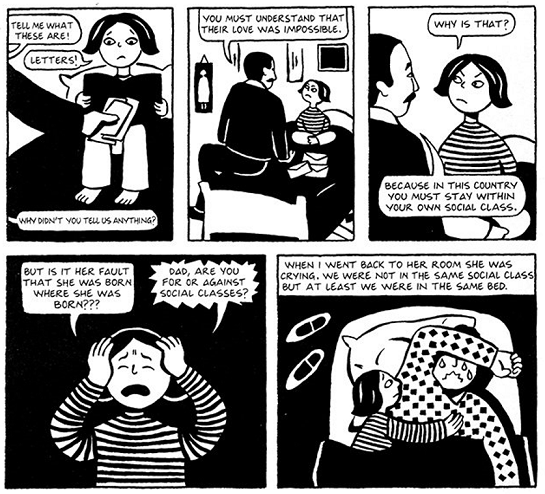
A6: Understanding social classes gives Marji her first taste of injustice in society and encourages her fight for what is right. An instance of this is when Mehri cannot love the neighbor because of social class. Marji sees this as unfair and rebels for the first time #MarjiChat
A5: When Marji was still young and naive, she believed in god because she saw the world as good and free of evil. But once she saw the evils of within society and lost her beloved uncle Anoosh, she lost faith because God would never have allowed such cruelty. #MarjiChat
A4: The frame that best helps reader understand the Islamic Revolution is the "2500 Years of Tyranny and Submission" frame on Page 11. It shows the reader the history of oppression of the Iranian people and details what the revolution is trying to end. #MarjiChat
@gabybern_ I wholeheartedly agree. While her parents are not perfect, they exemplify everything that they want Marji to be. Their qualities of bravery, pride, willingness to fight for what is right, and perseverance are passed down to Marji, which is what good role models do. #Marjichat
@SaraHuynh10 I agree that Marji's parents are good role models, but for a different reason. I think a good role model shows great leadership in society, not just within loved ones. Marji's parents showed Marji the injustice in society and encouraged her to fight against it. #MarjiChat
A3: True. Marji's parents always fought for what was right and never backed down in the face of adversity. They always stayed true to their beliefs and did not flee like everyone else. Their influence played a huge part in Marji's maturity. #MarjiChat
@DevinBuckler I completely agree that Marji's parents have the most influence on her. Like many children, Marji's beliefs and opinions are built upon those of her parents. They are instrumental in Marji's maturity and her understanding of right and wrong. #MarjiChat
A2: Marji's mother Taji has the most influence on Marji's life because she is Marji's biggest role model. Even if Taji is strict towards Marji, she loves Marji the most and is the one who teaches Marji right from wrong. #MarjiChat
A1: I would rename the book "The Bread Swan" because I feel that it is an important and unique symbol. It symbolizes the beauty created in the adversity of the war and memorializes all who gave their life for their cause. #MarjiChat