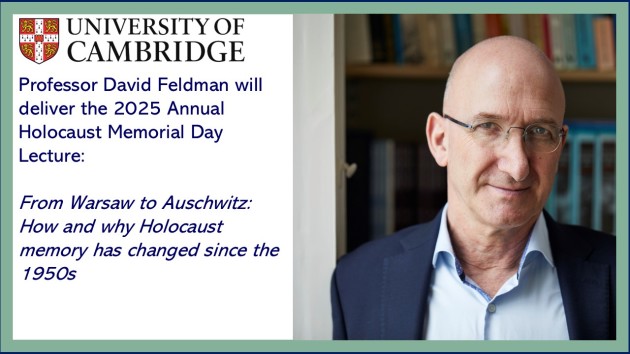
Our first event of the year will be the Annual Holocaust Memorial Day Lecture with Prof. David Feldman (@LondonU).
🗓️Monday 27 January, 5:30pm-6:30pm
📍Selwyn College (@Selwyn1882) and Zoom
🎟️In-person tickets: https://t.co/hObKW4G9UI
🖥️Online tickets: https://t.co/3H1dqJRbyp
"From Warsaw to Auschwitz: How and why Holocaust memory has changed since the 1950s" explores how the practice and meaning of Holocaust memorialisation have changed from the 1950s to the present day, and why this matters.
Our first event of the year will be the Annual Holocaust Memorial Day Lecture with Prof. David Feldman (@LondonU).
🗓️Monday 27 January, 5:30pm-6:30pm
📍Selwyn College (@Selwyn1882) and Zoom
🎟️In-person tickets: https://t.co/hObKW4G9UI
🖥️Online tickets: https://t.co/3H1dqJRbyp
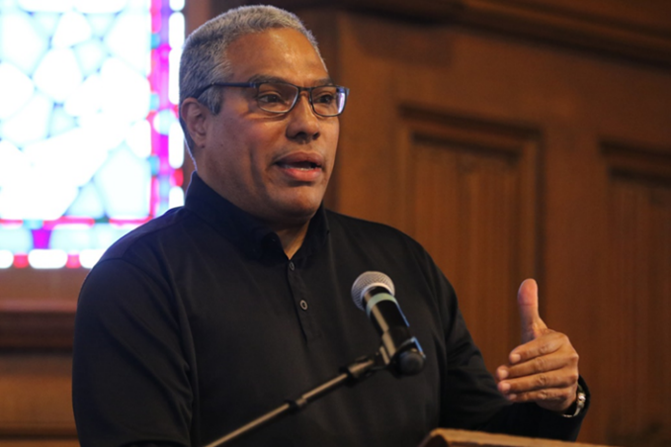
‘Racism Without Racists: How Racism Works in the USA and the Western World’ will cover ‘new racism’ in the western world and colour-blind racism, drawing parallels to the UK. Professor Bonilla-Silva will also discuss how to overcome ‘racism without racists.’
Join us for the 2024 @Cambridge_Uni Annual Race Equality Lecture with Professor Eduardo Bonilla-Silva (@DukeU)!
🗓️31 October at 17:45-18:45
📍Jesus College (@JesusCollegeCam) and Zoom
https://t.co/p6DmNgLGLf
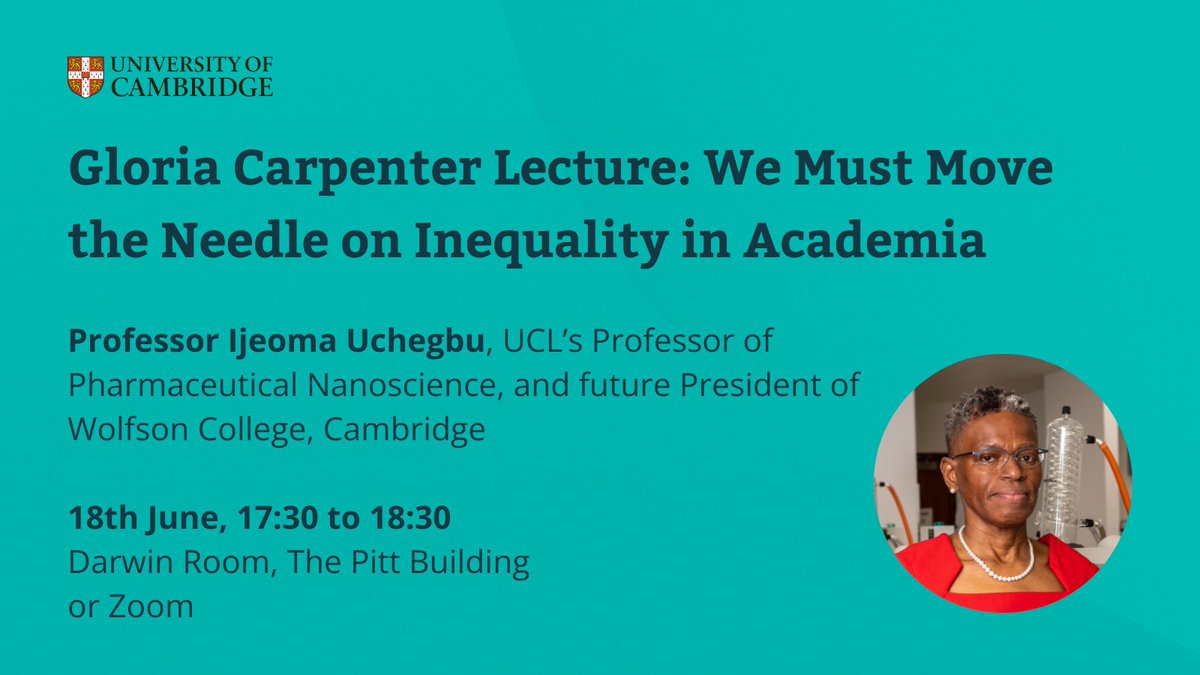
Despite ample evidence that inequalities harm innovation, productivity and general well-being, inequalities persist in all areas of economic life in the UK, including in academia. Professor Uchegbu will talk about the efforts to improve diversity. @Cambridge_Uni
There's still time to book your spot for this year's Gloria Carpenter Lecture with Professor Ijeoma Uchegbu (@ucl, @WolfsonCam)!
🗓️18th June, 17:30-18:30
📍Darwin Room @pittbuilding or Zoom
🎟️ (in-person tickets): https://t.co/RnsjKxJXrX
🖥️(Zoom): https://t.co/wG20S5oLwN
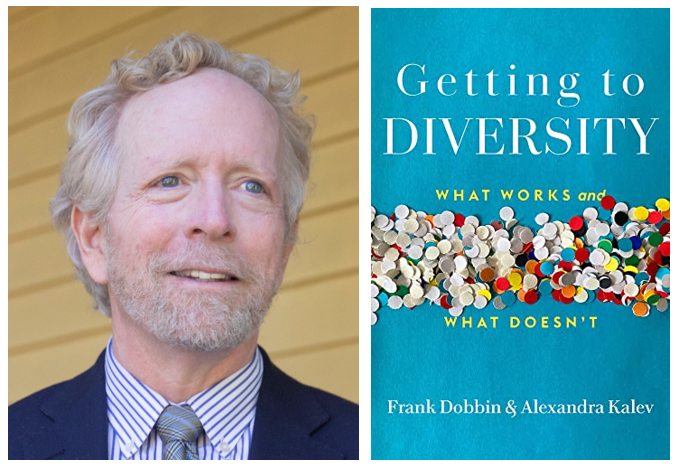
Frank Dobbin will discuss findings from his recent book with Alexandra Kalev which offers a comprehensive, data-driven analysis of initiatives designed to widen opportunity. The upshot: It’s time to focus on changing systems rather than individuals.
Don't forget to book your tickets for "Getting to Diversity": A Talk About Which Diversity Initiatives Work and Which Fail with @Harvard Professor Frank Dobbin (@DobbinFrank).
This will be hosted at @Selwyn1882@Cambridge_Uni on 16 May at 6-7pm.
https://t.co/XKU2k0TO22
In-person and online tickets are now available for '"Getting to Diversity": A Talk About What Works and What Doesn't Work' with @Harvard Professor Frank Dobbin (@DobbinFrank).
This will be hosted at @Selwyn1882@Cambridge_Uni on 16 May at 6-7pm:
https://t.co/VAPFrTwc8Z
In-person and online tickets are now available for '"Getting to Diversity": A Talk About What Works and What Doesn't Work' with @Harvard Professor Frank Dobbin (@DobbinFrank).
This will be hosted at @Selwyn1882@Cambridge_Uni on 16 May at 6-7pm:
https://t.co/VAPFrTwc8Z
Prof. Dobbin will discuss findings from his recent book with Alexandra Kalev which looks at the effectiveness of dozens of different diversity programs in over 800 companies to answer the questions: Which programs help, which hurt, and how can harmful programs be improved?
This event will be held inside the Darwin Room in the Pitt Building at 12:15-1pm. A light lunch and refreshments will be available. More information and booking details can be found here: https://t.co/YoGwkM5Tcs
Join us on Friday 8 March for our International Women's Day Lecture with Professor Sumi Madhok about "Anti-imperial epistemic justice: Building solidaristic coalitions in a time of global crises." https://t.co/7Mq0d3Kogw
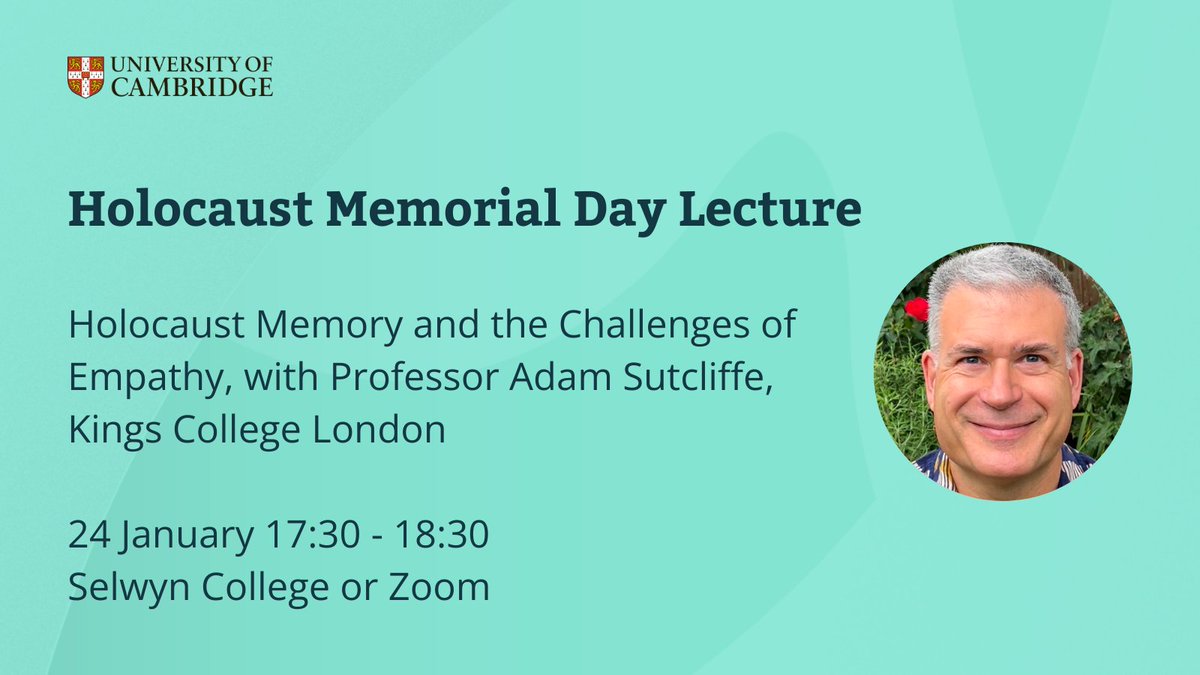
Adam Sutcliffe is Professor of European History at King’s College London (@KingsCollegeLon). He has written widely on early modern and modern Jewish history, intellectual history, and historiography. (3/)
We welcome everyone to attend this year's #HolocaustMemorialDay lecture with Professor Adam Sutcliffe on Wednesday 24th January at 5:30-6:30pm. Tickets for this hybrid event can be found on our webpage (1/): https://t.co/KHMFElbtVb
Holocaust memory has been closely associated with the increasing pedagogical emphasis on the idea of empathy. This lecture will explore why empathy has become so central to Holocaust education, and why this has not always led to straightforwardly positive outcomes. (2/)
Intervening in Africa’s economies to end the slave trade created a cascade of further interventions as humanitarians, policy experts, and business leaders tried to “fix” the problems they encountered. (3/)
Book your place for the talk at this link: https://t.co/qCoNM5NNyb
It's not too late to book your place for our Annual Gloria Carpenter Lecture ('Good Intentions: Slavery, Abolition, and Inequality in the Modern World') with Dr Bronwen Everill on 30th October. (1/)
https://t.co/qCoNM5NNyb
@CASCambridge@Cambridge_Uni@Selwyn1882
Since the end of the slave trade, ideas about Africa have played a regular role in the shaping of ideas about how economies should work, what the role of the economy in society is, how governments could intervene in the economy, and what makes people work. (2/)