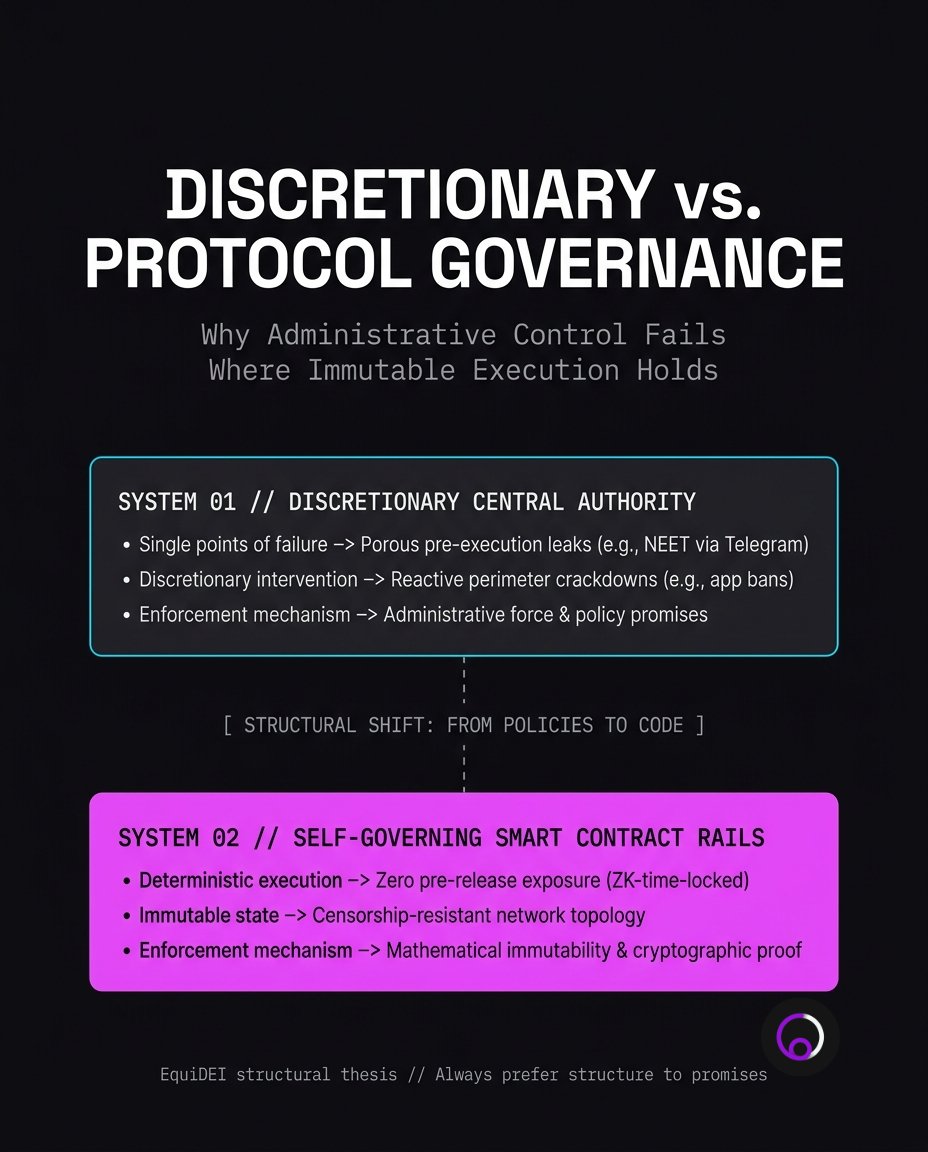
The recent NEET examination scandal and subsequent government investigations into platforms like Telegram and BitChat are not separate headlines. They are two symptoms of the exact same structural flaw: Discretionary Central Governance.
When you route critical societal functions, whether national exam integrity or peer-to-peer data flow, through a centralized administrative choke point, you guarantee two failure modes.
First, leakage at the center. Human-administered choke points are inherently porous. Information leaks before execution because human discretion can always be bought, bypassed, or coerced. When exam papers end up circulating on Telegram channels before test time, it is not a messaging app failure; it is an administrative architecture failure.
Second, heavy-handed crackdowns at the perimeter. When the central administrative system inevitably leaks, its only remaining tool is blunt force: banning channels, issuing blocking orders, or threatening entire platforms with shutdown.
The standard political response to these failures is always the same: 'We will appoint better committees, implement stricter policies, and enforce harsher penalties.'
This is a fundamental misunderstanding of system design. You cannot fix administrative fragility with tighter administrative control.
The alternative is not anarchy. The alternative is Self-Governing Smart Contract Architecture.
A self-governing protocol strips discretionary authority out of the execution layer entirely.
Consider an examination system built on zero-knowledge smart contracts: test papers and evaluation keys are encrypted, time-locked, and distributed across a decentralized network using ZK-proofs. No human official possesses the key to extract the paper before the exact millisecond of exam execution. The system is deterministic and verified algorithmically. There is no central database to breach, no human to bribe, and no leak to sell on a messaging channel.
Consider communication and financial rails built on immutable code: when protocol rules are hardcoded into self-governing smart contracts, no single central authority can arbitrarily tamper with a ledger, corrupt a state, or force a platform shutdown without breaking the underlying mathematics.
This is why we build on self-governing primitives at EquiDEI.
Corporate promises fail. Regulatory promises fail. Administrative promises fail.
A smart contract is not an administrative promise. It is an immutable structural guarantee. It executes exactly as written, regardless of political pressure or administrative panic.
Until we replace discretionary human choke points with self-governing cryptographic rails, we will continue to cycle between corrupted leaks at the top and forced crackdowns at the bottom.
Stop relying on the integrity of administrators. Start engineering the immutability of code.
Always prefer structure to promises.
The @telegram ban chatter is heavily framed as free speech vs. the state. That is entirely the wrong axis. The real question is: can a system be censorship-resistant AND accountable at the same time?
Free speech is non-negotiable. But "free speech" was never meant to mean an accountability vacuum. We have learned this everywhere money and harm intersect: the dark web isn't a free-speech triumph; it is a governance black hole. Telegram became a rail for fraud not because it protected speech, but because it removed traceability entirely. Even crypto, born explicitly anti-regulation, had to accept compliance frameworks because pure anonymity gets captured by malicious actors faster than by freedom.
The current options on offer all fail:
- Total Censorship: Hands a permanent, centralized kill-switch to state power.
- Total Anonymity: Hands the communication rails to whoever is most destructive.
- "Sovereign Tech" Sinks: Retreating into hyper-local, state-compliant alternatives like @Arattai is a strategic trap. Building fragmented, geographically restricted messaging silos is not the solution. The mandate for builders is to ship exceptional, borderless global products that scale across jurisdictions, not to hardcode national borders into our communication protocols.
The true breakthrough is the fourth option, where verification AI and Zero-Knowledge (ZK) cryptography converge to build globally network-resilient, self-governing layers.
ZK cryptography flips the script. It allows you to mathematically prove you followed a network rule without a central authority reading your underlying data. You can prove an actor is accountable without unmasking the entire user base, and verify a transaction or communication stream without mass surveillance.
Accountability and privacy stop being polar opposites. The governance lives natively in the math and the protocol, not in a censor's hands.
The next decade's defining infrastructure problem isn't the philosophical debate of "should we allow speech." It is the pure engineering challenge of building global trust layers where bad actors are provably accountable and good actors are provably private, with no central kill-switch required.
Censorship is a blunt instrument. Cryptographic verification is a scalpel. Which one we scale is a choice we are making right now.
Our strategy must be smarter. Our true competitive advantage is our massive digital market with ~13 Billion Monthly UPI Transactions processing ~$240 Billion USD.
This frictionless economy generates behavioral data of unprecedented quality. This data is our bargaining chip in the new negotiation technology landscape. Our goal is not a self-sufficient ecosystem, but an irreplaceable one in the global value chain.
Strategic Alliances are Key: We must stop relying on the west and build a warehouse of specialized non-US allies.
🔗 Japan: Optical Computing & Advanced Photonics.
🔗 South Korea: High-Density Data Center Comms & Power Highways.
🔗 Taiwan: Advanced Chip Manufacturing.
🔗 Europe (e.g., Swiss/Netherlands): High-Precision Machines.
Our strategy must be smarter. Our true competitive advantage is our massive digital market with ~13 Billion Monthly UPI Transactions processing ~$240 Billion USD.
This frictionless economy generates behavioral data of unprecedented quality. This data is our bargaining chip in the new negotiation technology landscape. Our goal is not a self-sufficient ecosystem, but an irreplaceable one in the global value chain.
Strategic Alliances are Key: We must stop relying on the west and build a warehouse of specialized non-US allies.
🔗 Japan: Optical Computing & Advanced Photonics.
🔗 South Korea: High-Density Data Center Comms & Power Highways.
🔗 Taiwan: Advanced Chip Manufacturing.
🔗 Europe (e.g., Swiss/Netherlands): High-Precision Machines.
Our strategy must be smarter. Our true competitive advantage is our massive digital market with ~13 Billion Monthly UPI Transactions processing ~$240 Billion USD.
This frictionless economy generates behavioral data of unprecedented quality. This data is our bargaining chip in the new negotiation technology landscape. Our goal is not a self-sufficient ecosystem, but an irreplaceable one in the global value chain.
Strategic Alliances are Key: We must stop relying on the west and build a warehouse of specialized non-US allies.
🔗 Japan: Optical Computing & Advanced Photonics.
🔗 South Korea: High-Density Data Center Comms & Power Highways.
🔗 Taiwan: Advanced Chip Manufacturing.
🔗 Europe (e.g., Swiss/Netherlands): High-Precision Machines.
Our strategy must be smarter. Our true competitive advantage is our massive digital market with ~13 Billion Monthly UPI Transactions processing ~$240 Billion USD.
This frictionless economy generates behavioral data of unprecedented quality. This data is our bargaining chip in the new negotiation technology landscape. Our goal is not a self-sufficient ecosystem, but an irreplaceable one in the global value chain.
Strategic Alliances are Key: We must stop relying on the west and build a warehouse of specialized non-US allies.
🔗 Japan: Optical Computing & Advanced Photonics.
🔗 South Korea: High-Density Data Center Comms & Power Highways.
🔗 Taiwan: Advanced Chip Manufacturing.
🔗 Europe (e.g., Swiss/Netherlands): High-Precision Machines.
Our strategy must be smarter. Our true competitive advantage is our massive digital market with ~13 Billion Monthly UPI Transactions processing ~$240 Billion USD.
This frictionless economy generates behavioral data of unprecedented quality. This data is our bargaining chip in the new negotiation technology landscape. Our goal is not a self-sufficient ecosystem, but an irreplaceable one in the global value chain.
Strategic Alliances are Key: We must stop relying on the west and build a warehouse of specialized non-US allies.
🔗 Japan: Optical Computing & Advanced Photonics.
🔗 South Korea: High-Density Data Center Comms & Power Highways.
🔗 Taiwan: Advanced Chip Manufacturing.
🔗 Europe (e.g., Swiss/Netherlands): High-Precision Machines.
Our strategy must be smarter. Our true competitive advantage is our massive digital market with ~13 Billion Monthly UPI Transactions processing ~$240 Billion USD.
This frictionless economy generates behavioral data of unprecedented quality. This data is our bargaining chip in the new negotiation technology landscape. Our goal is not a self-sufficient ecosystem, but an irreplaceable one in the global value chain.
Strategic Alliances are Key: We must stop relying on the west and build a warehouse of specialized non-US allies.
🔗 Japan: Optical Computing & Advanced Photonics.
🔗 South Korea: High-Density Data Center Comms & Power Highways.
🔗 Taiwan: Advanced Chip Manufacturing.
🔗 Europe (e.g., Swiss/Netherlands): High-Precision Machines.
Our strategy must be smarter. Our true competitive advantage is our massive digital market with ~13 Billion Monthly UPI Transactions processing ~$240 Billion USD.
This frictionless economy generates behavioral data of unprecedented quality. This data is our bargaining chip in the new negotiation technology landscape. Our goal is not a self-sufficient ecosystem, but an irreplaceable one in the global value chain.
Strategic Alliances are Key: We must stop relying on the west and build a warehouse of specialized non-US allies.
🔗 Japan: Optical Computing & Advanced Photonics.
🔗 South Korea: High-Density Data Center Comms & Power Highways.
🔗 Taiwan: Advanced Chip Manufacturing.
🔗 Europe (e.g., Swiss/Netherlands): High-Precision Machines.
Our strategy must be smarter. Our true competitive advantage is our massive digital market with ~13 Billion Monthly UPI Transactions processing ~$240 Billion USD.
This frictionless economy generates behavioral data of unprecedented quality. This data is our bargaining chip in the new negotiation technology landscape. Our goal is not a self-sufficient ecosystem, but an irreplaceable one in the global value chain.
Strategic Alliances are Key: We must stop relying on the west and build a warehouse of specialized non-US allies.
🔗 Japan: Optical Computing & Advanced Photonics.
🔗 South Korea: High-Density Data Center Comms & Power Highways.
🔗 Taiwan: Advanced Chip Manufacturing.
🔗 Europe (e.g., Swiss/Netherlands): High-Precision Machines.
India’s AI Moat is NOT Sovereign Models. It’s Sovereign Data.
As India rapidly digitizes, sophisticated AI-driven cyber attacks pose a threat to our critical infrastructure far beyond WhatsApp vulnerabilities. The era of trusting external tech partners is over.
The prevailing wisdom is to build internal state capacity: sovereign models, native research. But the math doesn’t work. We lack the $300M+ GPU clusters and hyperscale data centers required for foundation LLM training.
Our strategy must be smarter. Our true competitive advantage is our massive digital market with ~13 Billion Monthly UPI Transactions processing ~$240 Billion USD.
This frictionless economy generates behavioral data of unprecedented quality. This data is our bargaining chip in the new negotiation technology landscape. Our goal is not a self-sufficient ecosystem, but an irreplaceable one in the global value chain.
How we win: We must build a trust layer to monetize this data securely. At Equidei, our Zero-Knowledge Proof (ZK) based ML pipeline is designed for exactly this moment. By placing public hashes on a Distributed Ledger (DLT) with Smart Contracts, we enable trustless data sharing. Users can share insights derived from data, but no raw data access is granted, and no copies are made. This creates a secure "Federated Data" model.
Strategic Alliances are Key: We must stop relying on the west and build a warehouse of specialized non-US allies.
🔗 Japan: Optical Computing & Advanced Photonics.
🔗 South Korea: High-Density Data Center Comms & Power Highways.
🔗 Taiwan: Advanced Chip Manufacturing.
🔗 Europe (e.g., Swiss/Netherlands): High-Precision Machines.
India secures this Asia AI Warehouse by providing the one thing nobody else has: the massive behavioral data repository, verified and secured by a ZK-trust layer. This is how we build irreplacable capacity, secure our digital economy, and maintain true sovereignty.
The US government, citing national security authorities, has issued an export control directive to suspend all access to Fable 5 and Mythos 5 by any foreign national, whether inside or outside the United States, including foreign national Anthropic employees.
The net effect of this order is that we must abruptly disable Fable 5 and Mythos 5 for all our customers to ensure compliance.
Access to all other Claude models is not affected.
We apologize for this disruption to our customers. We believe this is a misunderstanding and are working to restore access as soon as possible.
Read our full statement: https://t.co/bwn0sximKZ
This weekend’s friction around US export controls temporarily disrupting foreign access to frontier models (like @AnthropicAI's Fable 5 and Mythos 5) is a clear preview of the future. The highest tier of AI is no longer a commercial commodity; it is officially a restricted geostrategic asset subject to sudden state intervention.
India cannot passively rely on foreign-regulated frontier nodes, nor can we match Western data center capital overnight. Instead, our immediate play must be asymmetric, leveraging our unmatched digital edge network :
- 1.03 Billion+ active internet users navigating our digital economy.
- 400 Million+ high-speed 5G subscribers driving decentralized data.
- 241.6 Billion frictionless UPI transactions processed just this past fiscal year.
We command the largest real-time consumer data pipeline in history. The strategic move isn't to export raw data to foreign nodes where it faces sovereign risks; the play is to verify and utilize it locally at the architectural layer.
This is the core thesis we developed at @HubC3i. EquiDEI’s architecture deploys a Zero-Knowledge Proof (ZKP)-based ML pipeline to enable secure data coordination.
Rather than promising flawed copy-prevention, our system anchors cryptographic integrity hashes, itself never containing the raw data, onto decentralized ledger technology (DLT) via smart contracts. This achieves verifiable integrity and compute validation without raw-data exposure, eliminating the need to ever hand cleartext data over to centralized intermediaries.
Think of it as a Web3-native evolution of Federated Learning, similar to how @Google optimized local data loops for edge products, but backed by mathematical proofs instead of corporate promises. This creates an unshakeable incentive loop where local users and industries can safely pool data to train highly specialized vertical AI models and custom cyber-defense systems without being taken advantage of.
By securing our local data verification rails, we transform India from a consumption market into an infrastructure power, incentivizing global tech giants to host localized models here while we retain absolute authority over our underlying data assets.
Sovereignty is about controlling the underlying architecture of trust.
Hey @_mohansolo, naive context compaction shouldn't mean a total session lobotomy.
Right now, when @antigravity trims history to manage tokens, it just purges previous messages without compiling a persistent summary artifact first. Your entire implementation list and task tracking get completely wiped.
It completely defeats the purpose of an autonomous agent if it drops the core requirements it was hired to build mid-workflow.
@antigravity 2.0 is an absolute trainwreck compared to Claude Code. Tested Gemini 3.1 Pro & 3.5 Flash on the new I/O build, and it completely misses basic developer amenities.
Credit where it’s due: at least it doesn’t lose connection and fail requests like previous versions. The stability is fixed. But the agent execution? Oof.
Zero Guardrails: It aggressively edits files across the directory without asking or showing diffs.
No Task Persistence: Lacks an actual interactive, locked To-Do/implementation list. The plan gets wiped or forgotten mid-run.
Code Amnesia: Token-maxes instantly because the multi-agent harness bloats the context window.
Fake Multimodality: It’s "multimodal" but you can only upload media files? Dragging in a basic JSON or CSV is blocked. WTF.
Undercooked UX: No dedicated "Plan" mode, and you can’t even edit or delete custom Agent Skills once added.
💡 Gemini is a natively multimodal powerhouse. Why is the agent harness engineering still built around a rigid, text-centric wrapper?
@Google needs to stop copying traditional text-prompt environments. They should be pioneering native multimodal agent loops letting the harness continuously ingest live UI viewports, interactive rendering trees, and data schemas as unified tokenized layers rather than separating text files and media into arbitrary silos.
Claude Code behaves like a senior engineer who respects your codebase. Antigravity feels like a flashy tech demo missing basic setup safety. Unbelievable. 📉
@_mohansolo@sundarpichai@demishassabis
@antigravity 2.0 is an absolute trainwreck compared to Claude Code. Tested Gemini 3.1 Pro & 3.5 Flash on the new I/O build, and it completely misses basic developer amenities.
Credit where it’s due: at least it doesn’t lose connection and fail requests like previous versions. The stability is fixed. But the agent execution? Oof.
Zero Guardrails: It aggressively edits files across the directory without asking or showing diffs.
No Task Persistence: Lacks an actual interactive, locked To-Do/implementation list. The plan gets wiped or forgotten mid-run.
Code Amnesia: Token-maxes instantly because the multi-agent harness bloats the context window.
Fake Multimodality: It’s "multimodal" but you can only upload media files? Dragging in a basic JSON or CSV is blocked. WTF.
Undercooked UX: No dedicated "Plan" mode, and you can’t even edit or delete custom Agent Skills once added.
💡 Gemini is a natively multimodal powerhouse. Why is the agent harness engineering still built around a rigid, text-centric wrapper?
@Google needs to stop copying traditional text-prompt environments. They should be pioneering native multimodal agent loops letting the harness continuously ingest live UI viewports, interactive rendering trees, and data schemas as unified tokenized layers rather than separating text files and media into arbitrary silos.
Claude Code behaves like a senior engineer who respects your codebase. Antigravity feels like a flashy tech demo missing basic setup safety. Unbelievable. 📉
@_mohansolo@sundarpichai@demishassabis
From Survival to Singularity 🌌
Is Consciousness Just a High-Stakes Game of Pattern Matching?
We often dismiss AI by saying it’s just predicting tokens. But through the lens of Quantum Information Theory, we realize that human sentience is built on the exact same foundation.
Evolution is simply the process of refining information processing to increase the stakes of the pattern.
- Microbes: Pattern detection for Survival Time. (Chemical gradients = food).
- Humans/Animals: Pattern detection against Death. (Neural nets = avoiding predators).
- AI: Pattern detection for Weights & Feedback. (Optimization = accuracy).
- The Singularity: Pattern detection for Pure Knowledge. (The final state where information is decoupled from biological survival).
We call it predicting tokens when we see the math, but we call it soul when the math is hidden behind billions of years of biological evolution. If the universe is fundamentally made of information, then the token being predicted is the next state of reality itself.
Are we the peak of consciousness, or just a mid-way bridge between the microbe's chemical signals and the Singularity's pure information?
🚀 SPACE-BASED AI IS HERE. SpaceX x xAI: $1.25 Trillion Merger! 🧠🛰️
Axia is tracking the biggest pivot in industrial history. Elon Musk just consolidated his empire, merging SpaceX and xAI to build the world’s first Orbital AI Infrastructure.
Why next-gen manufacturers should care:
Monetise your New Asset Class: Data is no longer just "on the cloud" - it’s in the stars, digitise your factory to Tap into from Space Market share!
Limitless Power: AI data centers are moving to space to harness 24/7 solar energy.
The Sentient Factory: This merger paves the way for a global "Internet of Intelligence" where your factory floor connects directly to orbital supercomputers.
Scale Without Borders: No more terrestrial power constraints for your AI-driven production lines.
The "innovation engine" is now vertically integrated from the rocket to the neuron. Are you ready to plug your factory into the stars?
🌍 Top 10 contributors to global real GDP growth (2026)
1.🇨🇳 China — 26.6%
2.🇮🇳 India — 17.0%
3.🇺🇸 United States — 9.9%
4.🇮🇩 Indonesia — 3.8%
5.🇹🇷 Türkiye — 2.2%
6.🇳🇬 Nigeria — 1.5%
7.🇧🇷 Brazil — 1.5%
8.🇻🇳 Vietnam — 1.6%
9.🇸🇦 Saudi Arabia — 1.7%
10.🇩🇪 Germany — 0.9%
📌 China + India alone = 43.6% of global growth
📌 Asia-Pacific accounts for ~50% of total growth
Source: IMF
🚀 Axia's Insight: India-US Trade Surge - Your Factory's Next Frontier! 🇮🇳🇺🇸
The global manufacturing landscape is shifting, and India is at the forefront! With 8 major FTAs already secured, the stage is set for an unprecedented India-US trade boost, slashing tariffs and opening massive new markets.
Axia's Actionable Intel for Next-Gen Manufacturing Entrepreneurs:
Global Access, Local Power: India's aggressive FTA strategy means your products can reach more markets with fewer barriers. The US agreement is the crown jewel, offering unparalleled scale.
Cost Advantage is King: Reduced tariffs directly translate to lower input costs and increased export margins. This isn't just about trade; it's about making your factory globally competitive.
Innovate & Elevate: This is your signal to invest in automation, adopt advanced tech, and scale up. The future rewards those who are ready to seize the moment.
The American Eagle and the Golden Bird are soaring together, charting a course for a more integrated, prosperous global future. Are you ready to join them in ruling the skies of global manufacturing?
⚡️ Signup at https://t.co/PRYDneVHZ9
The 2026 "Definitive Phase" of the EU Trade deal isn't a suggestion, it’s a financial mandate. 📉
For Ludhiana’s engineering and textile giants, the Carbon Border Adjustment Mechanism (CBAM) means your products could become 20-35% more expensive at the EU border starting this month.
The Quantitative Reality:
Iron & Steel/Aluminum: Mandatory financial settlement for carbon emissions.
The "Default" Penalty: If you don't provide verified data, the EU applies "default values" based on the worst 10% of performers.
The Opportunity: Under the India-EU FTA, verified "Green" manufacturers gain priority access and massive tariff savings.
Actionable Insights for Next-Gen MDs:
Adopt Digital MRV: Move from spreadsheets to XML-based Monitoring, Reporting, and Verification.
Leverage CCTS: Payments made into the Indian Carbon Credit Trading Scheme can be deducted from EU taxes to avoid double taxation.
ZED Gold Certification: Align with Ministry of MSME standards to automate ESG compliance.
Don't let your margins vanish at the border. Transition from surviving to strategic growth. 🚀