Shenzhen is a city of efficiency. During off-peak hours at night, the metro transports parcels, squeezing out every last drop of efficiency.
A small story like this offers a glimpse into the driving force behind China's rapid development.
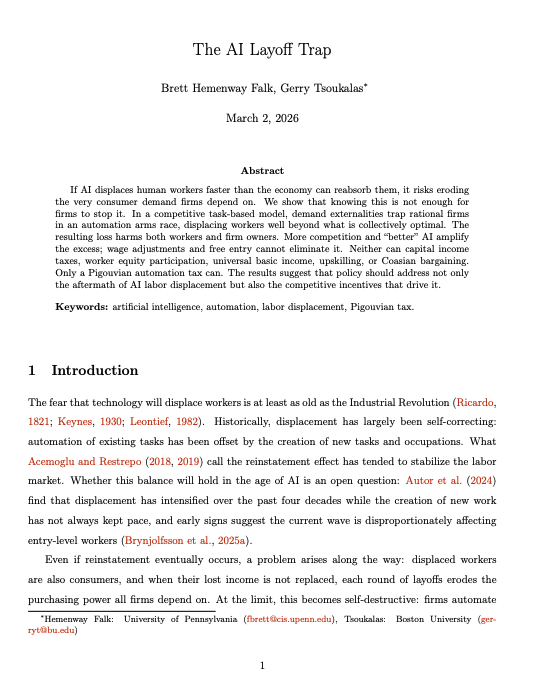
🚨RESEARCHERS JUST MATHEMATICALLY PROVED THAT AI LAYOFFS WILL DESTROY THE ECONOMY.. AND EVERY CEO ALREADY KNOWS IT.. BUT NONE OF THEM CAN STOP..
Two researchers from UPenn and Boston University just published a paper called "The AI Layoff Trap"..
They proved something terrifying..
Every company replacing workers with AI is also firing its own customers.. Every laid-off employee is someone who used to spend money.. When enough people lose their jobs.. Nobody can afford to buy anything.. And the companies that fired everyone go bankrupt selling products to an economy with no purchasing power..
Every CEO can see this coming.. The math is obvious.. Fire workers.. Lose customers.. Lose revenue.. Collapse..
But here's the trap..
No company can afford to stop..
If you don't automate.. Your competitor will.. They cut costs.. Undercut your prices.. Steal your market share.. And you die anyway..
So every company automates.. Knowing it's collectively suicidal.. Because the alternative is dying alone while everyone else survives..
It's a Prisoner's Dilemma.. And the researchers proved it mathematically..
The numbers are already stacking up..
Block cut nearly half its 10,000 employees this year.. CEO Jack Dorsey said AI made those roles unnecessary and that "within the next year, the majority of companies will reach the same conclusion"..
Salesforce replaced 4,000 customer support agents with AI..
Goldman Sachs deployed an AI coder that lets one senior engineer do the work of a five-person team..
Over 100,000 tech workers were laid off in 2025 alone.. AI was cited as the primary driver in more than half the cases..
80% of US workers hold jobs with tasks susceptible to AI automation..
And here's what should scare policymakers..
The researchers tested every proposed solution..
Universal Basic Income.. Doesn't fix it.. It raises living standards but doesn't change a single company's incentive to automate..
Capital income taxes.. Don't fix it.. They change profit levels but not the per-task decision to replace a human..
Worker equity and profit sharing.. Narrows the gap but can't close it..
Collective bargaining.. Can't fix it.. Because automating is a dominant strategy.. No voluntary agreement between companies is self-enforcing..
Only one thing works.. A Pigouvian automation tax.. A per-task charge that forces every company to pay for the demand it destroys when it fires a worker..
The researchers call it a "Red Queen effect".. Better AI doesn't solve the problem.. It makes it worse.. Because every company sees a bigger market share gain from automating faster than rivals.. But at the end.. Everyone automates equally.. The gains cancel out.. And the only thing left is more destroyed demand..
The paper's conclusion is devastating..
This isn't a transfer from workers to company owners.. Both sides lose.. Workers lose their income.. Companies lose their customers.. It's a deadweight loss that harms everyone..
And no market force can break the cycle..
The AI layoff trap isn't a prediction.. It's already happening.. And the math says it won't stop on its own.
Hayek was asked to leave “a statement for the future generations.” His response is brilliant:
“Modern civilization which enables us to maintain 4 billion people was made possible by the institution of private property. It is only thanks to this institution that we achieved an extensive order far exceeding anybody’s knowledge.”
“If you destroy that moral basis, which consists in the recognition of private property, we will destroy the sources which nourish present-day mankind, and create a catastrophe of starvation beyond anything mankind has yet experienced.”
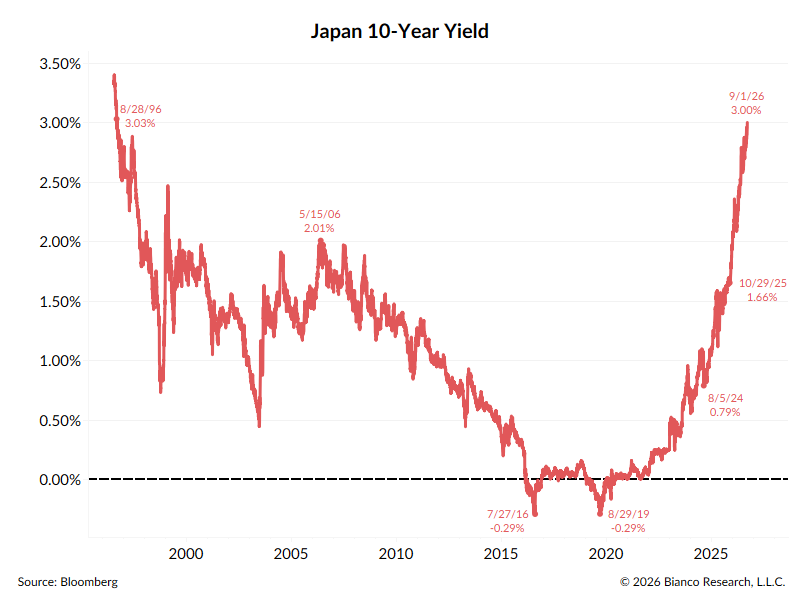
Japan's three lost decades stand as the most comprehensive real-world experiment disproving Keynesian stimulus theory. Since 1990, Japan has deployed every tool in the government spending playbook: massive infrastructure projects, quantitative easing, negative interest rates, and debt-to-GDP ratios exceeding 260%. The result? Persistent stagnation, deflation, and an entire generation that has never experienced genuine economic growth.
The numbers are damning. Japan's central bank balance sheet expanded from 20% of GDP in 2000 to over 130% today, while government debt exploded from manageable levels to the highest in the developed world. Yet GDP growth averaged barely 1% annually, wages remained flat, and productivity gains evaporated. Each stimulus package promised recovery but delivered only temporary sugar highs followed by deeper malaise.
What Japan actually needed was the creative destruction that recessions provide: allowing zombie companies to fail, clearing malinvestments, and letting market forces reallocate resources to productive uses. Instead, endless bailouts and cheap money preserved inefficient structures while punishing savers and productive enterprises. The Bank of Japan became the largest owner of Japanese stocks and bonds, turning free markets into centrally planned theater.
The lesson is crystal clear: you cannot print or spend your way to prosperity. Japan's lost decades prove that stimulus creates dependency, not growth. Real recovery requires letting markets work, allowing failures to clear, and rebuilding on solid foundations rather than papering over structural problems with monetary heroin.
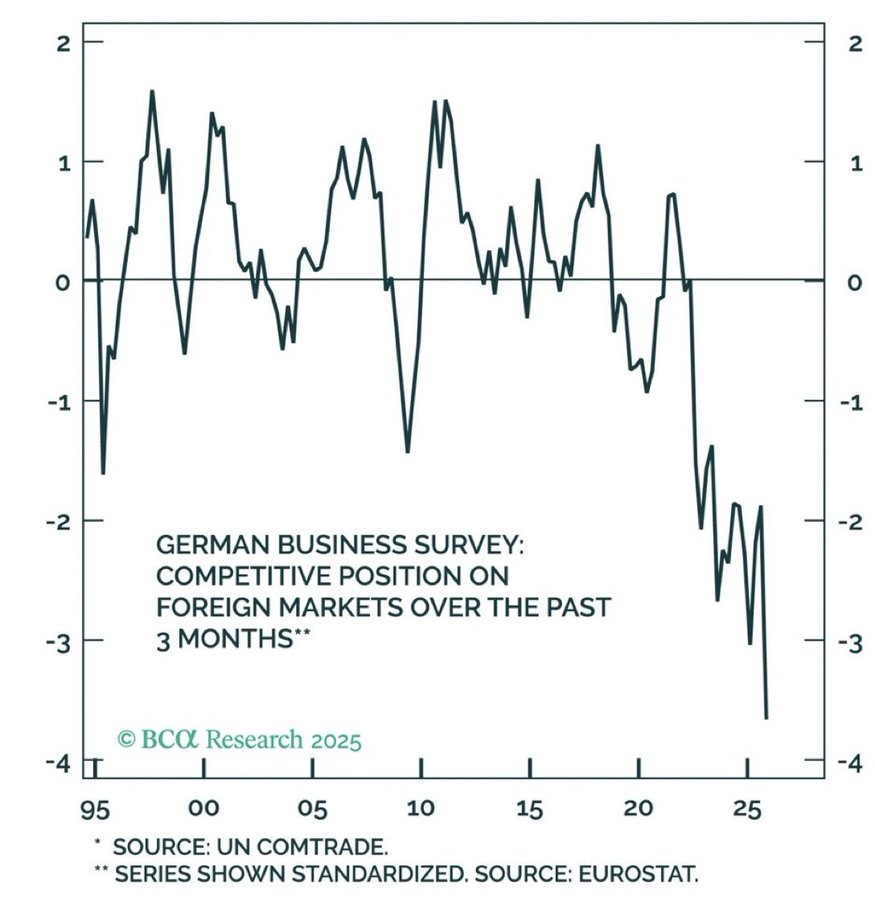
Germany’s businesses are in panic mode.
- They report the worst export competitiveness since 1995
- Twice as bad as during the Global Financial Crisis
- ~50% of Germany’s GDP comes from exports
Germany has effectively destroyed its own business model.