Project funded by @ERC_Research, hosted in @sapienzaRoma, PI A. Ghignoli. Graphic symbols in pragmatic literacy from Late Antiquity to early medieval Europe.
Si è spento nella sua casa di Vigalzano, frazione di Pergine Valsugana, in provincia di Trento. Durante la Seconda Guerra mondiale aveva salvato la vita a soldati in fuga e disertori
https://t.co/ekprFLjXdD
Hundreds of my Exeter colleagues at will be hearing the outcome of their applications for voluntary redundancy today. Spare a thought for them if you get a chance.
🦔AI companies are bulk-buying rare books, scanning them through high-speed machines that cut the spines off, and shredding the originals. A service called ISBNdb facilitates orders of up to a million books and keeps buyers anonymous. Pre-2022 books are premium because they're free of AI-generated text. A federal judge ruled the practice is fair use because eliminating the original means only one copy exists at a time. Anthropic hired the former head of Google Books partnerships to obtain "all the books in the world."
My Take
This got to me. A bookseller told 404 Media that rare books with almost no surviving copies are being fed into this pipeline. Books that survived wars, fires, and centuries of handling are being shredded so an AI can learn to write a better marketing email.
ISBNdb's website literally says "'AI company destroys two million books' is not a headline that generates sympathy," and they still built an entire business around making it happen quietly. They offer NDAs as a feature. They coach clients to call it "digital preservation."
I've covered AI companies scraping the internet, torrenting libraries, and stealing music. This is worse because it's irreversible. You can re-upload a website. You can reprint a bestseller. You can't replace the last three copies of an 18th-century botanical text once someone shreds them for training data. And the judge said it's legal. So it's going to accelerate.
"We shred rare books and offer NDAs so nobody finds out" is a legitimate business model in 2026. What a timeline.
Hedgie🤗
El solideo del Papa sólo se retira ante Dios. Y eso mismo es lo que ha pasado cuando León XIV ha llegado a Lampedusa… Lo ha encontrado, pero ya no se lo ha podido poner
@ProfLRoach Really so sad. She was expected here in Oslo tomorrow, where she would have to chair and deliver a paper at the conference of the Erc project Minitexts. She sent her slides and paper last week to make sure the PI would have them even if she wasn’t able to join the conference. 💔
On #LabourDay, we recognise not only the work we see, but also the work that often remains invisible⌛
Valeria Pulignano from KU Leuven explores how unpaid labour contributes to insecurity in today’s labour market by studying care, gig, and creative work.
Due to some connectivity issues on the GARR node in Catania, all the LAD databases are down. Other services are either down or running withstring limitations. Apologies, and we hope to be back online soon.
We are delighted to announce the publication of the book “Mani e scritture, simboli e testi”, edited by M. Boccuzzi, at Edizioni di Storia e Letteratura, in free open access, among the results of the Erc advanced grant project Notae. https://t.co/DcHy9TsLzZ
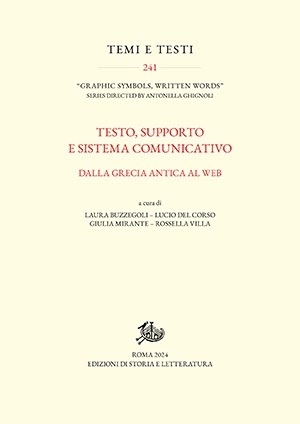
The third volume of the Book Series “Graphic Symbols, Written Words” promoted by the project Notae funded by @ERC_Research, is out in open access:
https://t.co/PXshYROg5G
A new output of the project NOTAE: I testamenti dei cittadini romani d'Egitto tra storia sociale e prassi giuridica, Harrassowitz, Philippika 178, by Lucia C. Colella in free OA <https://t.co/WmUp6iZTDz’Egitto_tra_storia_sociale_e_prassi_giuridica/titel_7426.ahtml>
New output of the Erc project NOTAE: the book authored by Livia Briasco - Aneta Skalec, L'Archivio di Patermouthis. Scrivere documenti nella Syene tardoantica, Roma, Edizioni di Storia e Letteratura, 2024. In free open access <https://t.co/5AGd9PUFth>
New book in free OA released today: T. De Robertis, A. Ghignoli, S. Zamponi, Il papiro di Vicenza (P.Vic). Un nuovo papiro latino del VI secolo, Firenze, Firenze University Press (Edizioni dell’Istituto papirologico “G. Vitelli”, 15). https://t.co/PYpiwSl2RW
The program of the final conference of the ERC project NOTAE, which will take place in Rome, Sapienza University, 31/05/2024-01/06/2024
https://t.co/lEKaIg0Dyf
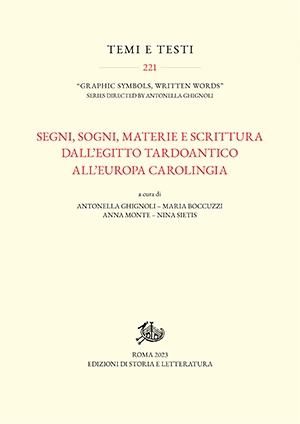
New #openaccess collection: Segni, sogni, materie e scrittura dall’Egitto tardoantico all’Europa carolingia edited by @AGhignoli , et al. https://t.co/C6e8fjRxGi @ErcNotae
The preview of a new paper published by the PI of the NOTAE project (Applied Category Analysis for Interpreting a List in the Late Antique Documentary Tradition) https://t.co/ZbiTDgx1uD via @academia
Our @__fleotta has just presented the experience of the project NOTAE, funded by @ERC_Research and hosted by @SapienzaRoma, at the first Conference organized by the Erc project DiDip. Thanks to our great IT team @mecellone @catarci1 Silvestro Eleonora Zahra and Lauren !
The last speaker of this session is Francesco Leotta (@__fleotta) from @SapienzaRoma. He speaks about Image processing and semantic technologies in digital humanities: The NOTAE experience.#digdipl2022
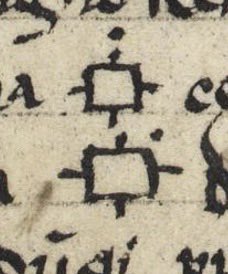
To medievalists or experts in Medieval Latin manuscripts, a request for help: Has anyone ever seen signs like these (ms. Brit. Library Harley 5402), studying manuscripts of the 12/13 centuries, containing texts (in Latin or in other languages) on astronomy or astrology? Thanks!