Extremely thrilled to see my new paper titled "Parental Educational Attainment and Child Labor: Evidence from Malawi" published open access in the Journal of Agricultural and Applied Economics.
Find paper here: https://t.co/4r7vIoNYBv
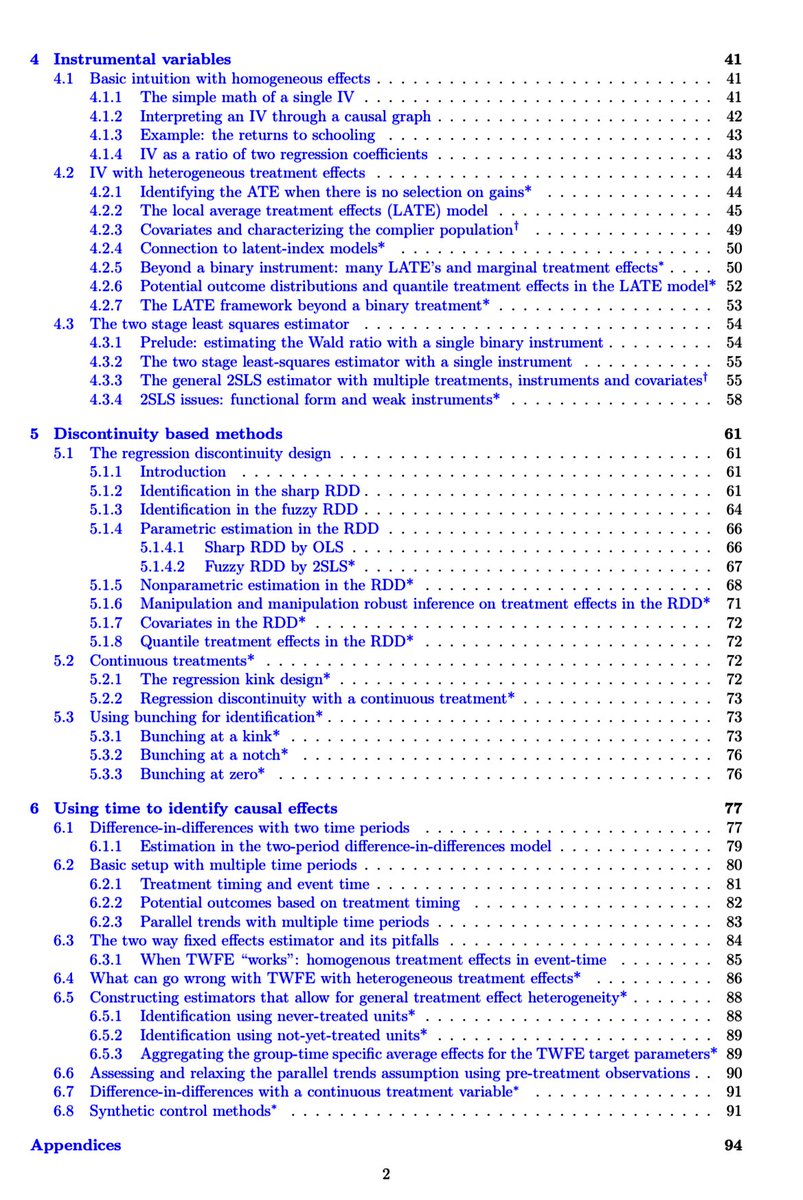
A year ago on Facebook, at the request of a former MSU student, I made this post. I used to say in class that econometrics is not so hard if you just master about 10 tools and apply them again and again. I decided I should put up or shut up.
#metricstotheface
Statistical Rethinking 2026 is done: 20 new lectures emphasizing logical & critical statistical workflow, from basics of probability to causal inference to reliable computation to sensitivity. It's all free, made just for you. Lecture list & links: https://t.co/jFpoiNC6oW
The Geometry Behind Maximum Likelihood Estimation (MLE):
Maximum Likelihood Estimation (MLE) has a rich geometric interpretation that views statistical models as curved surfaces embedded in high-dimensional probability spaces. Each parameter value corresponds to a point on a statistical manifold, and the likelihood function defines a landscape whose peaks represent the most plausible explanations of the data. Gradients and Hessians of the log-likelihood describe local geometry, while the Fisher information acts as a Riemannian metric, measuring how distinguishable nearby distributions are. From this perspective, MLE becomes a problem of finding geodesic directions of steepest ascent on a curved surface rather than in flat Euclidean space. In statistics, this geometry explains efficiency, curvature bias, and asymptotic normality. In machine learning and deep learning, natural gradient methods, information geometry, and mirror descent exploit this structure to accelerate training and improve stability. The geometric view reveals that learning is not just optimization, but navigation on a curved space of probability models.
Let's discuss different DiD estimators with unbalanced panels -- often due to missing data on Y, or attrition. I will use the Stata commands csdid and jwdid as part of the discussion. First, a review. Assume time-constant covariates, X and a balanced panel.
I recommend both books, to be read simultaneously. The first, for breadth of coverage, the second, for clarity -- free of the cognitively opaque notion of "potential outcome". @KirkDBorne
gander is an R package that brings AI directly into RStudio or Posit.
Instead of switching between your IDE and a chat window, gander lets you ask questions or request code changes right inside your script. It automatically shares relevant context such as variable names, data types, and the surrounding code, so the model can provide precise answers without extra copy-pasting.
You can trigger it with a simple keyboard shortcut, choose from different AI models (OpenAI, Claude, or local ones), and control how much of your data is sent for context. In short, gander makes working with AI in RStudio smoother, faster, and smarter.
Take a look at the visualization below. It shows an example of how to use gander to create a ggplot2 graph. It’s taken from the package website: https://t.co/DbsZTbsmVK
Join my newsletter for more tutorials and insights on R, Python, data science, and AI. For more information, visit this link: https://t.co/X93SeCe0rb
#Python #programmer #DataAnalytics #Rpackage #ggplot2 #DataViz #Statistics #RStats #DataVisualization #database #tidyverse #R4DS
I’ve started an ongoing project to collect all the datasets which economists can use, all in one place, organized by topic. Started with 50, further suggestions are extremely welcome. It will grow considerably.
Great initiative! For macro/finance/international topics, we’ve assembled a number of links to different datasets (as well as code and other resources) here:
https://t.co/CBRVY69C0N
The NBER IFM data page is another great resource.
Happy to announce our paper is finally in print, after many years, with a wonderful team of collaborators, including the late Patrick Bajari. https://t.co/hqkfeN0yUw
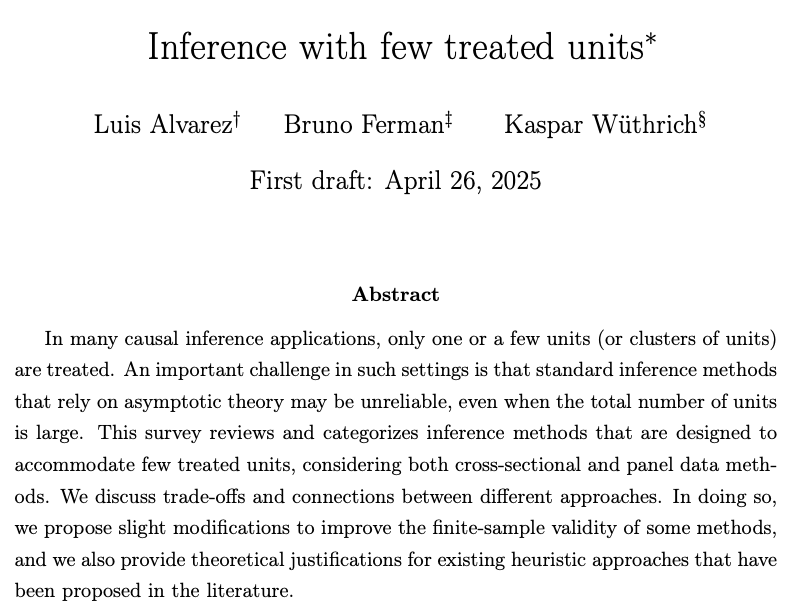
🧵New survey paper: "Inference with Few Treated Units"
Alvarez (@lafalvarez), Ferman (@bruno_ferman) and Wüthrich
Tired of referees saying your standard errors are wrong?
This survey will help you understand if you really have a problem — and, if so, how to fix it!
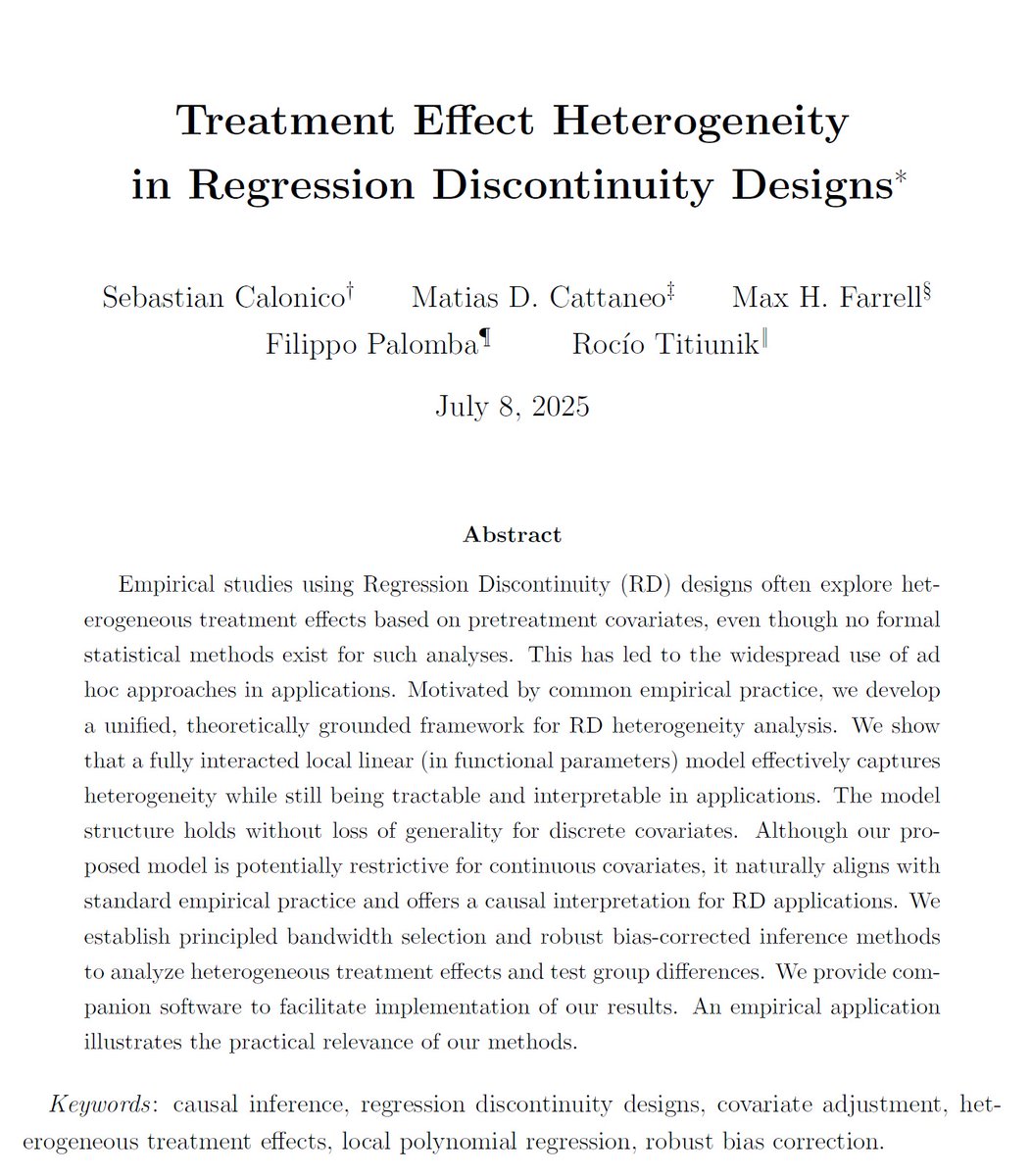
*** 𝐡𝐞𝐭𝐞𝐫𝐨𝐠𝐞𝐧𝐞𝐨𝐮𝐬 𝐭𝐫𝐞𝐚𝐭𝐦𝐞𝐧𝐭 𝐞𝐟𝐟𝐞𝐜𝐭𝐬 𝐚𝐧𝐝 𝐑𝐃𝐃 ***
Interested in 𝐑𝐞𝐠𝐫𝐞𝐬𝐬𝐢𝐨𝐧 𝐃𝐢𝐬𝐜𝐨𝐧𝐭𝐢𝐧𝐮𝐢𝐭𝐲 𝐃𝐞𝐬𝐢𝐠𝐧𝐬 and treatment effect heterogeneity?
Check out this new framework by Sebastian Calonico, Matias Cattaneo, Max Farrell, Filippo Palomba & Rocio Titiunik, as well as its companion software paper.
Links:
- Methods paper: https://t.co/SuhiRgcJ8I Software paper: https://t.co/viRWuMg0WX Software package #Stata and #R: https://t.co/XLV4A06d53
@TheImmortalKop Ekitike is a €60M player max. Isak was more complete at 22 especially with influencing big games. This is a massively risky signing for LFC. Would rather spend on both Watkins and go all out for Isak if selling Nunez, Chiesa, and Diaz.
Neural networks (e.g., LLMs) make often imperfect predictions, introducing biases into analyses that rely on them. Common empirical economics scenarios fall outside the existing literature on debiasing “black-box AI”. Our paper (with @J_S_Carlson) on robust and efficient inference with unstructured data (e.g., text, images) provides a unifying theoretical framework, relates inference with text/images to familiar problems like causal inference, develops new insights into efficiency, and provides practical guidance on common empirical scenarios. https://t.co/FQdVMuLpl0
@LFCTransferRoom@valterdemaggio Selling Nunez alone can get us close to Osimhen’s release clause. Then they have to negotiate separately for Chiesa. This deal doesn’t make sense.