La sociedad ucraniana 🇺🇦 está protestando después de que Zelensky tomara ayer la terrible decisión de cesar al Ministro de Defensa del país, Mykahilo Fedorov.
La sociedad ucraniana 🇺🇦 continúa siendo fuerte a pesar de las últimas decisiones de su gobierno y los habituales ataques rusos 🇷🇺 contra las grandes ciudades ucranianas 🇺🇦.
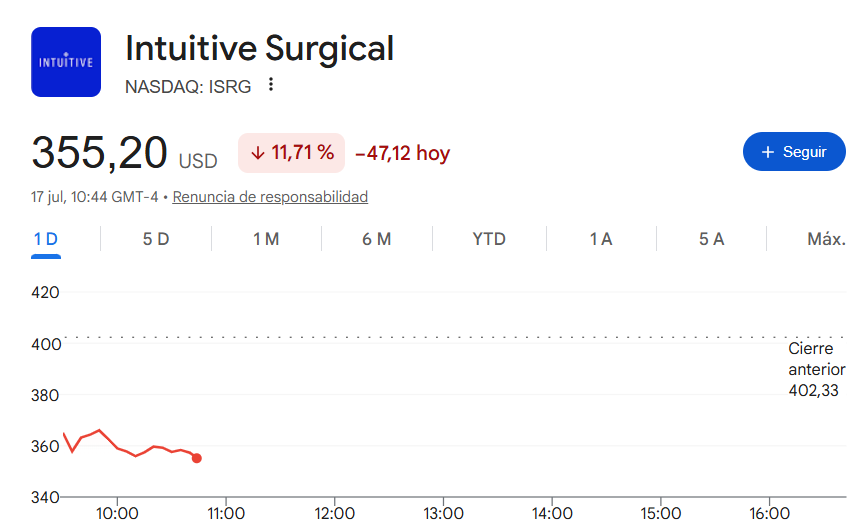
👨🔬He comprado una posición de 14 acciones 4980$ en Intuitive Surgical $ISGR.
🪂Ha caído un 12% después de presentar resultados muy buenos.
✅Modelo razor-blade. Te vendo la máquina y me pego toda su vida útil vendiéndote desechables, recambios, contratos de mantenimiento, actualizaciones de software, nuevos módulos.
🥼La máquina es un estándar para una gran cantidad de cirujanos. No cambian de aparato por cambios de precio. O sea, esto tiene pricing power.
🧑💻La tecnología es top y se retroalimenta con una base de datos de más de 17 millones de procedimientos, lo cual la sitúa en una posición privilegiada para ser el player que más mejora en ese tipo de procedimientos.
👨🎨🖼️Antes de conocer a Intuitive Surgical pensaba que da Vinci era un pintor renacentista.
🚀Ahora sé que es una máquina que salva vidas todos los días.
🎨Y para los que os preguntéis que qué pinta una empresa a 35 veces beneficios en mi portfolio que apuesta por el valor, os digo que con un crecimiento superior al 15%, márgenes operativos del 30% y un retorno sobre el capital invertido en el entorno del 20% me salen los números.
✈️Si hay problemas o vértigos de mercado duplicaré e incluso triplicaré la posición. De momento estamos plantando semillas en una compañía en la cual es difícil encontrar oportunidades.
El número de muertos en el ataque de hoy con bombas planeadoras rusas en Sumy asciende a 5, incluido un niño.
Decenas de personas también resultaron heridas después de que varias bombas planeadoras impactaran en las partes centrales de la ciudad.
Ucrania ha difundido videos de padres protegiendo a sus hijos con sus propios cuerpos.
#OJOALDATO - Ranking FIFA promedio de los 6 rivales de cada aspirante a semifinales en este Mundial (cuanto menor, más difícil ha sido el camino):
Noruega 🇳🇴 — 19,7
Iraq (57), Senegal (15), Francia (3), C. Marfil (33), Brasil (6), Inglaterra (4)
Bélgica 🇧🇪 — 28,0
Egipto (29), Irán (20), N. Zelanda (85), Senegal (15), USA (17), España (2)
Marruecos 🇲🇦 — 28,7
Brasil (6), Escocia (42), Haití (83), Holanda (8), Canadá (30), Francia (3)
España 🇪🇸 — 30,3
C. Verde (67), Arabia (61), Uruguay (16), Austria (24), Portugal (5), Bélgica (9)
Francia 🇫🇷 — 31,5
Senegal (15), Iraq (57), Noruega (31), Suecia (38), Paraguay (41), Marruecos (7)
Suiza 🇨🇭 — 32,0
Qatar (56), Bosnia (64), Canadá (30), Argelia (28), Colombia (13), Argentina (1)
Inglaterra 🏴 — 34,8
Croacia (11), Ghana (73), Panamá (34), Congo (46), México (14), Noruega (31)
Argentina 🇦🇷 — 38,3
Argelia (28), Austria (24), Jordania (63), C. Verde (67), Egipto (29), Suiza (19)
Reparto por confederación en el Mundial 2026 (participantes sobre 48 → clasificados a cuartos sobre 8):
UEFA: 16 (33%) → 6 (75%)
CAF: 10 (21%) → 1 (13%)
AFC: 9 (19%) → 0 (0%)
CONMEBOL: 6 (13%) → 1 (13%)
CONCACAF: 6 (13%) → 0 (0%)
OFC: 1 (2%) → 0 (0%)
Europa ha colocado 6 o más selecciones entre las 8 mejores en 14 de las 23 ediciones de la historia. Pasó por última vez en 2018. El récord: las 8, todas europeas, en 1934.
The 1-pager for my $ABCL thesis for those who don’t have time to read the whole thing.
I am sharing this again, as new investors continue to become interested in the company:
Long and strong!
Confirmado. La tapa del depósito de combustible fue volada por un misil de la defensa aérea de Moscú.
Rusia acaba de avanzar al nivel pro de la auto humillación
Video de @Tendar
Prime Minister Meloni fires back at Trump:
“President Trump, these constant, unprovoked attacks are senseless.
As for my popularity, being your friend certainly has not helped it, nor does it depend on my relationship with you. My popularity depends on my ability to defend Italy’s national interest, and that is exactly what I have always done.
That is also what I did regarding the American military bases in Italy. Their use is governed by agreements that we have always respected, and that cannot be violated as long as I am Prime Minister. Italy remains a sovereign nation.
In any case, my popularity is none of your concern. I suggest you focus on yours.”
1/8 La medida #8 destaca por su enfoque antiobrero: convierte a los trabajadores de empresas estatales cubanas en “corderos del sacrificio”. El “team de la continuidad” —¿o debo llamarlo “team reformista”?— subordina el salario a la “capacidad financiera” de las empresas
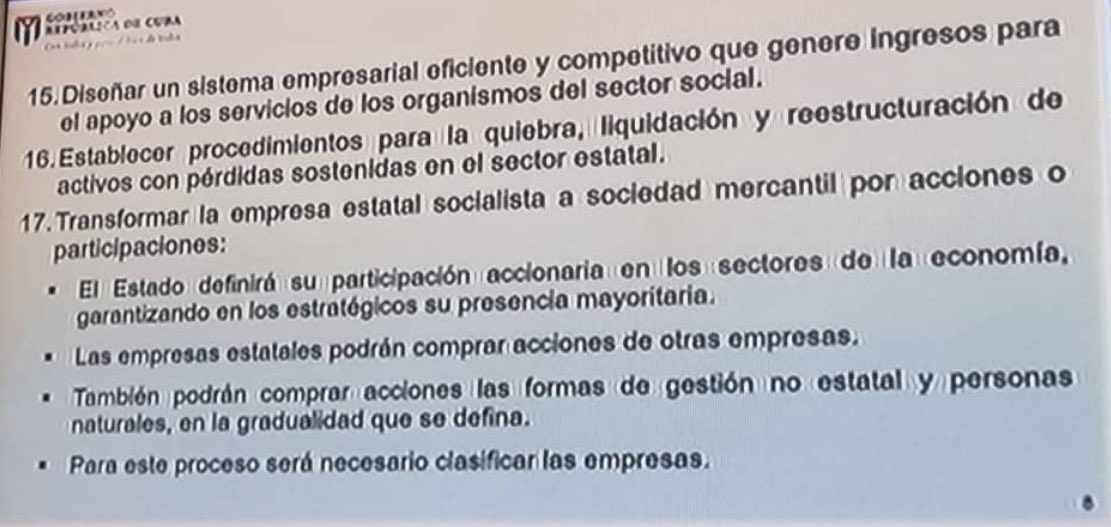
1/2 En una rápida lectura de las 176 medidas, me encuentro con la #17 (vender acciones de empresas estatales a formas de gestión no estatales y personas) e inevitablemente pienso en el “capitalismo de amiguetes” de la transición rusa
2/2 Con un Estado de derecho inexistente, la privatización acelerada de empresas estatales sin salvaguardas legales robustas suele terminar en la captura de activos estatales por parte de insiders bien conectados con el poder. Una cosa lleva a la otra. Sin escalas
WOW.
Respuesta fulminante de la Primera Ministra de Italia 🇮🇹, Giorgia Meloni, a Donald Trump 🇺🇸: “Las declaraciones de Donald Trump están totalmente inventadas, francamente estoy atónita. No sé por qué el Presidente de los Estados Unidos se comporte así con sus propios aliados, no es por cierto la primera vez que ocurre. Solo puedo decir que lamento que no tenga la misma determinación con los enemigos de Occidente, con los enemigos de los Estados Unidos, con liderazgos con los que en cambio se muestra mucho más complaciente, pero debe recordar una cosa: Italia y yo nunca suplicamos.”
No es tan complicado de analizar. EEUU e israel iniciaron los ataques del 28 de febrero con tres objetivos: cambiar el régimen en Irán y acabar con su programa nuclear y de misiles. Ninguno fue logrado y a EEUU se le sumó abrir el paso por Omuz.
107 días después el gran logro es reabir lo que antes estaba abierto, conversar sobre el tema nuclear con un régimen que sobrevivió y el tema misilístico quedará fuera de la agenda
Ahora Trump copia la paz de Obama con Irán, pero sin el respaldo de Rusia, China, Alemania, Gran Bretaña y Francia que eran parte del JCPOA, al que renunció porque "no inlcuía el tema misilístico" iraní. Y tenía el monitoreo de la OIEA, expulsada de Irán en julio del año pasado por los ataques que ordenó la Casa Blanca el mes anterior. Ahora todo dependerá de confiar en quienes iniciaron el ciclo de enriquecimiento de uranio a nivel militar tras la salida de EEUU de la JCPOA en 2018.
En el medio de tantas vueltas, se elevó el precio del Brent de U$S 67 hasta tocar los U$S 115 y ahora, luego de generarse un daño a la infraestructura regional y la oferta que va a demandar un semestre en recuperar el equilibrio, sigue en U$S 80, por encima del de preguerra. Las reservas estratégicas se vaciaron como en la crisis de 2022. La certeza de que Trump ya se resignó a buscar la salida rápida y evitar usar sus recursos militares ayuda a explicar una baja tan abrupta.
Y entretanto EEUU gastó parte importante de su arsenal antiaéreo y de ataque, ademas de aviones, helicópteros, radares y mas de una docena de vidas sin poder defender con eficacia a sus aliados en el Golfo. Y perdió el apoyo del resto del bloque occidental obsesionado con ser el líder de una estructura que por definición es cooperativa.
Irán está devastado, decir que ganó es engañoso, pero sentó un precedente, demostró que puede hacer un desastre regional y que no necesita atacar nuevamente. El solo ser considerado un estado "susceptible" le ahorra tener que explicar su influencia regional pese a haber perdido su ejército convencional. Y aspira a recuperar el capital embargado y unos U$S 300.000 millones por la caída de las sanciones. Es un PBI completo.
Iran hizo el camino opuesto a lo que logró Trump. El jefe de la fuerza militar mas poderosa del mundo no logró traducirla en logros políticos. Europa, acusada de no tener coraje para involucrarse directamente contra Rusia, sonríe al ver que su otrora aliado y ahora crítico extremo tampoco quiere meterse en el barro contra los iraníes. El daño a su capacidad de disuasión es extensa y se potencia por su obsesión por demoler la cooperación con sus aliados tradicionales, que incluyen a Europa, Canadá y ahora a Israel
Trump logró decepcionar a todos los líderes relevantes o provocar la idea de traición.
A todos, menos a Putin
Y traicionar a Netanyahu cediendo ante Irán es darle una estocada de muerte prematura a su estrategia de huida de la crisis. Israel no olvida ni especula porque se sabe en una instancia de supervivencia.
¿Que aliado le queda sin ofender al presidente de EEUU? Solo un par de mandatarios peso pluma.
Trump debería leer el libro The Art of Deal para entender en dónde falla su estrategia.
$IREN: The cloud market's dark horse
I bet most $IREN bulls are starting to get increasingly exhausted by the price action. I certainly am.
However, as long-term investors, we should see day-to-day price action as nothing more than noise.
$IREN is particularly "noisy," which makes it an especially difficult hold. Yet in times like these, it's important to step back and refocus on the company's fundamentals rather than let price action sway one's emotions.
And the way I see it, $IREN's competitive standing is rapidly improving.
I recently came across an interesting research report by Goldman Sachs that highlighted the discrepancy between planned data center capacity and realized capacity.
Out of the ~18 GW planned to be commissioned over the past 6 quarters, only about ~11 GW actually got built.
Not only is the gap between planned and realized capacity rapidly widening, but the rate at which new capacity is coming online has actually declined over the past couple of quarters.
Much of this discrepancy comes down to power continuing to be a major bottleneck.
As grids get more and more constrained with lead times reaching 5+ years, many developers are moving toward behind-the-meter (BTM) generation (on site power generation), circumventing the need for grid connectivity.
Yet that comes with its own set of problems and bottlenecks. The end result is an increasing amount of delays and outright project cancellations.
This industry backdrop plays directly into the hands of $IREN, which now has 5.8 GW of secured grid-connected power across global jurisdictions.
The only reason the industry is switching toward BTM is that it's the only option if you don't want to wait in multi-year queues to secure grid connections. But don't get it twisted, grid-connected power remains the preferred option.
$IREN is in a unique position to capitalize on this structural bottleneck and become one of the few cloud providers that can actually bring on 5+ GW of compute capacity over the coming years.
I'd even go as far as saying that this structural advantage is the primary reason the $NVDA partnership came to be.
While $NVDA undoubtedly remains king of the hill, even they face a real dilemma that could cause cracks in their growth trajectory.
On the supply side, they have to come to terms with the fact that the gap between planned and realized data center capacity is widening, while the trend of new capacity coming online is actually decelerating.
This is the issue I just flagged, and it could act as a potential growth bottleneck for $NVDA, since fewer builds means fewer GPU sales.
Layered on top of this is the demand side. It's perfectly clear that demand for $NVDA's AI hardware remains insatiable. However, when looking closer, it's also apparent that competition is increasing.
Pretty much every hyperscaler is working on their custom chips (TPU, Trainium, Maia, MTIA), and not exclusively for internal use cases anymore, but increasingly to service the compute needs of large AI labs. Anthropic alone has signed deals worth billions for Google TPU and AWS Trainium capacity.
Then you obviously have the likes of AMD and Cerebras directly competing against the AI giant, trying to claim market share.
Taken in aggregate, these two issues could gradually lead to a growth problem for $NVDA if not addressed.
This is exactly where $IREN comes in.
They've got the largest secured power portfolio of any neo-cloud at 5.8 GW and growing fast, they develop 100% of their data centers themselves, and they're not building competing silicon.
That makes them the most reliable demand outlet $NVDA can partner with at scale.
The Sweetwater partnership, positioning the 2 GW campus as a "flagship DSX deployment," isn't $NVDA doing $IREN a favor. It's $NVDA solving its two biggest problems at once.
I'm sure you know the popular saying that "history never repeats, but often rhymes." I think today's neo-cloud market is somewhat similar to the dot com era search engine war.
Back then, the front-runners leading the race were AltaVista, Excite, and Yahoo, while Google was a latecomer that ultimately came out on top.
Today, the vast majority of investors in this space are declaring either $CRWV or $NBIS the obvious winners in the race to become the next hyperscaler.
However, I believe the real dark horse that the mainstream doesn't give much credit to is $IREN.
I believe they have all the ingredients to leapfrog every competitor in a short amount of time, in large part due to their structural advantages and pursuing the right long-term strategy from the get go.
The asset-light model, which both $CRWV and $NBIS have been leaning into, doesn't work well in capital-intensive industries, at least not over the long run.
It's somewhat of an oxymoron, since it seems intuitive that one way to circumvent some of the CapEx burden is to outsource from colocation providers.
Yet that approach leaves you with less control, less flexibility, and ultimately higher costs in aggregate in the form of operating expenses (the landlord also has to earn $).
I studied the Bitcoin mining industry for years, and the asset-light model was once a popular strategy around the 2021 bull market. While it proved to be a strong growth lever, it ultimately ended up being a disaster for anyone who adopted it.
Companies like $MARA are the perfect example.
$MARA heavily adopted the asset-light model and grew to become the largest $BTC miner, yet ended up as one of the most unprofitable public miners of all, leading to significant value destruction for shareholders over time.
Once it became obvious that asset-light wasn't a sustainable strategy, $MARA tried to pivot away from it by increasing self-deployments. But developing infrastructure in-house is a much harder discipline to master, and you don't simply switch into it overnight.
$IREN ultimately won the mining race last cycle by doing the exact opposite of $MARA from the start.
They developed all of their data center infrastructure in-house, backed by a seemingly unlimited pipeline of secured power, which ended up making them the fastest growing and most profitable miner of all time.
While the cloud sector has significant differences from the mining industry, the primary drawbacks of the asset-light model carry over.
Over time, it will become obvious to Wall Street and the broader market that this strategy sounds great in theory, but in practice leads to a stack of operational issues and severe margin compression.
Out of the two current front-runners, $CRWV and $NBIS, I think Nebius will do better. They've at least started moving toward a more diversified mix of self-owned capacity rather than purely relying on hosted colocation, which is the right direction even if they're still early in that pivot.
That said, as the $MARA example showed, developing in-house gigawatt projects at scale is not something you learn overnight.
It's clear to me that a player like $IREN, which has been building this discipline from day one, has the most realistic pathway toward sustained, profitable growth in this space.
In my view, $IREN is the dark horse that will end up winning the race. Thus overthinking today’s price action wouldn't do me any favors.
Cheers guys, have a great weekend! ✌️