Senators Cantwell and Cruz have just introduced the most significant legislation in college sports history, as reported by @RossDellenger, @PeteNakos, @DanMurphyESPN and others.
Here's a deep dive🧵breaking down the 110-page bill, with the top 8 important items from a legal perspective, starting with perhaps the biggest:
1. Athlete employment
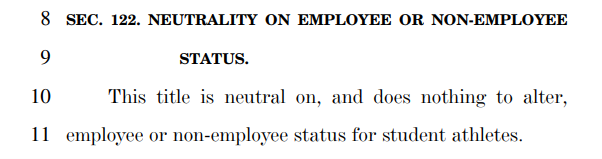
The biggest issue in the bill may be the one that's basically absent. Unlike SCORE, it doesn't prohibit athletes from becoming employees. Instead, this bill punts employee status to a "Commission" to study it and expressly states it is "neutral" on the issue.
As I read the bill, if athletes become employees able to unionize and collectively bargain, then schools would still need to negotiate compensation and terms of employment with them.
This means the bill's antitrust protections for the House salary cap (compensation), eligibility, transfers, and more (terms of employment) would essentially fall by the wayside as schools negotiated those rules with athletes.
In other words, the bill leaves the 800-pound gorilla firmly in the room. Until the athlete employment question is answered one way or another, there won't be legal stability in college sports.
I'd be very surprised if Sorsby won this motion. His legal theory is very similar to Trinidad Chambliss, but the facts are much different.
Chambliss was able to argue that the NCAA wrongly and inconsistently applied its medical waiver rule. Sorsby can't argue that the NCAA has allowed other players to bet on their team and play.
Sorsby's argument is more like Chandler Morris' (which he lost), but even more difficult.
It’s an important conversation and the college sports landscape is a complicated puzzle, but don’t expect stability soon given the number of major legal issues involved.
Even if the bill passes, it wouldn’t be surprising to see constitutional challenges to the new law.
And until the question of college athlete employment is answered, there won’t be stability in college sports. This bill is “neutral” on the question and explicitly leaves the door open to collective bargaining.
@RossDellenger You can understand the appeal when comparing the stability of pro sports to college, but instituting a commissioner probably has legal hurdles:
https://t.co/v12QCW0Lpb
Coach Saban just raised the question of whether college sports needs a Commissioner.
It also came up in the presidential committee letter (2nd image).
The analogy is to pro sports, so take the NFL. The NFL commissioner's authority comes from two sources: 1) the NFL Constitution, and 2) the Collective Bargaining Agreement.
The Constitution is created by the teams to govern themselves. The CBA governs the relationship between teams and players, and the athletes concede various authority (like the ability to discipline them) to the Commissioner in that negotiation.
Obviously college sports lacks collective bargaining at this time, so there are legal hurdles to instituting a Commissioner-based model.
@profgoose Yes, I've enjoyed following your work on that topic.
What we're wondering is, could schools continue to make football even bigger (increasing revenue and value) in a commercialized model, and follow this other academic-focused model for the non-rev sports?
Bevacqua just added another interesting wrinkle: proposing that the cap system include a "luxury tax," for spend over the cap, but that additional ~20% tax would be required to be spent on women's/Olympic sports.
Notre Dame AD Pete Bevacqua effectively advocating for changes to the cap and that it hasn't done what it was intended to do:
"We need a realistic cap. The concept of a cap emanating from the House settlement, in my opinion, is a fallacy. There is no cap.
"It's an equation. It's an X + Y + Z equation — X being the cap dollars, Y being the gray space of third-party NIL, which, quite frankly, right now is littered with abuse and uncertainty. The more money that can come from the cap to student-athletes will go a long way."
Fair point and thanks for the feedback. The funding issue is probably the biggest X factor in a new academic-based model.
I’ll add to the other side of the equation, that the costs of supporting these sports likely (hopefully) go down in an academic model.
No more flying the volleyball and soccer team cross-country for competition, etc. It would probably lead to some reorganization and logistical changes.
You may have seen but just in case, we wrote more about it here. More focused on the legal aspects and doesn’t touch on the funding issue.
https://t.co/2xRq65me3u
Coach Saban just raised the question of whether college sports needs a Commissioner.
It also came up in the presidential committee letter (2nd image).
The analogy is to pro sports, so take the NFL. The NFL commissioner's authority comes from two sources: 1) the NFL Constitution, and 2) the Collective Bargaining Agreement.
The Constitution is created by the teams to govern themselves. The CBA governs the relationship between teams and players, and the athletes concede various authority (like the ability to discipline them) to the Commissioner in that negotiation.
Obviously college sports lacks collective bargaining at this time, so there are legal hurdles to instituting a Commissioner-based model.
No doubt, and I didn't mean to suggest that non-rev sports should be emergency donor funded like Ark tennis. Just that situation demonstrates the value those sports still have.
What if non-rev sports were true academic programs and funded like the performing arts? Then you can use tuition, etc. and not as reliant on donor support?
It's a difficult issue any way you cut it, but it could be an option for some schools.
It's certainly complicated and agree that it's hard to find a "one size fits all" solution with so many institutions with such different goals.
Another option is to entirely separate the revenue/spend structure of the "big-time sports" from the non-revenue sports. In other words, schools no longer simply take football/basketball money to subsidize the rest. The concern is that schools will simply cut the latter.
But I think we've seen that there is enough demand and value from non-rev sports that schools will find a way. For example, Arkansas alum raising $5M in 3 weeks to get the school to reinstate tennis.
One alternative for non-revenue sports we've proposed is to treat them like the performing arts. It opens different funding mechanisms, and offers legal and other benefits too.
@PeteThamel Biggest thing that jumps out is what it *does not* say:
No mention of any objection to the Sports Broadcasting Act amendments, which could be read as a check on B10/SEC control over college sports.
Great stuff in this @SportsLawPod interview, and it's a primer for next week's huge federal court hearing that serves as the first major test of whether the House rev-share cap has teeth.
In short, I think there's a real chance that the court avoids the substantive question, the landscape remains uncertain, and more arbitrations like Nebraska-CSC will follow.
The substantive question the House plaintiffs are asking the court to resolve on June 10, is whether MMR partners (like PlayFly, Learfield, etc.) are "associated entities" such that their NIL deals with athletes are subject to CSC scrutiny at all. The plaintiffs say no.
If they are not, many believe the House cap becomes largely irrelevant, since schools can easily structure "above-cap" money through these MMR deals. That was the thrust of the Nebraska-CSC dispute.
But who should answer that substantive question: the courts, or arbitrators? That's the 2nd question Rakesh outlines below, and is highlighted in this excerpt from the NCAA's briefing.
I think the NCAA has a pretty good argument that this substantive question- whether a MMR is an "associated entity"- is required to be decided in arbitration under the settlement terms.
If so, the court has an out. The end result? More legal disputes as further arbitrations ensue over this MMR question.
"First, does it makes sense to say that these entities called MMRs, or multimedia rights organizations, are categorically exempt from this category of an associated entity and individual? That’s one question and then a second question… is should the court be deciding that or should the arbitrator be deciding it through the process that went through in the Nebraska case?"
During his appearance on SportsWise with Professor Gabe Feldman, Rakesh Kilaru discussed the debate over whether multimedia rights (MMR) organizations should be considered associated entities following the arbitration matter between Nebraska and the College Sports Commission (CSC), as well as a recent legal filing by plaintiffs' lawyers from the House v. NCAA settlement requesting that school's MMR partners are not subject to the CSC's NIL enforcement. Kilaru also broke down recent lawsuits dealing with NCAA eligibility disputes and whether amending the Sports Broadcasting Act of 1961 can truly solve the issues impacting college sports.
Episode Link: https://t.co/gC6gnN2F87
Yes, the model would reduce antitrust/employment exposure by removing the "big business" elements, and would capture the enormous (and untapped) educational value inherent in competitive sports.
Athletes wouldn't just be more like students, they'd truly be studying their sport as their degree/major. They'd receive academic credit for playing on the team, paired with rigorous traditional courses. This part of the model is flexible and can be shaped in different ways.
The model envisions more than club sports; this would be true varsity sports with real coaches, interschool play, etc. Retaining the value for both the schools (marketing, development, etc.) and the athletes.
There's no issue with airing them on TV, if the market is there. And players could still earn NIL. But realistically the economics would not look anything like major P4 football.
@RossDellenger Agree that the private rights of action are a really important part that isn't getting as much attention.
It opens the door for a lot of really interesting future lawsuits.
I detailed some of them here: https://t.co/PzGgPPxvUF
3. Private Rights of Action
This probably won't draw much attention but is really important. The bill allows athletes to sue under its own authority over disputes regarding various obligations the bill places on schools, conferences, and the NCAA.
Notably, the bill prohibits NCAA/conference/school from forcing these disputes to arbitration. We've seen how important that can be in the NFL's litigation with Brian Flores and John Gruden. So this is a strong provision in the athletes' favor.
Some really interesting possible lawsuits come to mind:
-Group of athletes sue over use of their NIL in school promotion (sec. 101(a)). The bill opens the door to group licensing, as is done in pro sports by players' unions.
-Could an athlete, or perhaps a reporter, sue a school for failing to report its expenses on sports? (sec. 104)
-Say an athlete graduates and is frustrated with their job opportunities and income, and believes they were pressured into a degree program that is less demanding so they can focus on sports, which has caused them to make less money. Can the student make a lost income claim? (sec. 105).
-a former athlete has long-term or catastrophic health problems arising from injuries while they played in college; if they have issues with medical insurance/coverage, could they sue the school to come out of pocket? (sec. 106)
-The bill obligates schools over significant health & wellness issues like brain injury and heat illness, potentially fatal conditions. Can athletes or their families file suit over an athlete's serious injury or death from these, and does it establish a new standard of care for tort lawyers? (sec. 107)
-Sedona Prince's viral video showing the inadequate facilities at the 2021 women's NCAA basketball tournament could now be grounds for a successful lawsuit! (sec. 109)
And much, much more.
This is probably Sorsby's best argument on his contract-breach legal theory, although I don't think it will be enough to win the day.
QB Trinidad Chambliss and others won extra seasons of eligibility on this same theory by showing that the NCAA inconsistently applied its waiver rules.
There are some important distinctions from Agne, perhaps the biggest that Sorsby bet on IU football while he was on the team, but it's the closest analogy I see to other successful injunction bids.
Kessler points to the gambling scandal involving former Indiana volleyball coach Brett Agne, who placed over 27 bets on Indiana football and basketball and whose bets totaled $327,000.
Agne completed gambling education and was suspended for 30% of the season.
@BillyMoonCRM There is a pending federal lawsuit arguing that certain college athletes should be considered employees subject to federal minimum wage laws.
One massive issue is conspicuously absent: athlete employment.
The proposed antitrust exemption doesn’t do anything to prevent athletes from seeking employee status for either/both minimum wage (FLSA) or forming unions (NLRA).
In fact, this proposal probably tilts the legal analysis further in favor of some college athletes being deemed employees under the relevant legal tests, which consider the schools’ level of control and whether the athletes’ work is primarily benefiting the schools or athletes.
This really jumps out, because employee status has been one of the biggest sticking points in the battle over college sports’ legal issues.
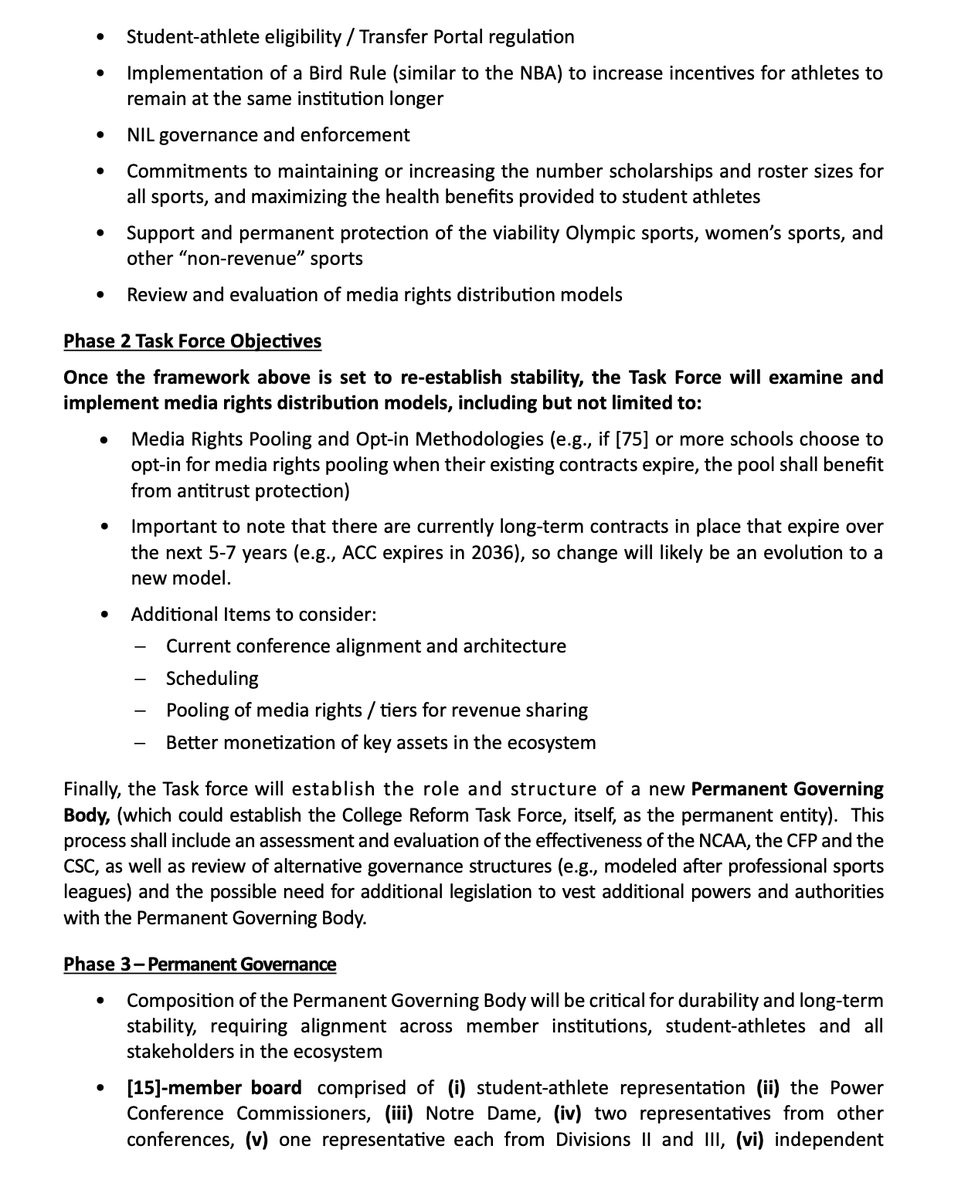
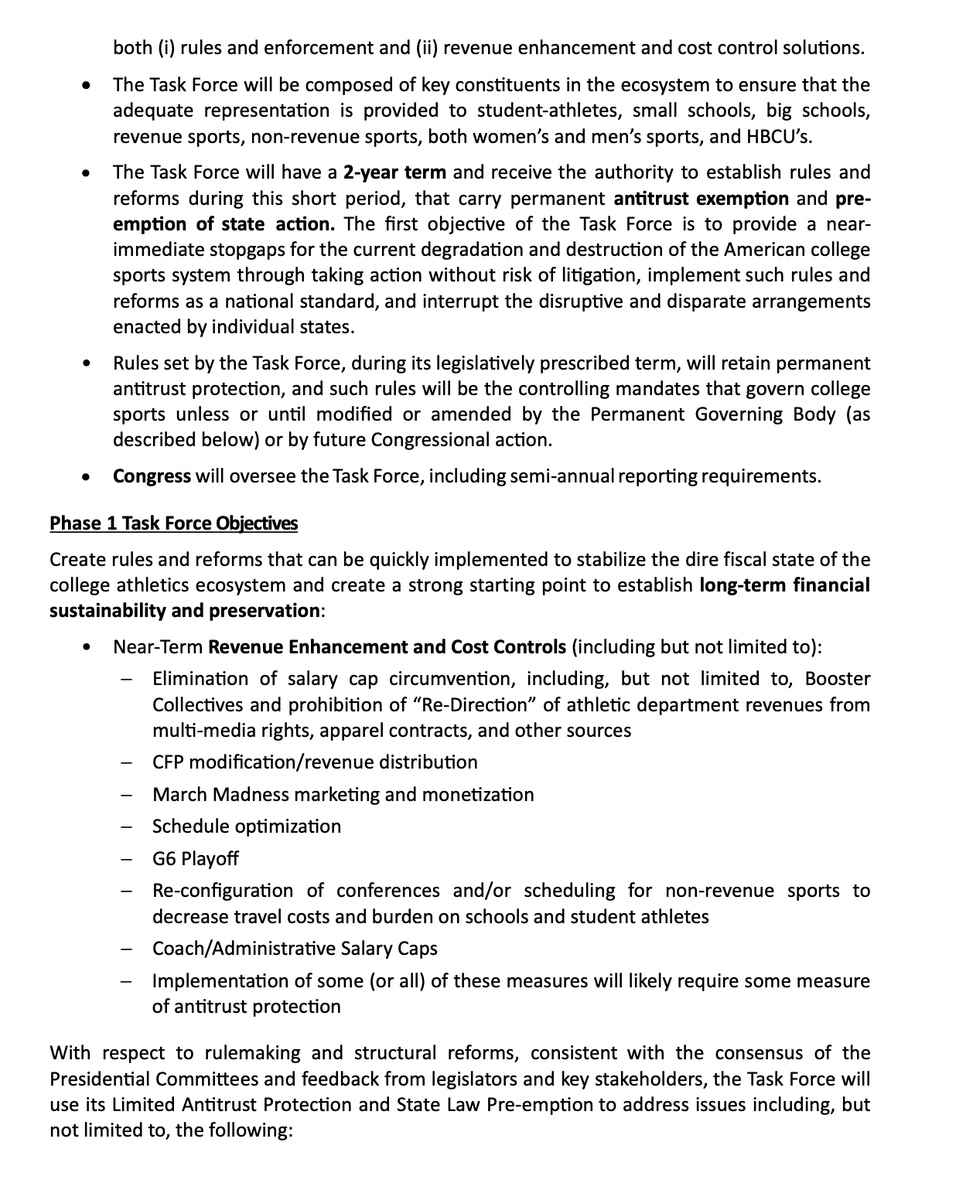
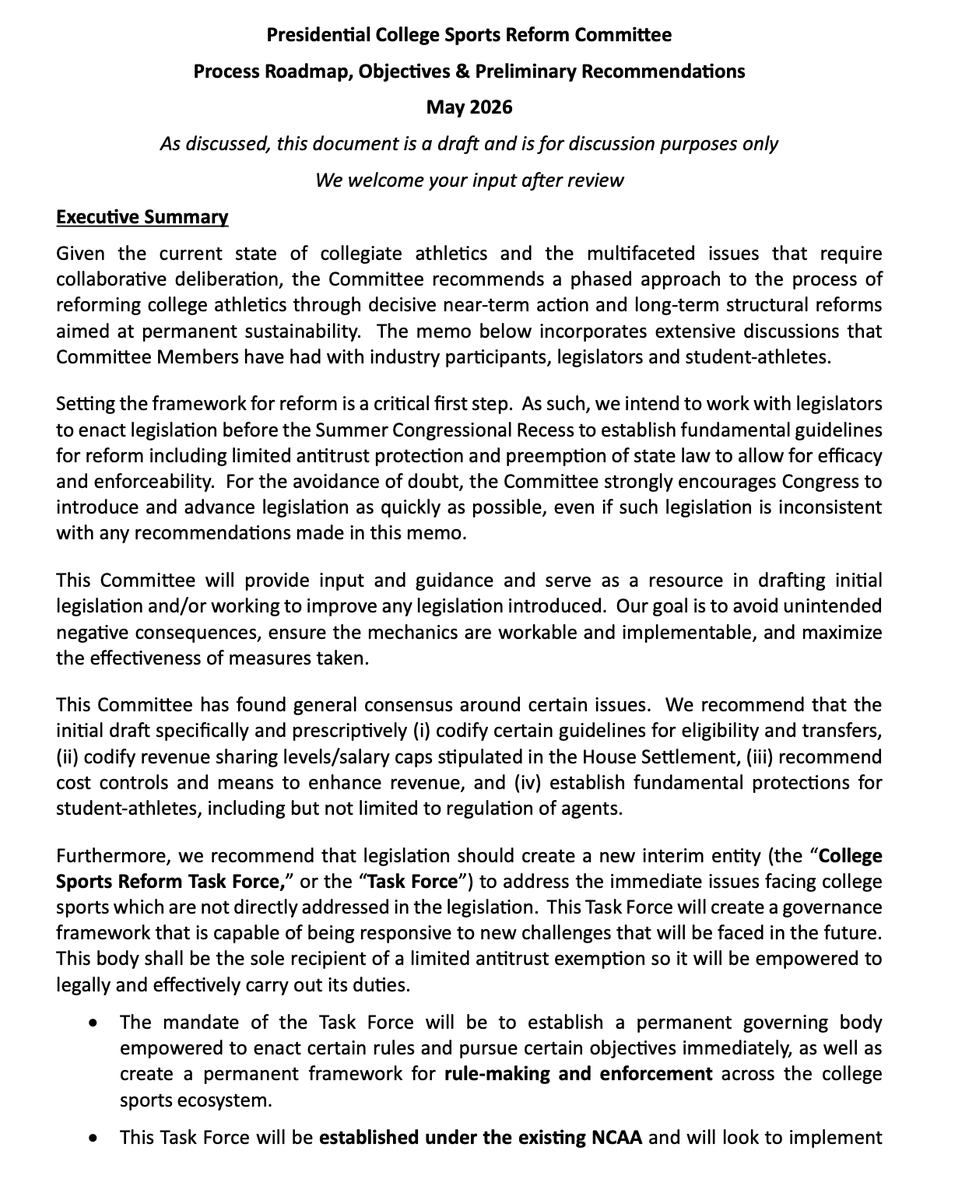
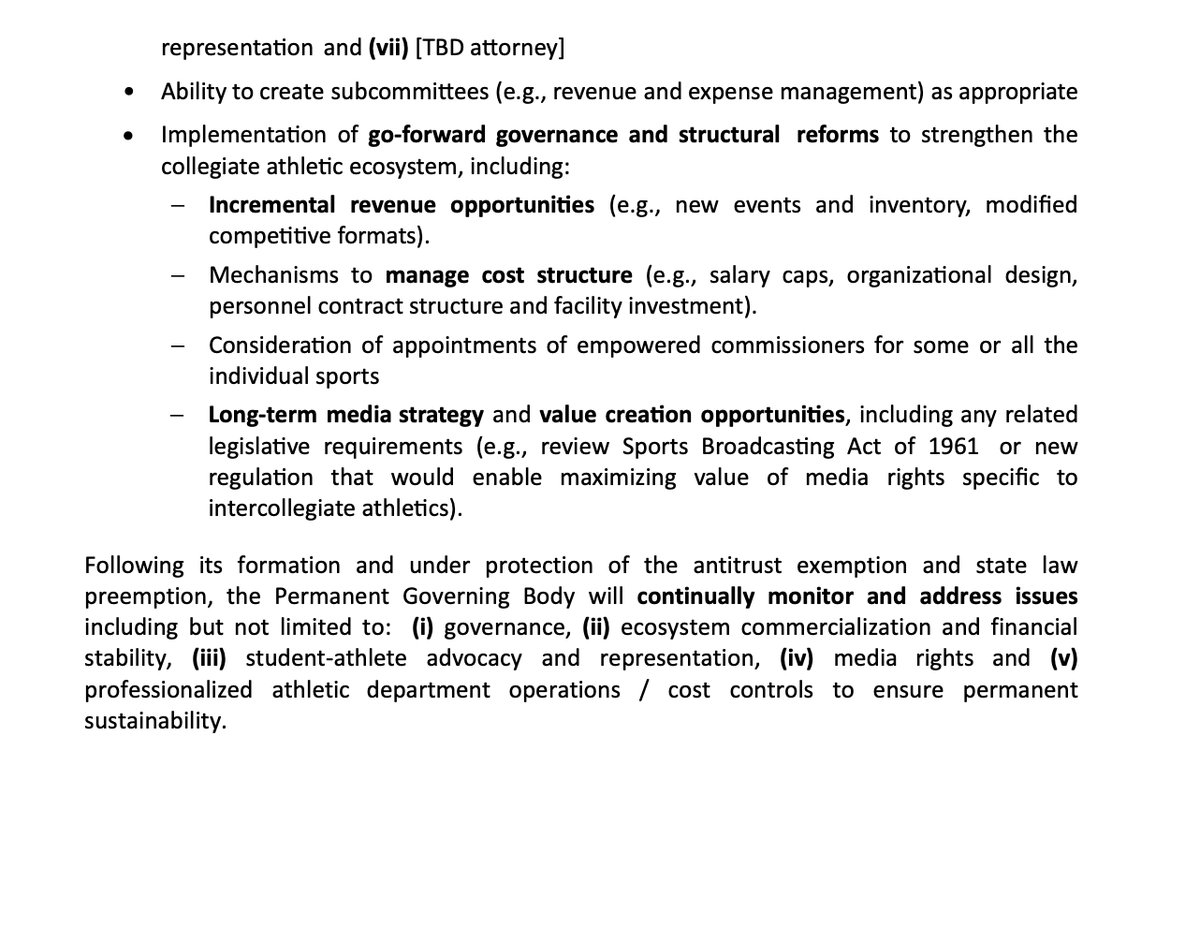
The college sports presidential committees have produced a draft of preliminary “ideas,” including establishing a new governing entity; strict cap circumvention; G6 playoff; regionalizing Olympic sports; capping coach/AD salaries; eligibility/transfer standards; pooling TV rights
I think Sorsby has a difficult legal argument and would be surprised if a judge granted an injunction to let him play in the meantime.
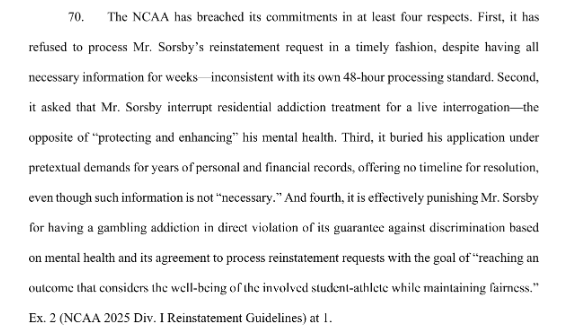
His legal theory is similar to Trinidad Chambliss,' but factually very different. Sorsby is arguing that punishing him breaches the NCAA's obligation under its bylaw not to discriminate based on mental health or treat him unfairly. But there's no allegation that the NCAA has allowed other athletes to play under similar circumstances.
And if there's any rule you'd think a court is likely to grant the NCAA leeway to enforce, it's those aimed at gambling's influence on integrity of the game.
Crazier things have probably happened but the judge granting this would really surprise me.
It's a fair argument that the "big business" elements of college sports have been interfering with the academic mission for some time, and why a move to a two-tier model could help solve some of the issues.
There's no going backwards and players are already paid millions, so the proposal is to separate the major revenue sports from "the rest" and treat them differently.
What would be next for the Olympic/non-revenue sports? One option is to treat them like the performing arts, as true academic fields of study.
We wrote about it here: https://t.co/2xRq65me3u
This argument has also shifted through the years.
The NCAA once argued that fans would abandon college sports if athletes were paid even for their NIL.
This from Judge Thomas’ dissent in the 9th Circuit’s 2015 O’Bannon decision:
“The NCAA insists that this multi-billion
dollar industry would be lost if the teenagers and young adults who play for these college teams earn one dollar above their cost of school attendance. That is a difficult argument to swallow. Given the trial evidence, the district court was well within its rights to reject it.”
I think this will be a difficult legal argument for Sorsby to win.
The legal theory is similar to the one Trinidad Chambliss used to win his eligibility case- a breach of the NCAA's contractual duty to apply its rules fairly.
But factually it's very different. Chambliss argued that the NCAA unevenly applied its medical waiver rule. But Sorsby can't argue that the NCAA has allowed other players to gamble on their team and play.
The key section of Sorsby's motion is below- the NCAA has denied his application for reinstatement, so the first arguments based on that delay are probably moot now. It's the fourth one that's up today.
The most similar case to me is the one that Chandler Morris lost over his eligibility. It was the same legal theory and alleged the NCAA failed to account for Morris' mental health issues.