Most teams I sit with say they need new software. An hour of watching them work usually says they need a cleaner handoff.
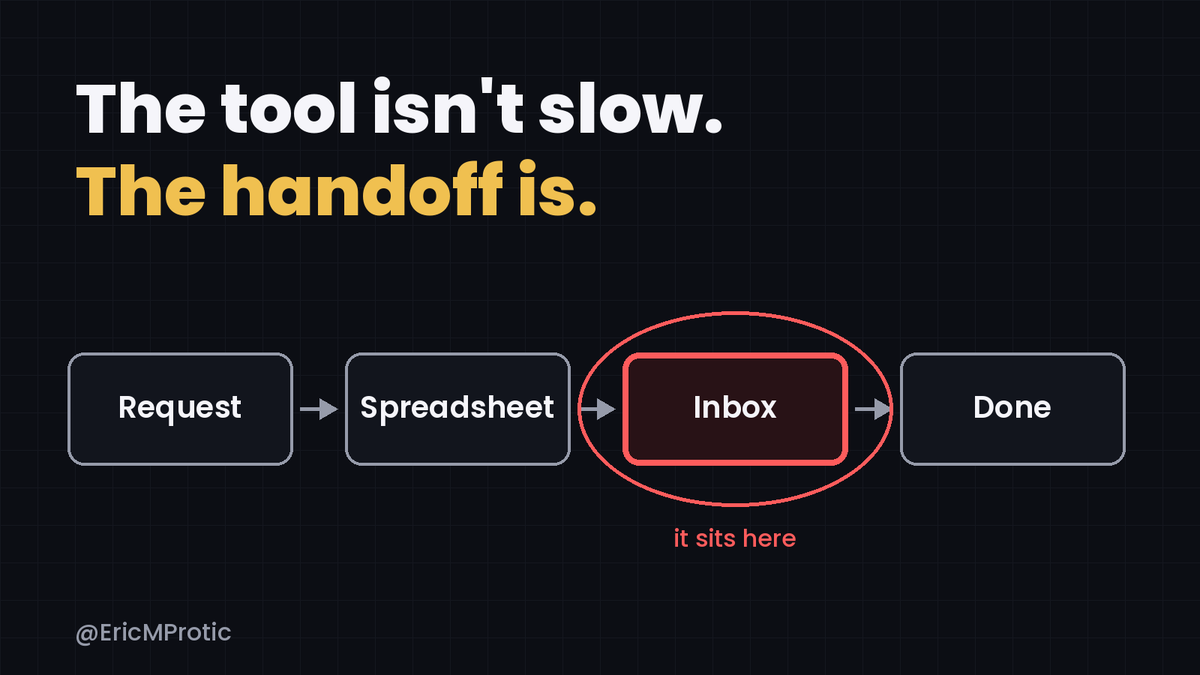
The pattern repeats. A request comes in. Someone copies it into a spreadsheet. Someone copies it again. Then it waits in an inbox for the one person who knows what "urgent" means.
The tools are fine. The baton keeps getting dropped between them.
So the fix is often small. One intake form, one place the work lives, one alert to whoever owns the next step.
Before you buy another seat, sketch the flow and circle where the work sits still. That circle is the project.
You could repost 100 times this week and barely grow your X account.
Meanwhile, someone quote reposts ONE post with a strong take and gets thousands of impressions.
That’s not necessarily luck.
X’s open-source algorithm reveals why these two actions are treated differently.
Here’s what the code reveals and how I’d use reposts strategically.
1. Reposts and quote posts aren’t the same thing.
X’s published For You ranking weights:
• Repost: 1.0
• Quote post: 5.0
• Reply: 5.0
• Follow: 4.0
• Like: 0.66
• DM share: 5.0
• Copy-link share: 20.0
But here’s the important distinction:
These weights multiply predicted engagement probabilities.
They DON’T mean a quote post automatically gets 5x the reach of a repost.
2. X actually discounts reposted content.
This surprised me.
The published algorithm includes:
• Out-of-network repost filtering
• A ranking discount for reposts from followed accounts
• Duplicate repost filtering
• Author diversity adjustments
In other words, repeatedly sharing content isn’t a guaranteed way to get distribution.
3. Quote reposts give you an opportunity to build authority.
Instead of simply sharing something, add an original perspective.
Example:
Someone posts:
“Publishing more content is the fastest way to grow SEO traffic.”
Bad quote:
“100% agree.”
Better quote:
“I’d check Google Search Console first. Find queries ranking 5–20 with strong impressions, improve the pages already ranking, and strengthen internal links. Publishing more isn’t always the answer.”
Now you’ve added something worth reading.
And potentially discussing.
4. Repost content that attracts YOUR audience.
If you’re building an SEO account, I’d focus on:
• Interesting SEO experiments
• Google algorithm changes
• Niche site case studies
• Original traffic data
• Useful SEO tools and workflows
Your reposts should reinforce what people follow you for.
Not turn your timeline into a random collection of viral content.
5. Repost your OWN content strategically.
X explicitly allows reposting older posts.
I’d revisit:
→ Evergreen tutorials
→ Useful frameworks
→ Original research
→ Posts relevant to new developments
But don’t repeatedly recycle the same thing.
The algorithm also filters duplicate and previously seen content.
6. Here’s the experiment I’d run for 30 days.
Every day:
→ Publish 1 original post
→ Quote repost 1 relevant post with a useful insight
→ Repost exceptional content your audience would appreciate
→ Reply to people who engage with your quote posts
→ Track profile visits, follows and meaningful engagement
This is an experiment, not a magic posting formula.
The takeaway?
Stop treating the repost button like a growth strategy.
Use reposts to curate.
Use quote posts to contribute.
Use original posts to establish expertise.
If someone can read your quote post and learn something from YOU, you’re doing it right.
Do you mostly repost content or quote repost it with your own take?
Source: https://t.co/SbQDADkL1k
OutboundPro® didn't start as a product. It started as a fix for our own sales team.
We built the simple version for ourselves first. Living the bottleneck beats guessing at it.
Selling it taught me the rest: nobody buys a feature list. They buy the hour back.
@MonteOSIntel
Company’s not hiring people who are actively building agents and automation workflows due to “ lack of technical tenure of yrs of experience “ will fall behind so fast.