Increíble de ver a los “expertos” en solventar la emergencia de vivienda que vive España! En cada televisión! @telediario_tve@A3Noticias@tele5_noticias@noticias_cuatro La realidad es que tenemos a políticos que intentan crear decretos y soluciones cuando no tienen la preparación ni el conocimiento para idear una solución real al problema que vivimos.
España no tiene un problema de falta de decretos. Tiene un problema de falta de viviendas.
Y mientras el Gobierno siga confundiendo anunciar medidas con resolver problemas, seguiremos pagando las consecuencias de su inacción.
Subvencionar la demanda sin aumentar la oferta presiona los precios. Regular cada vez más un mercado sin construir vivienda nueva no elimina la escasez: la administra. Castigar fiscalmente una modalidad de alquiler puede cambiar incentivos, pero tampoco pone un solo ladrillo.
El Gobierno puede aprobar todas las medidas que quiera y venderlas como grandes soluciones. Puede encadenar decretos, anuncios y campañas de propaganda. Pero hay una pregunta que desmonta cualquier discurso:
¿Cuántas viviendas nuevas crea todo esto?
Porque la vivienda no se abarata repartiendo la escasez. Se abarata acabando con ella.
España necesita construir. Mucho.
Más suelo disponible. Licencias en meses, no en años. Más densidad donde sea posible. Seguridad jurídica. Muchísima más vivienda pública y también privada.
Pero el Gobierno no está haciendo lo necesario. Prefiere intervenir sobre las pocas viviendas que existen antes que crear las condiciones para que haya muchas más. Prefiere presentar parches como soluciones y cargar sobre propietarios, promotores y ciudadanos el coste de su fracaso.
Lo demás puede servir para redistribuir, proteger a determinados colectivos o cambiar incentivos. Pero no confundamos eso con solucionar el problema de fondo.
No se arregla una falta de vivienda repartiendo mejor las pocas casas que existen. Se arregla haciendo que existan muchas más.
Menos propaganda. Menos parches. Menos obsesión por intervenir sobre el mismo piso.
Más oferta. Más construcción. Más casas.
ÚLTIMA HORA | El Gobierno confirma una nueva subida del salario mínimo en 2027 para compensar la subida del IPC
✍️ @gonzalodiaz37
https://t.co/8q4T9e2bF2
Tothom avançant i Europa sempre retrocedint. Suposo que encara ens cal caure moolt més avall per adonar-nos-en. Esperem que sigui qüestió d'anys i no dècades🇪🇺
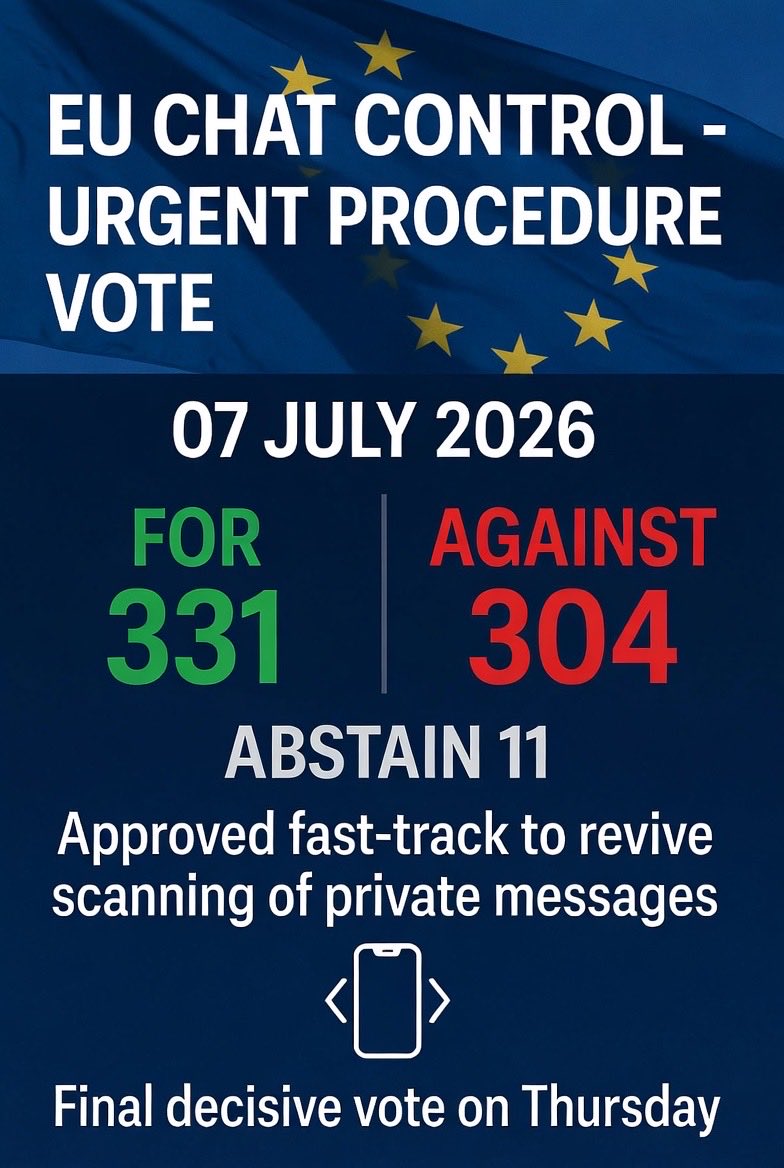
STRASBOURG: EU Chat Control 👁️🗨️
Just a few moments ago, the European Parliament approved the urgent procedure for the Chat Control extension (331 in favour, 304 against).
On Thursday, MEPs will vote on whether to allow online platforms to scan private messages.
In January 2015, Google and Fidelity wrote a combined $1 billion check for roughly 10% of SpaceX. The company was valued at $12 billion. Google’s portion: approximately $900 million for 7.4%.
At the time, SpaceX had just successfully landed a Falcon 9 first stage for the first time. Starlink was a PowerPoint presentation. Revenue was a rounding error compared to today.
Ten years later, SpaceX has become the most valuable private company on Earth.
The valuation trajectory tells the story:
2015: $12 billion
2020: $36 billion
2021: $100 billion
2022: $127 billion
2023: $180 billion
June 2024: $210 billion
Late 2024: $350 billion
2026 IPO target: $1.5 trillion
That $900 million investment from Google? At the $1.5 trillion IPO target, it would be worth approximately $111 billion.
A 123x return. From one check.
To put that in perspective: Adobe’s entire market cap is $144 billion. Google’s single 2015 investment in SpaceX would be worth more than 75% of one of the largest software companies on the planet.
But here’s where it gets interesting.
In Q1 2025, Alphabet reported $8 billion in unrealized gains from a “non-marketable equity security in a private company.” Bloomberg confirmed it was SpaceX. That $8 billion boost represented nearly 25% of Google’s entire net income for the quarter.
One investment. One quarter. Almost a quarter of their earnings.
And that was based on the $350 billion valuation from late 2024. If SpaceX hits the $1.5 trillion target, the paper gains from this single position could exceed $80 billion more.
The financial return alone would justify calling this one of the greatest venture investments ever made. But the financial return is actually the boring part.
Look at what SpaceX has become.
Starlink went from zero subscribers in 2020 to 1 million in 2022 to 4.6 million by end of 2024 to 8 million by November 2025. They’re doubling annually. Revenue hit $7.7 billion in 2024, up from $1.4 billion in 2022. Projections for 2025: $11.8 billion. Starlink now represents 58% of SpaceX’s total revenue and the majority of its profits.
SpaceX has reused a single Falcon 9 booster more than 20 times. They completed 134 Falcon-family launches in 2024. They’re on pace for 150+ in 2025. They now account for approximately 90% of the world’s payload mass delivered to orbit.
Read that again. One company. Ninety percent of global payload mass.
The reusability breakthrough is what made Starlink possible. You can’t launch 7,500+ satellites on expendable rockets. The math doesn’t work. But when you can reuse boosters 20 times and turn launches around in under 30 days, you can build an orbital internet constellation that would have been economically impossible for any other company on Earth.
And then there’s the government money.
SpaceX CEO Gwynne Shotwell said the company holds $22 billion in government contracts. Pentagon contracts alone total nearly $8 billion. The Space Force just awarded SpaceX $5.92 billion for satellite launches through 2029. The National Reconnaissance Office signed a classified $1.8 billion contract for Starshield, SpaceX’s militarized satellite network for intelligence and surveillance. The Pentagon plans to acquire more than 100 Starshield satellites for its future satcom architecture.
SpaceX is now the dominant launch provider for the U.S. military, the U.S. intelligence community, and NASA. They have more government contracts than most defense contractors, but they’re valued like a tech company because they actually are one.
Starlink isn’t just consumer internet anymore. It’s 75,000 vessels with maritime connectivity. 300 cruise ships. United, Air France, Hawaiian Airlines. Direct-to-cell service launching with T-Mobile. Military encrypted communications via Starshield. Ukraine’s battlefield connectivity runs on Starlink.
This used to be a rocket company. Now it’s a telecom company that happens to own the rockets.
Aquest testimoni exemplifica molt bé la desprotecció que patim els ciutadans respecte a la delinqüència.
Afegiu-li els errors administratius que pot haver-hi durant un procés i et queda un escenari força tèrbol.
Sumat al tipus de delinqüent i la seva insolvència.
Molts justificant el boicot a la Vuelta, per la participació d'un equip jueu, però callats quan Espanya compra gas liquat dels russos...🤦
De la compra de gas i petroli rus via Índia en parlem un altre dia? #hipocresia
@ChartsJavi My only concern is during last month, $ura has been in an incredible rally and at some point we should expect some pullback... Difficult times to know when to hold or sell 😅
Why use collections in the new System.Collections.Frozen namespace from #dotnet 8 versus the existing ones in System.Collections.Immutable?
Good clarity on the differences from Stephen Toub on the MS blog previously 👇 ...
@imapedestrian With the increased interest in $ura and the upcoming months were either russia ban is removed or funds to increase production are released, I don't think we will see such drop for the 30ema 🤔
On Wednesday, Feb. 26, the Blue Center for Global Strategic Assessment will host a conversation with @perearagones, former president of Catalonia, on the role of political leadership in de-escalating secessionist conflicts and restoring stability.
More: https://t.co/VDxxNGCVwB
@tradiactivitat Doncs espera que això només comença. L'estat esp ha estat el major receptor dels fons next generation, ara en demana més i ajornar el pagament que comença en 3 anys.
El 2028 fliparem si tot segueix així 🫠👀
https://t.co/Vznk5TN7Aj
El Gobierno 🇪🇸 acaba de presentar su posición respecto al Marco Financiero Plurianual 🇪🇺- el marco presupuestario de la UE en el que se enmarcan los presupuestos anuales de la Unión.
El Gobierno solicita:
❗️repetir los Fondos #NextGenerationEU
❗️retrasar el pago de la deuda generada por los #NGEU
❗️financiar la defensa europea con deuda común
Breve 🧵👇
Why AI Won't Cause Unemployment
Marc Andreessen
Reposted Jan 24, 2025
"In retrospect, I wish I had known more about the hazards and difficulties of [running] a business." -- George McGovern
Fears about new technology replacing human labor and causing overall unemployment have raged across industrialized societies for hundreds of years, despite a nearly continual rise in both jobs and wages in capitalist economies. The jobs apocalypse is always right around the corner; just ask the Luddites.
We had two such anti-technology jobs moral panics in the last 20 years — “outsourcing” enabled by the Internet in the 2000’s, and “robots” in the 2010’s. The result was the best national and global economy in human history in pre-COVID 2019, with the most jobs at the highest wages ever.
Now we’re heading into the third such panic of the new century with AI, coupled with a continuous drumbeat of demand for Communist-inspired Universal Basic Income. “This time is different; AI is different,” they say, but is it?
Normally I would make the standard arguments against technologically-driven unemployment — see good summaries by Henry Hazlitt (chapter 7) and Frédéric Bastiat (his metaphor directly relevant to AI). And I will come back and make those arguments soon. But I don’t even think the standand arguments are needed, since another problem will block the progress of AI across most of the economy first.
Which is: AI is already illegal for most of the economy, and will be for virtually all of the economy.
How do I know that? Because technology is already illegal in most of the economy, and that is becoming steadily more true over time.
How do I know that? Because, [see chart].
This chart shows price changes, adjusted for inflation, across a dozen major sectors of the economy.
As you can see, we actually live in two different economies.
The lines in blue are the sectors where technological innovation is allowed to push down prices while increasing quality. The lines in red are the sectors where technological innovation is not permitted to push down prices; in fact, the prices of education, health care, and housing as well as anything provided or controlled by the government are going to the moon, even as those sectors are technologically stagnant.
We are heading into a world where a flat screen TV that covers your entire wall costs $100, and a four year college degree costs $1 million, and nobody has anything even resembling a proposal on how to systemically fix this.
Why? The sectors in red are heavily regulated and controlled and bottlenecked by the government and by those industries themselves. Those industries are monopolies, oligopolies, and cartels, with extensive formal government regulation as well as regulatory capture, price fixing, Soviet style price setting, occupational licensing, and every other barrier to improvement and change you can possibly imagine. Technological innovation in those sectors is virtually forbidden now.
Whereas the sectors in blue are less regulated, technology whips through them, pushing down prices and raising quality every year.
Note the emotional loading of the interplay of production and consumption here. What do we get mad about? With our consumer hat on, we get mad about price increases — the red sectors. With our producer hat on, we get mad about technological disruption — the blue sectors. Well, pick one; as this chart shows, you can’t have your cake and eat it too.
Now think about what happens over time. The prices of regulated, non-technological products rise; the prices of less regulated, technologically-powered products fall. Which eats the economy? The regulated sectors continuously grow as a percentage of GDP; the less regulated sectors shrink. At the limit, 99% of the economy will be the regulated, non-technological sectors, which is precisely where we are headed.
Therefore AI cannot cause overall unemployment to rise, even if the Luddite arguments are right this time. AI is simply already illegal across most of the economy, soon to be virtually all of the economy.
Darrera el declivi econòmic de Catalunya i Barcelona hi ha molts motius: El monocultiu turístic low-cost, la desinsdustrialització, la manca d'inversions estatals o la hipertrofia ideològica de l'administració...
... però un dels motius és 100% culpa dels propis catalans, hi és la demonització de l'empresari i de voler guanyar diners amb activitats legítimes.
Gràcies als intel·lectuals dels Comuns i de la CUP, sembla que emprendre, invertir, o en definitiva, que tota activitat econòmico-empresarial estigui malament. La cultura del no. De la negació del progrés.
Plantes fotovoltaïques? no.
Inversions en infraesructures? no.
Construir habitatge? no.
Us poso un exemple d'aquests dies: Els desnonaments de la Casa Orsola. Un edifici de l'Eixample que es posa a la venda. L'Ajuntament té dret a tanteig, però renuncia a fer-ho (molt bé Sra Colau). El compra un empresari, ràpidament etiquetat de "fons voltor". Aquesta és un altra: Quan us parlen de fons voltors, mireu bé si parlen de Cerberus o de Blackstone, que sí que ho són. Però amb aquests, els Comuns i companyia no s'hi atreveixen. Amb una persona individual, un empresari, sí. Seguim...
No conec els detalls de si aquest empresari ha negociat amb els inquilins previs o no, de fet, aquest no és el tema principal. La qüestió és que l'Ajuntament de la Sra Colau va tenir dret de tanteig i va declinar. Si no ho hagués fet, la Casa Orsola seria avui part del parc d'habitatge públic. Per cert, en l'era Colau, l'ajuntament de Barcelona va tancar pressupost en superavit en diverses ocasions, és a dir, diners hi havia. Però no ho va fer. No va fer res.
En canvi, avui el seu grup municipal es manifesta de forma airada: "Hem guanyat. Hem vençut el capital. tenim molt poder"... i el sr empresari es qüestiona si vendre's l'edifici.
Quina irresponsabilitat, Sres @jessicaalbiach i @janetsanz .
Mentrestant, com és lògic, la comunitat empresarial catalana es qüestiona si val la pena l'esforç de ficar-se en embolics o si és millor quedar-se a casa a esperar temps millors.
Post-scriptum:
Amb tot el tema aquest de la Casa Orsola, tinc una sensació de deja vu... joves activistes mediàtiques que es preparen per fer el salt a la política, i clar, em torna a grinyolar que algú s'aprofiti de les desgràcies alienes per la seva autopromoció.
@StockCompil After checking the last 5 years, it seems it will revisit $45 support trend before going up.
Similar behaviour as November '21 up&down. The difference is that now the market is aware of the nuclear necessity and we may have some news.
Any thoughts?🤔